Beneficial Insects Market Size, Share & Industry Analysis, By Insect Type (Predatory Mites, Parasitic Wasps, Lady Beetles, Lacewings, Fly Pollinators, and Others), By Application (Protected Cultivation, Open Field Farming, and Crop Protection), By Crop Type (Cereals & Grains, Fruits & Vegetables, Oilseeds & Pulses, and Others), and Regional Forecast, 2026-2034
 Download Free Sample
(Offer valid till 15th Oct 2026)

Beneficial Insects Market Size
 Listen to Audio Version
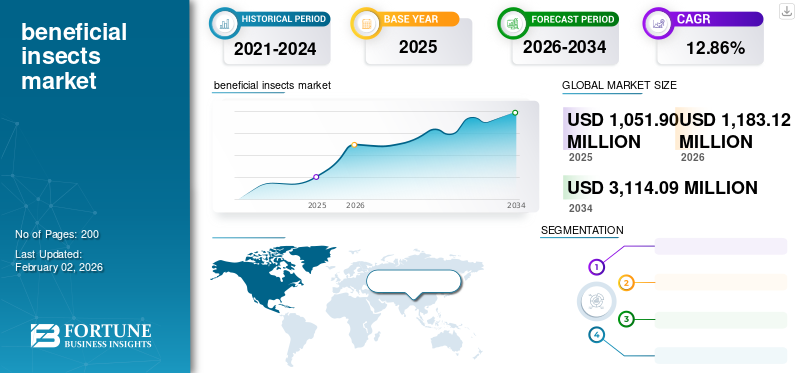
The global beneficial insects market size was valued at USD 1,051.90 million in 2025. The market is projected to grow from USD 1,183.12 million in 2026 to USD 3,114.09 million by 2034, exhibiting a CAGR of 12.86% during the forecast period. North America dominated the global beneficial insects market with a market share of 35.96% in 2025.
The demand for beneficial insects such as predatory mites, parasitic wasps, and lady beetles in integrated pest management programs is becoming increasingly important, as these beneficial insects contribute to maintaining ecological balance, reducing chemical residues, and naturally controlling pests. Increasing environmental consciousness, deterioration in soil health, and the global trend toward residue-free food production have accelerated the adoption of predatory mites, parasitic wasps, lady beetles, and other biocontrol agents. The shift away from conventional pesticides, coupled with government subsidies to promote biologicals, continues to alter the global market growth. The increasing adoption of sustainable farming practices includes the use of beneficial insects to reduce chemical pesticide dependency.
Major players in the global market include Koppert Biological Systems, Biobest Group NV, Applied Bio-nomics Ltd., Andermatt Biocontrol AG, and BioBee Biological Systems. The market is moderately fragmented but highly competitive, with key companies focusing on breeding innovations, developing mass rearing technologies, enhancing micro-habitat systems, and forming partnerships with greenhouse manufacturers and controlled environment farming companies.
Download Free sample to learn more about this report.
BENEFICIAL INSECTS MARKET KEY TAKEAWAYS
 Market Size & Forecast
- 2025 Market Size: USD 1,051.90 Million
- 2026 Market Size: USD 1,183.12 Million
- 2034 Forecast Market Size: USD 3,114.09 Million
- CAGR: 12.86% from 2026–2034
 Market Share
- North America dominated the beneficial insects market with a 35.96% share in 2025.
- Predatory mites led the market with revenue of USD 388.27 million in 2025.
- Protected cultivation accounted for the largest market share and is projected to reach USD 559.04 million in 2026.
 Key Regional Highlights
North America
North America is projected to grow from USD 422.95 million in 2026 to USD 1,059.39 million by 2034 at a CAGR of 12.16%.
Europe
Europe is expected to expand from USD 325.06 million in 2026 to USD 859.75 million by 2034, growing at a CAGR of 12.93%.
Asia Pacific
Asia Pacific is anticipated to register the fastest regional growth with a CAGR of 13.91% through 2034.
U.S.
The country leads the North American market, supported by strong demand from organic farming, greenhouse vegetables, and cannabis cultivation.
Japan
Market growth is supported by increasing greenhouse projects and government initiatives promoting biological crop protection solutions.
Read More

MARKET DYNAMICS
Market Drivers
Rising Adoption of Integrated Pest Management (IPM) to Accelerate Market Growth
Growing concerns about pesticide overuse, chemical residues in food, and pest resistance are accelerating the global shift toward Integrated Pest Management (IPM). Beneficial insects consequently play a central role in IPM programs by offering natural, sustainable, and cost-effective pest suppression. Greenhouse growers, protected cultivation farms, and high-value crop producers increasingly rely on predatory mites, parasitic wasps, and lady beetles to manage pests such as thrips, aphids, whiteflies, and spider mites. This transition directly supports the double-digit growth of eco-friendly pest control. All these factors are expected to boost the beneficial insects market growth in the coming years.
- According to the Food and Agriculture Organization (FAO), up to 40% of global crop production is lost annually to plant pests and diseases.
Market Restraints
Seasonal Availability, Climatic Variability, and Labor-Intensive Rearing to Restrain Growth
The production and deployment of beneficial insects are sensitive to environmental factors such as temperature, humidity, and day length. Technical expertise, constant monitoring, and controlled conditions are essential in mass-rearing technologies to maintain the vigor and reproductive efficiency of the insects. This increases production cost and constrains scalability. In open-field farming, efficiency is reduced by climate variability, and this may be a limiting factor in adoption compared to protected cultivation.
- According to a study co-authored by a researcher from the University of California, Agriculture and Natural Resources (UCANR), the parasitic wasp Aphidius colemani experienced a 52% decline in field establishment during unusually high-temperature periods.
Market Opportunities
Rise in Organic Farming Practices and Export-Oriented Horticulture to Create Strong Demand and Unlock New Growth Opportunities
Global organic farming acreage continues to expand, driven by growing consumer demand for chemical-free food. Beneficial insects play a crucial role in organic crop production, as the use of synthetic pesticides is limited. Export-oriented horticultural crops, including berries, grapes, tropical fruits, leafy greens, spices, and greenhouse vegetables, are increasingly adopting biologically friendly pest control solutions to fulfill the strict residue compliance standards of the EU, Japan, and the U.S., thus creating long-term, high-value opportunities for beneficial insect manufacturers.
- According to the Research Institute of Organic Agriculture (FiBL), the area dedicated to organic farming grew to 26,600 hectares, representing 0.6% of the overall farmland in Malta in 2021.
Beneficial Insects Market Trends
Expansion of Digital IPM Tools and Precision Biological Pest Control to Shape Industry
Manufacturers and growers are increasingly integrating digital technologies, such as sensors, automated scouting systems, machine vision, and AI-driven pest analytics, to enhance the precision and efficiency of beneficial insect deployment. Machine vision–based pest scouting is gaining particular traction. In particular, machine vision–enabled pest scouting is an increasingly popular area of innovation. For instance, companies such as Arugga AI Farming (Israel) and Ecoation (Canada) reportedly achieve 85–92% accuracy in the early detection of pest infestations with their AI scouting platforms, which enable the timely release of predatory mites and parasitic wasps. Collectively, these advancements illustrate a clear shift in the industry toward data-driven, automated, and AI-supported biological pest management, significantly enhancing the scalability, consistency, and impact of beneficial insect programs.
Download Free sample to learn more about this report.
SEGMENTATION ANALYSIS
By Insect Type
Broad Pest Control Spectrum and Rising Sustainable Agriculture Trends to Lead Predatory Mites Segment Growth
By insect type, the market is segmented into predatory mites, parasitic wasps, lady beetles, lacewings, fly pollinators, and others.
The predatory mites are the largest segment, valued at USD 388.27 million in 2025, and are expected to reach USD 1,183.63 million by 2034, with a strong CAGR of 13.23%. This strong market share and rapid growth are attributed to their broad prey spectrum, which effectively controls multiple pests, including thrips, spider mites, and whiteflies, in both greenhouse and open-field environments. The global shift away from chemical pesticides and advances in mass-rearing technology are further strengthening their dominance and growth in the global market.
The parasitic wasps segment is expected to grow significantly over the forecast period with a CAGR of 13.78%.
Insects such as ladybugs and lacewings also play a vital role in the global market due to their effectiveness in controlling pest populations naturally.
To know how our report can help streamline your business, Speak to Analyst
By Application
Controlled Environment and High Pest Pressure to Lead Protected Cultivation Segment Growth
On the basis of application, the market is segmented into protected cultivation, open field farming, and crop protection.
Protected cultivation is the leading segment, accounting for a major beneficial insects market share and contributing a value of USD 559.04 million by 2026, reaching USD 1,461.53 million by 2034, with a CAGR of 12.76%. Protected cultivation involves growing crops in a controlled environment, such as greenhouses, indoor farms, or other protective structures, which shield the crops from external factors like weather, pests, and diseases. Enclosed environments tend to have high pest and disease pressure, necessitating the need for biological control agents, such as beneficial insects, that are effective yet sustainable alternatives to chemicals.
The open field farming segment is expected to grow significantly at a CAGR of 13.62% during the forecast period.
By Crop Type
Growing Global Population and Health and Nutrition Awareness to Fuel Cereals & Grains Segment Leadership
By crop type, the market is divided into cereals & grains, fruits & vegetables, oilseeds & pulses, and others.
Cereals & grains are expected to dominate the market, reaching USD 1,601.08 million by 2034, with a CAGR of 12.60%. The increasing population, especially in Asia and Africa, drives demand for staple cereals and grains as a primary source of carbohydrates and essential nutrients, thereby increasing food consumption and, correspondingly, food production. Health consciousness increases the demand for whole grain products, fortified cereals, and organic foods.
The fruits & vegetables segment is anticipated to grow at a CAGR of 13.70% during the forecast period.
Beneficial Insects Market Regional Outlook
Regionally, the report covers the global market analysis across North America, Europe, Asia Pacific, South America, and the Middle East & Africa.
North America Beneficial Insects Market Size, 2025 (USD Million)
To get more information on the regional analysis of this market, Download Free sample
North America
The market in North America is expected to grow from USD 422.95 million in 2026 to USD 1,059.39 million by 2034, at a CAGR of 12.16%. The region dominates the global market, benefiting from strong adoption of Controlled Environment Agriculture (CEA), greenhouse farming, and stringent restrictions on synthetic pesticides. The U.S. dominates the regional market, driven by considerable demand for organic farming, greenhouse vegetables, and cannabis cultivation.
Europe
Europe is the second-largest market, projected to grow from USD 325.06 million in 2026 to USD 859.75 million by 2034, growing at a CAGR of 12.93%. The region has favorable regulatory frameworks, several chemical pesticide bans, and strong adoption in the Netherlands, Spain, France, and Italy.
Asia Pacific
The Asia Pacific region is expected to reflect the highest CAGR of 13.91% due to the increase in greenhouse projects in China, India, Japan, and Australia. Adoption is supported by rapid urbanization, protected farming, and government programs promoting biologicals.
South America
A major growth driver in South America, particularly in the production of fruits, vegetables, and soybeans, is the rapid adoption of advanced agricultural inputs and agtech solutions in countries such as Brazil, Argentina, and Chile, thereby supporting a robust market trajectory with a reported CAGR of 13.48%.
Middle East & Africa
The Middle East & Africa region continues to present a very promising growth outlook in the global beneficial insects market, at a CAGR of around 10.97%, driven by new greenhouse projects in countries such as UAE, Saudi Arabia, and South Africa. Precisely, Saudi Arabia and the UAE are spearheading sustainable agricultural solutions that include insect farming, which is expected to improve food security while ensuring environmental sustainability in the region.
COMPETITIVE LANDSCAPE
Key Industry Players
Mass-Rearing and Partnerships by Key Players to Support Market Growth
Companies are focusing on the development of mass-rearing technologies, diversification of species, global distribution, and partnerships with greenhouse farms and IPM consulting firms. Common strategies include mergers, acquisitions, and partnerships with agritech companies.
Key Players in the Beneficial Insects Market
|
Rank |
Company Name |
|
1 |
Koppert Biological Systems |
|
2 |
Biobest Group NV |
|
3 |
Applied Bio-nomics Ltd. |
|
4 |
Andermatt Biocontrol AG |
|
5 |
BioBee Biological Systems |
List of Key Beneficial Insect Companies Profiled:
- Koppert Biological Systems (Netherlands)
- Biobest Group NV (Belgium)
- SDS Biotech K.K. (Japan)
- Applied Bio-nomics Ltd. (Canada)
- EcoFly Technologies (U.S.)
- BioBee Biological Systems Ltd. (Israel)
- Andermatt Biocontrol AG (Switzerland)
- Anatis Bioprotection Inc. (Canada)
- Tip Top Bio-Control (U.S.)
- Syngenta Biologicals (Switzerland)
KEY INDUSTRY DEVELOPMENTS:
- October 2025: Koppert achieved a breakthrough in the large-scale production of the complex predatory mite Amblydromalus limonicus, marketed under the product name Limonica. This predatory mite is highly effective against various insect pests such as thrips and whiteflies and is considered one of the best due to its broad diet, high consumption capacity, and rapid reproduction.
- July 2025: The Zoological Survey of India (ZSI) announced the discovery of four new species of microscopic parasitic wasps belonging to the genus Idris Förster (Hymenoptera: Scelionidae). These wasps were found in West Bengal and are primary egg parasitoids of jumping spiders (Salticidae).
- September 2024: Agrobio S.L. launched PHYTOplus, its latest product for spider mite control, which is transforming pest management in crops. PHYTOplus is based on an innovative breeding system of the predatory mite Phytoseiulus persimilis, also known as "white phyto," enabling faster and more effective control of spider mites.
- April 2023: Biobest Crop Specialist Eline Braet introduced the ABS-System (Amblyseius-Breeding-System) and Amblyseius-System to control thrips pests effectively. The ABS-System uses breeding sachets where Amblyseius cucumeris predatory mites multiply before dispersing steadily into the crop, providing continuous control by feeding voraciously on thrips larvae.
- May 2022: Biobest Group N.V. launched Nutrimite, which is a 100% natural, highly nutritious supplementary feed based on selected pollen designed to boost the development and establishment of predatory mite populations used for biological pest control. It is especially effective for predatory mite species such as Amblyseius swirskii, Amblyseius montdorensis, and Amblyseius degenerans, which are commonly used to control pests such as thrips and whiteflies in crops.
REPORT COVERAGE
The global beneficial insects market industry report analyzes the market in depth and highlights crucial aspects such as global market trends, market dynamics, prominent companies, investment in research and development, and end-use. Besides this, the report also provides insights into the global market analysis and highlights significant industry developments.
Request for Customization to gain extensive market insights.
Report Scope & Segmentation
| ATTRIBUTE | DETAILS |
| Study Period | 2021-2034 |
| Base Year | 2025 |
| Forecast Period | 2026-2034 |
| Historical Period | 2021-2024 |
| Growth Rate | CAGR of 12.86% from 2026 to 2034 |
| Unit | Value (USD Million) |
| Segmentations | By Insect Type, Application, Crop Type, and Region |
| Segmentation |
By Insect Type
|
|
By Application · Protected Cultivation · Open Field Farming · Crop Protection |
|
|
By Crop Type
|
|
|
By Region · North America (By Insect Type, Application, Crop Type, and Country) • U.S. (By Crop Type) • Canada (By Crop Type) • Mexico (By Crop Type) · Europe (By Insect Type, Application, Crop Type, and Country) • Germany (By Crop Type) • Spain (By Crop Type) • Italy (By Crop Type) • France (By Crop Type) • U.K. (By Crop Type) • Rest of Europe (By Crop Type) · Asia Pacific (By Insect Type, Application, Crop Type, and Country) • China (By Crop Type) • Japan (By Crop Type) • India (By Crop Type) • Australia (By Crop Type) • Rest of Asia Pacific (By Crop Type) · South America (By Insect Type, Application, Crop Type, and Country) • Brazil (By Crop Type) • Argentina (By Crop Type) • Rest of South America (By Crop Type) · Middle East & Africa (By Insect Type, Crop Type, Application, and Country) • South Africa (By Crop Type) • UAE (By Crop Type) • Rest of Middle East & Africa (By Crop Type) |



- 2021-2034
- 2025
- 2021-2024
- 200
-
(Offer valid till 15th Oct 2026)
Get 30-60 hrs Free Customization
Expand Regional and Country Coverage, Segments Analysis, Company Profiles, Competitive Benchmarking, and End-user Insights.














-
US +1 833 909 2966 ( Toll Free )
-
Get In Touch With Us