Bicycle Accessories Market Size, Share & Industry Analysis, By Product Type (Apparels and Components), By Propulsion (Conventional and Electric), By Bicycle Type (Mountain Bikes, Road Bikes, Hybrid Bikes, Cargo Bikes, and Other Bicycles), By Distribution Channel (Offline and Online), By Sales Channel (OEM and Aftermarket), and Regional Forecast, 2026-2034
 Download Free Sample
(Offer valid till 15th Oct 2026)

Bicycle Accessories Market Overview
 Listen to Audio Version
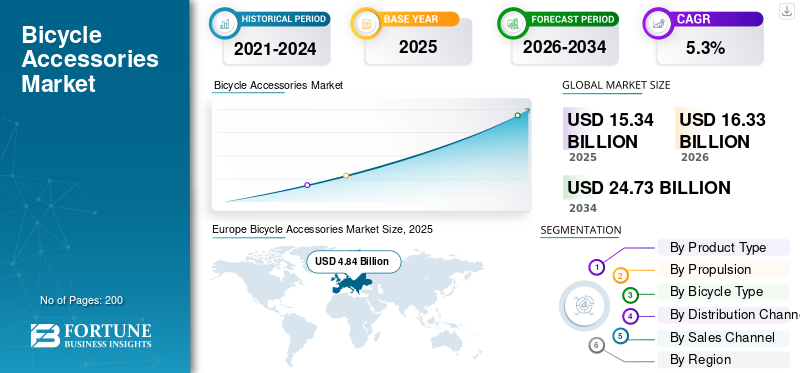
The global bicycle accessories market size was valued at USD 15.34 billion in 2025 and is projected to grow from USD 16.33 billion in 2026 to USD 24.73 billion by 2034, with a CAGR of 5.3% over the forecast period. Europe dominated the bicycle accessories market with a market share of 31.55% in 2025.
Bicycle accessories are supplementary products designed to enhance a bicycle’s safety, performance, comfort, convenience, and aesthetics. They include components such as helmets, lights, locks, pumps, bags, racks, fenders, GPS devices, and maintenance tools, serving both functional and lifestyle purposes for commuting, sports, and recreational cycling. Growth is driven by rising cycling participation for fitness and commuting, increasing urban congestion, and expanding cycling infrastructure. Adoption of e-bikes, safety awareness leading to higher helmet and lighting demand, and the growth of adventure and sports cycling further stimulate sales. E-commerce penetration and product innovation in smart accessories such as GPS trackers and performance sensors also support market expansion.
Key players include Shimano Inc., Trek Bicycle Corporation, Giant Manufacturing, Garmin Ltd., Thule Group, Vista Outdoor (Bell, Giro), and Specialized Bicycle Components. Market trends highlight smart and connected accessories, lightweight and sustainable recycled materials, premiumization in performance gear, and expansion of direct-to-consumer online channels alongside strong aftermarket sales growth.
Download Free sample to learn more about this report.
Bicycle Accessories Market Key Takeaways
 Market Size & Forecast
- 2025 Market Size: USD 15.34 billion
- 2026 Market Size: USD 16.33 billion
- 2034 Forecast Market Size: USD 24.73 billion
- CAGR: 5.3% from 2026-2034
 Market Share
- Europe dominated the bicycle accessories market with a 31.55% share in 2025.
- The components segment is projected to grow at a CAGR of 5.7% during the forecast period.
- The cargo bikes segment is expected to register a CAGR of 8.2% during the forecast period.
 Key Regional Highlights
Europe
Europe leads the market, supported by mature cycling infrastructure, strong commuter culture, and increasing e-bike penetration.
Asia Pacific
Asia Pacific is the fastest-growing region, driven by rapid urbanization, rising disposable incomes, and expanding e-bike adoption.
North America
North America is witnessing steady growth due to strong recreational cycling participation and increasing commuter adoption.
U.S.
The market is driven by recreational cycling, mountain biking, and the growing popularity of gravel bikes.
Japan
Daily commuter cycling and compact urban mobility needs are supporting demand for bicycle accessories.
Read More

BICYCLE ACCESSORIES MARKET TRENDS
Smart & Connected Cycling Accessories to be a Significant Market Trend
Integration of smart technologies into bicycle accessories is reshaping consumer preferences, with GPS-enabled bike computers, app-connected safety lights, and advanced digital locks enhancing navigation, performance data, and security on rides. Tech-oriented cyclists increasingly seek accessories that seamlessly connect with smartphones and wearables, improving overall ride experience and safety without sacrificing convenience. This trend reflects broader adoption of IoT-enabled gear in personal mobility and active lifestyles.
- In April 2025, Garmin introduced the Varia Vue cycling headlight with a 4K incident camera and smartphone connectivity, illustrating rising demand for advanced safety technology in bike accessories.
MARKET DYNAMICS
MARKET DRIVERS
Download Free sample to learn more about this report.
Urban Cycling & Health Awareness to Drive Market Growth
Urbanization, increased health consciousness, and sustainable commuting habits are driving global bicycle accessories market growth as more cyclists invest in safety gear, comfort items, and performance tools. As cities expand bike lanes and cycling is seen as eco-friendly transportation, riders prioritize accessories that support everyday commuting and recreational use. The rise of e-bikes further drive demand by encouraging the purchase of accessories tailored to comfort and utility.
MARKET RESTRAINTS
Cost Barriers & Affordability to Restraint Market Growth
A key restraint in the market stems from consumer price sensitivity and affordability issues, especially in developing regions where demand for premium accessories may be limited. High-end smart and tech-integrated products often carry steeper price tags that deter cost-conscious cyclists, who may opt for basic or generic alternatives, dampening uptake of advanced gear and limiting market expansion in budget-driven segments.
MARKET OPPORTUNITIES
E-Bike-Focused Accessory Expansion to Create Lucrative Opportunities
The rapid expansion of the e-bike segment presents a strong opportunity for accessory manufacturers to offer specialized gear, such as reinforced locks, integrated lighting systems, and ergonomic comfort products designed for electric bicycles. E-bike riders often require accessories that enhance range, safety, and convenience beyond traditional cycling gear, creating new revenue streams for innovative, compatible add-ons.
- In March 2025, the Taipei International Cycle Show highlighted new e-bike accessory innovations and product showcases, signaling industry focus on this growing niche.
MARKET CHALLENGES
Compatibility & Standardization to Challenge Market Growth
Rapid product innovation and varying bicycle designs pose a market challenge, as a lack of universal accessory standards can lead to compatibility issues between accessories and different bike models. Cyclists may hesitate to purchase accessories if they are unsure about fit or interoperability, which complicates retailers' inventory management and increases returns. This fragmentation requires manufacturers to invest in adaptable designs or modular solutions to maintain consumer confidence and streamline adoption.
Segmentation Analysis
By Product Type
High Replacement Cycle and Safety Demand Strengthen Components Segment Leadership
Based on product type, the market is segmented into apparel and components.
The components segment dominates and is projected to grow at a 5.7% CAGR over the forecast period. Components such as lights, locks, drivetrains, pedals, and braking parts witness consistent replacement demand due to wear and tear, safety upgrades, and performance optimization. Growth in commuting and sports cycling further accelerates repeat purchases.
The apparels segment is expanding steadily and is set to grow at a CAGR of 4.2% over the forecast period, supported by rising awareness of rider safety and performance-enhancing clothing.
- In September 2023, Shimano announced expanded investment in cycling component production capacity in Singapore, reinforcing strong global demand for performance parts.
By Bicycle Type
Versatility and Urban Commuting Preference Boost Hybrid Bike Segment Dominance
Based on bicycle type, the market is segmented into mountain bikes, road bikes, hybrid bikes, cargo bikes, and other bicycles.
The hybrid bikes segment dominates due to its versatility for commuting, leisure, and light trail use, encouraging higher attachment rates for accessories such as racks, panniers, lights, and comfort upgrades.
The cargo bikes segment are projected to grow at a CAGR of 8.2% over the forecast period, driven by urban last-mile delivery and family mobility trends.
- In October 2023, UPS expanded cargo e-bike deliveries in European cities, underscoring the growing use of cargo bikes.
To know how our report can help streamline your business, Speak to Analyst
By Propulsion
Expanding Urban Mobility Reinforces Conventional Bicycle Accessory Demand
Based on propulsion, the market is segmented into conventional and electric.
The conventional segment remains dominant due to its large installed base globally and strong adoption across developing economies, where affordability drives bicycle usage. Accessories such as lights, locks, racks, and helmets see steady sales tied to daily commuting and recreational riding.
The electric segment is projected to grow at a CAGR of 8.1% over the forecast period, supported by accelerating e-bike adoption in Europe and Asia.
- In June 2024, Bosch e-Bike Systems launched upgraded smart system enhancements in Europe, highlighting continued momentum in electric bicycle ecosystems.
By Distribution Channel
Strong Retail Networks Sustain Offline Channel Leadership
Based on distribution channel, the market is segmented into offline and online.
The offline segment dominates as specialty bicycle stores provide fitting services, technical guidance, and immediate product availability, which is particularly important for safety gear and performance components.
However, the online segment is projected to grow at a CAGR of 7.9% over the forecast period, supported by a wider product assortment and competitive pricing.
- In August 2023, Decathlon announced continued global store expansion alongside strengthening its omnichannel retail strategy, reflecting the sustained importance of physical retail presence.
By Sales Channel
Extensive Installed Base Drives Aftermarket Sales Expansion
Based on sales channel, the market is segmented into OEM and aftermarket.
The aftermarket segment dominates and is projected to grow at a 5.7% CAGR over the forecast period, supported by recurring replacement cycles, customization trends, and performance upgrades among cycling enthusiasts.
OEM sales are growing steadily alongside new bicycle production, particularly with bundled accessory offerings in mid- to premium-range bikes. The segment is projected to grow at CAGR of 3.9% over the forecast period.
- In May 2023, Giant Group reported growth in cycling gear and accessory sales linked to global cycling participation trends, supporting aftermarket strength.
BICYCLE ACCESSORIES MARKET REGIONAL OUTLOOK
By geography, the market is categorized into Europe, North America, Asia Pacific, and the rest of the world.
Europe
Europe Bicycle Accessories Market Size, 2025 (USD Billion)
To get more information on the regional analysis of this market, Download Free sample
Europe dominates the global bicycle accessories market share, supported by mature cycling infrastructure, strong commuter culture, and rapid e-bike penetration across Western Europe. Government-backed cycling policies, urban low-emission zones, and sustainability targets continue to support accessory demand, particularly for safety gear, lights, locks, and cargo solutions. Countries such as Germany, the Netherlands, and the U.K. maintain high bicycle ownership rates, encouraging steady aftermarket replacement cycles. Additionally, Europe’s large e-bike fleet drives demand for advanced accessories, including smart displays, reinforced locks, and integrated lighting systems, strengthening the region’s premium accessory sales base.
U.K. Bicycle Accessories Market
The U.K. market benefits from urban cycling initiatives, expanding bike lane networks, and rising commuter adoption in cities such as London and Manchester. Demand is concentrated in helmets, high-visibility apparel, and security locks due to concerns about theft. Growth in gravel and hybrid bike adoption further supports accessory purchases tied to versatility and comfort. The U.K. market to value USD 0.52 billion in 2026.
Germany Bicycle Accessories Market
Germany is one of Europe’s largest bicycle and e-bike markets, with a 21.2% share in 2025, which directly supports strong accessory sales. High e-bike penetration increases demand for premium lighting systems, digital displays, and durable locking mechanisms. Established cycling tourism routes and commuter usage sustain steady aftermarket replacement demand, while consumers demonstrate a strong consumers preferring for high-quality engineered components.
Asia Pacific
Asia Pacific is the fastest-growing region in the market, driven by rapid urbanization, rising disposable incomes, and strong e-bike adoption in key countries. Expanding middle-class populations are investing in personal mobility and fitness activities, increasing demand for helmets, lighting systems, and performance components. Government initiatives promoting electric mobility and congestion reduction further stimulate the adoption of accessories. The region’s large population base and increasing organized retail penetration create strong volume-driven growth opportunities across both affordable and premium accessory categories.
China Bicycle Accessories Market
China’s market, with a 45.3% share in 2026, is supported by widespread bicycle and e-bike use for urban commuting and shared mobility platforms. High e-bike ownership drives demand for replacement batteries, lights, and security accessories. Domestic manufacturing strength ensures the broad availability of competitively priced components, while urban safety regulations continue to promote the adoption of helmets and visibility gear.
Japan Bicycle Accessories Market
Japan’s demand for bicycle accessories is shaped by daily commuter cycling and compact urban mobility needs. Consumers prioritize safety features such as advanced lighting systems, child seats, and rain protection accessories. The country’s aging population also supports demand for comfort-oriented upgrades, including ergonomic saddles and electric-assist compatible accessories. Japan is set to value USD 0.56 billion in 2026.
India Bicycle Accessories Market
India’s market is expanding at the highest CAGR of 8.1% over the forecast period due to rising fitness awareness, growing challenges of urban commuting, and increasing adoption of premium bicycles in metropolitan cities. Demand is concentrated in helmets, mobile holders, and entry-level performance components. E-bike adoption and government focus on sustainable mobility are gradually strengthening the premium accessory segment.
North America
North America demonstrates steady growth in bicycle accessories, supported by strong recreational cycling culture, mountain biking participation, and increasing commuter adoption in selected urban centers. Consumers show a high willingness to spend on premium helmets, GPS cycling computers, hydration systems, and high-performance components. Growth in gravel biking and adventure cycling further supports demand for specialized accessories. E-commerce penetration is particularly strong in the region, supporting direct-to-consumer accessory sales and broader product accessibility across urban and suburban markets.
U.S. Bicycle Accessories Market
The U.S. market is driven by recreational cycling, mountain biking, and the growing popularity of gravel bikes. Demand for premium helmets, smart cycling computers, and high-lumen lighting systems remains strong. Growing interest in outdoor fitness and adventure sports sustains aftermarket upgrades, while online retail platforms significantly influence purchasing patterns and brand visibility. The U.S. market to value USD 4.13 billion in 2026.
Rest of the World
The rest of the world region, including Latin America and the Middle East & Africa, presents moderate but improving growth prospects in bicycle accessories. Urban congestion, rising fuel costs, and the gradual development of cycling infrastructure are encouraging bicycle use in selected metropolitan areas. Demand is primarily for affordable safety accessories, such as helmets, reflectors, and locks. As cycling awareness and organized retail penetration increase, mid-range accessory adoption is expected to strengthen, particularly in tourist-centric and densely populated urban zones.
COMPETITIVE LANDSCAPE
Key Industry Players
Product Innovation, Brand Diversification, and Omnichannel Expansion Shape Bicycle Accessories Competition
The global market trends are characterized by strong brand-driven competition, continuous product innovation, and an expanding omnichannel supply chain and distribution strategies. Leading players such as Shimano Inc., Garmin Ltd., Trek Bicycle Corporation, Giant Manufacturing Co., Specialized Bicycle Components, Thule Group, and Vista Outdoor (Bell, Giro) compete through performance-focused components, advanced safety gear, and smart connected devices. Companies differentiate through lightweight raw materials, aerodynamic designs, integrated lighting systems, and app-enabled cycling computers. Strategic priorities include expanding direct-to-consumer platforms, strengthening aftermarket networks, and leveraging sponsorships in professional cycling to enhance brand visibility. Manufacturers are also investing in sustainable materials and modular product architectures to align with environmental regulations and evolving consumer preferences. Partnerships with e-bike manufacturers and technology providers further enhance competitive positioning, particularly in high-growth electric and premium cycling segments, where innovation speed and brand loyalty significantly influence market share gains.
LIST OF KEY BICYCLE ACCESSORIES COMPANIES PROFILED IN REPORT
- Shimano Inc. (Japan)
- Giant Manufacturing Co. Ltd. (Taiwan)
- Trek Bicycle Corporation (U.S.)
- Specialized Bicycle Components, Inc. (U.S.)
- Garmin Ltd. (U.S.)
- Thule Group AB (Sweden)
- Vista Outdoor Inc. (Bell, Giro brands) (U.S.)
- Continental AG (Bicycle Tires Division) (Germany)
- SRAM LLC (U.S.)
- DT Swiss AG (Switzerland)
- Bosch eBike Systems (Germany)
- Panaracer Corporation (Japan)
- Bike (Netherlands)
- Accell Group N.V. (Netherlands)
- Fox Factory Holding Corp. (U.S.)
KEY INDUSTRY DEVELOPMENTS
- February 2026: Garmin launched the Varia RearVue 820, its newest rearview radar and tail light, featuring extended vehicle detection up to 175m, enhanced alerting, and brake-light functionality. Positioned as a safety-forward electronics accessory, the launch reinforces the trend toward connected visibility systems that integrate with bike computers, apps, and wearables.
- February 2026: Magnum Industries (BLACK X smart locks) and OnGuard signed an exclusive multi-year distribution agreement with Outdoor Gear Canada (OGC) for Canada. The partnership expands national availability of security accessories, particularly smart lock offerings, by leveraging OGC’s established distribution relationships in the Canadian cycling retail ecosystem.
- January 2026: HEAD Group announced the 100% acquisition of Le Col, a premium British cycling apparel brand. The deal extends HEAD’s sportswear footprint into cycling apparel and accessories, enabling scale across design, sourcing, and distribution while preserving Le Col’s brand equity in high-performance kits that often attach to broader gear-and-accessory purchases.
- January 2026: Wheels Manufacturing acquired accessory maker Mirrycle Corporation, including the Incredibell brands. The deal consolidates a well-known mirrors-and-bells portfolio under Wheels’ manufacturing and distribution footprint, supporting broader accessory cross-selling, channel reach, and operational continuity.
- December 2025: TeoSport announced a strategic partnership with D3O, integrating D3O’s impact-absorbing material into TeoSport cycling pads. The collaboration targets higher-performance protection accessories by applying a proven materials platform used in other safety-critical domains, aiming to improve comfort, durability, and impact energy management for riders.
REPORT COVERAGE
The global bicycle accessories market analysis provides an in-depth study of the market size & forecast across all market segments included in the report. It contains details on market research dynamics and trends expected to drive the market during the forecast period. It offers information on technological advancements, new product launches, key industry developments, strategic partnerships, mergers & acquisitions. The market forecast provides a comprehensive competitive landscape, including the most significant global market share, emerging opportunities, and profiles of key players in the automotive industry.
Request for Customization to gain extensive market insights.
Report Scope & Segmentation
| ATTRIBUTE | DETAILS |
| Study Period | 2021-2034 |
| Base Year | 2025 |
| Estimated Year | 2026 |
| Forecast Period | 2026-2034 |
| Historical Period | 2021-2024 |
| Growth Rate | CAGR of 5.3% from 2026 to 2034 |
| Unit | Value (USD Billion) |
| Segmentation | By Product Type, By Propulsion, By Bicycle Type, By Distribution Channel, By Sales Channel, and By Region |
| By Product Type |
|
| By Bicycle Type |
|
| By Propulsion |
|
| By Distribution Channel |
|
| By Sales Channel |
|
| By Region |
|
Frequently Asked Questions
Fortune Business Insights says that the global market value stood at USD 15.34 billion in 2025 and is projected to reach USD 24.73 billion by 2034.
In 2025, Europes market value stood at USD 4.84 billion.
The market is expected to grow at a CAGR of 5.3% from 2026 to 2034.
The conventional segment led in the propulsion segment.
The rising participation in cycling for fitness and commuting, along with increasing urban congestion, is driving market momentum.
Key market players include Shimano Inc., Trek Bicycle Corporation, Giant Manufacturing, Garmin Ltd., and Thule Group.
Europe held the largest share of the market in 2025.



- 2021-2034
- 2025
- 2021-2024
- 200
-
(Offer valid till 15th Oct 2026)
Get 30-60 hrs Free Customization
Expand Regional and Country Coverage, Segments Analysis, Company Profiles, Competitive Benchmarking, and End-user Insights.




















-
US +1 833 909 2966 ( Toll Free )
-
Get In Touch With Us