Bioconjugation Market Size, Share & Industry Analysis, By Offering (Products {Instruments [Chromatography Systems, and Others] and Consumables [Reagents & Kits, Labels, and Others]} and Services {Custom Synthesis & Conjugation Services, and Others}), By Technique (Chemical Conjugation, Enzyme-Mediated Conjugation, and Others), By Conjugate Type (Antibody–Drug Conjugates (ADCs), Protein-Drug Conjugates, and Others) By Application (Therapeutics, Diagnostics, and Others), By End User (Pharmaceutical & Biotechnology Companies, CROs & CDMOs, and Others), and Regional Forecast, 2026-2034
 Download Free Sample
KEY MARKET INSIGHTS
 Listen to Audio Version
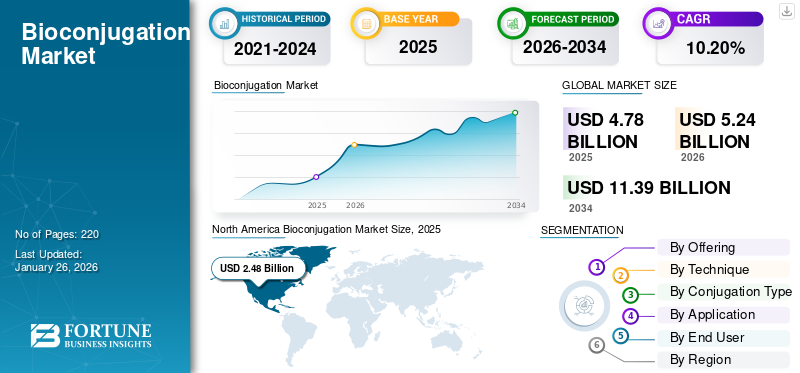
The global bioconjugation market size was valued at USD 4.78 billion in 2025 and is projected to grow from USD 5.24 billion in 2026 to USD 11.39 billion by 2034, exhibiting a CAGR of 10.20% during the forecast period. North america dominated the bioconjugation market with a market share of 51.82% in 2025.
Bioconjugation is the process of chemically linking two distinct molecules together, often via a covalent bond, to create a novel complex with combined properties. Prominent factors such as rising demand for targeted therapeutics, increasing influx of investment for research & development, and technological advancements fueled the adoption of these technologies in various applications. Additionally, growing partnerships between biopharmaceutical companies and contract service providers is also fueling the market growth.
Furthermore, the market encompasses several major players with Thermo Fisher Scientific Inc., Agilent Technologies Inc., Lonza, and others. Strong geographic presence coupled with availability of wide range of products/services by these companies have supported their dominance in the global market.
Download Free sample to learn more about this report.
Bioconjugation Market Key Takeaways
 Market Size & Forecast
- 2025 Market Size: USD 4.78 billion
- 2026 Market Size: USD 5.24 billion
- 2034 Forecast Market Size: USD 11.39 billion
- CAGR: 10.20% from 2026–2034
 Market Share
- North America dominated the global bioconjugation market with a 51.82% share in 2025.
- The Products segment is expected to account for 75.83% of the market in 2026.
- The Antibody–Drug Conjugates (ADCs) segment is projected to hold 56.91% of the market in 2026.
 Key Regional Highlights
North America
North America led the global market with a valuation of USD 2.48 billion in 2025 and is projected to reach USD 2.72 billion in 2026.
Asia Pacific
Asia Pacific accounted for USD 0.76 billion in 2025 and is projected to reach USD 0.84 billion in 2026.
Europe
Europe represented USD 1.23 billion in 2025 and is expected to reach USD 1.35 billion in 2026.
U.S.
The market projected to reach USD 2.52 billion in 2026.
Japan
While Japan-specific data was not provided, the country remains one of Asia Pacific’s key biopharmaceutical research hubs supporting regional market growth.
Read More

MARKET DYNAMICS
MARKET DRIVERS
Increasing Focus on Development of Antibody–Drug Conjugates (ADCs) to Propel Market Growth
The increasing focus on the development of Antibody–Drug Conjugates (ADCs) is a prominent factor driving the market growth. ADCs represent one of the most advanced applications of bioconjugation, combining the target specificity of monoclonal antibodies with the potency of cytotoxic drugs. This surge in antibody-drug conjugate (ADC) development is driven by their success in treating various cancers and the continuous innovation in their components. Additionally, recent advances in site specific conjugation have improved efficacy and reduced toxicity, leading to a substantial increase in approved ADCs and a vast pipeline of candidates in clinical trials.
- For instance, according to the data published by Hunan Huateng Pharmaceutical Co., Ltd. in April 2025, till date a total of 19 ADC drugs have been approved across the globe.
MARKET RESTRAINTS
Regulatory & Safety Concerns to Restrict Market Expansion
A prominent factor restraining the growth of the market is the stringent regulatory and safety requirements surrounding novel conjugated products. The regulatory pathways for novel conjugates are stringent and lengthy, given the potential for off-target toxicity. This results in lengthy approval timelines and higher trial costs compared to conventional drugs. Additionally, safety concerns such as premature drug release or off-target binding can cause severe toxicities, leading to trial delays or terminations. Thus, failures in late-stage trials due to safety or efficacy issues can significantly delay market growth.
- For example, in July 2023, ADC Therapeutics SA discontinued the phase II LOTIS-9 Clinical Trial of Rituximab and ZYNLONTA (loncastuximab tesirine-lpyl) in unfit or frail previously untreated DLBCL patients.
MARKET OPPORTUNITIES
Rising Demand for Companion Diagnostics & Imaging Agents to Create Lucrative Growth Opportunities
One of the most promising growth opportunities in the market is the rising demand for companion diagnostics and imaging agents. Bioconjugation plays a key role in precision diagnostics and molecular imaging. It allows the attachment of molecular probes, radioactive isotopes, or fluorescent dyes to antibodies and peptides, enabling highly specific disease detection and patient stratification. Thus, expansion into non-therapeutic applications offers new opportunities, especially in early cancer detection.
- For instance, trastuzumab-based imaging agents have been developed to identify HER2-positive tumors.
BIOCONJUGATION MARKET TRENDS
Rising Outsourcing to CROs and CMOs is a One of the Significant Market Trends
In recent years, pharmaceutical & biotechnology companies are increasingly outsourcing complex conjugation/characterization tasks to CROs/CDMOs and specialized service providers. This is identified as one of the significant market trends. Outsourcing allows these companies to access state-of-the-art facilities, advanced conjugation technologies, and regulatory-compliant manufacturing capacity without making heavy capital investments. This approach also helps accelerate timelines by leveraging the experience of specialized partners in managing complex production workflows. Owing to this, biopharmaceutical companies are partnering with CROs/CMOs for bioconjugation processes.
- For instance, in October 2024, Lonza expanded its collaboration with major biopharmaceutical company as a commercial-scale manufacture of ADCs.
MARKET CHALLENGES
High Cost and Technical Complexity to Hamper Market Growth
One of the major challenging factors for the bioconjugation market growth is the high development cost associated with bioconjugated therapeutics, particularly antibody–drug conjugates (ADCs). The development process includes highly complex R&D followed by multiple phases of expensive clinical trials. The processes such as conjugation, purification, stability testing, and scaling up conjugated molecules require sophisticated equipment, expertise, and control, which results in rising overall cost.
- For instance, according to a study published in National Center for Biotechnology Information (NCBI), in June 2023, the development of ADCs is extremely costly with final cost of ADC therapy is around USD 100–500 thousand per annum.
Download Free sample to learn more about this report.
Segmentation Analysis
By Offering
High Demand for Products Contributed to Growth of the Products Segment
On the basis of the offering, the market is classified into products and services.
To know how our report can help streamline your business, Speak to Analyst
The products segment is expected to account for the leading share of the bioconjugation market, at 75.83% in 2026. Among products, consumables segment held the significant market share. The segment's growth has mostly been driven by the rising demand for products from pharmaceutical, biotechnology, and research institutions as well as by the growing use of these products in diagnostics. The growing use of conjugates in drug development, cancer research, and pharmacogenomics, as well as the rising incidence of chronic diseases like cancer that require targeted therapies. Furthermore, the growth of the segment is also fueled by major players launching new products. All these factors contribute to the segment’s expansion.
- For instance, in January 2025, Bio-Rad Laboratories, Inc. introduced TrailBlazer StarBright Dye Label and TrailBlazer Tag Kits for antibody conjugation.
By Technique
Various Applications Fuels the Segment Dominance of Chemical Conjugation
In terms of technique, the market is divided into chemical conjugation, enzyme-mediated conjugation, click chemistry, photoreactive crosslinking, and others.
The Chemical Conjugation segment is projected to dominate the market with a share of 47.68% in 2026. the global market was dominated by chemical conjugation segment. Wide adoption of this technique, expanding usage across various applications, and cost-effectiveness & compatibility with large-scale manufacturing are some of the factors propelling the segmental growth. Additionally, increasing adoption of this technique in commercially approved products also supplements the market growth.
- For instance, Kadcyla (ado-trastuzumab emtansine) is created using chemical conjugation (thiol–maleimide chemistry). This drug is approved for HER2-positive breast cancer.
The enzyme-mediated conjugation segment is expected to grow at a CAGR of 11.71% over the study period.
By Conjugate Type
Increasing Adoption of ADCs Contributed to the Highest Share of ADCs
On the basis of conjugate type, the market is classified into antibody–drug conjugates (ADCs), protein-drug conjugates, peptide-drug conjugates, and others.
The antibody–drug conjugates (ADCs) segment is expected to hold the dominant share of the market, accounting for 56.91% in 2026. This dominance is contributed to rising demand for targeted cancer therapies, strong pipeline development, and increasing number of approved products in the market. Moreover, presence of well-established biopharmaceutical companies in the development of these products also supplements the segment growth.
- For instance, according to a study published in BMC Journal in March 2024, there are more than 100 ADC drugs at different stages of clinical trials and this number is anticipated to increase rapidly in the near future.
The peptide-drug conjugates segment is expected to grow at a CAGR of 10.28% over the study period.
By Application
Increasing Focus on Drug Research Fuels Growth of Therapeutic Applications Segment
In terms of application, the market is categorized into therapeutics, diagnostics, and research & development.
The therapeutics segment is expected to capture the largest market share, accounting for 66.74% in 2026. In 2025, the segment is anticipated to dominate with 66.0% share. High demand for targeted drug delivery, large and expanding pipeline of bioconjugated drugs, increasing regulatory approvals, and strong investment focus have primarily driven the segment growth. Additionally, large biopharmaceutical companies are also actively involved in the development of innovative therapies using this method.
- For instance, in January 2025, the U.S. FDA approved AstraZeneca and Daiichi Sankyo’s Enhertu (trastuzumab deruxtecan) to treat HER2-positive breast cancer. It is an antibody drug conjugate product.
The diagnostics segment is expected to witness 8.76% growth over the forecast period.
By End User
Focus on Innovative Therapeutic Development by Pharmaceutical & Biotechnology Companies Boosted Segment Growth
Based on end-user, the market is segmented into pharmaceutical & biotechnology companies, CROs & CDMOs, academic & research institutes, and others.
In 2024, in terms of end-user, pharmaceutical & biotechnology companies held the dominating share of the global market. Factors contributing to this dominance include strong focus on targeted therapy development, increasing number of commercialized products, and active involvement in strategic initiatives. Furthermore, the segment is set to hold 56.7% share in 2025.
- For instance, in March 2024, AstraZeneca signed an agreement for the acquisition of Fusion Pharmaceuticals Inc. to expand its presence in the development of next-generation radioconjugates (RCs).
In addition, CROs & CDMOs segment is projected to grow at a CAGR of 12.68% during the forecast period.
Bioconjugation Market Regional Outlook
By geography, the market is segmented into North America, Europe, Asia Pacific, Latin America, and Middle East & Africa.
North America
North America Bioconjugation Market Size, 2025 (USD Billion)
To get more information on the regional analysis of this market, Download Free sample
The North America dominated the global market in 2025 with a revenue generation of USD 2.48 billion and also took the leading share in 2026 with USD 2.72 billion. Key factors fostering the dominance of the region include high influx of investment for biopharmaceutical R&D, regulatory support, high disease burden, and advanced manufacturing infrastructure. In 2026, U.S. market is estimated to reach USD 2.52 billion. The country has a robust network of CMOs and CROs such as Catalent Inc., Lonza’s U.S. facilities, and others which are actively involved in strategic collaborations, in turn supporting the country’s market growth.
- For instance, in November 2022, Catalent Inc., and Exelixis, Inc. signed an agreement three Antibody-Drug Conjugate Programs.
Europe
The Europe market was valued at USD 1.23 billion in 2025, capturing 25.81% of global revenue, and is estimated to reach USD 1.35 billion in 2026. The Europe market is projected to grow at a notable rate in the coming years and is expected to register a CAGR of 9.82% during the forecast period, making it the second-largest regional market. The region is anticipated to reach a valuation of USD 1.23 billion by 2025. This growth is mainly driven by the increasing focus on biopharmaceutical research and manufacturing, along with the rising emphasis on precision medicine development by key companies. Among the major countries, the U.K. is expected to reach USD 0.31 billion, Germany is projected to record USD 0.28 billion by 2026, and France is anticipated to reach USD 0.20 billion by 2025.
Asia Pacific
In 2025, Asia Pacific held 15.92% of the global market, reaching a valuation of USD 0.76 billion, and is projected to grow to USD 0.84 billion in 2026. The Asia Pacific market is also expected to grow significantly and is projected to reach a value of USD 0.84 billion by 2026, securing the position of the third-largest regional market. Growth in the region is supported by expanding healthcare infrastructure, increasing investments in biotechnology, and rising research activities. Within the region, India and China are both estimated to reach market values of USD 0.15 billion and USD 0.16 billion, respectively, by 2026.
Latin America
The Latin America region captured 4.00% of the global market in 2025, generating USD 0.19 billion in revenue, and is projected to reach USD 0.21 billion in 2026. Latin America is anticipated to witness relatively slower market growth during the forecast period. The region’s market is projected to reach a valuation of USD 0.419 billion in 2025. However, increasing biopharmaceutical research and development activities are expected to support the adoption of these products and bioconjugation services in the near future.
Middle East & Africa
Middle East & Africa contributed approximately USD 0.12 billion to the global market in 2025, accounting for 2.45% share, and is expected to reach USD 0.13 billion in 2026. The Middle East & Africa region is also expected to experience comparatively slower growth over the forecast years. In this region, GCC countries are projected to reach a market value of USD 0.06 billion in 2025, supported by the gradual expansion of biopharmaceutical research and the growing adoption of advanced bioconjugation technologies.
COMPETITIVE LANDSCAPE
Key Industry Players
Availability of Diverse Bioconjugation Technologies and Robust Clinical Pipelines and Capabilities Supported the Dominating Positions of Leading Companies
The global bioconjugation market is semi-consolidated, with the presence of several large pharmaceutical and biotechnology players alongside specialized reagent and technology providers. Companies such as Thermo Fisher Scientific Inc., Merck KGaA, Danaher, and Lonza are among the leading players in the market. Their dominance is attributed to road product pipelines and strong global presence across therapeutic and diagnostic applications.
The other prominent players include Catalent, Inc., Sartorius AG, Seagen Inc., and Creative Bioconjugates among others. These companies are focusing on innovative linker technologies, conjugation services, and customized solutions to support biopharmaceutical R&D and manufacturing.
- For instance, in May 2023, Seagen and Pfizer expanded their collaboration to co-develop next-generation ADCs, enhancing their clinical pipeline.
LIST OF KEY BIOCONJUGATION COMPANIES PROFILED
- Agilent Technologies Inc. (U.S.)
- Thermo Fisher Scientific Inc. (U.S.)
- Bio Rad Laboratories Inc. (U.S.)
- Merck KGaA (Germany)
- Lonza (Switzerland)
- Catalent, Inc. (U.S.)
- BD (U.S.)
- Sartorius AG (Germany)
- Danaher (U.S.)
- Vector Laboratories, Inc. (U.S.)
KEY INDUSTRY DEVELOPMENTS
- July 2025: Biosynth expanded its GMP bioconjugates production capabilities with new commercial bioconjugation suite at Berlin site.
- June 2025: Veranova expanded U.S. Bioconjugate CDMO Services with an investment of more than USD 50 million.
- May 2025: Shilpa Biologicals opened a dedicated bioconjugation suite at its Dharwad site in India.
- November 2024: Lonza announced the investment for additional bioconjugation capabilities in Visp, Switzerland. This was aimed to address growing market demands.
- April 2024: Abzena expanded its bioconjugation and ADC capabilities with significant investment.
REPORT COVERAGE
Request for Customization to gain extensive market insights.
Report Scope & Segmentation
|
ATTRIBUTE |
DETAILS |
|
Study Period |
2021-2034 |
|
Base Year |
2025 |
|
Estimated Year |
2026 |
|
Forecast Period |
2026-2034 |
|
Historical Period |
2021-2024 |
|
Growth Rate |
CAGR of 10.20% from 2026-2034 |
|
Unit |
Value (USD Billion) |
|
Segmentation |
By Offering, Technique, Conjugate Type, Application, End User, and Region |
|
By Offering |
· Products o Instruments § Chromatography Systems § Spectroscopy Instruments § Mass Spectrometers § Flow Cytometers § Others o Consumables § Reagents & Kits § Labels § Others · Services o Custom Synthesis & Conjugation Services o Analytical & Characterization Services o Scale-up & Manufacturing Services o Others |
|
By Technique |
· Chemical Conjugation · Enzyme-Mediated Conjugation · Click Chemistry · Photoreactive Crosslinking · Others |
|
By Conjugate Type |
· Antibody–Drug Conjugates (ADCs) · Protein-Drug Conjugates · Peptide-Drug Conjugates · Others |
|
By Application |
· Therapeutics · Diagnostics · Research & Development |
|
By End User |
· Pharmaceutical & Biotechnology Companies · CROs & CDMOs · Academic & Research Institutes · Others |
|
By Region |
· North America (By Offering, Technique, Conjugate Type, Application, End User, and Country) o U.S. o Canada · Europe (By Offering, Technique, Conjugate Type, Application, End User, and Country/Sub-region) o Germany o U.K. o France o Spain o Italy o Scandinavia o Rest of Europe · Asia Pacific (By Offering, Technique, Conjugate Type, Application, End User, and Country/Sub-region) o China o Japan o India o Australia o Southeast Asia o Rest of Asia Pacific · Latin America (By Offering, Technique, Conjugate Type, Application, End User, and Country/Sub-region) o Brazil o Mexico o Rest of Latin America · Middle East & Africa (By Offering, Technique, Conjugate Type, Application, End User, and Country/Sub-region) o GCC o South Africa o Rest of the Middle East & Africa |
Frequently Asked Questions
Fortune Business Insights says that the global market value stood at USD 4.78 billion in 2025 and is projected to reach USD 11.39 billion by 2034.
In 2025, the market value stood at USD 2.48 billion.
The market is expected to exhibit a CAGR of 10.20% during the forecast period.
The therapeutics segment led the market, by application.
The key factors driving the market are rising demand for targeted therapies, shift toward personalized & precision medicine and increasing adoption of ADCs.
Agilent Technologies Inc., Lonza, and Thermo Fisher Scientific Inc. are some of the leading players in the market.
North America dominated the market in 2025.
Expansion of diagnostic applications and strong biopharma R&D investments are some of the factors that are expected to favor the product adoption.



- 2021-2034
- 2025
- 2021-2024
- 220
Get 30-60 hrs Free Customization
Expand Regional and Country Coverage, Segments Analysis, Company Profiles, Competitive Benchmarking, and End-user Insights.













.webp)






-
US +1 833 909 2966 ( Toll Free )
-
Get In Touch With Us