Biofuel Storage and Distribution Market Size, Share & Industry Analysis, By Service Type (Transportation & Logistics, Storage Services, Terminal Handling Services, Blending Services, and Others), By Fuel Type (Renewable Diesel, Biodiesel, Bioethanol, and Others), By End User (Industrial Fuel Consumers, Aviation Fuel Suppliers, Biofuel Producers, Commercial Fuel Distributors, Oil Marketing Companies, and Others), and Regional Forecast, 2026-2034
 Download Free Sample
Biofuel Storage and Distribution Market Size and Future Outlook
 Listen to Audio Version
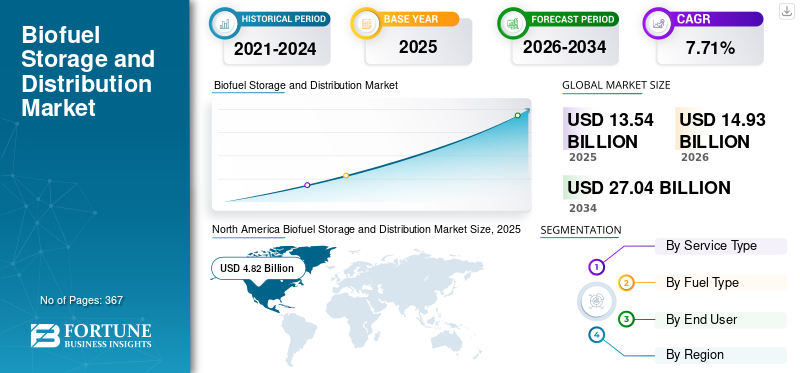
The biofuel storage and distribution market size was valued at USD 13.54 billion in 2025. The market is projected to grow from USD 14.93 billion in 2026 to USD 27.04 billion by 2034, exhibiting a CAGR of 7.71% during the forecast period. North America dominated the biofuel storage and distribution market with a market share of 35.59% in 2025.
Biofuel storage and distribution refers to the infrastructure, services, and logistics network involved in the safe storage, handling, transportation, blending, and delivery of biofuels from production and processing facilities to end users. It includes bulk storage terminals, tanks, pipelines, road and rail transportation, marine logistics, distribution depots, and terminal handling operations for fuels such as bioethanol, biodiesel, renewable diesel, and other renewable liquid fuels. The sector plays a critical role in maintaining fuel quality, ensuring supply chain reliability, supporting regulatory blending requirements, and enabling the efficient movement of biofuels across domestic and international markets. As biofuel production and renewable fuel mandates expand globally, storage and distribution infrastructure has become an essential component of the clean energy value chain.
The market is primarily driven by increasing adoption of renewable fuels to meet global decarbonization targets and stringent government blending mandates. Rising production of bioethanol, biodiesel, renewable diesel, and Sustainable Aviation Fuel (SAF) is creating strong demand for dedicated storage terminals, transportation networks, and blending facilities. Growing investments in fuel logistics infrastructure, expansion of cross-border biofuel trade, and modernization of existing fuel terminals are further supporting market growth. Additionally, increasing corporate commitments toward net-zero emissions and the transition to low-carbon energy systems are accelerating investments in efficient biofuel storage and distribution infrastructure worldwide.
Leading companies such as Royal Vopak N.V., Kinder Morgan, Inc., Exolum Corporation, Oiltanking GmbH, and Neste Oyj are playing a crucial role in advancing the market through continuous investments in storage terminals, renewable fuel logistics, and blending infrastructure. These companies are expanding tank storage capacity, modernizing terminal facilities to handle renewable diesel, biodiesel, bioethanol, and SAF, and strengthening multimodal transportation networks across key markets. They are also forming strategic partnerships with biofuel producers, refiners, and distributors to optimize supply chain efficiency while investing in digital terminal management, emissions reduction technologies, and sustainable logistics solutions to support the global energy transition.
Download Free sample to learn more about this report.
Biofuel Storage and Distribution Market Key Takeaways
 Global Market Size & Forecast
- 2025 Market Size: USD 13.54 billion
- 2026 Market Size: USD 14.93 billion
- 2034 Forecast Market Size: USD 27.04 billion
- CAGR: 7.71% from 2026–2034
 Market Share
- North America dominated the biofuel storage and distribution market with a 35.59% share in 2025.
- Transportation & logistics accounted for a 36.60% market share in 2025.
- Bioethanol accounted for a 42.23% market share in 2025.
 Key Regional Highlights
North America
North America led the market with a valuation of USD 4.82 billion in 2025.
Europe
Europe held a 27.62% share of global revenues, valued at USD 3.74 billion in 2025.
Asia Pacific
Asia Pacific accounted for 24.06% of the global market, valued at USD 3.26 billion in 2025.
U.S.
The market was valued at USD 4.15 billion in 2025 and is estimated to reach USD 4.57 billion in 2026.
Japan
The market was valued at USD 0.41 billion in 2025 and is estimated to reach USD 0.46 billion in 2026.
Read More

Biofuel Storage and Distribution Market Trends
Expansion of Renewable Fuel Terminal Infrastructure Are Amplifying Market Growth
One of the most significant trends shaping the market is rapid expansion and modernization of terminal infrastructure to accommodate renewable fuels such as renewable diesel (HVO), bioethanol, biodiesel, and SAF. Existing petroleum storage terminals are increasingly being retrofitted with dedicated tanks, blending systems, loading facilities, and digital monitoring technologies to handle multiple renewable fuel streams while maintaining fuel quality and regulatory compliance. According to the International Energy Agency (IEA), global biofuel demand exceeded 190 billion liters in 2024 and is expected to continue growing through the next decade, creating substantial demand for specialized storage and logistics infrastructure. Independent terminal operators such as Royal Vopak, Exolum, and Oiltanking have announced investments in renewable fuel storage and import/export facilities across Europe, North America, and Asia. Ports are also emerging as strategic biofuel logistics hubs to facilitate international trade. This transition from conventional fuel terminals to multi-product renewable energy hubs is improving supply chain flexibility, supporting large-scale biofuel adoption, and positioning storage and distribution infrastructure as a critical enabler of global energy transition strategies.
MARKET DYNAMICS
Market Drivers
Download Free sample to learn more about this report.
Government Blending Mandates and Decarbonization Policies to Push Market Growth
Government policies promoting renewable fuels remain the primary driver for the biofuel storage and distribution market growth. Countries across North America, Europe, Latin America, and Asia Pacific continue to strengthen biofuel blending mandates, low-carbon fuel standards, and decarbonization targets, directly increasing demand for storage terminals, transportation networks, and blending facilities. The European Union's Renewable Energy Directive (RED III) and the U.S. Renewable Fuel Standard (RFS) require increasing volumes of renewable fuels in transportation, while countries such as Brazil, India, and Indonesia continue expanding ethanol and biodiesel blending programs. According to the IEA, global biofuel demand is projected to increase by approximately 23% between 2023 and 2028, driven largely by policy support. Higher production volumes require larger storage capacities, improved logistics networks, and efficient distribution infrastructure to ensure uninterrupted fuel supply. Government support for renewable sources is also encouraging investments in renewable diesel and SAF infrastructure through financial incentives, tax benefits, and infrastructure funding. Consequently, regulatory support is accelerating investments across the entire biofuel logistics value chain and strengthening long term market growth.
|
Rank |
Market Driver |
Overall Impact Rank |
CAGR Contribution (2026-2034) |
Impact 2026-2028 |
Impact 2029-2031 |
Impact 2032-2034 |
|
1 |
Increasing government mandates for biofuel blending and low-carbon fuel adoption across transportation sectors |
High |
+2.30% |
High |
High |
Medium |
|
2 |
Growing production and trade of biodiesel, renewable diesel, bioethanol, and sustainable aviation fuel (SAF) driving demand for dedicated storage and logistics infrastructure |
High |
+1.95% |
High |
High |
High |
|
3 |
Expansion of biofuel storage terminals, blending facilities, and multimodal distribution networks by terminal operators and energy companies |
High |
+1.65% |
Medium |
High |
High |
|
4 |
Rising investments in port infrastructure, digital terminal operations, and supply chain modernization supporting efficient biofuel handling |
Medium-High |
+1.35% |
Medium |
High |
High |
|
5 |
Increasing international biofuel trade, cross-border supply agreements, and demand from aviation and marine sectors |
Medium |
+1.10% |
Medium |
Medium |
High |
|
6 |
Others, including fleet decarbonization initiatives, industrial biofuel consumption, renewable feedstock logistics, and strategic storage capacity expansion |
Low |
+0.65% |
Low |
Low |
Medium |
|
|
Total Positive Growth Contribution |
|
+9.00% |
|
|
|
Market Restraints
High Capital Investment and Infrastructure Conversion Costs to Limit Market Growth
Despite strong demand fundamentals, the market faces significant challenges from the high capital expenditure required to develop or convert infrastructure for renewable fuels. Biofuels often require dedicated storage tanks, corrosion-resistant raw materials, specialized blending equipment, vapor recovery systems, and upgraded loading facilities to maintain product quality and comply with safety regulations. Converting conventional petroleum terminals into multi-fuel renewable facilities requires substantial engineering modifications and operational investments. Industry estimates indicate that large-scale terminal modernization projects can require investments ranging from tens to hundreds of millions of dollars, depending on facility size and product mix. Smaller terminal operators and regional logistics providers often face financial constraints that delay infrastructure upgrades. In addition, compliance with environmental regulations, fire safety standards, hazardous material handling requirements, and emissions monitoring further increases project costs. These financial barriers can slow the expansion of storage capacity, particularly in emerging markets where renewable fuel demand is growing faster than supporting logistics infrastructure, thereby limiting the pace of market development.
|
Rank |
Market Restraint |
Estimated Contribution to CAGR (2026-2034) |
Impact on Market Growth |
2026-2028 |
2029-2031 |
2031-2034 |
|
1 |
High capital investment required for terminal construction, storage tanks, blending facilities, and logistics infrastructure |
High |
-0.48% |
High |
High |
High |
|
2 |
Feedstock supply volatility, fluctuating biofuel production, and inconsistent policy implementation affecting storage utilization |
High |
-0.36% |
High |
Medium |
Medium |
|
3 |
Compatibility challenges of existing petroleum infrastructure with certain advanced biofuels and SAF, requiring infrastructure upgrades |
Medium-High |
-0.28% |
Medium |
Medium |
Medium |
|
4 |
Others, including transportation bottlenecks, regulatory compliance costs, land availability constraints, and operational safety requirements |
Low |
-0.17% |
Medium |
Low |
Low |
|
|
Total Negative Growth Impact |
|
-1.29 |
|
|
|
Market Opportunities
Growing Sustainable Aviation Fuel (SAF) Supply Chains to Create New Growth Avenues
The rapid commercialization of SAF presents one of the largest growth opportunities for the market. Airlines, airports, fuel suppliers, and governments are investing heavily in SAF production and logistics infrastructure to reduce carbon emissions. The International Air Transport Association (IATA) estimates that SAF could contribute around 65% of the aviation sector's carbon reduction required to achieve net-zero emissions by 2050. As new SAF production facilities are commissioned, dedicated storage terminals, airport fuel farms, blending facilities, marine import terminals, and specialized transportation networks will be required to support global distribution. Several major terminal operators, including Vopak and Exolum, are already expanding infrastructure capable of handling SAF alongside conventional aviation fuels. Increasing international SAF trade is also creating opportunities for export terminals, strategic storage hubs, and multimodal logistics services. As global aviation regulations become more stringent and airline procurement of SAF increases, investments in dedicated storage and distribution infrastructure are expected to accelerate significantly throughout the forecast period.
Market Challenges
Managing Diverse Fuel Specifications Across Supply Chains to Limit Market Growth
A major operational challenge faced by the market is maintaining fuel quality while handling multiple biofuel products with different physical and chemical characteristics. Renewable diesel, biodiesel, bioethanol, SAF, and emerging renewable fuels each have unique storage requirements, blending specifications, temperature sensitivities, and contamination risks. Cross-contamination between fuel types can affect product quality and regulatory compliance, requiring dedicated tanks, pipelines, loading systems, and cleaning procedures. As governments introduce stricter sustainability certification and traceability requirements, logistics providers must implement advanced inventory management, digital monitoring, quality testing, and documentation systems throughout the supply chain. International biofuel trade further complicates logistics as fuel standards vary across countries and regions. Storage operators must therefore comply with multiple regulatory frameworks while maintaining operational efficiency and minimizing handling losses. Successfully managing these increasingly complex supply chains requires continuous investment in digital terminal management systems, automation, workforce training, and quality assurance processes, making operational excellence a critical competitive differentiator within the industry.
Segmentation Analysis
By Service Type
Rising International Trade in Biofuel Leads to Transportation & Logistics Segment Growth
Based on service type, the market segment covers transportation & logistics, storage services, terminal handling services, blending services, and others.
Transportation & logistics segment accounted for approximately 36.60% of the biofuel storage and distribution market share in 2025. It is the largest segment in the market, as it enables the movement of biofuels from production plants to storage terminals, blending facilities, fuel depots, and end-users. The segment relies on road tankers, railcars, pipelines, barges, and marine tankers depending on regional infrastructure and trade routes. Rising international trade in bioethanol, biodiesel, renewable diesel, and SAF has significantly increased demand for efficient multimodal logistics networks. Countries with large biofuel production capacities, such as the U.S., Brazil, and Indonesia, depend heavily on integrated transportation systems to ensure uninterrupted fuel supply. Companies are increasingly adopting digital fleet management, route optimization, and real-time shipment tracking to reduce transportation costs and emissions. The continued expansion of cross-border renewable fuel trade and growing investments in logistics infrastructure are expected to strengthen this segment throughout the forecast period.
Blending services is the fastest growing segment and is expected to hold a CAGR of 9.01% during the forecast period.
To know how our report can help streamline your business, Speak to Analyst
By Fuel Type
Growing Ethanol Blending Mandates Leads to Bioethanol Segment Growth
Based on fuel type, the market is segmented into renewable diesel, biodiesel, bioethanol, and others.
Bioethanol segment accounted for approximately 42.23% of the market share in 2025. This segment held a dominant share of the market due to its extensive use in gasoline blending, particularly in major producing countries such as the U.S., Brazil, and India. Large production volumes require extensive transportation networks, storage terminals, and blending facilities to ensure continuous fuel availability throughout the distribution chain. Since ethanol is hygroscopic and can absorb water during storage and transportation, dedicated tanks, corrosion-resistant equipment, and strict quality control procedures are essential to preserve product quality. Growing ethanol blending mandates, including E10, E15, and E20 fuel programs, are driving investments in terminal infrastructure and logistics systems capable of handling increasing fuel volumes. Expansion of domestic consumption and international ethanol trade is further strengthening demand for specialized storage and distribution services worldwide.
Renewable diesel is the fastest growing segment and is predicted to hold a CAGR of 8.52% during the forecast period.
By End User
Increasing Frequency of Grid Outages and Extreme Weather Events to Propel Oil Marketing Companies Segment Growth
Based on end user, the market is segmented into industrial fuel consumers, aviation fuel suppliers, biofuel producers, commercial fuel distributors, oil marketing companies, and others.
Oil marketing companies segment represented the largest market share of around 31.93% in 2025. The segment is the largest end-user groups in the market due to their extensive fuel terminal infrastructure and nationwide distribution networks. OMCs are integrating renewable diesel, biodiesel, bioethanol, and sustainable aviation fuel into their existing petroleum supply chains to comply with renewable fuel mandates and evolving consumer demand. This transition requires investments in dedicated storage tanks, automated blending systems, upgraded loading facilities, and quality control technologies. Many OMCs are also converting conventional fuel terminals into multi-product energy hubs capable of handling both fossil fuels and renewable alternatives. Their established infrastructure, broad distribution reach, and strong customer base position them as key drivers of biofuel storage and logistics market expansion.
Aviation fuel suppliers is the fastest growing segment expected to hold a CAGR of 9.31% during the forecast period.
Biofuel Storage and Distribution Market Regional Outlook
By region, the market has been studied across North America, Europe, Asia Pacific, Latin America, and the Middle East & Africa.
North America
North America Biofuel Storage and Distribution Market Size, 2025 (USD Billion)
To get more information on the regional analysis of this market, Download Free sample
North America is the dominant region in the market and in 2025 it was valued at USD 4.82 billion, accounting for approximately 35.57% of global revenues. This is owing to its mature renewable fuel industry, well-developed fuel logistics infrastructure, and extensive pipeline, rail, and terminal network. The U.S. is the world's largest producer of fuel ethanol, with annual production exceeding 16 billion gallons, while renewable diesel capacity has expanded rapidly across states such as California, Texas, and Louisiana. Canada's Clean Fuel Regulations are also encouraging increased use of low-carbon fuels and investments in terminal upgrades. Major storage operators continue to expand renewable fuel handling capabilities at Gulf Coast and West Coast terminals, strengthening North America's position as both a major production hub and exporter of biofuels.
U.S. Biofuel Storage and Distribution Market
The U.S. market was valued at USD 4.15 billion in 2025 and is estimated to reach USD 4.57 billion in 2026. The U.S. is the largest market, supported by its extensive terminal network, advanced fuel logistics infrastructure, and high renewable fuel production. The country operates more than 130 ethanol bio-refineries with an annual production capacity exceeding 17 billion gallons and creating substantial demand for storage terminals, rail transport, and blending facilities. Federal programs such as the Renewable Fuel Standard (RFS) and California's Low Carbon Fuel Standard (LCFS) continue to drive investments in renewable diesel, SAF, and associated storage infrastructure.
Europe
Europe accounted for USD 3.74 billion in 2025, representing approximately 27.62% of global revenues. Europe represents a highly developed market driven by ambitious climate policies, cross-border fuel trade, and increasing demand for advanced biofuels. The European Union's FuelEU Maritime regulation and the implementation of ReFuelEU Aviation are accelerating investments in renewable fuel logistics, storage terminals, and blending infrastructure. Major ports such as Rotterdam, Antwerp-Bruges, and Hamburg are being transformed into renewable energy hubs capable of handling bioethanol, renewable diesel, biodiesel, and sustainable aviation fuel. The region's integrated transport network and growing imports of renewable fuels continue to increase demand for sophisticated storage and distribution services across multiple countries.
Germany Biofuel Storage and Distribution Market
Germany market was valued at USD 0.94 billion in 2025 and is estimated to reach USD 1.05 billion in 2026. Germany is one of Europe's leading markets due to its strong renewable fuel policies and highly integrated fuel logistics network. As Europe's largest economy, Germany has an extensive network of inland fuel terminals, pipelines, and storage depots supporting biodiesel, renewable diesel, and bioethanol distribution. The country's mandate to reduce greenhouse gas emissions for transport fuels has encouraged fuel suppliers to increase renewable fuel adoption, resulting in continuous investments in blending facilities and modernized storage infrastructure across major industrial and logistics hubs.
U.K. Biofuel Storage and Distribution Market
The U.K. market was valued at USD 0.56 billion in 2025 and is estimated to reach USD 0.61 billion in 2026. It is witnessing steady growth in biofuel storage and distribution as it advances its net-zero strategy and expands sustainable transport fuel adoption. The U.K. Sustainable Aviation Fuel Mandate, started in 2025, is encouraging investments in dedicated SAF storage, airport fuel logistics, and terminal handling infrastructure. Major import terminals across ports such as Birmingham and Teesside are enhancing their renewable fuel capabilities to support increasing imports of bioethanol, renewable diesel, and advanced biofuels, strengthening the country's renewable fuel supply chain.
Asia Pacific
Asia Pacific market was valued at USD 3.26 billion in 2025, accounting for approximately 24.06% of the global market. Asia Pacific is expected to witness the fastest growth over the forecast period, due to rising energy demand, expanding biofuel production, and supportive government blending programs. Countries including India have advanced their ethanol blending program from around 1.5% in 2014 to nearly 20% in 2025, significantly increasing demand for storage depots, transportation infrastructure, and blending terminals. Indonesia and Malaysia continue expanding biodiesel production under higher blending mandates, while China is investing in renewable fuel logistics to support its decarbonization objectives. Rapid industrialization and infrastructure development across the region are creating substantial opportunities for terminal operators and fuel logistics providers.
China Biofuel Storage and Distribution Market
China remains the dominant contributor in Asia Pacific, valued at USD 1.45 billion in 2025, and is estimated to reach USD 1.62 billion in 2026. China is rapidly strengthening its biofuel logistics infrastructure as part of its broader decarbonization and energy diversification strategy. The country continues expanding renewable diesel, sustainable aviation fuel, and advanced biofuel production capacities while investing heavily in modern storage terminals and port infrastructure. China's 14th Five-Year Plan emphasizes the development of green transportation fuels and cleaner energy systems, encouraging state-owned energy companies to upgrade storage facilities, distribution networks, and blending infrastructure to support increasing renewable fuel deployment across industrial and transportation sectors.
India Biofuel Storage and Distribution Market
India was valued at USD 0.60 billion in 2025 and is estimated to reach USD 0.66 billion in 2026. India is emerging as one of the fastest-growing markets due to its aggressive ethanol blending program and expanding renewable fuel production. The country achieved 20% ethanol blending in petrol ahead of its original target, significantly increasing demand for ethanol storage tanks, transportation fleets, blending depots, and fuel terminals. Public sector oil marketing companies are investing in additional storage infrastructure, dedicated ethanol handling facilities, and automated blending systems to support nationwide renewable fuel distribution and strengthen India's energy security.
Japan Biofuel Storage and Distribution Market
Japan was valued at USD 0.41 billion in 2025 and is estimated to reach USD 0.46 billion in 2026. Japan's market is expanding with growing emphasis on sustainable aviation fuel, marine based biofuels, and low-carbon transportation. The country has established ambitious targets to increase SAF usage while major refiners and trading companies continue investing in renewable fuel import terminals and dedicated storage facilities. Given Japan's dependence on imported energy, highly efficient port infrastructure and integrated fuel logistics networks play a critical role in supporting biofuel imports, storage, blending, and nationwide distribution while maintaining stringent fuel quality standards.
Latin America
Latin America accounted for USD 1.00 billion in 2025, accounting for approximately 7.42% of global revenues. Latin America remains a strategically important region due to its abundant agricultural resources and well-established biofuel production industry. Brazil, the world's second-largest ethanol producer, maintains one of the most extensive ethanol logistics and distribution networks globally through pipelines, storage terminals, and fuel depots. The country's RenovaBio program continues to encourage low-carbon fuel production and investments in biofuel infrastructure. Argentina also plays a significant role in biodiesel exports, creating demand for export terminals and marine logistics. Increasing regional biofuel consumption and expanding export activities are strengthening investments in storage and transportation facilities across Latin America.
Middle East & Africa
The Middle East & Africa was valued at USD 0.72 billion in 2025. It is an emerging market supported by increasing renewable energy investments, expanding fuel trade infrastructure, and growing interest in low-carbon transportation fuels. Several Gulf countries are diversifying their energy sectors by investing in renewable fuel production and export infrastructure, leveraging their established petroleum logistics expertise. In Africa, countries including South Africa are exploring greater adoption of biofuels through national energy diversification initiatives, while new port and terminal developments are improving regional fuel logistics capabilities. Growing investments in modern storage facilities, import terminals, and integrated logistics networks are expected to enhance the region's role in the global biofuel supply chain over the forecast period.
GCC Biofuel Storage and Distribution Market
The GCC market was at USD 0.33 billion in 2025 and is estimated to reach USD 0.36 billion in 2026. It is gradually developing biofuel storage and distribution capabilities by leveraging its world-class petroleum logistics infrastructure and strategic location along major international shipping routes. Countries such as the United Arab Emirates and Saudi Arabia are investing in renewable fuels, including sustainable aviation fuel and renewable diesel, as part of broader economic diversification and net-zero initiatives. Existing oil storage terminals, export facilities, and deep-water ports provide a strong foundation for integrating biofuel handling, positioning the GCC as an emerging regional hub for renewable fuel imports, storage, blending, and international trade.
COMPETITIVE LANDSCAPE
Key Industry Players
Investments in Dedicated Storage Terminals and Renewable Fuel Logistics Are Boosting Market Share for Companies
Leading companies such as Royal Vopak N.V., Kinder Morgan Inc., Exolum Corporation, Oiltanking GmbH, and Neste Oyj hold a dominant position in the market. These companies are playing a pivotal role in expanding the market by investing in dedicated storage terminals, renewable fuel logistics, blending facilities, and integrated supply chain infrastructure. Major operators are repurposing conventional petroleum assets to handle bioethanol, biodiesel, renewable diesel, and SAF, enabling faster adoption of low-carbon fuels without requiring entirely new infrastructure. Strategic partnerships between terminal operators, biofuel producers, airlines, and oil marketing companies are improving fuel availability across domestic and international markets while strengthening global trade networks. In addition, companies are adopting digital terminal management, automation, and advanced inventory systems to enhance operational efficiency, ensure regulatory compliance, and support the growing demand for renewable fuel distribution worldwide.
List of Key Biofuel Storage and Distribution Companies Profiled
- Royal Vopak N.V. (Netherlands)
- Kinder Morgan, Inc. (U.S.)
- Buckeye Partners, L.P. (U.S.)
- Navigator Terminals (U.K.)
- Exolum Corporation (Spain)
- Oiltanking GmbH (Germany)
- LBC Tank Terminals (Netherlands)
- HES International B.V. (Netherlands)
- NuStar Energy L.P. (U.S.)
- Eni Sustainable Mobility S.p.A. (Italy)
- Valero Energy Corporation (U.S.)
- Neste Oyj (Finland)
- Archer Daniels Midland (ADM) (U.S.)
- Bunge Global SA (U.S.)
KEY INDUSTRY DEVELOPMENTS
- November 2025: ADM inaugurated a new Green Barge Terminal at its Decatur, Illinois complex to improve the transportation of soybean meal and renewable feedstocks. The investment enhances inland logistics efficiency, lowers transportation emissions, and strengthens biofuel feedstocks availability for renewable diesel and biofuel production across North America.
- October 2025: Exolum announced a USD 6.05 million investment to develop the U.K.’s first independent Sustainable Aviation Fuel (SAF) blending facility at Redcliffe Bay. The project upgrades existing storage tanks and blending infrastructure, enabling efficient SAF distribution through the U.K.'s pipeline network and supporting aviation decarbonization.
- September 2025: Valero Energy, through its Diamond Green Diesel joint venture, continued expanding renewable diesel and Sustainable Aviation Fuel production capabilities to meet increasing global demand for low-carbon transportation fuels. The expansion supports higher volumes of renewable fuel distribution while driving investments in storage terminals, blending infrastructure, and integrated logistics networks across North America.
- August 2025: Royal Vopak announced an investment to expand its PT2SB terminal in Malaysia by 272,000 cubic meters to support the storage of biofuels and renewable feedstocks. The project strengthens the company's energy transition portfolio and enhances logistics capacity for sustainable fuels in the Asia Pacific region, supporting growing international biofuel trade.
- May 2025: Neste expanded its collaboration with DHL Express to increase the supply of Sustainable Aviation Fuel (SAF) for international air cargo operations. The partnership supports wider adoption of low-carbon aviation fuels while strengthening global SAF supply chains, driving additional demand for dedicated storage, blending, and fuel distribution infrastructure.
REPORT COVERAGE
The report provides a comprehensive analysis of the market, focusing on key aspects such as leading companies, product processes, and Porter’s Five Forces. Additionally, the report provides valuable insights into market trends and highlights key industry developments. In addition to the factors mentioned above, the report also encompasses several factors that contributed to the market's growth in recent years.
Request for Customization to gain extensive market insights.
REPORT SCOPE & SEGMENTATION
| ATTRIBUTE | DETAILS |
| Study Period | 2021-2034 |
| Base Year | 2025 |
| Estimated Year | 2026 |
| Forecast Period | 2026-2034 |
| Historical Period | 2021-2024 |
| Growth Rate | CAGR of 7.71% from 2026 to 2034 |
| Unit | Value (USD Billion) |
| Segmentation |
By Service Type
|
|
By Fuel Type
|
|
|
By End User
|
|
|
By Region
|
Frequently Asked Questions
Fortune Business Insights says that the market value stood at USD 13.54 billion in 2025 and is projected to reach USD 27.04 billion by 2034.
The market is expected to grow at a CAGR of 7.71% during the forecast period of 2026-2034.
The oil marketing companies segment led the market in terms of end user.
Government blending mandates and decarbonization policies are driving the global market growth.
Royal Vopak N.V., Kinder Morgan Inc., Exolum Corporation, Oiltanking GmbH, and Neste Oyj are some of the prominent players in the market.
North America is the leading region in the market.



- 2021-2034
- 2025
- 2021-2024
- 367
Get 30-60 hrs Free Customization
Expand Regional and Country Coverage, Segments Analysis, Company Profiles, Competitive Benchmarking, and End-user Insights.


















Related Reports
-
US +1 833 909 2966 ( Toll Free )
-
Get In Touch With Us