Bioimpedance Analyzers Market Size, Share & Industry Analysis By Product Type (Single Frequency and Multi Frequency), By Modality (Wired and Wireless), By Application (Body Composition Analysis, Clinical Fluid Management, Fitness & Wellness Assessment, and Others), By End User (Hospitals & Clinics, Fitness Clubs & Wellness Centers, Homecare Settings, and Others), and Regional Forecast, 2026-2034
 Download Free Sample
KEY MARKET INSIGHTS
 Listen to Audio Version
The global bioimpedance analyzers market size was valued at USD 653.3 million in 2025 and is projected to grow from USD 700.1 million in 2026 to USD 1,116.7 million by 2034, exhibiting a CAGR of 6.0% during the forecast period. North America dominated the global bioimpedance analyzers market with a market share of 37.77% in 2025.
Bioimpedance analyzers are medical devices used to measure precise body composition, including body fat, muscle mass, and hydration levels, and others. The increasing prevalence of metabolic disorders and obesity is resulting in a growing preference toward routine body check-ups among the patient population. The increasing awareness toward preventive care and the expansion of sports & fitness programmes among patients, thereby boosting the adoption rate of these devices in the market.
- For instance, according to the 2021 statistics published by the National Center for Biotechnology Information (NCBI), about 40.3% people are suffering from obesity in India.
Additionally, growing technological advancements in these products are further supporting the R&D investments in bioimpedance analyzers among the key players, such as Omron Healthcare, Inc., Inc., and Hologic, Inc., among others, further contributing to the demand for these systems in the market.
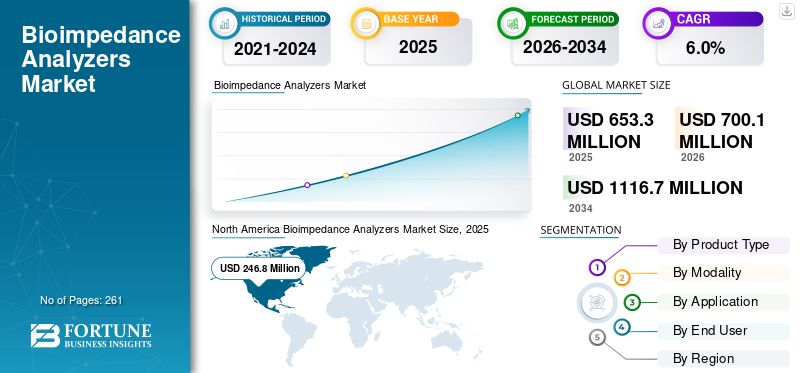
Download Free sample to learn more about this report.
Bioimpedance Analyzers Market Key Takeaways
 Global Market Size & Forecast
- 2025 Market Size: USD 653.3 million
- 2026 Market Size: USD 700.1 million
- 2034 Forecast Market Size: USD 1,116.7 million
- CAGR: 6.0% (2026–2034)
 Market Share
- North America dominated the market with a 37.77% share in 2025.
- The multi frequency segment held the largest market share in 2025.
- The wired segment dominated the market, accounting for 56.0% of the global market in 2025.
 Key Regional Highlights
Asia Pacific
Asia Pacific is estimated to reach USD 160.0 million by 2026.
North America
North America generated USD 246.8 million in 2025, maintaining its leading market position.
Europe
Europe is projected to reach USD 224.1 million by 2026, registering a 5.3% growth rate during the forecast period.
U.S.
U.S. market is projected to reach USD 237.6 million by 2026.
Japan
Japan market is projected to reach USD 48.8 million by 2026.
Read More

Bioimpedance Analyzers Market Trends
Preferential Shift toward Wireless and App-Connected Systems are Key Market Trends
There is an increasing focus on app-connected and wireless bioimpedance analyzers owing to several benefits, such as automated reporting, remote accessibility, and others. The prominent companies are focusing on the incorporation of cloud platforms, mobile applications, and web-based dashboards, which enable fluid status trends and real-time visualization of body composition globally.
These advancements improve remote clinical decision-making and allow easy data sharing across teams. Moreover, cloud-based patient management systems enhance workflow efficiency and enable the integration of hospital systems such as electronic health records (EHRs) in these systems, which is further anticipated to fuel the demand for these products in the market.
- In September 2025, Akern s.r.l. launched a new BIA101BIVA PRO vector bioimpedance analyzer to strengthen its product portfolio.
Other Prominent Trends
- Shift to multi-frequency and segmental systems
- Standardization of pre-test conditions
- Integration into care pathways and software
Download Free sample to learn more about this report.
Market Dynamics
Market Drivers
Increasing Prevalence of Obesity and Metabolic Disorders to Drive Market Growth
There is an increasing prevalence of obesity and metabolic disorders such as diabetes and others among the patient population, subsequently fueling the demand for body composition analysis tests in the market.
- For instance, according to 2024 statistics published by the Center for Disease Control & Prevention, it was reported that about 1 in 20 adults has coronary artery disease in the U.S.
The growing volume of body composition analysis tests is resulting in rising demand for technologically advanced devices in the market. Therefore, the factors above, along with the growing focus of key players on introducing innovative products, are expected to boost the adoption rate of these devices, thereby supporting the global market size.
Market Restraints
High Cost Associated with these Devices to Hamper Market Growth
There is an increasing demand for these devices due to their distinct benefits, such as non-invasive and others. However, the high cost associated with these advanced products is anticipated to hamper the adoption rate for these devices, particularly in emerging countries, including Mexico, China, India, and others.
The high cost of capital investment represents a huge expenditure, particularly for small clinics and wellness centers. Furthermore, the additional costs associated with these devices, such as software licenses, calibration of these devices, and accessories, further add to the financial burden.
- For instance, according to 2025 data published by Hci Fitness, it was reported that the price of bioimpedance analyzers ranges from USD 2,000 to USD 30,000.
Market Opportunities
Integration with Telehealth and Remote Patient Monitoring Systems
There is a rapid integration of these devices with remote patient monitoring and telehealth platforms, which presents a lucrative opportunity in the market. The healthcare systems are shifting toward value-driven care models; hence, the devices are being deployed to remotely measure fluid status and longitudinal body composition changes. Additionally, improving reimbursement policies, increasing healthcare expenditure, and inorganic growth strategies among governmental organizations to promote routine body check-ups are anticipated to contribute to the adoption rate of these products in the market.
- According to 2025 statistics published by the International Trade Administration (ITA), the healthcare spending of Brazil is USD 135.0 billion.
Market Challenges
Limited Awareness in Emerging Countries to Hinder Market Growth
There is a growing focus on strategic initiatives among governmental organizations to promote awareness about routine body check-ups among the patient population. However, there is a growing prevalence of delayed detection of metabolic disorders due to certain factors, such as limited professional expertise, delayed referrals of patients with metabolic conditions, along insufficient reimbursement policies, especially in developing countries.
Limited number of healthcare settings and availability of clinical facilities, among others, are some of the prominent factors resulting in delayed detection of metabolic disorders, further resulting in the diagnosis postponement among patients, particularly in emerging countries, including Mexico, India, among others.
- For instance, according to 2025 data published by the Life Insurance Movember Poll, it was reported that only 14% of South African men surveyed undergo regular health screenings.
Other Prominent Challenges
- Regulatory & Claim Limits to Hinder the Product Adoption
SEGMENTATION ANALYSIS
By Product Type
Increasing Adoption of Multi Frequency Bioimpedance Analyzers Led to Segment Dominance
Based on the product type, the market is classified into single frequency and multi frequency.
The multi frequency segment held the largest revenue share in 2025. The growth is due to the increasing prevalence of metabolic conditions among patients, resulting in a growing number of routine body check-ups globally. This, along with the growing adoption of these multi frequency analyzers, is resulting in the growing number of key players toward strengthening their product portfolio, and is further expected to contribute to the global bioimpedance analyzers market growth.
- In November 2025, Hume Health LLC announced that its Body Pod bioelectrical impedance analysis platform has reached over 1.2 million users since launching in early 2024, reflecting broader consumer migration toward home-based health monitoring solutions.
The single frequency segment is expected to grow at a CAGR of 5.8% over the forecast period.
To know how our report can help streamline your business, Speak to Analyst
By Modality
Increasing Prevalence of Metabolic Conditions Led to Dominance of Wired Segment
Based on modality, the market is segmented into wired and wireless.
The wired segment dominated the global market in 2025. By modality, the wired segment held the share of 56.0% in 2025. The growth is due to the increasing prevalence of metabolic conditions, including diabetes and others, resulting in a growing demand for wired bioimpedance analyzers, thereby supporting the adoption rate of these products in the market.
- For instance, according to the 2024 data published by the International Diabetes Federation (IDF), about 590 million adults have diabetes globally.
The segment of wireless is set to flourish with a growth rate of 6.3% across the forecast period.
By Application
Increasing Prevalence of Obesity Led to Dominance of Body Composition Analysis Segment
Based on application, the market is segmented into body composition analysis, clinical fluid management, fitness & wellness assessment, and others.
The body composition analysis segment dominated the global market in 2025. By application, the body composition analysis segment held a share of 48.0% in 2025. The growth is due to the increasing prevalence of obesity, resulting in a growing number of body composition analysis tests among patients, thereby supporting the adoption rate of these devices in the market.
- For instance, according to the 2022 data published by the World Obesity Atlas (WOA), almost 2.3 billion children and adults are living with overweight and obesity.
The segment of fitness & wellness assessment is set to flourish with a growth rate of 29.4% across the forecast period.
By End-user
Increasing Number of Hospitals & Clinics Led to Segmental Dominance
Based on end user, the market is divided into hospitals & clinics, fitness clubs & wellness centers, homecare settings, and others.
The hospitals & clinics segment dominated the market in 2025. The growing prevalence of metabolic disorders, growing routine check-ups in hospitals, growing number of hospitals, among others, are some of the vital factors supporting the growth of the segment in the market. Moreover, the segment is anticipated to hold a 37.6% share in 2026.
- For instance, according to 2025 statistics published by Definitive Healthcare, there are about 6,093 hospitals in the U.S.
In addition, homecare settings’ end users are projected to witness a growth of 6.9% CAGR during the forecast period.
Bioimpedance Analyzers Market Regional Outlook
Based on region, the market has been studied across North America, Europe, Asia Pacific, Latin America, and the Middle East & Africa.
North America
North America Bioimpedance Analyzers Market Size, 2025 (USD Million)
To get more information on the regional analysis of this market, Download Free sample
The North America market held the dominant share in 2024, valued at USD 230.2 million, and also took the leading share in 2025 with USD 246.8 million. The increasing prevalence of obesity, strong uptake in obesity/weight management clinics, sports medicine, and hospital nutrition programs, improving reimbursement and clinical validation, among others, are some of the factors supporting the growth of the segment in the market.
- For instance, according to 2024 data published by the International Diabetes Federation (IDF), it was reported that about 13.7% adults are living with diabetes in the U.S.
U.S. Bioimpedance Analyzers Market
Based on North America’s strong contribution and the U.S. dominance within the region, the U.S. market can be analytically approximated at around USD 237.6 million in 2026, accounting for roughly 33.9% of global bioimpedance analyzers sales.
Europe
Europe is projected to record a growth rate of 5.3% in the coming years, which is the second highest among all regions, and reach a valuation of USD 224.1 billion by 2026. The high adoption in clinical nutrition and dialysis, standardized interpretation of BIA/PhA in nutrition assessment contexts, among others, are some of the factors supporting the growth of the market.
U.K Bioimpedance Analyzers Market
The U.K. market in 2026 is estimated at around USD 41.7 million, representing roughly 6.0% of global bioimpedance analyzers revenues.
Germany Bioimpedance Analyzers Market
Germany’s market is projected to reach approximately USD 43.1 million in 2026, equivalent to around 6.2% of global bioimpedance analyzers sales.
Asia Pacific
Asia Pacific is estimated to reach USD 160.0 million in 2026 and secure the position of the third-largest region in the market. The growth is due to large installed bases of devices in fitness clubs and wellness centers and growing hospital adoption, increasing prevalence of obesity in parts of the region, and expanding chronic disease management programs. In the region, India and China are both estimated to reach USD 25.7 million and USD 31.1 million, respectively, in 2026.
Japan Bioimpedance Analyzers Market
The Japan market in 2026 is estimated at around USD 48.8 million, accounting for roughly 7.0% of global revenues. Japan has historically reported an increasing prevalence of metabolic conditions, with a strong number of routine check-ups among patients.
China Bioimpedance Analyzers Market
China’s market is projected to be one of the largest worldwide, with 2026 revenues estimated at around USD 31.1 million, representing roughly 4.4% of global sales.
India Bioimpedance Analyzers Market
The India market size in 2026 is estimated at around USD 25.7 million, accounting for roughly 3.7% of global revenues.
Latin America and Middle East & Africa
The Latin America and the Middle East & Africa regions are expected to witness moderate growth in this market space during the forecast period. The Latin America market is set to reach a valuation of USD 29.4 million in 2026. The growth is owing to private healthcare expansion, bariatric pathways, and dialysis capacity development. In the Middle East & Africa, the GCC is set to reach a value of USD 10.5 million in 2026.
South Africa Bioimpedance Analyzers Market
The South Africa market is projected to reach around USD 4.6 million in 2026, representing roughly 0.7% of global revenues.
Competitive Landscape
Key Industry Players
Increasing Number of Product Launches to Support Their Dominance
A significant product portfolio, along with a strong geographic presence globally, is one of the prominent factors supporting the dominance of these players in the market. Hologic, Inc., Omron Healthcare, Inc., and seca are major companies in the market in 2025. Additionally, the growing focus of key companies toward launching novel products is likely to support the global bioimpedance analyzers market share.
- For instance, in May 2025, seca, a player in medical measuring and weighing, launched advanced body composition analyzers, mBCA Alpha (Alpha), a compact, portable scanner specifically designed for use in a primary care setting.
Other market players, including Akern s.r.l. and others, are also growing in the market, primarily due to their increasing focus on acquisitions and mergers among other players to strengthen their presence in the market.
List of Key Bioimpedance Analyzers Companies Profiled
- Akern s.r.l. (Italy)
- Hologic, Inc. (U.S.)
- Seca (Germany)
- Omron Healthcare, Inc. (Japan)
- Biodynamics Corporation (U.S.)
- BioTekna (Italy)
- TANITA CORP of America (U.S.)
- InBody Co., Ltd. (U.S.)
- GE Healthcare (U.S.)
- ImpediMed Inc. (Australia)
KEY INDUSTRY DEVELOPMENTS
- November 2025: STARBIA MEDiTEK Co., Ltd., has been awarded the 2025 National Innovation Advancement Award by the Research Center for Biotechnology and Medicine Policy. The honor recognizes the companyʹs sustained innovation in bioelectrical impedance analysis (BIA) body composition technology.
- November 2025: STARBIA MEDiTEK Co., Ltd., has been approved by the National Science and Technology Councilʹs Science Park Review Committee to establish operations in the Huwei Park of the Central Taiwan Science Park, with a planned investment to develop bioimpedance analysis products.
- January 2025: seca, the player in medically validated body composition analysis, launched its mobile BIA system: the seca mBCA Go, with an aim to strengthen its product portfolio.
- May 2024: Anya, a company, produced a body composition analyzer based on bioelectrical technology, which assists nutritional doctors and sports instructors in assessing people's health and fitness in Iran.
- May 2018: GE Healthcare collaborated with FitTrace, a cloud-based body composition analysis and reporting software company, with an aim to strengthen its presence in the market.
REPORT COVERAGE
The market report provides a detailed global bioimpedance analyzers market analysis and focuses on key aspects such as leading companies and market segmentation, including product type, modality, application, and end user. Besides this, the global report offers insights into the key market trends and highlights key industry developments. In addition to the aforementioned factors, the report encompasses several factors that have contributed to the growth and advancement of the market over recent years.
Request for Customization to gain extensive market insights.
Report Scope & Segmentation
|
ATTRIBUTE |
DETAILS |
|
Study Period |
2021-2034 |
|
Base Year |
2025 |
|
Estimated Year |
2026 |
|
Forecast Period |
2026-2034 |
|
Historical Period |
2021-2024 |
|
Growth Rate |
CAGR of 6.0% from 2026-2034 |
|
Unit |
Value (USD Million) |
|
Segmentation |
By Product Type, Modality, Application, End User, and Region |
|
By Product Type |
· Single Frequency · Multi Frequency |
|
By Modality |
· Wired · Wireless |
|
By Application |
· Body Composition Analysis · Clinical Fluid Management · Fitness & Wellness Assessment · Others |
|
By End User |
· Hospitals & Clinics · Fitness Clubs & Wellness Centers · Homecare Settings · Others |
|
By Region |
· North America (By Product Type, By Modality, By Application, By End User, and by Country) o U.S. (By Product Type) o Canada (By Product Type) · Europe (By Product Type, By Modality, By Application, By End User, and by Country/Sub-region) o U.K. (By Product Type) o Germany (By Product Type) o France (By Product Type) o Italy (By Product Type) o Spain (By Product Type) o Scandinavia (By Product Type) o Rest of Europe (By Product Type) · Asia Pacific (By Product Type, By Modality, By Application, By End User, and by Country/Sub-region) o China (By Product Type) o Japan (By Product Type) o India (By Product Type) o Australia (By Product Type) o Southeast Asia (By Product Type) o Rest of Asia Pacific (By Product Type) · Latin America (By Product Type, By Modality, By Application, By End User, and by Country/Sub-region) o Brazil (By Product Type) o Mexico (By Product Type) o Rest of Latin America (By Product Type) · Middle East & Africa (By Product Type, By Modality, By Application, By End User, and by Country/Sub-region) o GCC (By Product Type) o South Africa (By Product Type) o Rest of the Middle East & Africa (By Product Type) |
Frequently Asked Questions
Fortune Business Insights says that the global market size was USD 608.3 million in 2025 and is projected to reach USD 1,116.7 million by 2034.
In 2025, the North America regional market value stood at USD 246.8 million.
Growing at a CAGR of 6.0%, the market will exhibit steady growth over the forecast period.
By product type, the multi frequency segment is the leading segment in this market.
The introduction of novel bioimpedance analyzers techniques is one of the major factors driving the markets growth.
Hologic, Inc. and Omron Healthcare, Inc. are the major players in the global market.
North America dominated the market share in 2025.
The growing prevalence of metabolic disorders, the increasing number of routine check-ups, among others, are some of the crucial factors anticipated to boost the adoption of these products worldwide.



- 2021-2034
- 2025
- 2021-2024
- 261
Get 30-60 hrs Free Customization
Expand Regional and Country Coverage, Segments Analysis, Company Profiles, Competitive Benchmarking, and End-user Insights.













.webp)






Related Reports
-
US +1 833 909 2966 ( Toll Free )
-
Get In Touch With Us