Bionematicides Market Size, Share & Industry Analysis, By Product Type (Microbial and Biological/Organic), By Form (Liquid, Granular, Emulsifiable Concentrate (EC), Water, Dispersible Powder (WDP), and Others), By Application Method (Soil Treatment, Seed Treatment, Foliar Spray, Fumigation, and Irrigation / Drip Application), By Crop Type (Fruits &, Vegetables, Cereals and Grains, Oilseeds & Pulses, Commercial Crops, and Others), and Regional Forecast, 2026-2034
 Download Free Sample
(Offer valid till 15th Oct 2026)

Bionematicides Market Size and Future Outlook
 Listen to Audio Version
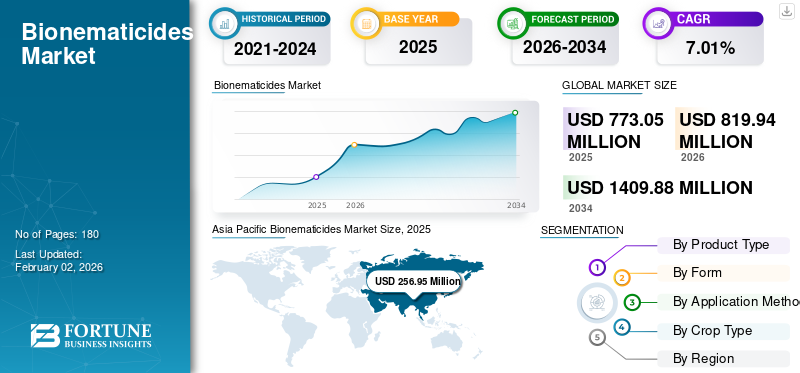
The global bionematicides market size was valued at USD 773.05 million in 2025 and is projected to grow from USD 819.94 million in 2026 to USD 1409.88 million by 2034, exhibiting a CAGR of 7.01% during the forecast period. Asia Pacific dominated the bionematicides market with a market share of 33.24% in 2025.
Bionematicides are bio-based formulations that contain beneficial microbes or natural compounds which help to suppress or kill nematodes that are responsible for crop root damage and yield loss. Microbes such as root knot nematodes (Meloidogyne spp.) lead to nutrient deficiency, stunted growth, and significant yield losses in vegetable and fruit crops. The use of such agricultural inputs helps to suppress the growth of such microorganisms in the region.
Companies such as BASF SE, Bayer AG, and Corteva Bioscience are some of the key players operating in this market. Major strategies adopted by the companies include launching or expansion of new product lines in the market.
Download Free sample to learn more about this report.
Bionematicides Market Key Takeaways
 Market Size & Forecast
- 2025 Market Size: USD 773.05 Million
- 2026 Market Size: USD 819.94 Million
- 2034 Forecast Market Size: USD 1,409.88 Million
- CAGR: 7.01% from 2026–2034
 Market Share
- Asia Pacific dominated the bionematicides market with a 33.24% share in 2025.
- The microbial segment is expected to hold a 68.42% market share in 2026.
- The soil treatment segment is expected to account for a 45.92% market share in 2026.
 Key Regional Highlights
Asia Pacific
Asia Pacific accounted for USD 256.95 million and 33.24% of the global market in 2025.
Europe
Europe generated USD 149.27 million and held a 19.31% market share in 2025.
Latin America
Latin America recorded USD 147.90 million and contributed 19.13% of global revenue in 2025.
U.S.
The market is projected to reach USD 98.45 million in 2026.
Japan
The market was valued at USD 79.66 million in 2025.
Read More

MARKET DYNAMICS
MARKET DRIVERS
Rising Cognizance of Soil Vigor and Sustainable Farming Supports Market Growth
The use of bionematicides helps to improve soil biodiversity and microbial balance thus making it a suitable alternative of chemical pesticides that cause long-term degradation. Farmers increasingly recognize the dual benefits of such products which helps to control nematodes and improve root growth and nutrient uptake of the plants. Moreover, increasing adoption of regenerative agriculture and organic agriculture among farmers also helps to support the adoption of such biological alternatives leading to the bionematicides market growth.
MARKET RESTRAINTS
Limited Field Effectiveness and Inconstant Performance Hindering Market Growth
The use of these products may lead to inconsistent results under different soil and climatic conditions. Comparatively, synthetic products yield a consistent result on the crops. The microbial survivability may also be affected by temperature, pH, and soil moisture. This change in abiotic factors may impact the performance of the nematode species. Moreover, farmers often perceive biological products as “slower-acting” and less predictable, impacting the market’s growth.
MARKET OPPORTUNITY
Technological Advancements in Microbial Formulation Creates Opportunity To Expand Product Line
There are ongoing research and development initiatives aimed at improving the microbial stability, survivability, and efficacy of the products through developing next-gen formulations. This includes producing encapsulation, Nano carriers, and dry-flowable granules of such products that have longer shelf life. Manufacturers are also developing microbial consortia that supports multi-target efficacy on crops. Therefore, manufacturers can adopt key strategies such as product innovation that supports products with wider crop adaptability that can be integrated with different farming techniques.
BIONEMATICIDE MARKET TRENDS
Growing Penetration in High-Value and Protected Crops is the key Market Trend
Primary adoption of these products in the production of vegetables, fruits, ornamentals, coffee, and plantation crops is high. Moreover, there is also a rising adoption of such products in greenhouse and hydroponic systems, which support microbial consistency. As a preventative treatment for target pests, they are increasingly being used in the seedling and nursery sector. The increasing usage of these products in agriculture is further supported by the growing inclusion of bionematicides in national sustainable agriculture programs in several countries such as India, Brazil, and others. The growing favorable market related initiatives is expected to fuel the market’s growth in the future.
Download Free sample to learn more about this report.
Segmentation Analysis
By Product Type
Microbial Segment to Register Large Market Share Owing to Broad Spectrum And Multifunctional Activity Of Such Products
The market is divided by product type into microbial and biological/organic.
The microbial segment is expected to account for the largest market share of 68.42% in 2026, during the forecast period. Microbial strains help to suppress the action of nematodes through multiple mechanisms. Such a mechanism makes them more effective against other products and less prone to microbe resistance compared to chemical nematicides.
The biological/organic segment is expected to grow at a CAGR of 7.18% over the forecast period. As organic farming is growing rapidly, farmers who grow produce under the EU Organic Regulation are bound to use such products in place of chemical products. Moreover, conventional farmers are also switching to “residue-free” or “low-residue” farming systems to meet organic retailer and export requirements to enhance crop yield supporting this segment’s growth.
By Form
Liquid form Account for Major Market Share due to Easier Application across Agricultural Fields
The market is segmented by form into liquid, granular, Emulsifiable Concentrate (EC), Water Dispersible Powder (WDP), and others.
The liquid segment is expected to account for the largest market share of 40.82% in 2026. In liquid formulations, the microbes remain suspended in nutrient-rich media that helps to preserve microbial activity viability and enhance their metabolic activity for a longer period. Products in this form allow uniform distribution of nutrients through soil or fertigation systems therefore ensuring uniform nematode suppression.
Granular form is another major segment which is expected to grow by 6.66% during the forecast period. These products can be applied without the use of specialized equipment or irrigation systems making them suitable for rainfed and large-acreage farming.
By Application Method
Soil Treatment Account For Major Market Share Due to Suitability Across Wide Range Of Crops
The market is segmented by application method into soil treatment, seed treatment, foliar spray, fumigation, and irrigation/drip application.
Soil treatment segment is expected to account for the largest market share of 45.92% in 2026. Soil treatment is suitable for open-field and protected cultivation systems and is compatible with granular and liquid formulations providing flexibility to the farmers.
Seed treatment is another major segment which is expected to grow by 6.66% during the forecast period. As the seed is coated with bionematicides which include beneficial microbes, this enables the roots to grow providing crop protection to the plants during its early growth stage.
By Crop Type
To know how our report can help streamline your business, Speak to Analyst
High Cultivated Area of Cereals and Grains Contributes To Higher Usage Of Bionematicides on Such Crops
The market is segmented by crop type into fruits & vegetables, cereals and grains, oilseeds & pulses, commercial crops, and others.
Cereals and grains are expected to account for the highest market share of 31.34% in 2026. They are the largest cultivated crop in the world and hence bionematicides application in this category is also high. These crops are staples in key agricultural regions across the world ensuring a broad and consistent demand base for such products on those crops. The segment is expected to continue to grow at a high CAGR during the forecast period.
Fruits and vegetables are closely monitored for pesticide residues in key consuming markets especially the European Union. As the use of chemical nematicides (e.g., methyl bromide, oxamyl, and carbofuran) are banned or heavily restricted bionematicides are most suitable products for the farmers in this region. The segment is expected to grow at a CAGR of 6.74% during the forecast period.
Bionematicides Market Regional Outlook
By region, the market is categorized into Europe, North America, Asia Pacific, South America, and the Middle East & Africa.
Asia Pacific
Asia Pacific Bionematicides Market Size, 2025 (USD Million) To get more information on the regional analysis of this market, Download Free sample
The Asia Pacific market accounted for USD 256.95 million in 2025, representing 33.24% of the global industry, and is expected to reach USD 273.17 million in 2026. Several Asia Pacific countries provide incentives for usage of bio‐inputs, which helps to promote organic farming, regulate and limit the usage of chemical nematicides, thus increasing the adoption of bionematicides. Moreover, increased emphasis of manufacturers to improve the formulation improvements is also making biological alternatives more efficient and helping to increase farmers; trust on such products. In this region, China and Japan are estimated to reach USD 74.05 million and USD 79.66 million, each, in 2025.
South America
Over the forecast period, South America would witness a high growth in this market. The South America market in 2025 is set to record USD 147.9 million as its valuation which was the second largest market in the world. There are several issues such as limited awareness, cost sensitivity, product availability and distribution, and variable field performance of such products which are cited as key factors restricting the market’s growth.
Europe
In 2025, Europe generated USD 149.27 million, contributing 19.31% to global market revenue, and is projected to grow to USD 157.8 million in 2026. Stringent chemical nematicide regulations along with strong organic farming activity in key European countries support sustainable agriculture activity and increased usage of such products in these regions. The European Union is increasingly adopting regulations and member-state policies that increasingly restrict or phase out older, high-toxicity chemicals thus supporting the adoption of biological and bio-based alternatives among farmers. During the forecast period, the European region is projected to record a growth rate of 6.18%. Backed by these factors, countries including Germany are expected to record the valuation of USD 28.34 million and the U.K. to record USD 17.19 million in 2026. France to record USD 22.54 million in 2025.
North America
After Europe, North America maintained a strong presence in the global market, reaching USD 127.25 million in 2025, accounting for 16.46% share, and is expected to reach USD 134.21 million in 2026. Bionematicides are widely accepted in North American countries where it is used for producing vegetables, fruits & nuts, and turf & ornamentals. Several major agricultural manufacturers such as Bayer, Corteva biosciences, and others are launching new products as a part of the bionematicides product line. In 2026, the U.S. market is estimated to reach USD 98.45 million. In the U.S., California, Florida, Texas, and Ontario are some of the key hotspots where adoption of sustainable nematode management is emphasized. The regulatory guidelines of the U.S. updated biopesticide registration simplifying the process and which in turn accelerated product availability in the market.
Middle East & Africa
In 2025, Middle East & Africa represented USD 91.67 million, accounting for 11.86% of the worldwide market, and is projected to grow to USD 97.26 million in 2026. In several Middle East and African countries climatic variations impact the market which includes arid climates, fragmented smallholder farming systems in such countries, weaker dealer/distributor networks in these regions which hamper broad adoption of such products in many African and some Middle East countries.
Latin America
Latin America contributed 19.13% to the global market in 2025, with a valuation of USD 147.9 million, and is projected to reach USD 157.5 million in 2026.
COMPETITIVE LANDSCAPE
Key Industry Players
Merger and Acquisition Is The Key Strategy Adopted By Key Manufacturers to Expand Market Presence
The global market exhibits a semi-consolidated structure as there are several well-established multinational companies, startups, and regional manufacturers operating in this space. Key agrochemical companies are expanding their presence in this market through acquisitions or partnerships with other prominent market players in the biological space and strengthen their bionematicide portfolios and reduce nematode infestation. Emerging markets such as Asia-Pacific, South America among others also present themselves as major untapped markets creating opportunities for manufacturers to establish local production/distribution.
LIST OF KEY BIONEMATICIDES COMPANIES PROFILED
- BASF SE (Germany)
- Bayer AG (Germany)
- Corteva Agriscience (U.S.)
- FMC Corporation (U.S.)
- Syngenta AG (Switzerland)
- UPL Limited (India)
- Nufarm Limited (Australia)
- Lallemand Inc. (Canada)
- Koppert Biological System N.V. (Netherlands)
- Andermatt Biocontrol AG (Switzerland)
KEY INDUSTRY DEVELOPMENTS
- October 2025: DPH Biologicals®, commercialized the production of biological solutions for modern agriculture and launched its bionematicides Companion Maxx in Brazil.
- March 2025: Certis Biologicals partnered with Certis-Belchim to launch new biocontrol nematicide which is formulated with the Purpureocillium lilacinum microorganism. This product is suitable for use in Spain, Italy, France, Portugal, Greece, Bulgaria, and Denmark.
- January 2025: Lesaffree launched a new bio-nematicide, Atroforce, which is composed of the active ingredient “Trichoderma atroviride strain K5”. It is suitable for use on soybeans, corn, cotton, and potatoes as well as other cereal grains, brassicas, cucurbits, and fiber type plants.
- January 2025: Bayer AG signed an exclusive distribution agreement with U.K.-based Ecospray to market a biological liquid nematicide which is sourced from garlic. It will be available for use in Europe, the Middle East, and parts of Africa in 2026.
- August 2024: Scheffer and Andermatt Brasil partnered with each other to manufacture production of bio-inputs namely Phosbac at Scheffer’s factory in Sapezal.
REPORT COVERAGE
Request for Customization to gain extensive market insights.
Report Scope & Segmentation
| ATTRIBUTE | DETAILS |
| Study Period | 2021-2034 |
| Base Year | 2025 |
| Estimated Year | 2026 |
| Forecast Period | 2026-2034 |
| Historical Period | 2021-2024 |
| Growth Rate | CAGR of 7.01% from 2026-2034 |
| Unit | Value (USD Million) |
| Segmentation |
By Product Type
By Form
By Application Method
By Crop Type
By Region North America (By Product Type, Form, Crop Type, Application Method, and Country)
Europe (By Product Type, Form, Crop Type, Application Method, and Country)
Asia Pacific (By Product Type, Form, Crop Type, Application Method, and Country)
South America (By Product Type, Form, Crop Type, Application Method, and Country)
Middle East and Africa (By Product Type, Form, Crop Type, Application Method , and Country)
Rest of the Middle East & Africa (By Product Type ) |
Frequently Asked Questions
Fortune Business Insights says that the global market value stood at USD 773.05 million in 2025 and is projected to reach USD 1409.88 million by 2034.
In 2025, the market value stood at USD 256.95 million.
The market is expected to exhibit a CAGR of 6.70% during the forecast period.
By product type, the microbial segment led the global market in 20245
Growing cognizance of soil vigor and sustainable farming supports market growth.
BASF SE., Bayer AG, and Corteva Bioscience are a few of the players in the market.
Asia Pacific held the largest market share in 2025.
Growing penetration in high-value and protected crops is the key trend influencing the market.



- 2021-2034
- 2025
- 2021-2024
- 180
-
(Offer valid till 15th Oct 2026)
Get 30-60 hrs Free Customization
Expand Regional and Country Coverage, Segments Analysis, Company Profiles, Competitive Benchmarking, and End-user Insights.











Related Reports
-
US +1 833 909 2966 ( Toll Free )
-
Get In Touch With Us