Biotech Ingredients Market Size, Share & Industry Analysis, By Source (Microbial, Plant-based and Animal-based), By Product Type (Enzymes, Amino Acids, Organic Acids, Proteins & Peptides, Collagen & Gelatin, Vitamins, Terpenoids, Alkaloids, Glycosides, Polysaccharides and Others), By Application (Pharmaceuticals, Food and Beverages, Personal Care & Cosmetics, Plant Nutrition & Health Care, Animal Nutrition & Health Care, Medical Beauty and Others), and Regional Forecast, 2026-2034
 Download Free Sample
(Offer valid till 31st Oct 2026)

Biotech Ingredients Market Size and Future Outlook
 Listen to Audio Version
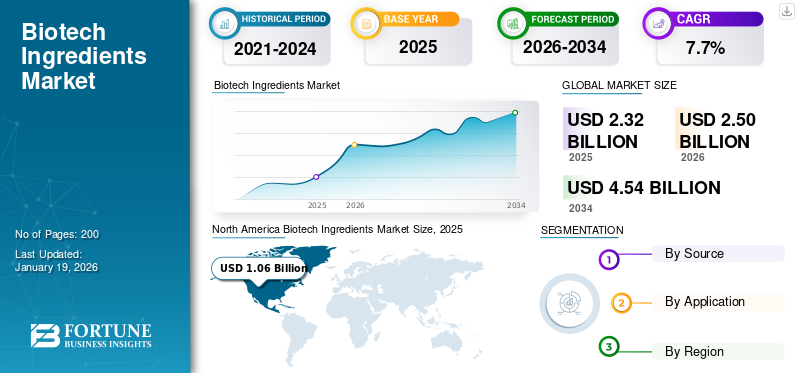
The biotech ingredients market size was valued at USD 2.17 billion in 2025 and is projected to grow from USD 2.50 billion in 2026 to USD 4.61 billion by 2034 at a CAGR of 7.9% during the forecast period (2026-2034). North America dominated the biotech ingredients market with a market share of 39.17% in 2025.
Biotech ingredients refer to substances produced using biotechnological processes such as fermentation, genetic engineering, cell culture and enzymatic synthesis. These ingredients are derived from natural sources such as microorganisms, plants, or animal cells and are used across various industries, including pharmaceuticals, cosmetics, food & beverages and agriculture. Unlike traditional ingredients that often require chemical synthesis or extraction from limited natural resources, biotech ingredients are sustainable, consistent in quality and can be tailored for specific functionalities. Examples include bio-based enzymes, peptides, amino acids, vitamins, probiotics, and active pharmaceutical ingredients (APIs).
The market is witnessing significant growth, driven by increasing demand for sustainable and natural alternatives, rising awareness around health and well-being and advancements in biotechnology. In the pharmaceutical industry, biotech APIs are increasingly being used in the development of biologics for the treatment of chronic diseases such as cancer, diabetes and autoimmune disorders. In the cosmetic sector, consumers are shifting toward biotech-based active ingredients that are safer and more effective, such as hyaluronic acid produced via microbial fermentation. In the food and beverage sector, enzymes and probiotics manufactured through biotechnology enhance nutrition, shelf-life and taste.
The rising need for green manufacturing processes, supportive government regulations promoting bio-based products and growing R&D investments in synthetic biology fermentation technologies are driving market growth.
Givaudan, Concord Biotech Limited, dsm-firmenich, Abel, and Aesthetics Rx are few key players operating in the market.
Download Free sample to learn more about this report.
Biotech Ingredients Market Key Takeaways
 Global Market Size & Forecast
- 2025 Market Size: USD 2.17 Billion
- 2026 Market Size: USD 2.50 Billion
- 2034 Forecast Market Size: USD 4.61 Billion
- CAGR: 7.90% from 2026–2034
 Market Share
- North America dominated the biotech ingredients market with a 39.17% share in 2025.
- Animal-based source segment held the largest market share in 2025.
- Pharmaceuticals application segment is projected to account for 45.00% of the market in 2026.
 Key Regional Highlights
North America
North America generated USD 1.06 billion in 2025, representing 45.00% of the global market.
Europe
Europe reached USD 0.64 billion in 2025, accounting for 27.00% of global revenue.
Asia Pacific
Asia Pacific recorded USD 0.47 billion in 2025, capturing 20.00% of the global market.
U.S.
The market reached USD 0.67 billion in 2025, representing 29.0% of global revenue.
Japan
The market reached USD 0.07 billion in 2025, accounting for approximately 3% of global revenue.
Read More

Biotech Ingredients Market Trends
Technological Innovations to Boost Market Growth
Advancements in biotechnology, such as recombinant DNA technology, synthetic biology and CRISPR gene editing, have significantly enhanced the production efficiency, purity and scalability of active ingredients used in pharmaceuticals, cosmetics and the food industry. These innovations enable the creation of highly targeted and sustainable ingredients, reducing dependency on traditional chemical synthesis and animal-derived sources. For instance, precision fermentation allows for the bio-manufacture of complex molecules such as vitamins, fragrances and enzymes in controlled environments, minimizing waste and carbon footprints. Additionally, continuous progress in bioprocessing techniques, including cell-free synthesis and biocatalysis, contributes to faster development timeline and cost-effective production. Artificial intelligence and machine learning are also increasingly integrated into biotech R&D to predict protein structures, optimize gene sequences and streamline discovery processes.
Market Dynamics
Market Drivers
Download Free sample to learn more about this report.
Rising Demand for Sustainable and Clean-Label Ingredients to Drive Market Growth
The rising demand for sustainable and clean-label ingredients across various industries, such as food & beverages, cosmetics and pharmaceuticals, drives the biotech ingredients market growth. Consumers increasingly prioritize health, environmental impact and product transparency, pushing manufacturers to replace synthetic additives with bio-based, naturally derived alternatives. They are produced through environmentally friendly processes such as microbial fermentation, enzymatic synthesis and cell culture, which further boost their demand. These methods often result in lower carbon emissions, reduced water usage and decreased reliance on petrochemicals, offering a more sustainable solution for ingredient production. In the food industry, clean-label trends encourage the use of biotech-derived flavors, enzymes, and preservatives that meet consumers' expectations of recognizable and minimally processed components. Similarly, biotech ingredients such as plant stem cells, microbial-derived peptides, and hyaluronic acid are gaining traction in cosmetics due to their safety, efficacy and eco-conscious sourcing.
Market Restraints
High R&D and Production Costs Limits Market Growth
Biotech ingredients, crucial to the pharmaceutical, cosmetic, and food industries, often require extensive scientific research, rigorous clinical trials and advanced biotechnological processes before reaching commercialization. Developing new biotech ingredients involves high capital investment in sophisticated lab infrastructure, skilled personnel and long development timelines that can span several years. These expenses place a significant financial burden on manufacturers that lack the funding capacity of large multinationals. Moreover, the complexity of regulatory approvals for pharmaceutical biotech products adds another layer of time and cost, as companies must comply with stringent global standards such as FDA or EMA requirements. In addition, production processes such as fermentation, cell culture, or genetic engineering often require specialized equipment and a controlled environment, further escalating operation costs. The scalability of these technologies can also be limited, making mass production cost-intensive and less economically viable compared to traditional chemical synthesis.
Market Opportunities
Expansion of Biosimilars, Monoclonal Antibodies and Advanced Therapies to Create Significant Growth Opportunities
A major wave of patent expirations on high-value biologics such as Humira, Herceptin, and Remicade has opened the door to biosimilar development, enabling cost-effective alternatives that maintain therapeutic equivalence. This enhanced access to biologic treatments compels manufacturers to scale up production of core biotech ingredients such as recombinant proteins and cell culture media to meet heightened demand. Monoclonal antibodies remain in high demand due to their broad application in oncology and autoimmune diseases. The urgency to control drug costs and burdened healthcare budgets reinforces the adoption of mAb biosimilars, boosting ingredient assumption. Moreover, advanced therapies including cell and gene therapies, CAR-T, and antibody-drug conjugates are gaining momentum, supported by favourable regulated pathways, breakthrough designations and substantial R&D investments worldwide in the U.S., China, and Europe.
Market Challenges
Regulatory Complexity May Hurdle Market Expansion
Regulatory frameworks vary widely across regions, with agencies such as the U.S. Food and Drug Administration (FDA), European Medicines Agency (EMA), and various national authorities setting different approval standards, testing protocols and documentation requirements. This lack of harmonization creates uncertainty for manufacturers, leading to extended product development cycles, increased compliance costs and delays in market entry. Additionally, newer biotech innovations such as those derived from synthetic biology or genetically engineered microbes often face heightened scrutiny due to biosafety risks and public perception issues. Furthermore, frequent updates to guidelines on labeling, traceability and environmental impact demand continuous adaptation from manufacturers.
Trade Protectionism and Geopolitical Impact
Trade protectionism and geopolitical tensions are significantly reshaping the global market, constraining growth while triggering strategic realignments. Recent U.S. tariffs, including baselines of 10% on imports and higher country-specific duties, have been announced and are expected to expand to pharmaceuticals and biotech ingredients. These measures disrupt established supply chains and increase costs. Many biotech firms rely heavily on APIs and biologics sourced from China (~80-90%), Europe, and India, making them vulnerable to sudden tariff escalations, customs delays and export controls. The geopolitical rivalry between the U.S. and China has accelerated efforts to decouple critical biotech processes such as gene-editing, vaccines, and biology drug manufacturing from Chinese supply chains. While this promotes reshoring initiatives, it also exacerbates fragmentation and increases regulatory complexity. Meanwhile, non-tariff barriers such as stringent GMO labeling and approval regimes in Europe and Japan continue to hinder ingredient trade independence.
Research and Development (R&D) Trends
New advances in synthetic biology, precision fermentation, genetic engineering, and machine learning are enabling the creation of novel enzymes, peptides, proteins and high-purity bioactives with greater efficiency. AI-driven strain optimization and process modeling, for example, have raised fermentation yield by up to 20%, slashing development cycles and production costs. Companies are also embedding green chemistry principles into their design pipelines, using renewable feedstocks and pursuing carbon-neutral production. This shift is being spurred by pressure from regulators and consumers favoring clean-label, naturally derived ingredients.
Segmentation Analysis
By Source
Animal-based Segment Dominated the Market Owing to its Increasing Use in Pharmaceuticals Applications
Based on source, the market is classified into microbial, plant-based and animal-based.
The animal-based segment held the largest biotech ingredients market share in 2025 and is expected to experience substantial growth. This growth is driven by its high bioavailability and efficacy in pharmaceutical, nutraceutical and cosmetic applications. Ingredients such as collagen, gelatin and hormones are derived from animal tissues and offer proven functionality in drug delivery, wound healing and anti-aging products.
The rising veganism, clean-label preference, and sustainability awareness drive the growth of the plant-based segment. They are widely used in functional foods, supplements and cosmetics, offering natural antioxidants, phytochemicals and bioactive compounds such as flavonoids and terpenes. Biotechnology has enhanced the extraction efficiency and bioavailability of these plant compounds through enzyme engineering and fermentation.
The microbial segment is projected to experience significant growth in the coming years. The growth of this segment is driven by rapid advancement in metabolic engineering and CRISPR-based gene editing, which enhances yield and specificity. Microbial production also supports sustainability goals by reducing dependency on animals or plant biomass, enabling precision manufacturing in controlled environments.
By Product Type
Proteins & Peptides Segment is Fastest Growing Due to Demand for Precision Fermentation and Recombinant Platforms that Unlocks High-value Molecules
In terms of product type, the market is segmented into pharmaceuticals, food and beverages, personal care & cosmetics, plant nutrition & health care, animal nutrition & health care, medical beauty, and others.
The proteins & peptides segment is the fastest-growing product type, driven by precision fermentation and recombinant platforms that unlock high-value molecules with strong application pull. The growth is fueled by biopharma workflows, functional nutrition, and premium cosmetic actives where efficacy and consistency is significant. Additionally, the demand expands as producer’s scale fermentation, improve expression systems and reduce purification costs. Regulatory familiarity with recombinant production also supports adoption in high-spec markets.
The enzymes segment held the largest share of the global market due to rising demand across pharma processing, diagnostics, premium personal care actives and specialized food applications, where functionality and purity are valued. The segment's growth is supported by rapid innovation cycles, tailored enzyme variants and improved formulations that expand operating ranges. Producers benefit from established fermentation know-how and scalable production, while customers gain cost-in-use advantages.
The growth of the amino acids segment is driven by increasing biologics manufacturing intensity and broader biotech R&D activity that consumes higher-grade inputs. Competitive dynamics include pricing pressure as production scales up, but premium grades retain value. The segment’s growth rate is moderate, shaped by substitution limits and the exclusion of commodity fermentation volumes.
By Application
To know how our report can help streamline your business, Speak to Analyst
Pharmaceuticals Segment Dominates Due to Increasing Incidence of Chronic Diseases
In terms of application, the market is segmented into pharmaceuticals, food and beverages, personal care & cosmetics, plant nutrition & health care, animal nutrition & health care, medical beauty and others.
The pharmaceuticals segment held the largest market share in 2025 and is expected to dominate the market with 45% market share in 2026. Biotech-derived APIs (Active Pharmaceutical Ingredients), such as recombinant proteins, monoclonal antibodies and vaccines, are favored for their efficacy and safety profiles. The increasing burden of chronic diseases such as diabetes, cancer and autoimmune disorders necessitates biologic-based therapies.
The food and beverages segment is also experiencing favorable growth over the projected period. The growth of this segment is due to increasing consumer demand for natural, sustainable and health-enhancing products. Enzymes, probiotics, flavor enhancers and functional proteins derived from biotechnology offer clean-label alternatives to synthetic additives.
The personal care & cosmetics segment is also registering positive growth in the market due to increasing consumer awareness about sustainability, skin compatibility and product efficacy. Biotechnologically derived peptides, hyaluronic acid, ceramides and enzymes are widely used in anti-aging, hydration and skin repair formulations.
Biotech Ingredients Market Regional Outlook
By region, the market is segmented into North America, Europe, Asia Pacific, Latin America, and the Middle East & Africa.
North America
North America Biotech Ingredients Market Size, 2025 (USD Billion)
To get more information on the regional analysis of this market, Download Free sample
In 2025, North America held 45.00% of the global market share, reaching a valuation of USD 1.06 billion, and is projected to grow to USD 1.14 billion in 2026. North America dominates the market and is projected to register the highest CAGR during the forecast period. Growth in the region is driven by increasing demand for sustainable and bio-based ingredients across various industries. The U.S dominates the North America market, particularly in the pharmaceutical and cosmetic sectors. Biotech ingredients, including enzymes, amino acids, peptides and proteins, are gaining traction due to their ability to enhance product quality, improve sustainability and meet consumer demand for natural and clean-label products.
U.S. Biotech Ingredients Market
The U.S. market in 2025 was at USD 0.67 billion, representing approximately 29.0% of global revenues. The U.S dominates the North America market, particularly in the pharmaceutical and cosmetic industries. Increasing demand for bio-ingredients from pharmaceutical and cosmetic industries to drive market growth in the country.
To know how our report can help streamline your business, Speak to Analyst
Asia Pacific
Asia Pacific contributed approximately USD 0.47 billion to the global market in 2025, accounting for 20.00% share, and is expected to reach USD 0.5 billion in 2026. The Asia Pacific market is witnessing rapid growth, driven by increasing demand for bio-based products, rising investments in R&D and supportive government policies. This growth is notable in countries such as China and India, which are making significant investments in biotechnology and bio-manufacturing.
China Biotech Ingredients Market
The China market was at USD 0.27 billion in 2025, accounting for 11.4% of global revenues.
Japan Biotech Ingredients Market
Japan’s market in 2025 reached at USD 0.07 billion, accounting for roughly 3% of the global revenues.
India Biotech Ingredients Market
India’s market in 2025 was at around USD 0.14 billion, accounting for 5.9% of global revenues.
Europe
The market in Europe reached USD 0.64 billion in 2025, representing 27.00% of total market revenue, and is projected to reach USD 0.68 billion in 2026. Europe is also a positive contributor to the market. Growth in the region is attributed to strong demand for sustainable products, stringent regulations on synthetic chemicals, and significant investments in research and development. This growth is further boosted by the increasing adoption of biologics in disease management, expanding product use across various industries such as pharmaceuticals, cosmetics, and food & beverages, and advancements in biotechnology itself.
U.K. Biotech Ingredients Market
The U.K. market in 2025 was USD 0.10 billion, accounting for 4.1% of global revenues.
Germany Biotech Ingredients Market
Germany’s market in 2026 reached at USD 0.23 billion, accounting for 9.9% of global revenues.
Latin America
In 2025, Latin America generated USD 0.1 billion, contributing 4.30% to global market revenue, and is projected to grow to USD 0.11 billion in 2026. The market in the Latin America region is growing steadily, attributed to the expanding pharmaceutical manufacturing and rising demand for sustainable and natural ingredients in cosmetic and personal care. Countries such as Brazil, Mexico, and Argentina are witnessing consistent growth owing to the increasing focus on local biopharmaceutical production and government support for biotech R&D initiatives.
Brazil Market Biotech Ingredients Market
The Brazil market in 2025 is estimated to be USD 0.05 billion, accounting for approximately 2% of global revenues.
Middle East & Africa
The Middle East & Africa region captured 3.00% of the global market in 2025, generating USD 0.06 billion in revenue, and is projected to reach USD 0.07 billion in 2026. The region is expected to witness positive growth during the study period, driven by the growing interest in sustainable and organic products, coupled with increasing awareness about the health benefits of bio-based ingredients, which is driving market growth.
South Africa Biotech Ingredients Market
The South Africa market in 2025 was at USD 0.03 billion, accounting for approximately 1% of global revenues.
Competitive Landscape
Key Market Players
Key Players are Adopting an Expansion Strategy to Maintain Their Dominance in Market
In terms of the competitive landscape, the market is characterized by the presence of emerging and established companies. Givaudan, Concord Biotech Limited, dsm-firmenich, Abel, and Aesthetics Rx are the major players in this market. These companies possess substantial production capabilities and manufacture products for industry-specific applications. They are also expanding their global manufacturing capacity, sales, and distribution network.
List of Key Biotech Ingredients Companies Profiled
- Givaudan(Switzerland)
- Codex-ing Biotech Ingredients (U.S.)
- dsm-firmenich (Netherlands)
- Abel (Germany)
- Aesthetics Rx (Australia)
- Nikko Chemicals Co., Ltd. (Japan)
- Evonik Industries (Germany)
- Fermenta Biotech Limited (India)
- Titan Biotech. (India)
- Conagen, Inc. (U.S.)
- Advanced Biotech (U.S.)
- Merck KGaA (Germany)
KEY INDUSTRY DEVELOPMENTS
- August 2025: dsm-firmenich opened a new Animal Nutrition & Health plant in Jadcherla (Hyderabad), India, strengthening its regional manufacturing capacity for feed additives and biotech-related nutrition solutions.
- May 2025: Astorg, a European private equity firm, announced that it signed a definitive agreement to acquire a majority stake in Solabia Group, a global biotechnology ingredient solutions provider, from TA Associates, a private equity firm, which will reinvest in the business. Astorg would partner with TA to support Solabia in executing its growth plan, which is focused on international expansion and product innovation, through a combination of organic initiatives and targeted M&A.
- April 2025: Amgen announced a USD 900 million expansion of its Ohio biotech manufacturing facility, becoming the latest in a string of drugmakers pledging to increase U.S. capacity amid under the Trump administration’s renewed threats of potential import tariffs.
- March 2025: Isobionics, a biotechnology brand of BASF Aroma Ingredients, launched two new natural ingredients on the flavor market. Isobionics Natural beta-Sinensal 20 and Isobionics Natural alpha-Humulene 90 are produced using an innovative cutting-edge fermentation process, making them a novelty in the flavor industry.
- January 2025: Biotech beauty company Debut released BeautyORB, an artificial intelligence tool designed to formulate bio-based ingredients for beauty and cosmetic products. The tool eliminates the need for labor-intensive research into rare plant ingredients and is set to create two biotech ingredients a year.
- November 2024: CABIO Biotech and Nourish Ingredients officially announced a milestone joint commercial agreement. Nourish Ingredients, an industry specializing in specialty fats and precision fermentation, is partnering in this international collaboration. The collaboration aimed to produce Tastilux, Nourish's flagship animal-free fat ingredient, at scale for the Asia-Pacific market.
- October 2024: Givaudan’s Prigiv joint venture with Privi Speciality Chemicals commenced operations at a new fragrance ingredients manufacturing facility in Mahad, India, expanding production capacity for specialty and bio-based aroma ingredients used in personal care and beauty applications.
- February 2024: Evonik launched Vecollage Fortify L, a new vegan collagen for the beauty and personal care market that is identical to collagen in the skin.
REPORT COVERAGE
The report provides a detailed analysis of the market. It focuses on key aspects, such as leading companies, end-use industries, and product applications. Besides this, it offers insights into the market and current industry trends and highlights key industry developments. In addition to the factors mentioned above, it encompasses several factors contributing to the market's growth.
Request for Customization to gain extensive market insights.
Report Scope & Segmentation
| ATTRIBUTE | DETAILS |
| Study Period | 2021-2034 |
| Base Year | 2025 |
| Estimated Year | 2026 |
| Forecast Period | 2026-2034 |
| Historical Period | 2021-2034 |
| Unit | Value (USD Billion) |
| Growth Rate | CAGR of 7.9% from 2026 to 2034 |
| Segmentation | By Source, Product type, Application and Region |
| By Source |
|
| By Product Type |
|
| By Application |
|
| By Region |
|
Frequently Asked Questions
Fortune Business Insights says that the global market size was valued at USD 2.17 billion in 2025 and is projected to record a valuation of USD 4.61 billion by 2034.
In 2025, North Americas market value stood at USD 0.85 billion.
Recording a CAGR of 7.9%, the market will exhibit steady growth during the forecast period of 2026-2034.
In 2025, pharmaceuticals are the leading segment in the market by application.
Growing demand from the pharmaceutical industry is a key factor driving the growth of the market.
North America captures the highest market share.
Givaudan, Concord Biotech Limited, dsm-firmenich, Abel, and Aesthetics Rx are major players in the global markets.



- 2021-2034
- 2025
- 2021-2024
- 240
-
(Offer valid till 31st Oct 2026)
Get 30-60 hrs Free Customization
Expand Regional and Country Coverage, Segments Analysis, Company Profiles, Competitive Benchmarking, and End-user Insights.


















-
US +1 833 909 2966 ( Toll Free )
-
Get In Touch With Us