Blended Spices Market Size, Share & Industry Analysis by Product Type (Garam Masala, Curry Powder, 5 Chinese Spices, Shichimi Togarashi, Berbere, Italian Seasoning, and Others), By Form (Powder/Granules and Liquid/Paste), By Packaging (Pouches, Bottles, and Bulk), By End-Use (Household, Food Service, and Food Processing), By Distribution Channel (B2B and B2C [Supermarkets/Hypermarkets, Convenience Stores, Specialty Grocery & Ethnic Stores, and Online/E-commerce), and Regional Forecast, 2026-2034
 Download Free Sample
(Offer valid till 15th Oct 2026)

Blended Spices Market Size and Future Outlook
 Listen to Audio Version
The global blended spices market size was valued at USD 8.62 billion in 2025 and is projected to grow from USD 9.28 billion in 2026 to USD 17.71 billion by 2034, exhibiting a CAGR of 8.42% during the forecast period. Asia Pacific dominated the blended spices market with a market share of 55.19% in 2025.
Blended spices, or "masalas" or "spice mixes," are various ground spices and herbs mixed in a specific proportion to create a distinctive flavor profile for individual dishes or general cuisine. They provide an easy means of imparting complex and authentic flavors to food without having to measure out and mix individual spices for every meal. Rising interest in varied culinary cultures worldwide is leading to an increasing demand for region-specific spice blends. Additionally, worldwide access to traditionally regional blends bolsters market expansion.
McCormick & Company, Inc., Badia Spices, Inc., Everest Food Products Pvt. Ltd., Tony Chachere's, and Mahashian Di Hatti (MDH) Pvt. Ltd are key companies operating in the market. All these companies remain competitive by continually devising new blends, keeping up with health and sustainability trends, increasing their geographical presence, and ensuring consistent quality to appeal to consumer tastes globally.
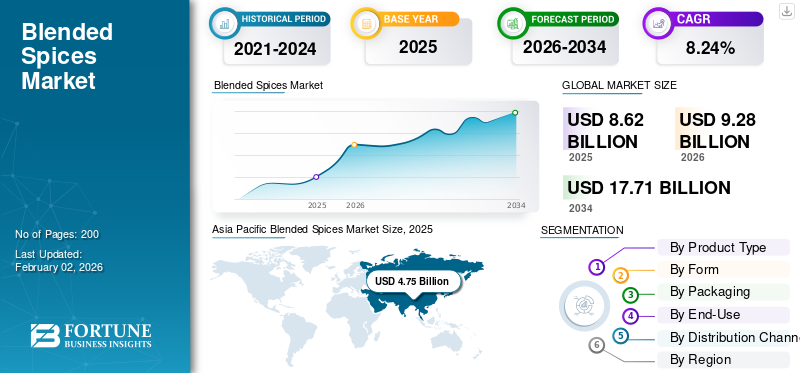
Download Free sample to learn more about this report.
Blended Spices Market Key Takeaways
 Market Size & Forecast
- 2025 Market Size: USD 8.62 billion
- 2026 Market Size: USD 9.28 billion
- 2034 Forecast Market Size: USD 17.71 billion
- CAGR: 8.42% from 2026–2034
 Market Share
- Asia Pacific dominated the blended spices market with a market share of 55.19% in 2025.
- The Italian seasoning segment is expected to account for 27.32% of the global market in 2026.
- The powder/granules segment held the largest market share, with a value worth USD 5.81 billion in 2024, due to its convenience, longer shelf life, and ease of storage.
 Key Regional Highlights
Asia Pacific
Asia Pacific generated USD 4.75 billion in 2025 and is expected to reach USD 5.13 billion in 2026, supported by strong spice production, growing domestic consumption, and expanding exports.
Europe
The Europe region captured 19.98% of the global market in 2025, generating USD 1.72 billion in revenue, and is projected to reach USD 1.85 billion in 2026.
North America
North America reached USD 1.20 billion in 2025 and is projected to grow to USD 1.29 billion in 2026, fueled by increasing demand for ethnic cuisines and clean-label seasoning blends.
U.S.
The market is projected to reach USD 1.12 billion in 2026, supported by growing consumer interest in globally inspired flavors, fusion cuisines, and premium spice blends.
Japan
The market is projected to reach USD 0.58 billion in 2026, driven by rising demand for convenient seasoning solutions and increasing adoption of international cuisines.
Read More

MARKET DYNAMICS
Market Drivers
Globalization and Increased Travel and Cultural Exchange to Drive Market Growth
Increased global food culture and international trade have resulted in more varied spice mixes becoming increasingly available globally, enabling consumers to relish true tastes from across the world. This is driven by increasing consumer demand for international cuisine, home-based culinary discovery, and the consumption of ethnic and fusion cuisine based on travel and cultural exchange. Culinary content on social media and cooking television shows supports greater consumer experimentation with global flavors and this drives the demand for pre-mixed spice blends that replicate the original regional flavor, increasing the demand for blended spices that blend traditional and fusion flavors. This is further supported by product innovation and increasing regional market penetration, especially within the Asia Pacific and developed nations.
- According to the World Tourism Barometer, international tourism kept expanding during the first half of 2025 with almost 690 million international visitors, a 5% hike from 2024 and 4% more than in 2019. This growth is also reflected in key food trends, with greater exposure to international cuisines driving a desire for globally inspired spice blends and at-home culinary replication.
Market Restraints
Rising Incidences of Adulteration Practices to Impede Market Growth
Rising incidences of spice adulteration are indeed a major challenge hampering the growth of the market. Spice adulteration is a process of adding lower-quality, toxic, or cheaper ingredients such as sawdust, starch, artificial color, and toxic chemicals such as lead chromate and ethylene oxide to spices, which lowers the quality as well as safety. This greatly erodes consumer confidence in spice products and ruins the reputation of brands and regions famous for spices, resulting in lower demand and economic losses for authentic producers.
- According to the Food Safety and Standards Authority of India (FSSAI), in India, which is the largest spice producer globally, it is estimated that around 15-20% of spices in the market are adulterated.
Market Opportunities
Increasing Prominence of Private-Label Brands to Unlock New Growth Opportunities
The escalating popularity of private-label brands is opening up new opportunities for growth in the blended spices industry by providing consumers with affordable, high-quality, and bespoke spice blends. Private-label brands attract price-sensitive consumers while encouraging product innovation, quality control, and robust supplier relationships, driving trust and loyalty. This trend allows retailers and manufacturers to develop differentiated offerings, enhance market reach, and drive significant market growth globally during the next few years.
- For instance, in April 2022, Darwin Platform Group of Companies (DPGC), a diverse conglomerate in India, launched a new-age range of premium quality blended and pure spices under the brand name "DP Retail Masala." The company aimed to cater to diverse regional tastes across India under the private label "DP Masala."
Blended Spices Market Trends
Increasing Focus on Packaging Innovations to Shape the Industry Outlook
Growing emphasis on packaging innovations is playing a major role in transforming the blended spices business by improving the shelf life, safety, convenience, and attractiveness of the product. Currently, there is a fast-changing trend of packaging made from recyclable, biodegradable, and compostable materials to respond to consumer needs for environmentally friendly products. New-age materials such as plant-based plastics and paper-based pouches are becoming increasingly popular, which is anticipated to drive product demand, propelling blended spices market growth.
- For instance, in July 2025, Kotányi, a fourth-generation Austrian family-owned spice company, launched a new range of spice blends for the Austria and Germany markets, packaged in Sonoco’s GREENCAN solution. The new innovative packaging is made from 92-98% paperboard, including 69% recycled paper, and features an integrated paper lid, making it widely recyclable and environmentally responsible.
Download Free sample to learn more about this report.
SEGMENTATION ANALYSIS
By Product Type
Widespread Global Popularity of Italian Food to Drive the Italian Seasoning Segment’s Dominance
On the basis of product type, the market is segmented into Garam Masala, Curry Powder, 5 Chinese Spices, Shichimi Togarashi, Berbere, Italian seasoning, and others.
The Italian seasoning segment is expected to account for 27.32% of the market in 2026, primarily due to shifting consumer lifestyles, increased fascination with foreign foods, and the use of convenient ready-to-use mixes consisting of various herbs characteristic of Italian cooking. The global popularity of Italian cuisine worldwide, which employs adaptable blends of herbs such as basil, oregano, rosemary, and thyme, drives the demand for Italian seasoning.
On the other hand, the Shichimi Togarashi segment is expected to exhibit the highest CAGR of 9.33% over the forecast period due to increasing consumer interest in unique, exotic, ethnic spices and blends from international cuisines such as Japanese. Shichimi Togarashi, a traditional Japanese seven-spice blend, is gaining popularity globally as consumers experiment with bold and diverse flavors.
By Form
Convenience in Use and Longer Shelf Life to Impel Powder/Granules Segment Growth
On the basis of form, the market is segmented into powder/granules and liquid/paste.
The powder/granules category led the global blended spices market share, with a value worth USD 5.81 billion in 2024, owing to its convenience, flexibility, longer shelf life, ease of transportation and storage, and uniform flavor contribution in cooking. Powdered spices are simple to use, blend easily into recipes, and are commonly used in household and industrial food preparation applications. They also have lower transportation and storage costs than liquids or pastes, which has led to their global demand.
The liquid/paste segment, on the other hand, is expected to grow at a CAGR of 8.79% over the forecast period.
By Packaging
Cost-Effective Packaging and Convenience to Fuel Pouches Segment Market Leadership
On the basis of packaging, the market is segmented into pouches, bottles, and bulk.
The pouches segment is expected to lead the market, contributing 56.94% globally in 2026 as a result of numerous benefits that consumers and manufacturers appreciate. Pouches provide easy, light, and affordable packaging that is great for maintaining product freshness and long shelf life. They are convenient to store, transport, and use, which augments their demand from consumers for daily cooking purposes, boosting the segment's growth.
The bottles segment is anticipated to grow at the fastest CAGR of 7.92% during the forecast period.
By End-Use
Household Segment Leads the Market Due to Large Usage in Cooking at Home
On the basis of end-use, the market is segmented into household, food service, and food processing.
To know how our report can help streamline your business, Speak to Analyst
The household segment will account for 52.22% of the market share in 2026, with a value of USD 4.21 billion in 2024. Blended spices offer convenience, consistency, and complexity of flavor to home cooks, supporting diverse and global cuisines as consumers increasingly experiment with exotic and ethnic flavors. The growing trend of home cooking, driven by busy lifestyles, culinary exploration, and health consciousness, contributes significantly to the dominance of this segment. Additionally, the retail availability of packaged blended spices in user-friendly formats encourages frequent household usage.
The food service segment is anticipated to grow at the fastest CAGR of 8.85% during the forecast period.
By Distribution Channel
Wide Accessibility and Expanding Retail Channels to Push the B2C Segment’s Expansion
Based on distribution channel, the market is segmented into B2B and B2C.
The B2C segment will account for 53.56% market share in 2024. The expanding retail channels, including supermarkets, hypermarkets, and especially e-commerce platforms, have made these spices widely accessible to consumers globally. Busy lifestyles and urbanization have led to a greater demand for quick and easy cooking solutions, making blended spices a popular choice for households. Additionally, the globalization of food culture and rising interest in ethnic and exotic cuisines encourage consumers to experiment with diverse flavors, driving B2C sales.
The B2B segment is expected to grow significantly at a CAGR of 8.50% over 2025 to 2032.
Blended Spices Market Regional Outlook
Regionally, the report covers the global market analysis across North America, Europe, Asia Pacific, South America, and the Middle East and Africa.
Asia Pacific
Asia Pacific maintained a strong presence in the global market, reaching USD 4.75 billion in 2025, accounting for 55.19% share, and is expected to reach USD 5.13 billion in 2026. India, China, Vietnam, and other nations are the major producers and exporters of spices such as turmeric, cumin, and other herbs, which are an essential part of their day-to-day cuisine. The growing consumer preference for natural wellness products has increased the demand for blended spices, as many spice blends feature ingredients with strong anti-inflammatory properties such as turmeric, ginger, and black pepper. According to the Spices Board of India, in the financial year 2022–23, India's spice production reached 11.14 million tonnes. The dominance of the region is also spurred by growing domestic consumption propelled by urbanization, higher demand for convenience foods with ethnic tastes, growth in processed and ready-to-consume food industries, and robust export demand. The Japan market is projected to reach USD 0.58 Billion by 2026, the China market is projected to reach USD 1.76 Billion by 2026, and the India market is projected to reach USD 1.53 Billion by 2026.
Asia Pacific Blended Spices Market Size, 2025 (USD Billion)
To get more information on the regional analysis of this market, Download Free sample
Europe
The Europe region captured 19.98% of the global market in 2025, generating USD 1.72 billion in revenue, and is projected to reach USD 1.85 billion in 2026. The market is poised to reach nearly USD 2.97 billion by 2032. Europe's growth is fueled by consumer trends comprising exotic flavors, health consciousness, and strong retail and organic farming sectors, especially in countries such as Italy, Germany, and the U.K. The UK market is projected to reach USD 0.38 Billion by 2026, while the Germany market is projected to reach USD 0.44 Billion by 2026.
North America
In 2025, the North America market stood at USD 1.2 billion, representing 13.98% of global demand, and is projected to grow to USD 1.29 billion in 2026.The growth drivers include the increasing popularity of ethnic cuisines, demand for natural and organic seasoning blends, and innovations in clean-label products, particularly in the U.S. and Mexico markets. A core driver in the U.S. market is the American appetite for bold and globally inspired flavors. Ethnic and fusion cuisines such as Mexican, Asian, and Mediterranean are gaining prominence, leading to increased purchases of blends such as BBQ rubs, Cajun, curry, and Mediterranean herbs. This trend is reinforced by a multicultural population and exposure through food media and dining experiences. The U.S. market is projected to reach USD 1.12 Billion by 2026.
South America and the Middle East & Africa
South America and the Middle East and Africa markets exhibit moderate growth rates due to smaller market sizes, developing retail infrastructure, and slower consumer adoption of blended spices compared to Asia Pacific and Europe. The market penetration by international brands is increasing but at a slower pace due to economic and infrastructural factors. The Middle East & Africa market accounted for USD 0.53 billion in 2025, representing 6.21% of the global industry, and is expected to reach USD 0.57 billion in 2026.
Latin America
In 2025, Latin America represented USD 0.4 billion, accounting for 4.64% of the worldwide market, and is projected to grow to USD 0.43 billion in 2026.
COMPETITIVE LANDSCAPE
Key Industry Players
Product Innovation and Customization to Support the Growth of Key Players
The global market is moderately fragmented, with a mix of large established players and numerous smaller regional companies. The leading players adopt strategies focused on product innovation, organic and sustainable sourcing, advanced packaging technologies, and expanding distribution channels, including e-commerce, to drive growth and strengthen market presence. The market is dominated by McCormick & Company, Inc., Badia Spices, Inc., Everest Food Products Pvt. Ltd., Tony Chachere's, Mahashian Di Hatti (MDH) Pvt. Ltd., and others. Additionally, the leading companies are investing in innovative blended spice formulations tailored to regional tastes and health trends.
Key Players in the Market
|
Rank |
Company Name |
|
1 |
McCormick & Company |
|
2 |
Badia Spices, Inc. |
|
3 |
Everest Food Products Pvt. Ltd. |
|
4 |
Tony Chachere's |
|
5 |
Mahashian Di Hatti (MDH) Pvt. Ltd. |
List of Key Blended Spices Companies Profiled:
- McCormick & Company, Inc. (U.S.)
- Unilever Ltd. (U.K.)
- Associated British Foods plc. (U.K.)
- Everest Food Products Pvt. Ltd. (India)
- Badia Spices, Inc. (India)
- Mahashian Di Hatti (MDH) Pvt. Ltd. (India)
- Tony Chachere's (U.S.)
- Goya Foods, Inc. (U.S.)
- DS Group (India)
- Olam International (Singapore)
KEY INDUSTRY DEVELOPMENTS
- September 2025: Orika, an Indian spice brand, launched its Korean All Purpose Seasoning in India, bringing bold and authentic Korean flavors to Indian kitchens. The seasoning is inspired by gochugaru (Korean red pepper flakes) and offers a balanced blend of spicy, savory, and fermented umami notes.
- September 2024: Sunpure, one of South India's largest edible oil brands under MK Agrotech, launched a new product category of blended spices consisting of Sambar Powder, Rasam Powder, and Puliyogare Powder.
- September 2024: iD Fresh Food, a food products company based in India, entered the branded spices market with the launch of three distinctive spice variants, including Red Chilli Powder (pure spice), Garam Masala (blended spice), and Sambar Powder (blended spice). These new spices are crafted without synthetic additives or chemicals and adhere to rigorous FSSAI standards.
- June 2023: Vasant Masala launched Awadhi Garam Masala to offer the distinct taste and aroma of Awadhi cuisine, targeting food connoisseurs seeking authentic regional flavors. The product is crafted using a traditional Awadhi recipe where spices are roasted and ground at controlled temperatures to preserve essential oils and nutritional value.
- October 2021: Olam Food Ingredients (OFI), an agri-business company, launched “Blends of the Americas,” a collection of 17 new spice blends. The new range is designed to celebrate the diverse and vibrant flavors across the American continents, especially from Mexico and the Caribbean to the U.S. Southwest.
REPORT COVERAGE
The global market report analyzes the market in depth and highlights crucial aspects such as global market trends, market dynamics, prominent companies, investment in research and development, and end-use. Besides this, the report also provides insights into the global market analysis and highlights significant industry developments.
Request for Customization to gain extensive market insights.
Report Scope & Market Segmentation
|
ATTRIBUTE |
DETAILS |
|
Study Period |
2021-2034 |
|
Base Year |
2025 |
|
Forecast Period |
2026-2034 |
|
Historical Period |
2021-2024 |
|
Growth Rate |
CAGR of 8.42% from 2026 to 2034 |
|
Unit |
Value (USD Billion) |
|
Segmentations |
By Product Type, By Form, By Packaging, By End-Use, By Distribution Channel, and by Region |
|
Segmentation |
By Product Type · Garam Masala · Curry Powder · 5 Chinese Spices · Shichimi Togarashi · Berbere · Italian Seasoning · Others |
|
By Form · Powder/Granules · Liquid/Paste |
|
|
By Packaging · Pouches · Bottles · Bulk |
|
|
By End-Use · Household · Food Service · Food Processing |
|
|
By Distribution Channel · B2B · B2C o Supermarkets/Hypermarkets o Convenience Stores o Specialty Grocery & Ethnic Stores o Online/E-commerce |
|
|
By Region · North America (By Product Type, Form, Packaging, End-Use, By Distribution Channel, and Country) • U.S. (By End-Use) • Canada (By End-Use) • Mexico (By End-Use) · Europe (By Product Type, Form, Packaging, End-Use, By Distribution Channel, and Country) • Germany (By End-Use) • Spain (By End-Use) • Italy (By End-Use) • France (By End-Use) • U.K. (By End-Use) • Rest of Europe (By End-Use) · Asia Pacific (By Product Type, Form, Packaging, End-Use, By Distribution Channel, and Country) • China (By End-Use) • Japan (By End-Use) • India (By End-Use) • Australia (By End-Use) • Rest of Asia Pacific (By End-Use) · South America (By Product Type, Form, Packaging, End-Use, By Distribution Channel, and Country) • Brazil (By End-Use) • Argentina (By End-Use) • Rest of South America (By End-Use) · Middle East & Africa (By Product Type, Form, Packaging, End-Use, By Distribution Channel, and Country) • South Africa (By End-Use) • UAE (By End-Use) • Rest of the Middle East & Africa (By End-Use) |
Frequently Asked Questions
Fortune Business Insights says that the global market was USD 8.62 billion in 2025 and is anticipated to reach USD 17.71 billion by 2034.
The global market is projected to exhibit a CAGR of 8.42% over the forecast period.
By form, the powder/granules segment led the market in 2026.
Asia Pacific dominated the blended spices market with a market share of 55.19% in 2025.
Globalization and increased travel and cultural exchange are key factors driving the market growth.
McCormick & Company, Inc., Badia Spices, Inc., Everest Food Products Pvt. Ltd., Tony Chachere's, and Mahashian Di Hatti (MDH) Pvt. Ltd. are the leading companies in the market.
Increasing focus on packaging innovations is a key trend in the industry.



- 2021-2034
- 2025
- 2021-2024
- 200
-
(Offer valid till 15th Oct 2026)
Get 30-60 hrs Free Customization
Expand Regional and Country Coverage, Segments Analysis, Company Profiles, Competitive Benchmarking, and End-user Insights.




















Related Reports
-
US +1 833 909 2966 ( Toll Free )
-
Get In Touch With Us