Blockchain Distributed Ledger Market Size, Share & Industry Analysis, By Application (Smart Contracts, Cryptocurrency, Supply Chain Management and Others), By Ledger Type (Permissioned, Permissionless and Hybrid), By Deployment (Cloud and On-Premise), and Regional Forecast, 2026–2034
 Download Free Sample
Blockchain Distributed Ledger Market Size
 Listen to Audio Version
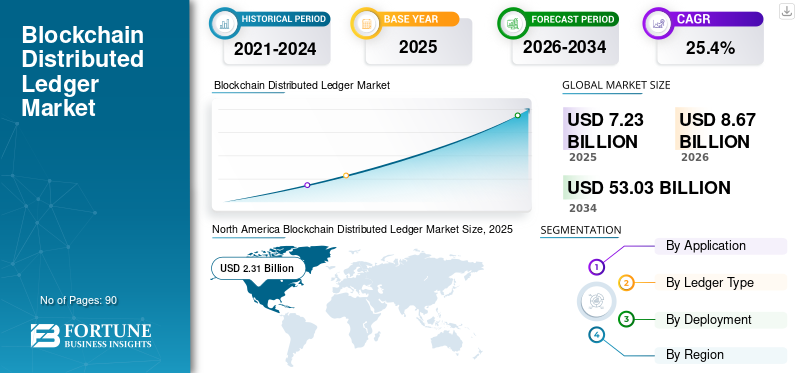
The global blockchain distributed ledger market size was valued at USD 7.23 billion in 2025. The market is projected to grow from USD 8.67 billion in 2026 to USD 53.03 billion by 2034, exhibiting a CAGR of 25.4% during the forecast period. North America dominated the global blockchain distributed ledge market with a market share of 31.95% in 2025.
A blockchain distributed ledger is a digital record system where data is stored across many computers instead of one central location. Each new entry is grouped into a block that links securely to the previous one, creating an unchangeable chain. All participants share the same synchronized copy, which adds transparency and trust. Once information is added, it cannot be altered easily, helping prevent fraud and illegal changes.
The market is driven by the growing need to automate claims processing. Insurers are under pressure to handle rising claim volumes quickly and accurately, and AI helps reduce manual effort, minimize errors, and shorten settlement time. By using tools that can analyze documents, images, and customer data in real time, companies can improve efficiency and lower operational costs. This rising focus on faster, more reliable claims management is pushing insurers to adopt AI solutions at a rapid pace.
Major companies in the market including IBM, R3, Ripple Labs, Digital Asset, and Fujitsu are pursuing strategies such as launch of advanced distributed ledger platforms and enhancement of existing solutions with improved scalability and security features. These players are also forming strategic partnerships and collaboration with banks, financial institutions, and technology providers to accelerate real world adoption.
Download Free sample to learn more about this report.
Blockchain Distributed Ledge Market Key Takeaways
 Global Market Size & Forecast
- 2025 Market Size: USD 7.23 billion
- 2026 Market Size: USD 8.67 billion
- 2034 Forecast Market Size: USD 53.03 billion
- CAGR: 25.4% from 2026-2034
 Market Share
- North America dominated the blockchain distributed ledger market with a 31.95% share in 2025.
- The cryptocurrency segment captured the largest market share in 2025.
- The permissionless segment is projected to grow at the highest CAGR of 27.5% during the forecast period.
 Key Regional Highlights
North America
North America accounted for USD 2.31 billion in 2025, maintaining its leading position in the global market.
Europe
Europe reached USD 1.96 billion in 2025, securing a strong position in the global market.
Asia Pacific
Asia Pacific recorded USD 1.77 billion in 2025 and is expected to witness the highest growth at a CAGR of 30.6% during the forecast period.
U.S.
The market reached USD 1.76 billion in 2025, driven by rapid blockchain adoption across banking, fintech, and enterprise sectors.
South America
South America reached USD 0.51 billion in 2025, supported by increasing blockchain adoption across financial and digital services.
Read More

MARKET DYNAMICS
Market Drivers
Growing Emergence of Decentralized Applications Boosts Market Expansion
The emergence of decentralized applications is becoming a major catalyst for the adoption of blockchain distributed ledger technology. These applications operate without a central authority, allowing users to interact directly in a trustable digital environment. This structure appeals to industries that require transparent and efficient workflows, including finance, gaming, real estate, and supply chain. As developers create new tools and user friendly interfaces, decentralized applications are becoming easier for businesses and consumers to adopt. Their ability to handle digital assets, identity, payments, and data sharing in a secure and tamper resistant way further strengthens their appeal. For instance,
- In July 2024, blockchain analytics platform DappRadar reported that user adoption of Web3 technology had increased exponentially, driven largely by rapid growth in decentralized applications in sectors such as gaming and DeFi.
This momentum is expected to accelerate overall blockchain distributed ledger market growth.
Market Restraints
Integration Tests with Legacy Systems to Restrict Market Growth
Integration tests with legacy systems are becoming a major obstacle that restricts the growth of the market. Most enterprises still operate on traditional IT infrastructures such as ERP, CRM, and core banking platforms, which are not designed to work with decentralized technologies. When companies try to connect blockchain based solutions with these older systems, they face compatibility issues, data format mismatches, and high customization requirements.
This leads to lengthy integration tests that demand significant technical effort and financial investment. In different cases, firms must redesign parts of their legacy architecture, creating further delays. These challenges make organizations hesitant to move beyond pilot projects as the full scale deployment becomes complex and resource intensive.
As a result, the slow and costly integration process limits the speed at which blockchain distributed ledger technology can be adopted across industries, ultimately restraining market growth.
Market Opportunities
Rising Cross Border Payments and Remittances Create Major Market Opportunities
Traditional cross border transfers were often slow, costly, and dependent on multiple intermediaries, which leads to delays and high fees for both individuals and businesses. Blockchain based systems allow transactions to move directly between parties, reducing processing time from days to minutes. This improves transparency as every participant can view the status of a payment in real time. Financial institutions and fintech companies are increasingly exploring blockchain to streamline global transfers, especially for regions with high migrant worker populations. For instance,
- In September 2024, Ripple Labs published a report titled “Driving Global Payments Volume With Blockchain” that explained how blockchain-based cross-border payment solutions are enabling near-real-time settlement, improved transparency and reduced cost compared to correspondent-bank models.
These developments highlight how blockchain is rapidly transforming the global payments landscape and addressing long standing inefficiencies in international transfers. As more financial institutions adopt these solutions, cross border transactions are expected to become faster, affordable, and transparent. This shift is especially valuable for remittance dependent economies seeking smoother financial flows. Overall, the growing use of blockchain in global payments presents a strong opportunity for continued market expansion.
Blockchain Distributed Ledger Market Trends
Increased Investments in Blockchain Startups is an Emerging Market Trend
Investors are recognizing the long term potential of decentralized technologies to transform industries ranging from finance and logistics to healthcare and identity management. As a result, venture capital firms, corporate innovation arms, and global financial institutions are allocating larger funds toward early stage blockchain companies. This rising capital flow allows startups to accelerate product development, strengthen technical teams, and scale innovative solutions that address challenges such as interoperability, transaction speed, and security. Many startups are also focusing on niche applications including tokenization, decentralized identity, and data sharing, which further broadens the market scope. For instance,
- In September 2025, AI blockchain startup Kite secured an USD 18 million Series A round led by PayPal Ventures and General Catalyst to build a blockchain based infrastructure layer for AI agents and commerce.
SEGMENTATION ANALYSIS
By Application
Rise in Adoption of Blockchain Technology in Cryptocurrency Accelerated Segment Growth
Based on application, the market is divided into smart contracts, cryptocurrency, supply chain management, and others
Cryptocurrency captured the largest blockchain distributed ledger market share in 2025 as it adopts a mature and wide blockchain technology. Digital currencies such as Bitcoin, Ethereum, and stable coins continued to gain traction for trading, cross border payments, remittances, and digital asset investment. Institutional investors, including banks and asset managers, increased their participation, bringing more liquidity and stability to the market. For instance,
- In March 2025, a joint survey by Coinbase and EY‑Parthenon found that more than three-quarters of institutional investors planned to increase their allocations to digital assets in 2025, and 59% expected to allocate over 5% of their assets under management to crypto and related products.
Supply chain management is anticipated to grow at the highest CAGR of 29.1% during the forecast period. Companies are adopting blockchain to comply with strict regulatory requirements and improve traceability from suppliers to end consumers. Smart contracts enable automation of processes such as quality checks, customs clearance and payments, cutting operational delays and costs. As organizations increasingly prioritize resilient and visible supply chains, blockchain based solutions are gaining strong momentum.
To know how our report can help streamline your business, Speak to Analyst
By Ledger Type
Strong Preference of Permissioned Environment by Enterprises to Boost Segment Growth
Based on ledger type, the market is divided into permissioned, permissionless, and hybrid.
Permissioned captured the largest market share in 2025 as enterprises preferred controlled, secure, and compliant environments for their operations. These systems allow only authorized participants to access and validate data, making it ideal for industries such as banking, supply chain, healthcare, and government services. Organizations also favored permissioned networks due to easier integration with existing IT systems and better alignment with regulatory requirements.
Permissionless anticipated to grow at highest CAGR of 27.5% during the forecast period owing to growing adoption of decentralized finance, Web3 applications, tokenized assets, and decentralized autonomous organizations that significantly boost demand for permissionless networks.
By Deployment
Rising Adoption of Cloud-based Platforms to Boost Segment Growth
Based on deployment, the market is divided into cloud and on premise.
Cloud has secured the largest share in 2025 and anticipated to grow at the highest CAGR of 26.8% during the forecast period. Cloud based platforms allow organizations to quickly set up nodes, manage networks, and integrate blockchain services without heavy upfront investment in hardware. Leading providers offer managed blockchain services that simplify configuration, security, and maintenance, making adoption easier for enterprises of all sizes. Cloud environments also support rapid experimentation, enabling companies to pilot blockchain applications and scale them globally with minimal technical barriers. As demand for interoperable, high performance blockchain networks rises, cloud deployment models continue to gain strong traction across industries. For instance,
- In February 2024 AWS highlighted how Brazilian bank Itaú Unibanco used Amazon Managed Blockchain Access and Query running on AWS cloud to launch an enterprise grade digital asset custody service more quickly and securely, without building on premises infrastructure.
BLOCKCHAIN DISTRIBUTED LEDGER MARKET REGIONAL OUTLOOK
By geography, the market is categorized into Europe, North America, Asia Pacific, South America, and Middle East & Africa.
North America
North America Blockchain Distributed Ledger Market Size, 2025 (USD Billion)
To get more information on the regional analysis of this market, Download Free sample
The North America held a dominant share in 2025 valuing at USD 2.31 billion. The growth is primarily driven by strong adoption of blockchain solutions across financial services, supply chain, and government sectors. The region benefits from advanced digital infrastructure, high investment in emerging technologies, and the presence of major blockchain providers such as IBM, Oracle, and Microsoft. Supportive regulations for digital assets in several states have encouraged enterprises to adopt blockchain for payments, identity, and data management.
In 2025, the U.S. market reached USD 1.76 billion due to rapid adoption of blockchain by banks, fintech companies, and enterprises modernizing their data systems. The U.S. benefited from strong venture capital funding, which accelerated the development of blockchain startups and enterprise platforms.
Download Free sample to learn more about this report.
Europe
The market in Europe reached USD 1.96 billion in 2025 securing a strong position. The European Union’s proactive approach toward digital asset regulation and initiatives such as the Markets in Crypto Assets framework have encouraged enterprises to adopt blockchain more confidently. Major industries including automotive, pharmaceuticals, and manufacturing are increasingly using distributed ledgers to improve traceability and operational efficiency. Strong government backed digital transformation programs and collaborations between technology firms and research institutions further support the region’s growth.
The region combines mature markets such as U.K. with high-growth opportunities in blockchain sector. Backed by these factors, countries including U.K. recorded a valuation of USD 0.38 billion, Germany secured USD 0.34 billion, and France registered a value of USD 0.32 billion in 2025.
Asia Pacific
After Europe, Asia Pacific region recorded highest growth rate of 30.6% and reached the valuation of USD 1.77 billion in 2025. In the region, India and China both registered USD 0.41 billion and USD 0.44 billion revenue share respectively in 2025. The region’s growth is supported by rapid digitalization, strong smartphone and internet penetration, and the presence of large unbanked and underbanked populations that encourage adoption of blockchain based financial services. Governments in countries such as India, China, Singapore, and South Korea are promoting blockchain pilots in areas including public services, trade finance, and identity management, which further accelerates deployment.
South America and Middle East & Africa
South America and Middle East & Africa regions witnessed a moderate growth in this marketspace. South America market in 2025 recorded USD 0.51 billion as its valuation. Governments and enterprises are exploring blockchain for land registries, supply chain tracking, and digital identity to combat fraud and improve governance. Increasing internet penetration and a rising startup ecosystem in countries such as Brazil, Colombia, and Argentina further supports market expansion across the region.
In Middle East & Africa, GCC is secured a value of USD 0.30 billion in 2025. This market growth is supported by strong government led digital transformation initiatives and national visions that prioritize blockchain for smart governance and public services. Financial institutions across GCC countries are adopting distributed ledger platforms to enhance cross border payments, trade finance and Islamic finance products.
COMPETITIVE LANDSCAPE
Key Industry Players
Strategic Collaborations and Industry Partnership Formation to Propel the Market Growth
Leading players such as IBM, R3, and Digital Asset are forming large scale blockchain distributed ledger industry consortia with banks, logistics companies, and regulators to accelerate enterprise blockchain adoption. By building sector specific networks in trade finance, capital markets, and supply chain, these firms are creating shared infrastructures that reduce integration costs and promote interoperability among participants. This collaborative approach helps establish standardized frameworks, enabling blockchain solutions to achieve faster commercialization across industries.
Long List of Companies Studied:
- IBM Corporation (U.S.)
- Microsoft Corporation (U.S.)
- Cloud Security Alliance (U.S.)
- Ant Group (China)
- Oracle Corporation (U.S.)
- R3 (U.S.)
- Ripple Labs (China)
- Consensys Software (U.S.)
- Digital Asset (U.S.)
- Fujitsu Global (Japan)
- JPMorgan (U.S.)
- HSBC (U.K.)
- Alibaba Group (China)
- Accenture (Ireland)
- Bitfury (Netherlands)
- Guardtime (Estonia)
KEY INDUSTRY DEVELOPMENTS:
- In November 2025, Dusk Network and NPEX formed a commercial partnership to build Europe’s first blockchain powered securities exchange designed specifically for regulated financial instruments. The collaboration aims to modernize capital markets by enabling faster settlement, enhanced transparency, and lower operational costs for issuers and investors.
- In September 2025, Swift added a blockchain-based shared ledger to its technology infrastructure, a pivotal step for global finance. The ledger will extend Swift's financial communication role into a digital environment, facilitating banks’ trusted and scalable movement of regulated tokenized value across digital ecosystems.
- In June 2025, 21X, announced a strategic partnership with d-fine GmbH, a European technology and consulting firm. The partnership addresses a critical need in digital finance and providing expert guidance for seamlessly integrating 21X’s DLT-based platform into institutional trading operations.
- In June 2025, Ripple and Circle announced a partnership bringing USDC to the XRP Ledger (XRPL). The XRPL is a decentralized, layer-1 blockchain developed for the efficient tokenization and exchange of value including crypto and real-world assets.
- In September 2024, Northern Trust (Nasdaq: NTRS) has launched of The Northern Trust Carbon Ecosystem with the first live transactions on the blockchain-based platform which enables institutional buyers to digitally access carbon credits from leading project developers.
REPORT COVERAGE
The report provides a detailed analysis of the market and focuses on key aspects such as leading companies, types, and leading applications of the product. Besides, the report offers insights into the market trends and highlights key industry developments. In addition to the factors above, the report encompasses several factors that contributed to the growth of the market in recent years.
Request for Customization to gain extensive market insights.
REPORT SCOPE & SEGMENTATION
| ARRTIBUTE | DETAILS |
| Study Period | 2021-2034 |
| Base Year | 2025 |
| Forecast Period | 2026-2034 |
| Historical Period | 2021-2024 |
| Growth Rate | CAGR of 25.4% from 2026 to 2034 |
| Unit | Value (USD Billion) |
| Segmentation | Application, Ledger Type, Deployment and Region |
|
By Application
By Ledger Type
By Deployment
By Region
|
|
| Companies Profiled in the Report |
|
Frequently Asked Questions
The market is projected to reach USD 53.03 billion by 2034.
In 2025, the market was valued at USD 7.23 billion.
The market is projected to grow at a CAGR of 25.4% during the forecast period.
By application, cryptocurrency is leading the market.
Growing Emergence of Decentralized Applications to Drive the Growth of the Market.
Ant Group, R3, IBM Corporation are the top players in the market.
North America is expected to hold the highest market share.



- 2021-2034
- 2025
- 2021-2024
- 90
Get 30-60 hrs Free Customization
Expand Regional and Country Coverage, Segments Analysis, Company Profiles, Competitive Benchmarking, and End-user Insights.









-
US +1 833 909 2966 ( Toll Free )
-
Get In Touch With Us