Body Warmer Heat Pad Market Size, Share & Industry Analysis, By Product Type (Disposable Heat Pads, Reusable Heat Pads, and Electric Heat Pads), By Heating Technology (Air-Activated, Chemical, Electric, and Gel-Based), By Application (Pain Relief & Medical Use, Sports & Fitness Recovery, Outdoor Activities, and Personal Warmth/Cold Weather Protection) By End User (Household Consumers, Athletes & Sports Professionals, Healthcare & Medical Facilities, and Outdoor Enthusiasts), By Distribution Channel (Supermarkets & Hypermarkets, Pharmacies & Drug Stores, and Regional Forecast, 2026-2034
 Download Free Sample
(Offer valid till 31st Jul 2026)
Body Warmer Heat Pad Market Size and Future Outlook
 Listen to Audio Version
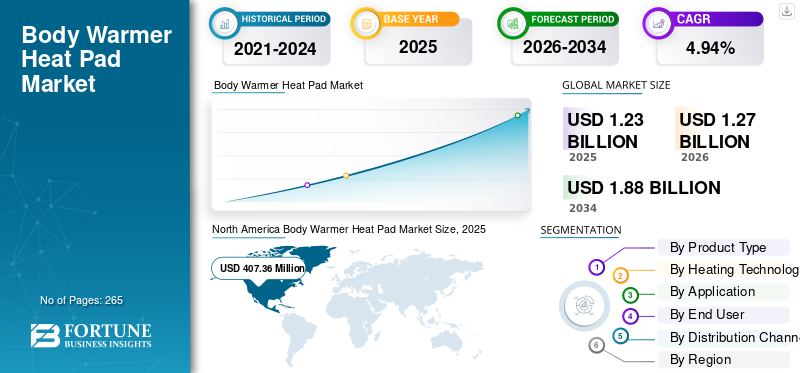
The global body warmer heat pad market size was valued at USD 1,230.00 million in 2025. The market is projected to grow from USD 1,279.94 million in 2026 to USD 1,882.08 million by 2034, exhibiting a CAGR of 4.94% during the forecast period. North America dominated the body warmer heat pad market with a market share of 33.11% in 2025.
The global body warmer heat pad market is growing steadily, driven by increased demand for convenient, portable products. Body warmers are used to relieve pain and provide comfort during cold weather. Awareness of the need for self-care, sports injuries, and muscle recovery has increased the use of disposable and reusable heat pads among sportspersons, older adults, and people suffering from chronic pain. Also, an increase in outdoor activities in cold weather and in cold regions worldwide is contributing to market growth. Advances in long-lasting, eco-friendly heat pads are also driving market growth. The Asia Pacific region leads in the production and consumption of body warmers, driven by large manufacturing facilities and seasonal demand. In contrast, North America and Europe have seen increased use of body warmers in healthcare and outdoor activities.
Prominent market players include HotHands (HeatMax Inc.), Kobayashi Pharmaceutical Co., Ltd., Beiersdorf AG, The Procter & Gamble Company (ThermaCare), and 3M Company. Manufacturers of body heat pads are constantly expanding their portfolios to develop eco-friendly, skin-friendly, and long-lasting head pads to capture a majority of the market share. Persistent research & development and the launch of advanced, reusable, and air-activated heating technologies help companies reinforce their market position while meeting evolving consumer needs.
Download Free sample to learn more about this report.
Body Warmer Heat Pad Market Takeaways
 Global Market Size & Forecast
- 2025 Market Size: USD 1,230.00 million
- 2026 Market Size: USD 1,279.94 million
- 2034 Forecast Market Size: USD 1,882.08 million
- CAGR: 4.94% from 2026–2034
 Market Share
- North America dominated the body warmer heat pad market with a 33.11% share in 2025.
- The Reusable Heat Pads segment is expected to witness strong growth at a 5.91% CAGR, supported by the market's 4.94% CAGR during 2026–2034.
- The Online Retail segment is projected to grow at the fastest 6.18% CAGR during the forecast period.
 Key Regional Highlights
North America
North America led the global market with a valuation of USD 407.36 million in 2025, driven by strong consumer demand for personal heating and pain relief products.
Europe
Europe accounted for USD 335.56 million in 2025, representing 27.28% of the global market, driven by increasing adoption of reusable and electric heating products.
Asia Pacific
Asia Pacific ranked as the second-largest regional market with USD 355.95 million in 2025, supported by rising health awareness and growing demand across China and India.
U.S.
The market reached USD 302.07 million in 2025, accounting for approximately 24.56% of global market revenue, supported by high demand from healthcare, sports, and wellness applications.
Japan
The market was valued at USD 88.92 million in 2025, representing approximately 7.23% of global market revenue, driven by an aging population and increasing demand for therapeutic heat products.
Read More

BODY WARMER HEAT PAD MARKET TRENDS
Growing Demand for Natural and Chemical-Free Heat Pads Lead to Market Trend
Modern-day consumers are highly aware of their well-being and skin protection, and are also eco-conscious buyers. This is reflected in their regular day-to-day purchases, which have boosted demand for chemical-free, natural body warmers. To fulfil this consumer demand, market players are incorporating natural ingredients such as activated carbon, iron powder, and salt-based heating elements while reducing the use of synthetic chemicals. This transition is driving innovation in skin-friendly, safer products and compelling brands to promote sustainability, thereby directly strengthening consumer trust and broadening market potential.
MARKET DYNAMICS
MARKET DRIVERS
Download Free sample to learn more about this report.
Growing Incidence of Musculoskeletal Pain and Sports Injuries Boosts Product Adoption
In addition, a fast-paced lifestyle, longer working hours, and increased participation in outdoor sports have increased the prevalence of joint pain, muscle stiffness, and sports-related injuries, thereby fueling demand for body heating pads. As the population ages, the number of sedentary individuals increases. With the increasing prevalence of chronic pain conditions and the rise in strenuous physical activities, people are seeking pain management solutions that are less intrusive. Consequently, body heating pads are gaining prominence for their capacity to provide targeted heat therapy that helps relieve muscle tension and improve blood circulation. This rapidly growing demand for body-heating pads for pain management is driving their adoption.
MARKET RESTRAINTS
Concerns over Skin Sensitivity and Product Safety Restrain the Market Expansion
Increasing safety concerns about skin irritations, burns, and allergic reactions from prolonged use of heat pads are among the factors affecting the body warmer heat pad market growth. Some heat pads contain chemicals that help generate heat during the process; improper use or poor quality can cause discomfort for people with sensitive skin. The safety concerns make consumers cautious about using the heat pad and prompt manufacturers to test the product.
MARKET OPPORTUNITIES
Expansion through E-commerce and Direct-to-Consumer Channels Curates Market Opportunities
The expansion of the online shopping market is creating new opportunities for the body warmer heat pad market. The online shopping market is becoming more accessible to consumers. Therefore, it is becoming more accessible for consumers to compare and buy products. Hence, manufacturers are using online marketplaces to market their products, improve product visibility, expand their consumer base, and expand their geographic reach into emerging regions.
MARKET CHALLENGES
Price Sensitivity and Competition from Conventional Socks Hamper the Market Growth
The presence of numerous low-cost manufacturers, particularly from Asia, is creating strong price competition in the body warmer heat pad market. As a result, established brands face pressure to maintain competitive pricing while ensuring product quality and safety standards. This intense competition can reduce profit margins and make it difficult for premium brands to differentiate their products, thereby challenging long-term market sustainability and brand positioning.
Segmentation Analysis
By Product Type
Instant Heat Generation and Great Convenience to Drive Demand for Disposable Heat Pads
Based on the product type, the market is divided into disposable heat pads, reusable heat pads, and electric heat pads.
The disposable heat pads segment dominated the market share on account of their excellent characteristics, such as portability, ease of use, and instant heat activation, making them highly convenient for consumers during outdoor activities, cold weather, and travel. Disposable pads work independently, without electricity or reheating, and are widely preferred for temporary warmth and rapid pain relief. Hence, their affordability and widespread availability across e-commerce and offline retail fortify their leading market position.
The reusable heat pads segment is anticipated to rise at the second-fastest CAGR of 5.91% over the forecast period.
To know how our report can help streamline your business, Speak to Analyst
By Heating Technology
Widespread Adoption of Air-Activated Technology to Drive Segment’s Dominance
Based on heating technology, the market is segmented into air-activated, chemical, electric, and gel-based.
In 2025, the air-activated segment accounted for the largest share of global revenue. This dominance of the segment was driven by its ability to generate heat automatically when exposed to oxygen, disregarding the need for electricity or external heating sources. Consequently, these air –activated heat pads offer instant activation, high portability, and ease of use, making them ideal for quick pain relief. Also, their affordable pricing and strong presence in disposable body warmers sustain their market dominance.
The electric heating pad segment is projected to grow at the second-fastest rate, with an annual growth rate of 4.30% over the forecast period.
By End User
High Prevalence of Everyday Pain and Self-Care Practices to Augment Household Consumer Demand
Based on end-user, the market is segmented into household consumers, athletes & sports professionals, healthcare & medical facilities, and outdoor enthusiasts.
In 2025, the household consumers segment accounted for the largest global body warmer heat pad market share of global revenue. This dominance of the segment was attributed to the prominent use of heating pads at home for menstrual cramps, relief from muscle tension, backache, and joint discomfort. Individuals increasingly seek non-invasive, comforting, and convenient over-the-counter pain relief solutions, and heating pads have become a more common self-care option in household applications, contributing to the segment's largest revenue.
The athletes & sports professionals segment is projected to grow at the fastest pace, with a CAGR of 6.12% over the forecast period.
By Application
High Prevalence of Menstrual Cramps to Lead the Growth for Pain Relief & Medical Use Applications
Based on the application, the market is divided into pain relief & medical use, sports & fitness recovery, outdoor activities, and personal warmth/cold weather protection.
The pain relief & medical use segment dominated market growth due to the rising occurrence of menstrual cramps, arthritis, muscle pain, and backache, which increased demand for non-invasive treatment alternatives. Since heat therapy rapidly improves blood circulation and relieves muscle stiffness, consumers are widely adopting body heating pads for therapeutic purposes. Subsequently, growing consumer awareness around self-care pain management and the availability of over-the-counter heat therapy products continue to fortify this segment’s hold.
The sports & fitness recovery segment is anticipated to rise at the second-fastest CAGR of 5.99% over the forecast period.
By Distribution Channel
Medical Positioning and Strong Consumer Trust to Drive Pharmacies & Drug Stores Segmental Growth
Based on distribution channels, the market is segmented into supermarkets & hypermarkets, pharmacies & drug stores, specialty stores, and online retail.
The pharmacies & drug stores segment dominated the global market. Body warmers and heating pads are widely available as over-the-counter therapeutic products used mainly for muscle pain relief. Consumers often see pharmacist recommendations and medically trusted products, and thus, pharmacies become a preferred purchasing channel. Moreover, the presence of well-recognized brands such as ThermaCare and other medical-grade heating pads available in pharmacies & drug stores strengthens consumer confidence, thereby augmenting the segment’s growth.
In addition, the online retail segment is projected to grow at the fastest compound annual growth rate of 6.18% during the forecast period.
Body Warmer Heat Pad Market Regional Outlook
By region, the market is categorized into Europe, North America, Asia Pacific, South America, and the Middle East & Africa.
North America
North America Body Warmer Heat Pad Market Size, 2025 (USD Million)
To get more information on the regional analysis of this market, Download Free sample
North America is projected to record the highest market share among all regions, and reached a valuation of USD 407.36 million in 2025. The region’s market growth is driven by the high prevalence of musculoskeletal disorders, sports-related injuries, and arthritis, which stimulate demand for easy-to-use, convenient pain relief solutions. Moreover, growing consumer demand for over-the-counter heat therapy products and rising consumer awareness of self-care practices are driving expansion in the North America market.
U.S Body Warmer Heat Pad Market
Given North America’s strong contribution and the U.S.'s dominance in the region, the U.S. market reached USD 302.07 million in 2025, accounting for roughly 24.56% of global market sales.
Europe
Europe held the third-largest share in 2025, accounting for USD 335.56 million and 27.28% of the global market. The European market is driven by cold weather and an aging population, which increase the prevalence of joint pain, arthritis, and muscle stiffness, driving demand for heat therapy products. Also, strong pharmacy distribution networks and self-care practices strengthen market growth in Europe.
U.K Body Warmer Heat Pad Market
The U.K. market in 2025 reached USD 64.81 million, representing roughly 5.27% of global market revenues.
Germany Body Warmer Heat Pad Market
Germany’s market reached USD 74.22 million in 2025, equivalent to around 6.03% of global market sales.
Asia Pacific
Asia Pacific reached USD 355.95 million in 2025 and secured second place in the market. In the region, India and China both reached USD 31.92 million and USD 112.78 million, respectively, in 2025.
Japan Body Warmer Heat Pad Market
The Japanese market in 2025 was valued at USD 88.92 million, accounting for roughly 7.23% of global market revenues. The country's market growth is supported by strong seasonal demand for kairo, that is, disposable body warmer heat pads during winter, as well as the country’s growing geriatric population, which heavily relies on over-the-counter heat therapy products for joint and muscle pain relief.
China Body Warmer Heat Pad Market
China’s market in 2025 was valued at USD 112.78 million in revenues, representing roughly 9.17% of global market sales.
India Body Warmer Heat Pad Market
The Indian market in 2025 was valued at USD 31.92 million, accounting for roughly 2.60% of global market revenues.
South America and the Middle East & Africa
The South America and Middle East & Africa regions are expected to witness moderate growth in this market space during the forecast period. The South America market reached USD 76.32 million in 2025. The growing awareness of non-invasive pain relief solutions and the expansion of retail distribution networks are driving regional market growth. In the Middle East & Africa, the UAE reached USD 15.05 million in 2025.
South Africa Body Warmer Heat Pad Market
The South African market reached USD 13.03 million in 2025, representing roughly 1.06% of global market revenues.
COMPETITIVE LANDSCAPE
Key Industry Players
Product Exclusivity and Brand Differentiation to Drive Competitive Intensity Among Industry Players
Industry players are proactively competing via improved heating technologies, product innovation, and differing product portfolios. Market players are investing in R&D to improve product performance and safety, as consumer demand grows for skin-friendly, long-lasting, and eco-friendly body warmer heating pads. In addition, they are also investing in advanced temperature controller systems and innovative raw material compositions to upgrade product performance. Moreover, brands are expanding their presence through online retail expansion, strategic partnerships, and targeted marketing campaigns. Subsequently, these strategies help companies differentiate their offerings and capture a significant share of the growing market.
LIST OF KEY BODY WARMER HEAT PAD COMPANIES PROFILED
- Kobayashi Pharmaceutical Co., Ltd. (Japan)
- HeatMax Inc. (HotHands) (U.S.)
- Procter & Gamble Co. (ThermaCare) (U.S.)
- Beiersdorf AG (Germany)
- 3M Company (U.S.)
- Sunbeam Products Inc. (U.S.)
- Ocoopa Technology Co., Ltd. (China)
- Mycoal Warmers (Mycoal Inc.) (Japan)
- Thermopad GmbH (Germany)
- Celestron Heat Products/Grabber Warmers (U.S.)
KEY INDUSTRY DEVELOPMENTS
- July 2025: Thermopad GmbH expanded its body warmer distribution across European outdoor retail networks, reinforcing its presence in outdoor activities and winter sports markets, including skiing and trekking.
- March 2025: The Procter & Gamble Company (ThermaCare) introduced a new ergonomic heat wrap format for back and shoulder pain relief, combining consistent heat therapy with flexible materials to enhance comfort and expand its OTC heat therapy portfolio.
- January 2025: Kobayashi Pharmaceutical, Ltd., widened its product portfolio with the Kairo disposable body warmer product line, featuring skin-friendly adhesive and enhanced long-lasting heat retention, to strengthen its presence in the winter wellness and personal comfort segment across Japan and other Asian markets.
- November 2024: 3M Company expanded its heat therapy product line by focusing on enhanced adhesives and heat-diffusion materials for medical-grade heating pads, aiming to deliver safer, more consistent therapeutic heat for pain management applications.
- September 2024: HeatMax Inc. (HotHands) launched an extended-duration air-activated body warmer series designed for outdoor workers and winter sports enthusiasts, offering up to 18 hours of heat to enhance user convenience and broaden its outdoor recreation customer base.
REPORT COVERAGE
The global body warmer heat pad market report includes a comprehensive study of the market size & forecast across all market segments covered. It includes details on market dynamics and fashion trends expected to drive the market over the forecast period. It provides information on key aspects, including an overview of technologically advanced product launches and innovation. Additionally, it details partnerships, mergers & acquisitions, and key gaming industry developments, along with their regional prevalence. The global market segmentation includes product type, heating technology, application, end user, distribution channel, and region. The market research report also provides a detailed competitive landscape, including market share and profiles of key operating players.
Request for Customization to gain extensive market insights.
Report Scope & Segmentation
| ATTRIBUTE | DETAILS |
| Study Period | 2021-2034 |
| Base Year | 2025 |
| Estimated Year | 2026 |
| Forecast Period | 2026-2034 |
| Historical Period | 2021-2024 |
| Growth Rate | CAGR of 4.94% from 2026-2034 |
| Unit | Value (USD Million) |
| Segmentation | By Product Type, Heating Technology, Application, End User, Distribution Channel, and Region |
| By Product Type |
|
| By Heating Technology |
|
| By Application |
|
| By End User |
|
| By Distribution Channel |
|
| By Region |
|
Frequently Asked Questions
According to Fortune Business Insights, the global market value stood at USD 1,230.00 million in 2025 and is projected to reach USD 1,882.08 million by 2034.
In 2025, the market value stood at USD 407.36 million.
The market is expected to grow at a CAGR of 4.94% over the forecast period.
By product type, the disposable segment led the market growth.
Awareness of the need for self-care, sports injuries, and muscle recovery has increased the use of disposable and reusable heat pads, along with activities in colder weather and colder regions, driving global product demand and market growth.
HotHands (HeatMax Inc.), Kobayashi Pharmaceutical Co., Ltd., Beiersdorf AG, The Procter & Gamble Company (ThermaCare), and 3M Company are the major players in the global market.
North America dominated the market in 2025.



- 2021-2034
- 2025
- 2021-2024
- 265
-
(Offer valid till 31st Jul 2026)
Get 30-60 hrs Free Customization
Expand Regional and Country Coverage, Segments Analysis, Company Profiles, Competitive Benchmarking, and End-user Insights.












Related Reports
-
US +1 833 909 2966 ( Toll Free )
-
Get In Touch With Us