Borates Market Size, Share & Industry Analysis, By Type (Sodium Borates, Boric Acid, Natural Borates, Zinc Borates, and Others), By Application (Glass & Fiberglass, Ceramics, Agriculture, Detergents & Cleaners, Flame Retardants & Wood Treatment, and Others), and Regional Forecast, 2026-2034
 Download Free Sample
Borates Market Size and Future Outlook
 Listen to Audio Version
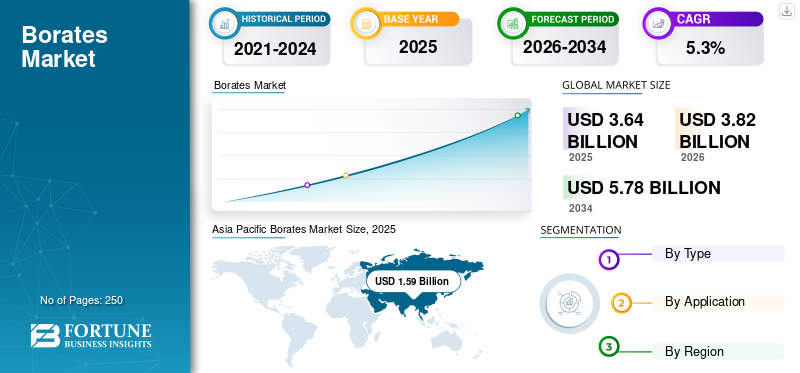
The global borates market size was valued at USD 3.64 billion in 2025. The market is projected to grow from USD 3.82 billion in 2026 to USD 5.78 billion by 2034, exhibiting a CAGR of 5.3% during the forecast period. Asia pacific dominated the borates market with a market share of 43.68% in 2025.
Borates are boron-containing compounds derived primarily from borate minerals such as borax, kernite, and colemanite. They are widely used across glass manufacturing, ceramics, agriculture, detergents, flame retardants, and specialty chemical applications. Such products enhance thermal resistance, chemical stability, durability, and fire-retardant properties in various industrial formulations. Sodium borates and boric acid represent the most commercially significant forms, while zinc borates are primarily used as flame retardants and smoke suppressants. The growing demand for fiberglass in the construction and renewable energy sectors significantly supports consumption. Additionally, agricultural micronutrient applications and detergent manufacturing contribute to steady global demand. With expanding infrastructure development and industrialization across emerging economies, the product continues to play a vital role in advanced material engineering and chemical processing, thus reinforcing their strategic importance in the global specialty chemicals market.
Major players in the market include Eti Maden İşletmeleri Genel Müdürlüğü, Rio Tinto Group, Boron Molecular Pty Ltd., American Borate Company, and 3M Company.
Download Free sample to learn more about this report.
BORATES MARKET KEY TAKEAWAYS
 Global Market Size & Forecast
- 2025 Market Size: USD 3.64 billion
- 2026 Market Size: USD 3.82 billion
- 2034 Forecast Market Size: USD 5.78 billion
- CAGR: 5.3% from 2026-2034
 Market Share
- Asia Pacific accounted for 45.38% of the paints and coatings additives market in 2019.
- Boric acid accounts for a significant market share and is projected to grow at a 6.5% CAGR during the forecast period.
- The segment is projected to grow at a 5.0% CAGR, supported by energy cost optimization in ceramic manufacturing through lower firing temperatures.
 Key Regional Highlights
North America
Strong mining activities and sustained industrial demand continue to drive market growth in North America.
Europe
Demand is supported by specialty manufacturing, construction, and regulatory compliance initiatives.
Asia Pacific
Growing industrialization and expanding manufacturing activities are expected to drive market growth across Asia Pacific.
U.S.
The market was valued at USD 0.58 billion in 2025.
Japan
Demand is supported by advanced manufacturing and increasing use in high-performance industrial applications.
Read More

Borates Market Trends
Renewable Energy Infrastructure and Sustainable Material Adoption Reshaping Demand Patterns
The market is increasingly influenced by expanding renewable energy infrastructure, particularly wind energy installations that rely heavily on fiberglass-reinforced materials. Sustainability initiatives are encouraging the use of energy-efficient building materials and promoting the use of insulation and specialty glass products. Another key trend is the shift toward halogen-free flame-retardant systems, where zinc borates serve as effective smoke suppressants. Agricultural modernization in developing countries is also increasing demand for boron, a micronutrient. Technological advancements in borate refining processes are enhancing product purity and performance efficiency. Growing regulatory emphasis on environmentally safer additives further supports adoption. These evolving industrial, sustainability, and regulatory dynamics are reshaping consumption patterns, thus influencing long-term growth in the global market.
MARKET DYNAMICS
MARKET DRIVERS
Download Free sample to learn more about this report.
Glass Industry Expansion to Stimulate Market Growth
The primary driver of the market is the expansion of glass and fiberglass production. The product improves thermal shock resistance, chemical durability, and mechanical strength in glass formulations, making them essential in construction and renewable energy sectors. Agricultural demand for boron-based micronutrients also significantly supports consumption, particularly in crop-intensive regions. Growth in detergent and cleaning product manufacturing supports stable demand for sodium borates. Industrial modernization and increasingly stringent fire safety regulations further drive the use of zinc borate in flame-retardant applications. These diversified industrial and agricultural drivers sustain consistent consumption, thus maintaining the steady borates market growth.
MARKET RESTRAINTS
Resource Concentration and Regulatory Scrutiny Limiting Flexibility
Borate production is geographically concentrated in limited regions such as Turkey and the U.S., creating supply dependency and potential pricing volatility. Regulatory scrutiny of boron toxicity classifications in certain consumer applications may also restrict use in specific markets. Environmental compliance requirements increase operational costs for mining and refining operations. Substitution risks in detergent formulations and alternative additives may further limit growth in price-sensitive segments. These structural supply and regulatory factors create market constraints in certain regions.
MARKET OPPORTUNITIES
Infrastructure Development and Agricultural Productivity Goals Creating Growth Potential
Rapid urbanization and infrastructure expansion across Asia, the Middle East, and Latin America create significant opportunities for product consumption in glass and ceramics. An increased focus on soil micronutrient balance presents additional growth opportunities for boric acid and sodium borates. The expanding electric vehicle and renewable energy markets further increase fiberglass demand, indirectly supporting market growth. Flame-retardant applications in advanced polymers and coatings also provide high-value growth potential. Additionally, advancements in specialty borate formulations broaden industrial applications. As governments invest in infrastructure modernization and sustainable agricultural productivity, product demand is expected to rise steadily, therefore strengthening long-term market prospects.
MARKET CHALLENGES
Sustainable Resource Management and Price Volatility to Influence Market Stability
A key challenge in the market is ensuring long-term sustainable resource management due to the finite nature of boron reserves. Producers must optimize extraction efficiency and adopt environmentally responsible mining practices. Price volatility linked to resource concentration may impact downstream industries. Additionally, maintaining compliance with evolving chemical safety regulations requires continuous investment in R&D and process improvements. These operational and regulatory pressures influence competitive dynamics, therefore shaping long-term stability in the global market.
Research and Development Trends
R&D initiatives are focused on improving product purity, optimizing glass compositions, and enhancing flame-retardant performance in polymer systems. Sustainable mining and refining technologies are also gaining importance as producers seek to reduce environmental impact while improving cost efficiency.
Segmentation Analysis
By Type
Sodium Borates Segment Led due to their Broad Industrial Versatility
Based on type, the market is segmented into sodium borates, boric acid, natural borates, zinc borates, and others.
Sodium borates hold the largest borates market share due to their broad industrial versatility and cost-effectiveness. They are widely used in glass manufacturing, detergents, agriculture, and industrial processing applications. In glass production, sodium borates improve durability, thermal shock resistance, and chemical stability. In detergents, they act as buffering agents and water softeners, enhancing cleaning efficiency. Additionally, agricultural use of micronutrients supports consistent demand in crop-intensive regions. Their availability in multiple hydrated forms further broadens application flexibility. Strong consumption across diversified industries ensures stable, high-volume demand, thereby maintaining sodium borates as the dominant segment in the global market.
Boric acid holds a significant market share and is growing at a CAGR of 6.5% during the forecast period due to its critical role in agriculture and specialty glass production. It is widely used to correct boron deficiencies in soil, improving crop yield and plant development. In glass and fiberglass applications, boric acid enhances heat resistance and mechanical strength. It also finds applications in pharmaceuticals, cosmetics, and flame retardant systems.
By Application
To know how our report can help streamline your business, Speak to Analyst
Glass & Fiberglass Segment Dominated due to its Properties
In terms of application, the market is segmented into glass & fiberglass, ceramics, agriculture, detergents & cleaners, flame retardants & wood treatment, and others.
The glass & fiberglass segment holds the largest share in the market. Borates improve thermal shock resistance, chemical durability, and mechanical strength in glass formulations. Rapid infrastructure development, urbanization, and the expansion of renewable energy, particularly wind energy installations, significantly increase fiberglass demand. Borate products also reduce melting temperatures, improving energy efficiency in production. Growing demand for energy-efficient buildings and insulation materials further strengthens consumption.
In ceramics production, the product act as fluxing agents, reducing firing temperatures and enhancing glaze finish quality. Their inclusion improves surface smoothness, mechanical durability, and chemical resistance. Growing residential construction and decorative product demand support ceramic tile and sanitary ware production, particularly in emerging economies. Energy cost optimization in ceramic manufacturing further encourages product use due to lower firing temperature requirements. The segment is growing at a CAGR of 5.0% during the forecast period.
BORATES MARKET REGIONAL MARKET OUTLOOK
Geographically, the market is studied across North America, Europe, Asia Pacific, Latin America, and the Middle East & Africa.
Asia Pacific
Asia Pacific Borates Market Size, 2025 (USD Billion)
To get more information on the regional analysis of this market, Download Free sample
The market in Asia Pacific stood at USD 1.59 billion in 2025. The region holds the largest share in the global market due to strong glass and fiberglass production, supported by rapid urbanization and infrastructure expansion. China and India are key consumption hubs, driven by large-scale construction activity and renewable energy installations, particularly wind power projects requiring fiberglass reinforcement. Additionally, agricultural modernization initiatives in India, Southeast Asia, and China increase demand for boron-based micronutrients to improve crop productivity. Expanding detergent manufacturing capacity across emerging economies further strengthens product consumption.
China Borates Market
Based on Asia Pacific’s strong contribution and China’s position as the leading country in the regional market, the Chinese market was valued at USD 0.77 billion in 2025, accounting for approximately 21.3% of regional revenues. Growth is driven by large-scale fiberglass production, expanding wind energy capacity, and robust infrastructure development.
To know how our report can help streamline your business, Speak to Analyst
North America
North America represents a mature yet stable market, primarily supported by strong domestic boron reserves and integrated mining operations. The U.S. is a major producer and consumer, benefiting from vertically integrated supply chains that ensure stable production. Growing product demand from fiberglass insulation, driven by renovation activities and infrastructure modernization, supports consistent consumption.
U.S. Borates Market
The U.S. market reached a valuation of USD 0.58 billion in 2025, accounting for approximately 16.0% of regional revenues. Growth is fueled by established boron mining operations, steady demand for fiberglass insulation, and stable agricultural consumption.
Europe
Europe’s market is shaped by stringent environmental regulations and strong specialty manufacturing industries. Countries such as Germany, France, and the U.K. maintain steady demand from high-value glass, ceramics, and flame-retardant applications. The region’s focus on energy-efficient buildings increases demand for fiberglass insulation, supporting product consumption. Additionally, agricultural practices emphasizing balanced micronutrient management help stabilize boric acid use. Regulatory oversight under REACH influences product classification and use in detergents and consumer products, encouraging the development of compliant formulations. Growing investments in renewable energy infrastructure also strengthen demand for specialty glass materials.
Germany Borates Market
Germany’s market reached a valuation of USD 0.17 billion in 2025, accounting for approximately 4.8% of regional demand. Demand is driven by specialty glass manufacturing, renewable energy infrastructure expansion, and strict fire-safety compliance in construction materials.
Latin America & Middle East & Africa
Latin America is experiencing moderate market growth, primarily driven by agricultural expansion and urban development. Brazil and Argentina are significant consumers due to extensive agricultural activities that require boron-based micronutrients to improve soil fertility and crop yields. On the other hand, the Middle East & Africa region is witnessing steady growth in product demand, supported by infrastructure expansion and industrial diversification initiatives. GCC countries are investing in large-scale construction and renewable energy projects, thereby increasing the consumption of fiberglass and glass materials. Rising detergent manufacturing and population-driven urbanization further contribute to product demand. In Africa, agricultural development programs aimed at improving soil productivity have gradually increased boric acid use.
GCC Borates Market
The GCC market in 2025 was valued at USD 0.13 billion, accounting for approximately 3.5% of Latin America revenues. Expansion is driven by large-scale construction projects, diversification into glass manufacturing, and growing demand for detergents and wood treatment products.
Competitive Landscape
Key Industry Players
Key Players Focus on Flame-Retardant Applications to Gain Competitive Edge
The global market is moderately concentrated, with companies that have direct access to boron mineral reserves dominating overall supply. Major producers such as Eti Maden and Rio Tinto dominate supply through vertically integrated mining, refining, and distribution operations. Competitive advantage is largely determined by reserve ownership, production scale, and export infrastructure. Regional players compete through cost efficiency and specialty product offerings. Increasing demand from fiberglass, agriculture, and flame-retardant applications encourages downstream integration and portfolio diversification among key producers. High capital intensity and limited availability of global boron deposits create strong entry barriers, therefore reinforcing the dominance of established producers in the global market.
LIST OF KEY BORATES COMPANIES PROFILED
- Eti Maden İşletmeleri Genel Müdürlüğü (Turkey)
- Rio Tinto Group (U.S. Borax) (U.K.)
- Quiborax S.A. (Chile)
- American Borate Company (U.S.)
- 3M Company (U.S.)
- Searles Valley Minerals, Inc. (U.S.)
- Gujarat Boron Derivatives Pvt. Ltd. (India)
- YOGI CHEMICAL INDUSTRIES (India)
- Minera Santa Rita S.R.L. (Argentina)
- Orocobre Limited (Allkem Ltd.) (Australia)
KEY INDUSTRY DEVELOPMENTS
- February 2021: Akdeniz Chemson commenced production at the first phase of its new Zinc Borate facility, with an annual capacity of 3,000 tonnes, strengthening its position among the limited global producers of flame-retardant chemicals. This expansion was undertaken to address evolving market requirements and rising demand for Zinc Borate, which the company has been manufacturing since 2018. Additionally, to secure the supply of a key raw material, Zinc Oxide capacity in Turkey is being expanded in parallel, with operations scheduled to begin by January 2021.
REPORT COVERAGE
The global market research report provides a detailed analysis of the market and focuses on key aspects, including leading companies, types, and applications. Additionally, it offers insights into market trends and highlights vital industry developments. In addition to the factors mentioned above, the report encompasses various factors contributing to the market's growth in recent years. It further includes historical data & forecasts revenue growth at global, regional, and country levels and analyzes the industry's latest market dynamics and opportunities.
Request for Customization to gain extensive market insights.
Report Scope & Segmentation
| ATTRIBUTE | DETAILS |
| Study Period | 2021-2034 |
| Base Year | 2025 |
| Estimated Year | 2026 |
| Forecast Period | 2026-2034 |
| Historical Period | 2021-2024 |
| Unit | Value (USD Billion) and Volume (Kiloton) |
| Growth Rate | CAGR of 5.3% from 2026 to 2034 |
| Segmentation | By Type, Application, and Region |
| By Type |
|
| By Application |
|
| By Region |
|
Frequently Asked Questions
Fortune Business Insights says that the global market size was valued at USD 3.64 billion in 2025 and is projected to reach USD 5.78 billion by 2034.
In 2025, the Asia Pacific market size stood at USD 1.59 billion.
Registering a CAGR of 5.3%, the market will exhibit steady growth during the forecast period (2026-2034).
In terms of application, the glass and fiberglass segment led the market in 2025.
Glass industry expansion and agricultural demand are the key factors driving market growth.
Eti Maden İşletmeleri Genel Müdürlüğü, Rio Tinto Group, Boron Molecular Pty Ltd., American Borate Company, and 3M Company are the major players in the market.
Asia Pacific dominates the market.



- 2021-2034
- 2025
- 2021-2024
- 250
Get 30-60 hrs Free Customization
Expand Regional and Country Coverage, Segments Analysis, Company Profiles, Competitive Benchmarking, and End-user Insights.


















Related Reports
-
US +1 833 909 2966 ( Toll Free )
-
Get In Touch With Us