Boric Acid Market Size, Share & Industry Analysis, By Form (Powder, Granular, and Others), By End-Use Industry (Fiberglass Industry, Chemicals, Agriculture, Construction, and Others), and Regional Forecast, 2026-2034
 Download Free Sample
 Boric Acid Market Size and Future Outlook
 Listen to Audio Version
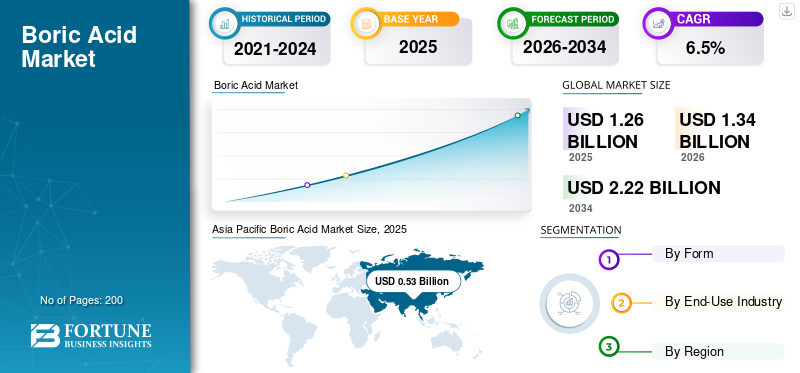
The global boric acid market size was valued at USD 1.26 billion in 2025. The market is projected to grow from USD 1.34 billion in 2026 to USD 2.22 billion by 2034, exhibiting a CAGR of 6.5% during the forecast period. Asia Pacific dominated the boric acid market with a market share of 42.06% in 2025.
The boric acid (H3BO3) market is progressing steadily due to its essential role in a wide range of industrial and formulation-based applications. The growing demand for performance-enhancing additives in fiberglass manufacturing, chemical processing, agriculture, and construction materials is driving broader adoption across global industries. H3BO3 contributes to thermal resistance, chemical stability, micronutrient efficiency, and high performance, making it a critical input in both bulk-volume and specialty-value chains. Rising consumption of insulation materials, increasing use of boron-based micronutrients to enhance crop productivity, and expanding demand for detergents, glass, and industrial chemicals are further driving the market growth.
Leading participants such as Eti Maden, Searles Valley Minerals, Inkabor, Minera Santa Rita SRL (MSR), and Rose Mill Co. are strengthening their market positions through capacity expansion, product portfolio expansion, and improved supply chain reach across key end-use industries.
Download Free sample to learn more about this report.
Boric Acid Market KEY TAKEAWAYS
 Market Size & Forecast
- 2025 Market Size: USD 1.26 billion
- 2026 Market Size: USD 1.34 billion
- 2034 Forecast Market Size: USD 2.22 billion
- CAGR: 6.5% from 2026–2034
 Market Share
- Asia Pacific dominated the boric acid market with a 42.06% share in 2025.
- The granular segment is projected to grow at a CAGR of 6.2% during the forecast period.
- The chemicals segment is projected to grow at a CAGR of 6.6% during the forecast period.
 Key Regional Highlights
Asia Pacific
Valued at USD 0.53 billion in 2025, driven by strong demand from fiberglass, chemicals, agriculture, and construction industries.
Europe
Valued at USD 0.29 billion in 2025, driven by diversified industrial demand and extensive use in fiberglass and chemical applications.
North America
Valued at USD 0.24 billion in 2025, supported by established industrial applications and steady demand across key end-use sectors.
U.S.
Valued at USD 0.21 billion in 2025, supported by strong demand from fiberglass, industrial chemicals, and agriculture.
Japan
Expected to witness steady growth, driven by increasing industrial demand and specialty chemical applications.
Read More

BORIC ACID MARKET TRENDS
Increasing Use of Boric Acid in Fiberglass and Insulation Applications is a Key Market Trend
A key trend in the market is the rising use of H3BO3 in fiberglass and insulation manufacturing. Industries such as construction, transportation, and industrial equipment increasingly rely on fiberglass-based materials due to their lightweight structure, thermal resistance, and durability. H3BO3 plays an important role in glass formulations by improving heat resistance, strength, and processing efficiency, making it a valuable input in insulation and reinforcement materials. As infrastructure development expands and energy-efficient building materials gain stronger adoption, demand for boric acid in fiberglass applications continues to increase.
- According to the U.S. Geological Survey (USGS), the glass and ceramics industries remained the leading domestic users of boron products in 2025, while Eti Maden states that H3BO3 is used in the production of glass fiber and increases glass resistance against heat, chemicals, and mechanical impacts.
MARKET DYNAMICS
MARKET DRIVERS
Download Free sample to learn more about this report.
Expanding Fiberglass and Glass Manufacturing Activities Driving Market Growth
The market is strongly driven by the rising use of boric acid in fiberglass and glass manufacturing, where it serves as an important performance-enhancing input in formulation and processing applications. It is widely used to improve thermal resistance, chemical durability, and mechanical strength in glass and fiberglass products, making it highly valuable for insulation materials, reinforcement fibers, and specialty glass applications. As global demand for energy-efficient buildings, lightweight composite materials, and durable industrial products continues to increase across construction, automotive, electronics, and infrastructure sectors, fiberglass and glass production capacities are expanding, thereby driving boric acid market growth.
- According to U.S. Borax, boron is a vital component in the manufacture of textile fiberglass, and its Optibor boric acid reduces melting temperatures in fiberglass production and assists the fiberizing process; this directly supports the view that expanding fiberglass and glass manufacturing is a key driver of H3BO3 market growth.
MARKET RESTRAINTS
Health, Safety, and Regulatory Compliance Challenges Restraining Market Growth
The market faces constraints due to the toxicological concerns and regulatory limitations associated with H3BO3 use in certain applications. As a chemically active boron compound, H3BO3 requires controlled handling, labeling, and compliance with safety standards, particularly in applications involving direct human exposure, household products, and sensitive industrial environments. Manufacturers and end users must invest in safe storage, occupational safety measures, product testing, and regulatory documentation to ensure compliance across regional markets.
- According to the European Chemicals Agency (ECHA), boric acid is harmonised in the EU as Reproductive Toxicity Category 1B (H360FD), which increases labeling, handling, and compliance requirements in regulated applications, thereby constraining broader market use.
MARKET OPPORTUNITIES
Rising Demand for Boron-Based Micronutrients in Agriculture Creating Growth Opportunities
The market presents significant growth opportunities as H3BO3 use in agricultural micronutrient applications increases across major farming economies. The product is widely used in fertilizer formulations to address boron deficiency, support cell wall development, improve flowering, fruiting, and overall crop quality. As concerns over soil nutrient imbalance, crop productivity, and sustainable agricultural output continue to rise globally, growers are increasingly adopting boron-based inputs to improve yield efficiency.
- According to the USDA Agricultural Research Service (USDA ARS), boron is an essential nutrient for crop growth, development, yield, and seed quality, and its deficiency in soil results in yield loss and poor seed quality, supporting the growing opportunity for H3BO3 in micronutrient fertilizer applications.
MARKET CHALLENGES
Supply Concentration and Raw Material Dependence Challenges Impact Market Growth
The market faces challenges due to the concentrated nature of global boron reserves and refined boron supply, which can increase vulnerability to supply disruptions and pricing volatility. H3BO3 production depends heavily on access to boron minerals and integrated processing infrastructure, limiting sourcing flexibility for many manufacturers and end users. As a result, shifts in mining output, export availability, energy costs, or trade conditions in major producing countries can directly affect global supply balance. This creates challenges for downstream industries that rely on consistent H3BO3 availability for fiberglass, chemicals, agriculture, and construction applications.
- According to the U.S. Geological Survey (USGS), the U.S. and Turkey are the world’s largest producers of boron, indicating a concentrated supply base that can increase market exposure to supply-side disruptions and trade-related risks.
Segmentation Analysis
By Form
Broad Industrial Usability and Commercial Availability Support the Dominance of the Powder Segment
Based on the form, the market is segmented into powder, granular, and others.
The powder segment holds the largest boric acid market share due to its broad commercial usability across major end-use industries and its suitability for large-scale industrial processing. Powder boric acid is widely preferred in fiberglass manufacturing, chemical formulations, agriculture, detergents, and specialty industrial applications as it offers easy blending, faster dissolution, and efficient handling in formulation-driven processes. As demand for H3BO3 continues to expand in insulation materials, crop nutrition, and industrial chemicals, the powder segment remains dominant due to its wider application compatibility and strong market acceptance.
- According to Eti Maden, H3BO3 is commercially available in both granular and powder grades, with applications and benefits in special types of glass and glass fiber, underscoring the broad industrial suitability and the dominant position of the powder segment in the market.
The granular segment is expected to grow at a CAGR of 6.2% over the forecast period.
By End-Use Industry
High Consumption in Glass Fiber Manufacturing Supports the Dominance of the Fiberglass Industry
In terms of end-use Industry, the market is categorized into fiberglass industry, chemicals, agriculture, construction, and others.
To know how our report can help streamline your business, Speak to Analyst
The fiberglass industry segment holds the largest market share due to the extensive use of H3BO3 as a key functional input in glass fiber production. The product is widely utilized in fiberglass formulations to improve thermal resistance, chemical durability, melting efficiency, and mechanical performance, making it essential for the production of insulation materials, reinforcement fibers, and specialty glass products. As demand for lightweight materials, energy-efficient insulation, and durable composite applications continues to rise across construction, automotive, electronics, and infrastructure sectors, the fiberglass industry segment maintains its leading position in the boric acid industry.
- According to the U.S. Geological Survey (USGS), approximately 90% of manufactured textile fiberglass was used to create electronic glass. In contrast, boron is used in glass to improve strength, chemical resistance, durability, and thermal shock resistance, supporting the dominant share of the fiberglass industry segment.
The chemicals segment is expected to grow at a CAGR of 6.6% over the forecast period.
Boric Acid Market Regional Outlook
Asia Pacific Boric Acid Market Size, 2025 (USD Billion)
To get more information on the regional analysis of this market, Download Free sample
By geography, the market is categorized into North America, Europe, Asia Pacific, Latin America, and the Middle East & Africa.
Asia Pacific held the dominant position in the market in 2025, valued at USD 0.53 billion, and is expected to maintain its leading position in 2026, reaching USD 0.57 billion. The region’s leadership is supported by its large H3BO3 consumption base across fiberglass manufacturing, chemical processing, agriculture, and construction-related applications. Strong demand from China, South Korea, Japan, and India, along with the region’s broad industrial manufacturing capacity and high dependence on H3BO3 in glass fiber, detergents, ceramics, and micronutrient fertilizers, continues to support regional consumption.
China Boric Acid Market
Based on Asia Pacific’s strong contribution and China’s position as the leading boric acid-consuming country in the region, the China market was valued at USD 0.21 billion in 2025, accounting for approximately 39.3% of regional revenues. The country’s large-scale fiberglass production base, extensive use of H3BO3 in industrial chemicals, strong demand from agriculture and construction-linked materials, and a broad manufacturing ecosystem support high-volume domestic consumption.
To know how our report can help streamline your business, Speak to Analyst
North America
North America is a stable, industrially significant regional market for H3BO3. The region was valued at USD 0.24 billion in 2025. Demand is supported by the region’s established use of H3BO3 across fiberglass manufacturing, chemical formulations, agriculture, and construction-related applications. The presence of a strong downstream industrial base, combined with consistent demand for insulation materials, specialty glass, detergents, and micronutrient fertilizers, continues to support regional consumption.
U.S. Boric Acid Market
The U.S. market in 2025 reached a valuation of USD 0.21 billion, accounting for approximately 87.0% of regional revenues. High demand for H3BO3 is supported by the country’s large-scale consumption across fiberglass, industrial chemicals, crop nutrition, and construction materials. The U.S. benefits from a well-established industrial manufacturing base and strong demand from end-use sectors requiring H3BO3 for glass performance, chemical stability, and formulation efficiency.
Europe
Europe is expected to maintain steady growth, reaching a valuation of USD 0.29 billion in 2025. The region’s development is supported by its diversified industrial base, established use of H3BO3 in fiberglass, chemicals, agriculture, construction-related applications, and strong demand across major economies such as Germany, France, and Italy. H3BO3 is widely used in glass and insulation materials, detergents and chemical formulations, crop nutrition products, and specialty industrial processes, all of which are integral to Europe’s manufacturing and processing ecosystem.
Germany Boric Acid Market
Germany reached a valuation of USD 0.080 billion in 2025, accounting for approximately 27.5% of regional revenues. Growth is driven by the country’s strong industrial manufacturing sector, along with its leadership in chemicals, glass-related applications, and high-value processing industries. H3BO3 is extensively used in fiberglass production, industrial formulations, specialty chemicals, and agricultural applications, supported by Germany’s advanced industrial capabilities and broad downstream demand base.
Latin America, and the Middle East, and Africa
Latin America and the Middle East & Africa are projected to experience steady market growth during the forecast period. The Latin America market reached a valuation of USD 0.129 billion in 2025, supported by strong demand from agriculture, chemicals, fiberglass-related applications, and industrial processing activities, particularly in Brazil and Mexico. The Middle East & Africa market was valued at USD 0.063 billion in 2025, driven by the expanding use of H3BO3 in agriculture, detergents, construction-related materials, and chemical applications across key regional markets. Continued industrial development, increasing demand for crop productivity inputs, and broader use of H3BO3 in glass and formulation-based products are supporting growth across both regions.
Brazil Boric Acid Market
The Brazilian market in 2025 was valued at USD 0.087 billion, accounting for approximately 67.4% of Latin America revenues. Demand is supported by the country’s strong agricultural base, expanding industrial chemical consumption, and rising use of H3BO3 in fiberglass, crop nutrition, and formulation-based applications. H3BO3 is widely used in micronutrient fertilizer products, chemical processing, and glass-related industrial applications, supported by Brazil’s broad end-use base and large domestic demand structure.
COMPETITIVE LANDSCAPE
Key Industry Players
High Capital Intensity and Integrated Production Structures Shape Market Competition
The market remains moderately consolidated, as large-scale boric acid production is closely tied to access to boron mineral resources, refined processing capabilities, and efficient distribution networks. The need for mining linkages or reliable raw material sourcing, specialized refining infrastructure, product quality control, and compliance with handling and safety requirements creates meaningful entry barriers for new participants.
Key players such as Eti Maden, Searles Valley Minerals, Inkabor, Minera Santa Rita SRL (MSR), and Rose Mill Co. focus on strengthening access to boron supply, expanding processing capabilities, enhancing product quality, and expanding supply chain reach to maintain their competitive position in the market.
LIST OF KEY BORIC ACID COMPANIES PROFILED
- Eti Maden(Turkey)
- Searles Valley Minerals (U.S.)
- Inkabor (Peru)
- Minera Santa Rita SRL (MSR) (Argentina)
- Rose Mill Co. (U.S.)
- Raviraj Chemiboron (India)
- ORGANIC INDUSTRIES PVT LTD. (India)
- Prime Industries. (India)
- Zibo Yihong Technology Chemical Co., Ltd (China)
- TOMIYAMA PURE CHEMICAL INDUSTRIES, LTD. (Japan)
KEY INDUSTRY DEVELOPMENTS
- December 2022: Minera Santa Rita S.R.L. (MSR) completed the acquisition of Borax Argentina S.A. from Allkem via Golden Wattle Springs Pty Ltd, giving MSR control of a major South American borates business with boric acid and related refined borate operations.
REPORT COVERAGE
The global market analysis provides an in-depth study of the market size and forecast for all the market segments included in the report. It includes details on the market dynamics and market trends expected to drive the market over the forecast period. It provides information on technological advancements, new product launches, key industry developments, and partnerships, mergers, and acquisitions. The market research report also includes a detailed competitive landscape, including market share and profiles of major players.
Request for Customization to gain extensive market insights.
Report Scope & Segmentation
| ATTRIBUTE | DETAILS |
| Study Period | 2021-2034 |
| Base Year | 2025 |
| Estimated Year | 2026 |
| Forecast Period | 2026-2034 |
| Historical Period | 2021-2024 |
| Growth Rate | CAGR of 6.5% from 2026-2034 |
| Unit | Value (USD Billion) Volume (Kiloton) |
| Segmentation | By Form, End-Use Industry, and Region |
| By Form |
|
| By End-Use Industry |
|
| By Geography |
|
Frequently Asked Questions
Fortune Business Insights says that the global market size was valued at USD 1.26 billion in 2025 and is projected to reach USD 2.22 billion by 2034.
Recording a CAGR of 6.5%, the market is slated to exhibit steady growth during the forecast period.
By end-use industry, the fiberglass industry segment is leading the market.
Asia Pacific held the highest market share in 2025.
Expanding fiberglass and glass manufacturing activities are the key factors driving the market.



- 2021-2034
- 2025
- 2021-2024
- 200
Get 30-60 hrs Free Customization
Expand Regional and Country Coverage, Segments Analysis, Company Profiles, Competitive Benchmarking, and End-user Insights.


















-
US +1 833 909 2966 ( Toll Free )
-
Get In Touch With Us