Cabin Crew Training Market Size, Share & Industry Analysis, By Training Type (Initial Training, Recurrent Training, and Type-Specific Training), By Training Module (Safety & Emergency Procedures, Medical Response, and CRM & Human Factors Training), By Delivery Mode (Classroom Training, Simulator-Based Training, and E-Learning), By Aircraft Type (Narrow-Body, Wide-Body, and Regional Aircraft), By Provider Type (Airline Academies, Independent ATOs, and OEM Providers), By End User (Commercial Airlines, Regional Airlines, and Business Aviation Operators), and Regional Forecast, 2026-2034
 Download Free Sample
Cabin Crew Training Market Size and Future Outlook
 Listen to Audio Version
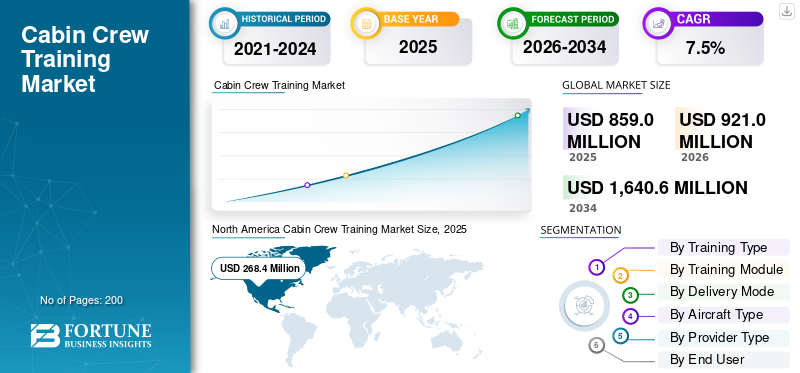
The cabin crew training market size was valued at USD 859.0 million in 2025. The market is projected to grow from USD 921.0 million in 2026 to USD 1,640.6 million by 2034, exhibiting a CAGR of 7.5% during the forecast period. North America dominated the cabin crew training market with a market share of 31.24% in 2025.
Cabin crew training covers safety procedures, emergency response, first aid, aircraft type familiarization, passenger handling, security, service delivery, and recurrent training programs required for commercial airline operations. The global market growth is driven by rising air traffic, growing crew hiring, and the shift toward simulation based training, simulator based drills, simulator training, and virtual reality VR modules.
Key players such as FlightSafety International, CAE Inc., Lufthansa Aviation Training, Etihad Aviation Training L.L.C., Qatar Airways Group Q.C.S.C., and Singapore Airlines Training Centre, are supporting market growth through new training solutions and airline-specific training program offerings.
Download Free sample to learn more about this report.
CABIN CREW TRAINING MARKET TRENDS
Shift Toward Specialized Training Solutions Shapes Market Growth
Beyond traditional classroom-based cabin crew training, airlines are adopting more specialized training programs, simulation-based training, and simulator-based emergency drills, and virtual reality (VR)-enabled modules. This trend is fueled by the need for cabin crew to consistently handle safety procedures, disruptive passengers, accessibility needs, premium service expectations, and aircraft type-specific operations.
MARKET DYNAMICS
MARKET DRIVERS
Download Free sample to learn more about this report.
Rising Air Traffic and Need to Recruit and Train Cabin Crew Drive Market Growth
The market is mainly driven by rising air traffic, airline network expansion, and the need to hire and train new cabin crew every year. Demand for cabin crew training is recurring as commercial airlines are required to conduct initial training, recurrent training programs, aircraft type training, safety drills, CRM, first aid, and customer service training before crew members can be deployed. This keeps sustained demand for training organizations and key players active across North America, Asia Pacific, Europe, and the Middle East.
MARKET RESTRAINTS
Aircraft Delivery Delays Restrain Market Growth
The demand for cabin crew training is closely related to new aircraft deliveries, aircraft type conversion, route expansion, and fleet utilization. Airlines often delay type-specific training, simulator training, recruitment batches and aircraft configuration training when aircraft deliveries are postponed. While this does not reduce the requirement for recurrent training programs, it can delay incremental training revenue associated with the introduction of new aircraft types.
MARKET OPPORTUNITIES
Rising Investments in Airline Training Infrastructure Creates New Growth Opportunities
Airlines are increasing their investment in dedicated training centers to enhance service quality, safety consistency, and crew readiness. This creates opportunities for training solutions providers, simulator-based equipment suppliers, LMS vendors, and specialized training organizations that support cabin mock-ups, door trainers, evacuation trainers, fire and smoke training, and service-standard training modules.
For instance, in July 2025, Boeing projected demand for 1,000,000 new cabin crew personnel from 2025 to 2044, representing an annual growth rate of 3.20% in new cabin crew personnel and highlighted the increasing use of augmented and virtual reality technologies in cabin crew training.
MARKET CHALLENGES
Regulatory Compliance and Lack of Qualified Instructors to Challenge Market Growth
To meet regulatory requirements, airlines must maintain sufficient numbers of trained cabin crew, qualified instructors, available training slots, and comprehensive compliance documentation. Any gaps in training records, aircraft type qualification, recurrent training, or crew deployment can create operational risks, especially as airlines expand flight schedules faster than their training capacity.
Impact of Tariff War
Rising Training Equipment Costs and Delaying Aircraft Type-Specific Training Demand to Restrain Market Growth
The tariff war will not directly reduce demand for cabin crew training as recurrent safety training, aircraft type training, emergency drills, and crew qualification remain mandatory. However, it can indirectly affect the market through three key routes: higher cost for imported training equipment, delays in aircraft deliveries, and weaker airline profitability. If tariffs raise the cost of cabin emergency evacuation trainers, door trainers, slide/raft systems, fire and smoke trainers, VR hardware, and simulator based training equipment, training organizations may delay facility upgrades or pass these additional costs to airlines. At the same time, delayed aircraft deliveries can slow aircraft type-specific training demand, while weaker business travel and air cargo demand may encourage commercial airlines to reduce discretionary spending on service excellence and specialized training programs.
Segmentation Analysis
By Training Type
Initial Training Segment Dominated the Market, Driven by Rising Cabin Crew Recruitment
By training type, the market is categorized into initial training, recurrent training, aircraft type-specific training, operator conversion training, and refresher/return-to-duty training.
The initial training segment held the largest global cabin crew training market share in 2025, as airlines continue to rebuild and expand cabin crew pipelines to support route growth, fleet utilization, and workforce replacement due to attrition. Unlike shorter recurrent training modules, initial training includes safety procedures, aircraft familiarization, emergency equipment handling, first aid, security awareness, service standards, company procedures, and final certification requirements before new cabin crew members can be deployed.
The recurrent training segment is expected to grow at a highest CAGR of 8.5% over the forecast period.
To know how our report can help streamline your business, Speak to Analyst
By Training Module
Safety & Emergency Procedures Segment Dominated the Market, Fueled by Mandatory Safety Certification Requirements
On the basis of training module, the market is classified into safety & emergency procedures, first aid & medical response, CRM & human factors, security & unruly passenger handling, service & hospitality, and dangerous goods awareness.
The safety & emergency procedures segment held the largest global market share in 2025, as the primary role of certified cabin crew is to ensure passenger safety in addition to delivering onboard services. This training module covers evacuation, fire and smoke response, emergency exits, slide/raft handling, decompression, ditching, emergency equipment, crew coordination, and abnormal cabin situations, making it the most essential module across commercial airlines and training organizations.
The CRM & human factors segment is expected to register a CAGR of 8.0% over the forecast period.
By Delivery Mode
Classroom Training Segment Dominated the Market due to Foundation for Cabin Crew Training
By delivery mode, the market is classified into classroom training, simulator/mock-up-based training, e-learning, blended learning, and VR/AR-based training.
Classroom training held the major global market share in 2025, as it remains the most practical format for delivering training on aviation regulations, airline SOPs, passenger handling, safety theory, security awareness, CRM, first aid basics, and service standards at scale. While simulator- based and simulation-based training are critical for emergency drills, classroom delivery continues to account for the largest market share as every training program begins with structured instruction before crew members progress to mock-up or simulator training.
The VR/AR-based training segment is expected to register a CAGR of 8.1% over the forecast period.
By Aircraft Type
Narrow-Body Aircraft Segment Dominated the Market Due to Expansion of LCC Fleets and Route Networks
By aircraft type, the market is classified into narrow-body aircraft, wide-body aircraft, regional aircraft, business jets, and turboprop aircraft.
Narrow-body aircraft held the major global market share in 2025, as single-aisle aircraft account for the largest share of global commercial airline operations, especially short- and medium-haul routes. These aircraft generate high demand for cabin crew training through frequent crew deployment, higher aircraft utilization, large LCC fleets, route expansion across Asia Pacific, and recurring aircraft type familiarization for Airbus A320 and Boeing 737 families.
For instance, in July 2025, Boeing’s Pilot and Technician Outlook projected 33,285 single-aisle aircraft deliveries during 2025-2044, compared with 7,815 widebody deliveries, confirming the long-term dominance of narrow-body aircraft in global airline fleet growth.
The business jets segment is expected to register a CAGR of 7.9% over the forecast period.
By Provider Type
Airline-Owned Academies Segment Dominated the Market, Driven by Preference for In-house Training
By provider type, the market is classified into airline-owned academies, independent ATOs, and OEM/type-specific providers.
Airline-owned academies held the major global market share in 2025, as commercial airlines prefer to keep cabin crew training, brand behavior, safety procedures, service delivery, and aircraft-specific SOPs in house. This approach allows airlines to maintain consistency across crew batches, reduce reliance on third-party training providers, and tailor training solutions to their own aircraft type, route structure and customer-service positioning.
For instance, in October 2025, Emirates inaugurated an USD 8 million Centre of Hospitality Excellence in Dubai to train more than 10,000 cabin crew by year-end and eventually support nearly 25,000 staff, highlighting continued investment in airline-owned training infrastructure.
The independent ATOs segment is expected to register a CAGR of 7.5% over the forecast period.
By End User
Compliance Airlines Segment Dominated the Market, Propelled by Large Cabin Crew Workforce
Based on end user, the market is segmented into commercial airlines, regional airlines, business aviation operators, and training institutes.
Commercial airlines captured the major global market share in 2025, as commercial airlines operate the largest fleets of passenger aircraft and need constant initial training, recurrent training programs, aircraft type training, CRM, safety modules and service standard training. This is recurring demand is driven by cabin crew member who must be trained and documented before being assigned to passenger operations.
The business aviation operators segment is expected to register a CAGR of 7.4% over the forecast period.
Cabin Crew Training Market Regional Outlook
By geography, the market is categorized into North America, Europe, Asia Pacific, the Middle East & Africa, and Latin America.
North America
North America Cabin Crew Training Market Size, 2025 (USD Million)
To get more information on the regional analysis of this market, Download Free sample
North America holds the largest market share and is anticipated to grow at a CAGR of 6.9% during the forecast period. The region’s leadership is due to the high training cost per crew member, strong airline owned training infrastructure, high number of commercial airline workforce, and stringent compliance requirements set by the FAA. Although Asia Pacific is expected to generate stronger long-term crew demand, North America maintains its leading market position due to mature training programs run by the airlines in the region, with higher recurrent, safety, simulator training and compliance documentation costs.
For instance, in August 2025, U.S. Bureau of Labor Statistics reported 130,800 flight attendant jobs in the U.S. in 2024 and projected around 19,800 openings per year from 2024 to 2034.
U.S. Cabin Crew Training Market
Based on the strong contribution of North America and the dominance of U.S. within the region, the U.S. market stood at around USD 232.5 million in 2025, growing at a CAGR of 6.9% during the forecast period.
Europe
The market in Europe is anticipated to grow at a CAGR of 7.0% during the forecast period. Cabin crew training market growth is supported by robust regulatory discipline, mature airline-owed academies, high recurrent training compliance, and continued aircraft type-specific training across full service carriers and low cost airlines. The region is also home to well-established training organizations in Germany, France, the U.K., Spain, Turkiye-linked networks, and Russia.
France Cabin Crew Training Market
The market in France reached approximately USD 31.2 million in 2025, equivalent to around 13.72% of Europe revenues.
Asia Pacific
Asia Pacific is anticipated to grow at a highest CAGR of 8.4% over the forecast period, driven by airline fleet expansion, strong domestic air travel in China and India, and the growth of Low-Cost Carrier (LCC) in Southeast Asia, and rising international connectivity from South Asia. The region is expected to generate strong need for initial training, aircraft type training, simulator training, service training, and digital training solutions as airlines continue to expand their crew pipelines and training-center capacity.
China Cabin Crew Training Market
The Chinese market revenues stood at around USD 85.1 million in 2025, representing roughly 32.38% of Asia Pacific sales.
India Cabin Crew Training Market
The Indian market stood at around USD 35.4 million in 2025, and will grow at a CAGR of 9.5% during the forecast period.
Middle East & Africa
Middle East & Africa is anticipated to grow at a CAGR of 8.3% over the forecast period, driven by the expansion of Middle Eastern hub carriers, premium service positioning, long-haul fleet operations, and rising aviation activity across Saudi Arabia, UAE, Qatar, and Africa. The region has a higher-value training profile as leading airlines invest heavily in service quality, safety training, aircraft type-specific training, and airline-owned training academies.
Saudi Arabia Cabin Crew Training Market
Saudi Arabia market was valued at USD 13.3 million in 2025, growing at a CAGR of 9.2% during the forecast period.
Latin America
Latin America holds a comparatively smaller market share but is expected to grow at a CAGR of 7.2%, supported by the recovery in regional air travel, and fleet renewal by major airlines, and rising demand for recurrent safety training. Brazil, Mexico, Chile, Colombia, and Argentina remain the key markets, with training demand concentrated around commercial airlines, regional carriers, and independent aviation training organizations.
Brazil Cabin Crew Training Market
Brazil’s market was valued at USD 12.9 million in 202 and is estimated to grow at a CAGR of 7.4% during the forecast period.
COMPETITIVE LANDSCAPE
Key Industry Players
Key Players Focus on Integrated Training Solutions to Strengthen their Competitive Position
The global cabin crew training market is moderately fragmented, with key players such as FlightSafety International, CAE Inc., Lufthansa Aviation Training, Pan Am Flight Academy, and BAA Training, competing through recurrent training programs, aircraft type training, simulator-based training, CRM, service training modules, and digital training solutions.
Competition is intensifying as commercial airlines look for faster cabin crew deployment, greater safety compliance, and consistent service standards. While North America and Europe remain mature markets, Asia Pacific and the Middle East offer better growth opportunities as air traffic grows, fleets expand, and increasing cabin crew hiring.
LIST OF KEY CABIN CREW TRAINING COMPANIES PROFILED
- FlightSafety International Inc. (U.S.)
- CAE Inc. (Canada)
- Lufthansa Aviation Training GmbH (Germany)
- Pan Am Flight Academy (U.S.)
- BAA Training Aviation Academy (Lithuania)
- Etihad Aviation Training L.L.C. (UAE)
- The Emirates Group (UAE)
- Singapore Airlines Training Centre (Singapore)
- Turkish Airlines Aviation Academy (Türkiye)
- Qatar Airways Group Q.C.S.C. (Qatar)
- Air France-KLM Group (France)
- British Airways Plc (U.K.)
- Cathay Pacific Airways Limited (Hong Kong)
- Air India Training Academy (India)
- Qantas Airways Limited (Australia)
- Japan Airlines Co., Ltd. (Japan)
- Korean Air Co., Ltd. (South Korea)
- Aviation Australia Pty Ltd. (Australia)
- Airways Aviation Group (UAE)
- International Air Transport Association (IATA) Training (Canada)
KEY INDUSTRY DEVELOPMENTS
- September 2025: CPaT Global announced a new contract with Uzbekistan-based Centrum Air to provide Airbus A320 Enhanced and A320neo aircraft systems courses, along with access to its General Subjects library, strengthening the adoption of digital airline training content.
- August 2025: Ryanair launched a major cabin crew recruitment drive, offering world-class training at no cost to successful candidates and deploying recruits across more than 90 European bases.
- August 2025: Aer Lingus launched a cabin crew recruitment campaign under which selected candidates would complete a six-week paid training program at the Aer Lingus Training Academy in Dublin, covering safety procedures, customer service, first aid, and aviation regulations.
- July 2025: India’s DGCA issued show-cause notices to Air India over multiple operational issues, including failure to meet required training standards and the deployment of inadequate cabin crew on ultra-long-haul flights, reinforcing the importance of regulatory compliance and ongoing cabin crew training.
- January 2025: Emirates announced that more than 30,000 cabin crew and ground staff would receive specialized autism-awareness training as part of its plan to become the world’s first Autism Certified Airline.
REPORT COVERAGE
The global cabin crew training market analysis provides an in-depth study of market size, market segmentation, company profiling & forecast by all the market segments included in the report. It includes details on the market dynamics and trends that are expected to drive the market during the forecast period. It offers information on the technological advancements, new product launches, key industry expert’s developments, and details on strategic partnerships, mergers & acquisitions. The market research report also encompasses detailed competitive landscape with information on the market share and profiles of key players.
Request for Customization to gain extensive market insights.
Report Scope & Segmentation
| ATTRIBUTE | DETAILS |
| Study Period | 2021-2034 |
| Base Year | 2025 |
| Estimated Year | 2026 |
| Forecast Period | 2026-2034 |
| Historical Period | 2021-2024 |
| Growth Rate | CAGR of 7.5% from 2026 to 2034 |
| Unit | Value (USD Million) |
|
Segmentation |
By Training Type
|
|
By Training Module
|
|
|
By Delivery Mode
|
|
|
By Aircraft Type
|
|
|
By Provider Type
|
|
|
By End User
|
|
|
By Region
|
Frequently Asked Questions
Fortune Business Insights says that the global market value stood at USD 859.0 million in 2025 and is projected to reach USD 1,640.6 million by 2034.
In 2025, the North America market value stood at USD 268.4 million.
The market is expected to exhibit a CAGR of 7.5% during the forecast period.
By training type, the initial training segment led the market.
Rising air traffic and need to recruit and train cabin crew is a key factor driving market growth.
Key players in the market include FlightSafety International Inc., CAE Inc., Lufthansa Aviation Training GmbH, and Pan Am Flight Academy.
North America dominates the market.



- 2021-2034
- 2025
- 2021-2024
- 200
Get 30-60 hrs Free Customization
Expand Regional and Country Coverage, Segments Analysis, Company Profiles, Competitive Benchmarking, and End-user Insights.




















Related Reports
-
US +1 833 909 2966 ( Toll Free )
-
Get In Touch With Us