Camera Gimbal Market Size, Share & Industry Analysis, By Product Type (Handheld Gimbals, Shoulder & Body-Mounted Gimbals, and Rig & Platform-Mounted Gimbals), By Stabilization Technology (Motorized Electronic Gimbals and Mechanical/Non-Motorized Gimbals), By Purchaser Type (Individual Consumers & Content Creators, Film & Video Production Companies, Broadcasting & Media Organizations, and Event Photography Providers), By Distribution Channel (Specialty Camera Stores, Consumer Electronics Chains, Online Marketplaces, Brand-Owned Websites, and Direct Sales), and Regional Forecast, 2026-2034
 Download Free Sample
(Offer valid till 15th Oct 2026)

Camera Gimbal Market Size and Future Outlook
 Listen to Audio Version
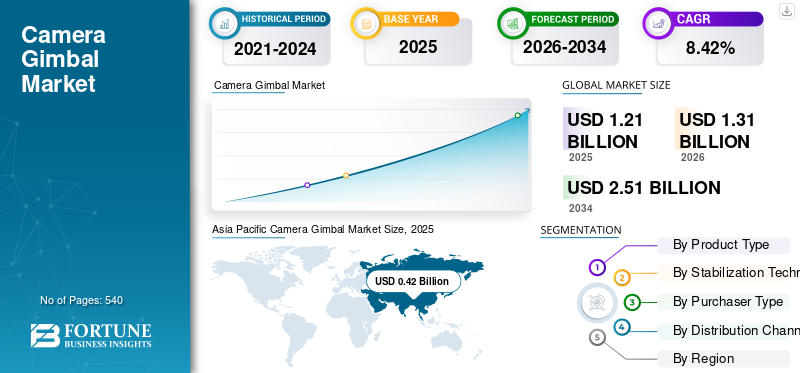
The global camera gimbal market size was valued at USD 1.21 billion in 2025. The market is projected to grow from USD 1.31 billion in 2026 to USD 2.51 billion by 2034, exhibiting a CAGR of 8.42% during the forecast period. Asia Pacific dominated the camera gimbal market with a market share of 34.71% in 2025.
Camera gimbal has revolutionized high-production filmmaking and has become an essential tool for professional videographers, travel vloggers, and digital marketers. It provides professional grade video stabilization, automatic subject tracking, and cinematic motion control. The rising video content creation, expanding social media engagement, and increasing demand for smooth, professional-quality footage across filmmaking, broadcasting, wedding videography, sport coverage, travel content, and live events are driving demand for travel-friendly compact gimbals across many countries. In addition, advancements in the development of camera stabilizers with three-axis stabilization, AI-based subject tracking, automated calibration, LiDAR-assisted focusing, and wireless camera control are encouraging consumers to buy such products, driving the global market expansion.
Prominent companies in the global market include SZ DJI Technology Co., Ltd., Guilin Zhishen Information Technology Co., Ltd., Guilin Feiyu Technology Incorporated Company, Shenzhen Gudsen Technology Co., Ltd., and Freefly Systems Inc.
Download Free sample to learn more about this report.
CAMERA GIMBAL MARKET TRENDS
Growing Interest in AI-based Subject Tracking and Gesture-Controlled Filming to Favor Market Growth
Consumers increasingly prefer camera stabilizers equipped with AI-based subject tracking to recognize, frame, and continuously follow a person or object during movement. The rising preference among vloggers, solo creators, and fitness instructors for such products to capture stable and properly composed footage is favoring global market growth. In addition, increasing popularity of products designed with gesture control features to start or stop recording, activate tracking, adjust framing, or capture photographs through predefined hand movements without touching the camera or gimbal is driving the product revenue growth globally.
MARKET DYNAMICS
MARKET DRIVERS
Download Free sample to learn more about this report.
Increasing Use of Mirrorless Cameras and Compact Professional Video Equipment to Drive Product Demand
Content creators, filmmakers, video photographers, and production professionals prefer mirrorless cameras due to their compact size, lighter weight, strong autofocus, and high-resolution video capabilities. This creates demand for compatible camera stabilizers that can deliver smooth footage while preserving the portability of lightweight filming setups, driving the global camera gimbal market growth. According to the Camera and Imaging Products Association (CIPA), in 2025, CIPA member companies shipped 6.31 million mirrorless cameras globally, compared to 5.61 million in 2024. In addition, increasing usage of compact professional video equipment for documentaries, events, advertisements, live streaming, and social-media production, requiring users to use gimbals with stronger motors and higher payload capacity, is augmenting product revenue growth.
Market Drivers - Impact & CAGR Contribution (2026–2034)
| Rank | Market Drivers | Expected Impact on Market Growth | Estimated Gross Market Growth Contribution (USD Billion) | Impact: 2026-2028 | Impact: 2029-2031 | Impact: 2032-2034 |
|---|---|---|---|---|---|---|
| 1 | Rising production of social-media, streaming, and creator-led videos is increasing demand for camera gimbals. | High | 0.48% | High | High | High |
| 2 | Growing demand for stable, professional-quality footage is supporting adoption across filmmaking, broadcasting, events, and commercial production. | High | 0.39% | High | High | High |
| 3 | Advancements in AI tracking, automated calibration, wireless control, and stabilization performance are accelerating product adoption. | High | 0.32% | Medium | High | High |
| 4 | Increasing use of mirrorless cameras and compact professional video equipment is expanding the potential customer base. | Medium | 0.25% | High | Medium | Medium |
| 5 | Availability of affordable, lightweight, and user-friendly gimbals is encouraging adoption among independent creators. | Medium | 0.19% | Medium | High | High |
| 6 | Others (e-commerce expansion, film-school enrollment, equipment-rental demand, tourism videography, and replacement purchases, etc.) | Low | 0.10% | Low | Low | Medium |
| Total Gross Growth Contribution | 1.73% | |||||
Source: Fortune Business Insights
Download Free sample For In-Depth Market Drivers & Impact Forecasts
MARKET RESTRAINTS
Increasing Use of Modern Cameras with In-Body Image Stabilization to Restrain Product Demand
Increasing use of modern cameras featuring in-body image stabilization, reducing camera shake and lowering users’ need to purchase, carry, balance, and maintain a separate gimbal, is restraining the global market growth. In addition, improvements in cameras with electronic stabilization and AI-assisted post-production enhancing footage with minimal additional equipment are hampering the global market growth.
Market Restraints - Impact & Negative CAGR Contribution (2026–2034)
| Rank | Market Restraints | Expected Impact on Market Growth | Estimated Reduction in Market Size (USD Billion) | Impact: 2026-2028 | Impact: 2029-2031 | Impact: 2032-2034 |
|---|---|---|---|---|---|---|
| 1 | Increasing use of in-body, lens-based, and software-enabled stabilization is reducing the need for standalone camera gimbals. | High | -0.21% | Medium | High | High |
| 2 | High prices of professional gimbals and compatible accessories are limiting adoption among budget-conscious users. | Medium | -0.16% | High | Medium | Medium |
| 3 | Camera-compatibility limitations, complex setup requirements, and rapid product obsolescence are discouraging some purchasers. | Medium | -0.11% | Medium | Medium | Medium |
| 4 | Others (component-cost volatility, counterfeit products, battery limitations, supply-chain disruptions, and low awareness in emerging markets, etc.) | Low | -0.05% | Low | Low | Low |
| Total Market Reduction | -0.53% | |||||
Source: Fortune Business Insights
Download Free sample For In-Depth Market Restraints & Risk Analysis
MARKET OPPORTUNITIES
Expanding Base of Film Studios, Broadcasting Firms, and Events Seeking Bulk Product Volume to Create Market Growth Opportunities
Film studios & schools, broadcasting companies, event management firms, and corporate media increasingly use camera gimbals for filmmaking, training, live coverage, and internal communications. An expanding base of these organizations seeking to order bulk volumes of products is creating newer market growth opportunities. In addition, the growing number of manufacturers capitalizing on these opportunities through bulk-purchase contracts, institutional pricing, equipment bundles, training services, extended warranties, and after-sales support is uplifting the product revenue growth globally.
MARKET CHALLENGES
Reliance on External Suppliers to Source Raw Materials and Arising Inventory Challenges to Hamper Major Players’ Business Profitability
Manufacturers significantly rely on sourcing specialized motors, motion sensors, processors, batteries, control boards, and materials required in producing gimbals from external suppliers and vendors. Component shortages, logistic disruptions, trade restrictions, or raw material price fluctuations could cause delays in production and increase manufacturing costs, posing challenges to the manufacturers’ profit margins. In addition, frequent technological advancements increase the risk of components becoming obsolete before inventories are fully utilized, increasing inventory costs and hampering business profitability.
Segmentation Analysis
By Product Type
Handheld Gimbals Segment Dominated Market due to its Significant Use and Suitability with Mirrorless Cameras and Video Equipment
By product type, the market is divided into handheld gimbals, shoulder & body-mounted gimbals, rig & platform-mounted gimbals, and others.
The handheld gimbals segment accounted for the leading global camera gimbal market share of 67.96% in 2025. The segment is projected to grow at the fastest CAGR of 8.64% from 2026 to 2034. Handheld gimbals are widely used by vloggers, independent filmmakers, wedding photographers, travel creators, and small production teams. The segment’s leading share is attributed to the significant use of handheld gimbals due to their portability, ease of operation, and suitability for mirrorless cameras and compact professional video equipment. In addition, increasing consumer accessibility to the handheld products with improved battery performance, automated calibration, vertical shooting, and wireless camera control is favoring the segment’s growth.
To know how our report can help streamline your business, Speak to Analyst
The rig & platform-mounted gimbals segment is projected to grow at the second-fastest CAGR of 8.35% during 2026-2034. Rig & platform-mounted gimbals can be effectively integrated with vehicles, cranes, jibs, dollies, cable systems, tripods, drones, and other fixed or moving production platforms. Increasing demand for such products among production studios, broadcasters, rental companies, and professional cinematographers where high payload capacity, remote pan-tilt-roll control, and precise movement are required is driving this segment’s growth.
By Stabilization Technology
Motorized Electric Gimbal Segment Dominated Market due to its Effectiveness in Stabilizing Camera Movement over Mechanical Gimbals
Based on stabilization technology, the market is bifurcated into motorized electronic gimbals and mechanical/non-motorized gimbals.
The motorized electronic gimbals segment exhibited a leading global market share. The segment is projected to grow at the fastest CAGR of 8.71% from 2026 to 2034. The segment’s leading share is attributed to the ability of the motorized products to automatically detect and correct unwanted camera movement using electric motors, motion sensors, and stabilization solutions. These products also support three-axis stabilization and advanced functions with AI-based subject tracking, automated calibration, motion time-lapse, wireless camera control, and programmable movements. In addition, advancements in the development of motorized electronic gimbals with improved motor responsiveness, payload capacity, battery life, portability, and camera compatibility are driving this segment’s growth.
The mechanical/non-motorized gimbals segment is projected to grow at a CAGR of 5.79% from 2026 to 2034. These gimbals use weights, springs, and balanced parts to stabilize cameras without motors, software, or batteries. The rising demand for such products among professional camera operators is driving this segment’s growth.
By Purchaser Type
Growing Number of Vloggers, Content Creators, and Videographers Seeking Handheld Gimbal to Drive Individual Consumers Segment
Based on purchaser type, the market is divided into individual consumers & content creators, film & video production companies, broadcasting & media organizations, event photography & videography service providers, and others.
The individual consumers & content creators segment exhibited a leading global market share of 50.14% during 2021 to 2034. The segment is growing at the fastest CAGR of 8.99% from 2026 to 2034. The rising number of vloggers, social media content creators, freelance videographers, and independent filmmakers seeking portable and affordable handheld gimbals to capture videos smoothly is driving this segment’s growth. In addition, the growing individual consumer accessibility to such products on online platforms is driving product revenues globally.
The event photography & videography service providers segment is projected to grow at the second-fastest CAGR of 8.33% during the forecast period of 2026-2034. Increasing spending on wedding photography and shooting during concerts & events requiring professionals to invest in innovative camera gimbals is driving this segment’s growth.
By Distribution Channel
Wide Product Selection and Frequent Discounts Provided by Online Portals Boosted Online Marketplaces Segment
Based on distribution channel, the market is divided into specialty camera stores, consumer electronics retail chains, online marketplaces, brand-owned websites, direct sales, and others.
The online marketplaces segment exhibited a leading global market share of 28.07% in 2025. The segment is growing at the fastest CAGR of 10.45% from 2026 to 2034. Wide product selection, competitive pricing, frequent discounts, and convenient home delivery options provided by the online marketplaces mainly generate considerable segmental revenues. In addition, the growing content creators’ preference toward buying professional filmmaking equipment from online marketplaces is driving the segment’s growth.
The brand-owned websites segment is projected to grow at the second-fastest CAGR of 9.82% during the forecast period. The growing number of brand-owned websites offering products with offers of exclusive models, accessory bundles, warranties, firmware updates, and promotional discounts is favoring the segment’s growth.
Camera Gimbal Market Regional Outlook
By region, the market is categorized into North America, Europe, Asia Pacific, South America, and the Middle East & Africa.
Asia Pacific
Asia Pacific Camera Gimbal Market Size, 2025 (USD Billion)
To get more information on the regional analysis of this market, Download Free sample
The Asia Pacific market is projected to grow at the fastest rate of 9.83% from 2026 to 2034. The region held a leading global market share of 34.75% and a market size of USD 0.42 billion in 2025. Expanding wedding photography industry and regional filmmaking production base seeking the usage of portable stabilization equipment is driving market growth across China and India. Rising product demand for broadcasting, consumer electronics, music-video production, and entertainment content creation is driving product demand across Japan and South Korea. Besides, a rising number of vloggers and content creators exploring tourist places is augmenting product sales across the Southeast Asian region.
China Camera Gimbal Market
China’s market is projected to be one of the largest in the Asia Pacific, with revenues of USD 0.16 billion in 2025, representing roughly 13.18% of global product sales. Camera gimbals improve the user experience through easy setup, smooth controls, and automated subject tracking. Rising purchases of such affordable products is driving Chinese market growth.
India Camera Gimbal Market
The Indian market stood at USD 0.067 billion in 2025, accounting for roughly 5.57% of global market revenues. Changing consumer preferences toward professional-quality video content are driving demand for camera gimbals in India.
Japan Camera Gimbal Market
The Japanese market stood at USD 0.076 billion in 2025, accounting for roughly 6.32% of global revenues. Increasing adoption of cutting edge stabilization technologies is driving demand for advanced camera gimbals in Japan.
North America
The North America region held the second-largest global market share of 28.87% in 2025. The North American market size is estimated to reach USD 0.38 billion by 2026. The market is projected to grow at a CAGR of 7.77% during 2026-2034. Well-established Hollywood film, television, broadcasting, advertising, and digital content industries and an expanding number of video creators, vloggers, and independent filmmakers spending on luxury camera accessories are driving the region’s market growth. In addition, advancement in the development of products with three-axis stabilization, AI-based tracking, wireless camera control, and broad camera compatibility is encouraging consumers toward investing in such products, driving product revenues across the region.
U.S. Camera Gimbal Market
The U.S. market size reached USD 0.28 billion in 2025. The U.S. market accounted for 23.27% of the global sales in 2025. High spending on professional camera equipment, widespread mirrorless camera use, and the presence of major production studios & rental businesses investing in luxury products are generating considerable product revenues nationwide.
Europe
Europe is estimated to hold the second-leading market share during the forecast period (2026-2034). The European market size reached USD 0.29 billion in 2025, accounting for approximately 24.34% of the global product sales. The region’s market is projected to grow at 7.43% during 2026-2034. European market growth is mainly driven by extensive film-location activity, public funding for audiovisual production, international co-productions, and a well-developed equipment rental network. In addition, an increasing number of international travelers spending on advanced camera accessories to support capturing their tourism journey is driving the demand for portable handheld gimbals across the region. According to UN Tourism, Europe welcomed 809.6 million international tourists in 2025, 4.9% up from 2024.
U.K. Camera Gimbal Market
The U.K.’s market reached USD 0.057 billion in 2025, representing approximately 4.71% of global sales. Increasing demand for high-quality video is driving camera gimbal adoption in the U.K.
Germany Camera Gimbal Market
Germany’s market reached USD 0.064 billion in 2025, equivalent to around 5.30% of global sales.
South America and Middle East & Africa
The markets in South America and the Middle East & Africa are expected to grow at a moderate pace from 2026 to 2034. The South American market in 2025 reached a valuation of USD 0.064 billion. Camera gimbals help creators capture stable, high quality video during dynamic filming. A rising number of independent filmmakers and video content creators spending on affordable camera accessories is driving the South American market growth. In addition, rising adoption of e-commerce shopping for consumer products is driving the product revenues across the region. Expanding infrastructure of filmmaking studios and tourism settings is augmenting the product demand across the Middle East & African region.
UAE Camera Gimbal Market
The UAE market reached a valuation of USD 0.023 billion in 2025. Rising demand for high quality video content is driving camera gimbal sales in the UAE.
South Africa Camera Gimbal Market
The South African market reached USD 0.019 billion in 2025, accounting for roughly 1.61% of global market revenues. Real-time motion correction improves filming stability and drives demand for advanced camera gimbals in the country.
COMPETITIVE LANDSCAPE
Key Industry Players
Product Innovation and Distribution Network Building by Key Players to Expand Market Share
The key players in the global market are SZ DJI Technology Co., Ltd., Guilin Zhishen Information Technology Co., Ltd., Guilin Feiyu Technology Incorporated Company, Shenzhen Gudsen Technology Co., Ltd., and Freefly Systems Inc. These players focus on launching products with improved battery performance, ease of setup, payload capacity, motor performance, and stabilization accuracy to offer innovative solutions to consumers. In addition, they focus on partnering with distributors and retailers to drive their international product sales.
LIST OF KEY CAMERA GIMBAL COMPANIES PROFILED IN REPORT
- SZ DJI Technology Co., Ltd. (China)
- Guilin Zhishen Information Technology Co., Ltd. (China)
- Guilin Feiyu Technology Incorporated Company (China)
- Shenzhen Gudsen Technology Co., Ltd. (China)
- Freefly Systems Inc. (U.S.)
- The Tiffen Company, LLC (U.S.)
- Arnold & Richter Cine Technik GmbH & Co. Betriebs KG (Germany)
- Shenzhen Tilta Technology Co., Ltd. (China)
- SHOTOVER Systems Limited (U.S.)
- Glidecam Industries, Inc. (U.S.)
KEY INDUSTRY DEVELOPMENTS
- January 2026: SZ DJI Technology Co., Ltd. launched DJI RS 5, a lightweight commercial camera gimbal incorporated with a fifth-generation stabilization algorithm. The product supports payloads up to 3 kg and adds enhanced tracking for people, vehicles, animals, and other subjects through a magnetically mounted intelligent tracking module.
- September 2025: GoPro, Inc. launched Fluid Pro AI, a three-axis gimbal developed for its GoPro cameras, smartphones, and compact point-and-shoot cameras weighing up to 400 grams.
- June 2025: Guilin Feiyu Technology Incorporated Company introduced the Feiyu SCORP Mini 3 Pro, an all-in-one gimbal supporting mirrorless cameras, compact cameras, action cameras, and smartphones.
- February 2025: SZ DJI Technology Co., Ltd. launched the DJI RS 4 Mini, a compact camera-and-smartphone gimbal designed for independent videographers and content creators.
- June 2024: Guilin Zhishen Information Technology Co., Ltd. launched the CINEPEER WEEBILL 3E camera gimbal for content creators using mirrorless cameras.
REPORT COVERAGE
The global camera gimbal market analysis provides an in-depth study of market insights, market sizing details, and market forecasts by product type and all other segmentation bases included in the market report. In addition, the report provides details on the market outlook, market dynamics, and trends expected to drive the market during the forecast period. The market report includes information on technological advancements, new product launches, key product developments, partnerships, and mergers & acquisitions. The market research report also includes a detailed competitive landscape, with market share and profiles of key players.
Request for Customization to gain extensive market insights.
Report Scope & Segmentation
| ATTRIBUTE | DETAILS |
| Study Period | 2021-2034 |
| Base Year | 2025 |
| Estimated Year | 2026 |
| Forecast Period | 2026-2034 |
| Historical Period | 2021-2024 |
| Growth Rate | CAGR of 8.42% from 2026 to 2034 |
| Unit | Value (USD Billion) |
| Segmentation | By Product Type, Stabilization Technology, Purchaser Type, Distribution Channel, and Region |
| By Product Type |
|
| By Stabilization Technology |
|
| By Purchaser Type |
|
| By Distribution Channel |
|
| By Region |
|
Frequently Asked Questions
Fortune Business Insights says that the global market value stood at USD 1.21 billion in 2025 and is projected to reach USD 2.51 billion by 2034.
In 2025, the Asia Pacific’s market value stood at USD 0.42 billion.
At a CAGR of 8.42%, the global market is projected to grow from 2026 to 2034.
By product type, the handheld gimbals segment is projected to hold the leading global market share throughout the forecast period of 2026-2034.
Increasing use of mirrorless cameras and compact professional video equipment is driving product demand and global market growth.
SZ DJI Technology Co., Ltd., Guilin Zhishen Information Technology Co., Ltd., Guilin Feiyu Technology Incorporated Company, Shenzhen Gudsen Technology Co., Ltd., and Freefly Systems Inc. are the leading players in the market.
Asia Pacific dominated the market in 2025.
The expanding base of film studios, broadcasting firms, and events seeking bulk product volume is expected to create new market growth opportunities.



- 2021-2034
- 2025
- 2021-2024
- 540
-
(Offer valid till 15th Oct 2026)
Get 30-60 hrs Free Customization
Expand Regional and Country Coverage, Segments Analysis, Company Profiles, Competitive Benchmarking, and End-user Insights.



















-
US +1 833 909 2966 ( Toll Free )
-
Get In Touch With Us