Carbon Aerogel Market Size, Share & Industry Analysis, By Application (Oil & Gas, Energy Storage, Aerospace & Defense, and Others), and Regional Forecast, 2026-2034
 Download Free Sample
Carbon Aerogel Market Size & Overview
 Listen to Audio Version
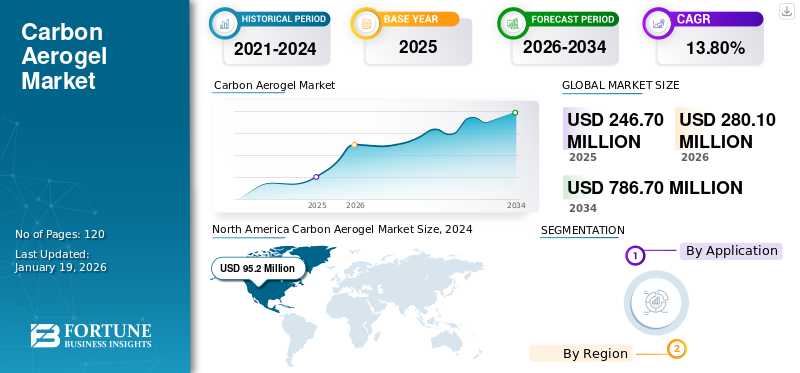
The global carbon aerogel market size was valued at USD 246.7 million in 2025. The market is projected to grow from USD 280.1 million in 2026 to USD 786.7 million by 2034, exhibiting a CAGR of 13.80% during the forecast period. North America dominated the carbon aerogel market with a market share of 43.41% in 2025.
The global carbon aerogel market is witnessing significant growth opportunities driven by various applications including energy storage, aerospace, defense, and oil & gas. Carbon-based aerogels are advanced nanostructured materials derived from the pyrolysis of organic aerogels, consisting of a highly porous three-dimensional carbon network. They are characterized by extremely low density, very high surface area, and exceptional electrical conductivity, making them suitable for advanced energy storage and insulation materials. Due to their open-cell microstructure, carbon-based aerogels allow for efficient transport of ions and molecules, which is important in supercapacitors, batteries, and filtration systems. The growing global shift toward advanced materials that enhance efficiency and sustainability is driving the market growth.
The main players working in the market include Aerogel Technologies, LLC, American Elements., Wedge India, and Aspen Aerogels, Inc.
Download Free sample to learn more about this report.
Carbon Aerogel Market Key Takeaways
 Global Market Size & Forecast
- 2025 Market Size: USD 246.7 million
- 2026 Market Size: USD 280.1 million
- 2034 Forecast Market Size: USD 786.7 million
- CAGR: 13.80% from 2026–2034
 Market Share
- North America dominated the carbon aerogel market with a 43.41% share in 2025.
- The Oil & Gas segment held the largest market share.
- The Energy Storage segment is expected to witness significant growth during the forecast period.
 Key Regional Highlights
North America
North America reached USD 107.9 million in 2025, accounting for 43.41% of the global market.
Asia Pacific
Asia Pacific generated USD 62.2 million in 2025 with a 25.00% market share and is the fastest-growing region.
Europe
Europe recorded USD 61.3 million in 2025, representing 25.00% of the global market.
U.S.
The market is driven by strong demand from aerospace, defense, and clean energy applications.
Japan
The market is supported by investments in advanced energy storage and aerospace technologies.
Read More

CARBON AEROGEL MARKET TRENDS
Growing Adoption in Energy Storage and Supercapacitors to be a Market Trend
One of the most prominent trends shaping the carbon-based aerogel market is its increasing adoption in energy storage applications, particularly in supercapacitors and batteries. Carbon-based aerogels possess exceptionally high surface area, low density, and excellent electrical conductivity, making them ideal candidates for next-generation energy storage solutions. As industries shift toward renewable energy and electric mobility, the demand for advanced materials that enable fast charging, high power density, and long cycle life continues to rise.
MARKET DYNAMICS
MARKET DRIVERS
Rising Importance of Carbon-based Aerogels in Oil & Gas Sector is fueling Market Growth
The oil and gas industry is becoming a key driver for the carbon aerogel market growth, due to its highly porous structure and strong absorbent capacity. Carbon-based aerogels are proving highly effective for oil spill response and environmental cleanup. Their ability to soak up hydrocarbons while rejecting water allows for faster recovery of spilled crude and refined products, offering a greener alternative to traditional absorbent materials. Beyond spill management, carbon-based aerogels are also being integrated into refining and filtration systems, where their large surface area and chemical durability help improve contaminant removal and enhance process efficiency.
MARKET RESTRAINTS
High Manufacturing Costs and Complex Production Processes are Hindering Market Growth
One of the major restraints of the carbon-based aerogel market is the high cost of manufacturing, driven by complex synthesis procedures and expensive precursor materials. Producing aerogel involves sol-gel processing, supercritical drying, and specialized equipment, which increases operational expenses and limits scalability. Despite their outstanding performance, the cost factor prevents their widespread use across price-sensitive industries such as packaging and consumer goods. Small-and medium-scale enterprises often struggle to adopt carbon-based aerogels due to the significant investment required in both infrastructure and technology.
MARKET OPPORTUNITIES
Growing Adoption in Aerospace and Defense Applications Brings New Opportunities
The aerospace and defense industries offer substantial opportunities for carbon aerogel adoption, driven by the need for lightweight, thermally insulating, and high-performance materials. Carbon-based aerogels provide excellent thermal management, energy absorption, and shielding capabilities, making them suitable for aircraft, spacecraft, and defense vehicles. Their low weight contributes to fuel efficiency and performance improvements, a key focus area in modern aviation and space exploration. Defense applications also benefit from their ability to absorb radar and electromagnetic waves, enhancing stealth technologies.
- According to the Observatory of Economic Complexity (OEC), the global trade value of tanks and armored vehicles reached USD 14.8 billion in 2023. Singapore led the market, accounting for 62.1% of exports, valued at USD 9.17 billion. This expanding trade highlights a significant growth opportunity for the carbon-based aerogel industry, as these materials are increasingly utilized in the production of armored vehicles.
MARKET CHALLENGES
Limited Market Awareness and Adoption Barriers Challenge Market Growth
One of the major key challenges is the limited awareness and adoption of carbon-based aerogels among potential end-users. Many industries still lack adequate knowledge about the properties, benefits, and applications of this advanced material. As a result, they often continue to rely on established alternatives such as polymers, foams, or silica aerogels, which are widely available and proven. Additionally, the perception of carbon-based aerogels as a high-cost and experimental material further discourages adoption.
Download Free sample to learn more about this report.
Segmentation Analysis
By Application
Oil & Gas Industry Fuels Carbon-based Aerogel Demand with Superior Thermal Insulation and Fire Resistance
Based on the applications, the market is classified into oil & gas, energy storage, aerospace & defense, and others.
The oil & gas segment holds the largest carbon aerogel market share, due to its porous structure and high absorbency. They can soak up oil while repelling water, which makes them effective for cleaning up oil spills and recovering crude oil or refined products. This makes them a more sustainable option compared to regular absorbents. They are also used in filtration systems during refining, where their large surface area and stability help remove contaminants more efficiently and improve operations.
Carbon-based aerogels are very important for energy storage, especially in supercapacitors and advanced batteries. They have a very high surface area, are lightweight, and conduct electricity well, which makes them great for use as electrode materials. This allows them to charge and discharge very quickly. In supercapacitors, carbon-based aerogels offer better energy storage and longer life than regular activated carbon, making them useful for electric vehicles, renewable energy systems, and consumer electronics.
The aerospace & defense sector is a significant growth area for the carbon-based aerogel market, owing to the material’s exceptional strength-to-weight ratio, low thermal conductivity, and high performance in extreme conditions. In aerospace, carbon-based aerogels are used for thermal insulation in spacecraft, aircraft cabins, and propulsion systems, where lightweight aerogel materials are crucial for fuel efficiency and payload optimization. Their ability to withstand high temperatures makes them ideal for protective layers in engines.
Carbon Aerogel Market Regional Outlook
By geography, the market is categorized into North America, Europe, Asia Pacific, Latin America, and Middle East & Africa.
North America
North America Carbon Aerogel Market Size, 2025 (USD Million)
To get more information on the regional analysis of this market, Download Free sample
North America contributed 44.00% to the global market in 2025, with a valuation of USD 107.9 million, and is projected to reach USD 122.4 million in 2026, driven primarily by advancements in aerospace, defense, and clean energy technologies. The U.S., with its established aerospace sector and extensive defense budget, is investing heavily in lightweight and high-performance materials, boosting the adoption of carbon-based aerogels. Furthermore, the region’s rising demand for renewable energy and grid-scale storage solutions creates opportunities in supercapacitors and advanced battery systems.
Asia Pacific
The Asia Pacific market was valued at USD 62.2 million in 2025, capturing 25.00% of global revenue, and is estimated to reach USD 71 million in 2026. The Asia Pacific region is the upcoming and fastest growing region in the carbon based aerogel market, supported by rapid industrialization, clean energy initiatives, and strong manufacturing ecosystems. China, Japan, and South Korea are leading investments in supercapacitors, lithium-ion batteries, and next-generation energy storage technologies, where carbon-based aerogels offer performance advantages. Additionally, Japan’s aerospace advancements and China’s expanding defense and marine industries provide significant opportunities for aerogel integration.
Europe
Europe accounted for USD 61.3 million in 2025, representing 25.00% of the global market share, and is projected to reach USD 69.3 million in 2026. Europe’s carbon-based aerogel market is strongly influenced by its regulatory push toward sustainability, carbon reduction, and advanced materials research. Countries such as Germany, France, and the U.K. are spearheading R&D initiatives focused on aerogels for clean energy storage, thermal insulation, and environmental remediation. The aerospace and automotive industries in Europe are also exploring lightweight aerogels to improve fuel efficiency and meet stringent emission norms.
Latin America
In 2025, the Latin America market stood at USD 9.4 million, representing 4.00% of global demand, and is projected to grow to USD 10.5 million in 2026. Latin America presents growing opportunities for carbon-based aerogels, particularly in oil and gas as well as environmental management applications. Countries such as Brazil, Mexico, and Venezuela, with their extensive oil production activities, face persistent challenges of spills and leaks, creating demand for efficient cleanup materials such as carbon-based aerogel. Their lightweight, high-absorption capacity makes them well-suited for marine and land-based oil remediation.
Middle East & Africa
The market in Middle East & Africa reached USD 6 million in 2025, representing 2.00% of total market revenue, and is projected to reach USD 6.9 million in 2026. The Middle East & Africa region holds significant potential for carbon-based aerogels, mainly driven by oil spill remediation, water treatment, and renewable energy applications. With its heavy reliance on oil production and marine transport, the region faces significant risks of oil spills, making carbon-based aerogels an attractive solution due to their high absorption efficiency and reusability.
COMPETITIVE LANDSCAPE
Key Industry Players
Continuous Development and Introduction of New Products by Key Companies Resulted in their Dominating Position in Market
The carbon aerogel market is highly competitive, with major players focusing on capacity expansion, sustainability, and mergers & acquisitions to strengthen their market presence. Key market players include Aerogel Technologies, LLC, American Elements., Wedge India, and Aspen Aerogels, Inc., among others. These companies compete based on product innovation, cost efficiency, and regional dominance. While global leaders dominate in developed markets, regional players are expanding aggressively in emerging economies, intensifying competition in the industry.
LIST OF KEY COMPANIES PROFILED
- Aerogel Technologies, LLC. (U.S)
- American Elements. (U.S.)
- Wedge India (India)
- Aspen Aerogels, Inc. (U.S.)
KEY INDUSTRY DEVELOPMENTS
- October 2024: Aspen Aerogels received a USD 670.6 million conditional loan commitment from the U.S. Department of Energy to expand U.S. production of aerogel and carbon-based aerogel battery materials.
- February 2022: Aspen Aerogels announced the establishment of a new advanced manufacturing facility in Statesboro, Georgia, designed to scale production of aerogel and carbon-based aerogel materials for the EV battery market.
REPORT COVERAGE
The global carbon aerogel market analysis provides market size & forecast by all the segments included in the report. It includes details on the market dynamics and market trends expected to drive the market in the forecast period. It offers information about the key regions/countries, key industry growth, new product launches, details on partnerships, mergers & acquisitions, and a number of carbon-based aerogel manufacturers in key countries. The report covers a detailed competitive landscape with information on the market share and profiles of key players.
Request for Customization to gain extensive market insights.
Report Scope & Segmentation
|
ATTRIBUTE |
DETAILS |
|
Study Period |
2021-2034 |
|
Base Year |
2025 |
|
Estimated Year |
2026 |
|
Forecast Period |
2026-2034 |
|
Historical Period |
2021-2024 |
|
Growth Rate |
CAGR of 13.80% from 2026-2034 |
|
Unit |
Value (USD Million) |
|
Segmentation |
By Application
|
|
By Region
|
Frequently Asked Questions
Fortune Business Insights says that the global market value stood at USD 280.1 million in 2026 and is projected to reach USD 786.70 million by 2034.
In 2025, the market value stood at USD 107.09 million.
The market is expected to exhibit a CAGR of 13.80% during the forecast period of 2026-2034.
The oil & gas segment led the market by application in 2025.
The expansion of the oil & gas industry is expected to be the primary driver of market growth.
Aerogel Technologies, LLC, American Elements, Wedge India, and Aspen Aerogels, Inc. are some of the leading players in the market.
North America dominated the market in 2025.
The increasing use of carbon-based aerogels in the oil & gas sector for spill cleanup, hydrocarbon recovery, and advanced filtration is expected to be a major factor driving product adoption in the coming years.



- 2021-2034
- 2025
- 2021-2024
- 120
Get 30-60 hrs Free Customization
Expand Regional and Country Coverage, Segments Analysis, Company Profiles, Competitive Benchmarking, and End-user Insights.


















Related Reports
-
US +1 833 909 2966 ( Toll Free )
-
Get In Touch With Us