Cardless ATM Market Size, Share & Industry Analysis, By Technology (QR Code, NFC, Biometric Authentication, Mobile App-Based Authentication, and Others), By Location (On-site ATM, Off-site ATM, and Mobile ATM), By End User (Banks, Independent ATM Deployers, Credit Unions, and Others), and Regional Forecast, 2026 – 2034
 Download Free Sample
Cardless ATM Market Size and Future Outlook
 Listen to Audio Version
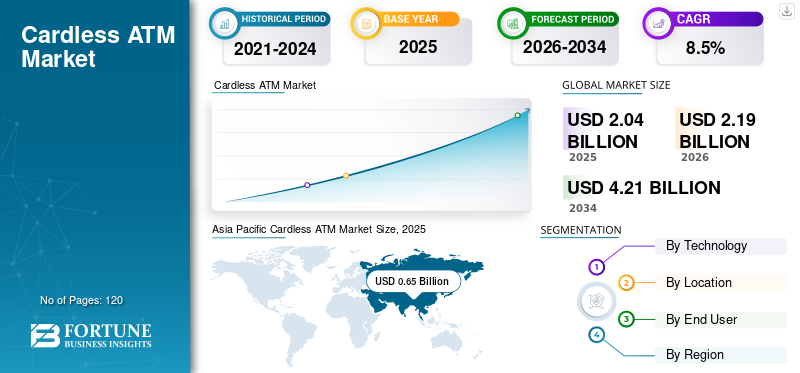
The global cardless ATM market size was valued at USD 2.04 billion in 2025. The market is projected to grow from USD 2.19 billion in 2026 to USD 4.21 billion by 2034, exhibiting a CAGR of 8.5% during the forecast period. Asia Pacific dominated the cardless ATM market with a market share of 31.86% in 2025.
The global market covers secure cash access solutions that allow customers to complete cardless cash withdrawals and access other ATM services without carrying a physical debit or credit card. These solutions use technologies such as quick response (QR) codes, near field communication (NFC), biometric verification, one-time passwords, token-based authentication, and mobile-enabled access connected with banking apps, digital wallets, and financial institution platforms. Wider mobile banking adoption, stronger demand for secure cardless ATM access, and the continued expansion of digital banking services are encouraging broader deployment of cardless ATM withdrawal solutions across branch ATM networks and off-site locations worldwide. Banks and ATM operators are also adding advanced authentication methods, real-time fraud monitoring, and mobile-first technologies into ATM operations to enhance transaction security, make cash withdrawal more convenient, and enable smoother cardless transactions throughout the banking ecosystem.
- For instance, in September 2025, Mastercard, NCR Atleos, and ITCARD introduced the Consumer Device Cardholder Verification Method, enabling mobile-authenticated cardless cash withdrawals at contactless ATMs across Europe.
NCR Atleos Corporation, Hitachi Payment Services Pvt. Ltd., Hyosung TNS Inc– Hyosung Innovue, GRG Banking Equipment Co., Ltd., OKI Electric Industry Co., Ltd., Euronet Worldwide, Inc., Mastercard Incorporated, and Fiserv, Inc. are among the major companies operating in the market.
Download Free sample to learn more about this report.
Cardless ATM Market Key Takeaways
 Global Market Size & Forecast
- 2025 Market Size: USD 2.04 billion
- 2026 Market Size: USD 2.19 billion
- 2034 Forecast Market Size: USD 4.21 billion
- CAGR: 8.5% from 2026-2034
 Market Share
- North America market held a 32.84% share in 2025, supported by mature banking infrastructure and high ATM penetration.
- The mobile app-based authentication market dominated in 2025 with USD 0.59 billion, driven by growing banking app usage and smartphone adoption.
- The off-site ATM market dominated in 2025 with USD 1.11 billion, owing to widespread deployment at high-footfall locations.
 Key Regional Highlights
North America
The market reached USD 0.67 billion in 2025, driven by mature banking infrastructure.
Asia Pacific
The market reached USD 0.65 billion in 2025, supported by mobile banking adoption.
Europe
The market is growing steadily, driven by digital banking adoption and ATM modernization.
U.S.
The market reached USD 0.54 billion in 2025, driven by broad ATM networks and smartphone penetration.
Japan
The market is estimated at USD 0.20 billion in 2026, supported by extensive ATM networks and banking app adoption.
Read More

CARDLESS ATM MARKET TRENDS
Growing Integration of Mobile-First Banking is Transforming Market Development
The cardless ATM market is steadily shifting toward mobile-first transaction models as banks and ATM operators integrate self-service terminals with banking apps, digital wallets, and real-time payment networks. Quick response (QR) codes, near field communication (NFC), biometric verification, and token-based authentication methods are gaining wider use as they allow customers to initiate cardless ATM withdrawals without carrying a physical debit card. Financial institutions are also upgrading ATM operations with app-based transaction pre-staging, dynamic authentication, and real-time fraud monitoring to reduce transaction times and strengthen security. This trend is particularly visible in markets with high mobile banking adoption, where interoperable payment systems are making cardless cash access across bank-owned ATMs, independent ATM networks, and business correspondent touchpoints. Continued integration between mobile payment infrastructure and cash-dispensing channels is expected to make cardless transactions more convenient, secure, and widely accessible.
- For instance, in October 2025, the National Payments Corporation of India enabled UPI-based cash withdrawals through MicroATMs at Business Correspondent touchpoints, expanding interoperable cardless cash access beyond conventional ATM locations.
MARKET DYNAMICS
MARKET DRIVERS
Download Free sample to learn more about this report.
Rising Adoption of Mobile Banking and Growing Demand for Secure Digital Cash Methods Driving Market Growth
Market demand is supported by the wider adoption of mobile banking, the continued expansion of digital payment ecosystems, and stronger consumer preference for convenient and secure cash withdrawal methods without physical payment cards. Banks and financial institutions continue to expand cardless ATM access by integrating banking apps, digital wallets, quick response (QR) codes, near field communication (NFC), and other authentication methods into ATM operations to make transactions more convenient while maintaining strong transaction security. Government initiatives promoting digital payments, growing smartphone penetration, and expanding real-time payment infrastructure are also encouraging financial institutions to upgrade branch ATM and off-site ATM networks with cardless cash capabilities. Alongside this, greater focus on reducing card fraud, improving operational efficiency, and delivering seamless omnichannel banking experiences is supporting the broader deployment of cardless ATM withdrawals solutions throughout developed and emerging markets.
For instance, in April 2026, Hitachi Payment Services expanded the deployment of its Android-based UPI ATMs across India, enabling interoperable cardless cash withdrawals through UPI QR authentication and supporting the country’s digital banking ecosystem.
|
Rank |
Market Driver |
Expected Impact on Market Growth |
Estimated Gross Market Growth Contribution (USD Billion) |
Impact: 2026-2028 |
Impact: 2029-2031 |
Impact: 2032-2034 |
|
1 |
Rising adoption of mobile banking and growing demand for secure digital cash methods |
High |
0.76 |
High |
High |
High |
|
2 |
Modernization of ATM networks through QR code, NFC, and mobile app-based authentication |
High |
0.62 |
High |
High |
High |
|
3 |
Increasing use of biometric verification and advanced authentication methods to improve transaction security |
Medium-High |
0.49 |
Medium |
High |
Medium |
|
4 |
Expansion of digital wallets, omnichannel banking platforms, and interoperable payment ecosystems |
Medium |
0.38 |
Medium |
High |
High |
|
5 |
Growing deployment of cardless solutions across off-site ATMs and independent ATM deployer networks |
Medium |
0.27 |
Medium |
Medium |
High |
|
6 |
Expansion of self-service banking and financial inclusion initiatives across emerging markets |
Medium-Low |
0.18 |
Low |
Medium |
High |
|
|
Total Gross Growth Contribution |
|
2.70 |
|
|
|
MARKET RESTRAINTS
High Implementation Costs and Cybersecurity Risks Limiting Product Adoption
Introducing cardless ATM solutions often requires major changes to ATM hardware, banking software, mobile applications, and transaction-security systems, making deployment costly for many financial institutions. Banks and ATM operators must link quick response (QR) codes, near field communication (NFC), biometric verification, token-based authentication, and real-time fraud monitoring with existing ATM operations while maintaining the stability of legacy banking infrastructure. The additional expense associated with software development, system testing, certification, maintenance, cybersecurity, and employee training can be difficult for smaller banks, credit unions, and independent ATM deployers with limited technology budgets. Customer concerns over mobile-device theft, phishing, account takeover, authentication failures, and weak network connectivity may also discourage the use of cardless ATM access. In addition, varying regulatory requirements and the challenge of connecting older banking systems with newer digital platforms can slow deployment across branch ATM and off-site ATM networks, particularly in price-sensitive and developing markets.
|
Rank |
Market Restraint |
Expected Impact on Market Growth |
Estimated Reduction in Market Size (USD Billion) |
Impact: 2026-2028 |
Impact: 2029-2031 |
Impact: 2032-2034 |
|
1 |
Cybersecurity risks, identity theft, fraud attempts, and vulnerabilities in mobile-based authentication systems |
High |
0.24 |
High |
High |
Medium |
|
2 |
High ATM modernization, software integration, cybersecurity, and network maintenance costs |
Medium-High |
0.17 |
High |
Medium |
Medium |
|
3 |
Uneven digital infrastructure and limited mobile banking adoption in rural and underdeveloped markets |
Medium |
0.15 |
Medium |
Medium |
Low |
|
4 |
Regulatory compliance, data privacy requirements, interoperability issues, and customer security concerns |
Medium-Low |
0.12 |
Medium |
Low |
Low |
|
|
Total Market Reduction |
|
0.68 |
|
|
|
MARKET OPPORTUNITIES
Expansion of Digital Banking Infrastructure and Financial Inclusion Initiatives Creating Significant Market Opportunities
The steady development of digital banking infrastructure and wider financial inclusion programs is opening fresh opportunities for banks, ATM operators, and cardless ATM solution providers. Greater spending on branch modernization, self-service banking, and interoperable payment networks are encouraging financial institutions to extend cardless ATM access across cities, smaller towns, and underserved communities. By linking banking apps, digital wallets, quick response (QR) codes, near field communication (NFC), and biometric verification with ATM systems, banks can offer secure cash withdrawal without requiring customers to carry physical cards. These services also make everyday cash access easier and can reduce dependence on branch staff. Furthermore, closer cooperation among banks, fintech firms, payment networks, and ATM technology providers is further supporting the introduction of modern self-service banking solutions across developed and emerging markets.
- For instance, in February 2026, Emirates NBD expanded its cardless cash withdrawal service through ENBD X, allowing customers to access cash from ATMs through the mobile banking application without using a physical debit card.
MARKET CHALLENGES
Balancing Advanced Authentication Technologies with Security and Convenience Creating Challenges for Market Growth
For market participants, a major challenge is introducing faster and more convenient cash access methods without weakening transaction security or making the user experience too complicated. Banks, ATM operators, and technology providers must support quick response (QR) codes, near field communication (NFC), biometric verification, one-time passwords, token-based authentication, and mobile banking applications across different devices and banking platforms. However, customers also expect cardless ATM withdrawals to remain simple, reliable, and quick, even when mobile networks are weak or authentication systems fail. This places additional pressure on providers to strengthen cybersecurity, improve real-time fraud monitoring, maintain compatibility with legacy ATM infrastructure, and meet changing data-protection and banking regulations. Companies must also manage software integration issues, inconsistent customer awareness, device compatibility concerns, and varying authentication requirements across branch ATM and off-site ATM networks.
Segmentation Analysis
By Technology
Mobile App-Based Authentication Segment Led the Market Owing to High Adoption of Mobile Banking and Seamless Account Integration
By technology, the market is segmented into QR Code, NFC, biometric authentication, mobile app-based authentication, and others (OTP, token-based authentication, etc.).
Mobile app-based authentication accounted for the largest cardless ATM market share in 2025, reaching a revenue of USD 0.59 billion. The segment’s dominance is mainly driven by the growing use of banking apps, strong smartphone penetration, and banks’ ability to connect cardless ATM access with their existing digital banking platforms. Customers can initiate a cash withdrawal through a verified mobile application and complete the transaction at an ATM using a generated code, token, or in-app approval. This approach provides customers with familiar and convenient user experience while enabling financial institutions to use account-level security controls, transaction limits, real-time alerts, and fraud monitoring. Rising preference for faster and more convenient cardless ATM withdrawals, combined with increasing investment in omnichannel banking and digital wallets, is likely to keep the segment in a leading position over the forecast period.
- For instance, Bank of America allows customers to use smartphones at its cardless ATMs after adding an eligible debit card to a digital wallet, enabling cash withdrawals, deposits, balance inquiries, and other ATM services without inserting a physical card.
Biometric authentication is expected to grow at the fastest CAGR of 11.6% from 2026 to 2034. This growth is supported by increasing demand for stronger identity verification, reduced reliance on passwords and physical cards, and improved protection against account takeover, PIN theft, and unauthorized cardless transactions. Fingerprint, facial, iris, and palm-vein recognition technologies allow financial institutions to connect ATM access with unique customer characteristics, strengthening transaction security while reducing authentication time. Continued improvements in biometric sensors, artificial intelligence-based identity matching, liveness detection, and integrated banking infrastructure are also encouraging banks and ATM manufacturers to introduce biometric verification across branch and off-site ATM networks. The segment is likely to witness wider adoption in markets with increasing investments in digital identity systems and safer self-service banking systems.
To know how our report can help streamline your business, Speak to Analyst
By Location
Off-site ATM Segment Led the Market Owing to Widespread Deployment at High-footfall Locations
By location, the market is segmented into on-site ATM, off-site ATM, and mobile ATM.
In 2025, the off-site ATM segment held the largest market share, generating revenue of USD 1.11 billion. The segment’s strong position is largely due to the widespread installation of ATMs across shopping centers, transportation hubs, retail outlets, petrol stations, educational institutions, entertainment venues, and other high-footfall locations. Off-site ATMs make it easier for customers to use cardless cash withdrawal services beyond traditional bank branches, enabling transactions through banking apps, quick response (QR) codes, near field communication (NFC), biometric verification, and token-based authentication. The rising need for 24/7 cash access, wider ATM networks, and increasing collaboration between banks and independent ATM deployers are likely to support continued growth of off-site cardless ATM operations across developed and emerging markets.
The mobile ATM segment is projected to register the fastest growth, expanding at a CAGR of 9.5% from 2026 to 2034. This growth is being driven by rising demand for temporary and flexible cash-access facilities in rural communities, disaster-affected areas, large public events, seasonal commercial locations, and regions with limited banking infrastructure. Mobile ATMs can be set up quickly to provide cardless cash access where permanent ATM installation may be expensive or difficult to manage. Increasing use of wireless connectivity, secure mobile banking platforms, biometric authentication, and real-time transaction monitoring is also improving the reliability and security of these units. Banks, government agencies, and financial service providers are expected to increase mobile ATM deployment to improve financial inclusion and provide continuous cash withdrawal services across underserved locations.
By End User
Extensive ATM Networks and Strong Digital Banking Integration Boosted Banks Segment Growth
By end user, the market is segmented into banks, independent ATM deployers, credit unions, and others (retailers, financial service providers, etc.).
The banks segment accounted for the largest market share in 2025, as they operate extensive branch and off-site ATM networks and can directly integrate these machines with customer accounts, banking apps, and transaction-security systems. Commercial and retail banks are adding quick response (QR) codes, near field communication (NFC), biometric verification, mobile app-based authentication, and token-based authentication to existing ATM operations to make cardless ATM withdrawals more secure and convenient. Their strong market position also reflects high customer trust, established banking infrastructure, wide ATM availability, and the ability to link cardless cash services with digital wallets, mobile banking platforms, fraud monitoring systems, and core banking networks. Continued investments in branch upgrades, self-service banking, and omnichannel platforms are expected to support the steady adoption of cardless ATM solutions across the banking sector.
Independent ATM deployers are expected to grow at a fastest CAGR of 11.3% over the forecast period. This rise is driven by the expanding presence of off-site ATM networks in shopping centers, transport hubs, retail outlets, petrol stations, entertainment venues, and underserved areas. These operators are adopting cardless ATM access to reduce transaction time, improve ease of use, and offer cash withdrawal services without a physical card. Cooperation with banks, payment networks, fintech companies, and digital wallet providers is helping Independent ATM deployers to introduce interoperable authentication methods and real-time transaction monitoring. Their focus on flexible placement and high-traffic locations is likely to increase adoption across both developed and emerging markets.
Cardless ATM Market Regional Outlook
By geography, the market is categorized into Europe, North America, Asia Pacific, South America, and the Middle East & Africa.
North America
Asia Pacific Cardless ATM Market Size, 2025 (USD Billion)
To get more information on the regional analysis of this market, Download Free sample
North America held the largest market share in 2025, generating revenue of USD 0.67 billion, supported by its mature banking infrastructure, high ATM penetration, and widespread use of mobile banking services across the U.S. and Canada. Banks and independent ATM deployers are increasingly integrating cardless cash access through banking applications, quick response (QR) codes, near field communication (NFC), biometric verification, and token-based authentication to improve transaction convenience and security. The region also benefits from strong consumer adoption of digital wallets, advanced fraud-monitoring systems, and well-developed branch-based and off-site ATM networks. Continued investment in ATM modernization, omnichannel banking, and self-service financial technologies is further expanding cardless cash withdrawal capabilities and supporting sustained market growth across North America.
U.S. Cardless ATM market
The U.S. is projected to lead the North American market. The market reached approximately USD 0.54 billion in 2025. Growth is mainly supported by the country’s mature banking infrastructure, broad ATM network, high smartphone penetration, and widespread use of mobile banking services. Banks and independent ATM deployers are increasing the availability of cardless ATM access through banking apps, digital wallets, quick response (QR) codes, near field communication (NFC), biometric verification, and token-based authentication. Demand is especially strong across branch-based ATM and off-site ATM locations, where customers increasingly prefer quicker and safer cardless cash withdrawals. Ongoing spending on ATM modernization, omnichannel banking, real-time fraud monitoring, and self-service banking technologies is expected to support market expansion.
Europe
Europe is expected to grow at a stable pace over the forecast period, supported by its mature banking infrastructure, high use of digital banking services, and continued modernization of branch ATM and off-site ATM networks. Banks and independent ATM deployers are expanding cardless ATM access through banking apps, digital wallets, quick response (QR) codes, near field communication (NFC), biometric verification, and token-based authentication. Demand across the region is also shaped by strict data-security requirements, rising focus on secure self-service banking, and regular upgrades of aging ATM systems. Germany, the U.K., France, Italy, and Russia remain important markets due to their developed financial sectors, broad ATM coverage, strong mobile banking adoption, and ongoing investment in omnichannel banking and real-time fraud monitoring systems.
U.K. Cardless ATM market
The U.K. market is likely to reach around USD 0.08 billion in 2026, representing roughly 16.8%% of global sales.
Germany Cardless ATM market
Germany’s market is projected to reach approximately USD 0.08 billion in 2026, equivalent to around 17.9% of global sales.
Asia Pacific
Asia Pacific as the second-largest regional market in 2025, generating revenue of USD 0.65 billion. However, the region is expected to record the fastest growth over the forecast period, supported by rapid mobile banking adoption, expanding digital payment ecosystems, and ongoing upgrades to ATM infrastructure across leading economies. China, India, Japan, and South Korea account for a substantial share of regional demand due to their large banking customer bases, extensive ATM networks, rising smartphone penetration, and increasing use of banking applications and digital wallets. Demand for cardless ATM solutions is also rising as banks and independent ATM deployers expand QR code, NFC, biometric, and mobile app-based authentication across branch and off-site ATM locations. Higher investment in financial inclusion, self-service banking, real-time fraud monitoring, and interoperable payment systems is expected to help Asia Pacific become the leading regional market from 2026 onward.
China Cardless ATM market
China’s market is projected to remain the dominant one in the Asia Pacific region. The market is expected to reach around USD 0.21 billion in 2026, representing roughly 29.3% of global sales.
Japan Cardless ATM market
The Japan market is estimated to reach around USD 0.20 billion in 2026, accounting for roughly 13.5% of the global sales.
India Cardless ATM market
The Indian market in 2026 is estimated to reach around USD 0.05 billion, accounting for roughly 27.9% of global sales.
Middle East & Africa
The Middle East & Africa is witnessing steady growth in the market, supported by increasing digital banking adoption, expanding ATM networks, and rising investment in modern banking infrastructure across key regional markets. Banks and independent ATM deployers are increasingly introducing cardless ATM access through banking apps, quick response (QR) codes, near field communication (NFC), biometric verification, and token-based authentication to improve customer convenience and transaction security. GCC countries are driving regional demand, backed by financial sector digitalization, smart government initiatives, growing cashless payment ecosystems, and continued investment in banking technology. South Africa is also contributing to market growth through the expansion of mobile banking services, ATM modernization, and wider deployment of secure self-service banking solutions. These developments are supporting the adoption of advanced cardless ATM solutions across the banking and financial services sector.
GCC Cardless ATM market
The GCC market is projected to reach around USD 0.04 billion in 2026, representing roughly 41.0% of the global sales.
South America
South America’s market is being supported by growing mobile banking adoption, wider ATM coverage, and continued investment in digital financial services across Brazil, Argentina, Chile, Peru, and Colombia. Demand is mainly linked to the expansion of banking apps, digital wallets, quick response (QR) codes, near field communication (NFC), biometric verification, and other secure authentication methods. Brazil remains the leading regional market due to its large banking customer base, extensive branch ATM and off-site ATM networks, and strong use of mobile banking services. Meanwhile, Chile, Peru, and Colombia are witnessing higher adoption as banks and independent ATM deployers modernize self-service channels and improve cardless cash withdrawal services. Together, these developments are encouraging wider use of cardless ATM solutions across the region’s banking and financial services sector.
Brazil Cardless ATM market
The Brazil market is projected to reach around USD 0.07 billion in 2026, representing roughly 55.8% of the global sales.
COMPETITIVE LANDSCAPE
Key Industry Players
Competitive Advantage is Driven by Technology Integration, Transaction Security, and Global ATM Network Presence
The global market has a relatively consolidated competitive structure, with competition mainly determined by ATM technology capabilities, software integration, transaction security, equipment reliability, service networks, and relationships with banks and independent ATM deployers. Leading companies, including NCR Atleos Corporation, Hyosung TNS Inc. (Hyosung Innovue), GRG Banking Equipment Co., Ltd., Hitachi Payment Services Pvt. Ltd., have established strong market positions through ATM hardware, cardless cash solutions, transaction-processing platforms, digital authentication technologies, and ATM management services. Market participants are increasing their focus on cardless ATM access, quick response (QR) codes, near field communication (NFC), biometric verification, mobile app-based authentication, cloud-based ATM management platforms, and advanced cybersecurity systems to improve operational control and strengthen transaction security.
Competition is increasingly centered on providing secure, convenient, and reliable cardless transactions across branch ATM and off-site ATM networks. Companies are integrating ATMs with banking apps, digital wallets, omnichannel banking platforms, real-time fraud monitoring, remote diagnostics, predictive maintenance, and interoperable authentication methods. These technologies help improve ATM availability, reduce operating expenses, strengthen transaction security, and make cash withdrawal easier for customers. In addition, companies are also developing partnerships with banks, fintech companies, payment networks, retailers, and independent ATM deployers to expand their service coverage and improve their long-term market presence. Their product portfolios continue to evolve through investments in ATM manufacturing, cardless cash access, ATM outsourcing, cash recycling, and multivendor ATM software platforms.
- For instance, in August 2025, NCR Atleos Corporation expanded its relationship with FCTI, Inc. to provide thousands of new ATMs and terminal-driving services across FCTI’s U.S. network, strengthening its ATM technology and managed-service presence.
LIST OF KEY CARDLESS ATM COMPANIES PROFILED
- NCR Atleos Corporation (U.S.)
- Hyosung TNS Inc. – Hyosung Innovue (South Korea)
- GRG Banking Equipment Co., Ltd. (China)
- Hitachi Payment Services Pvt. Ltd. (India)
- OKI Electric Industry Co., Ltd. (Japan)
- Fiserv, Inc. (U.S.)
- Auriga S.p.A. (Italy)
- Mastercard Incorporated (U.S.)
- Euronet Worldwide, Inc. (U.S.)
- Genmega Inc. (South Korea)
KEY INDUSTRY DEVELOPMENTS
- May 2026: Fiserv, Inc. entered into an agreement with Bridgeport Partners to establish a joint venture comprising its ATM Managed Services, Cash & Logistics, and MoneyPass businesses, strengthening its ATM network management capabilities and expanding surcharge-free cash access services.
- October 2025: Euronet Worldwide, Inc. expanded its EFT Processing network to more than 56,000 active ATMs and advanced its Ren payment platform through agreements with banks across India, Indonesia, Pakistan, and the Philippines.
- September 2025: OKI Electric Industry Co., Ltd. partnered with Lipi Data Systems Ltd. to begin local ATM production in India, expanding manufacturing capacity and strengthening the supply of advanced self-service banking equipment for Indian financial institutions.
- May 2025: GRG Banking Equipment Co., Ltd. supported Kienlong Bank in presenting its smart digital banking ecosystem, incorporating automated self-service technologies and digital financial solutions designed to improve banking accessibility and customer experience.
- April 2025: Hyosung TNS Inc. introduced the Hyosung 5XL and 5XW cash-dispensing ATMs, featuring contactless readers, optional fingerprint scanners, barcode readers, enhanced security systems, and flexible deployment across branch and off-site locations.
REPORT COVERAGE
The global cardless ATM market analysis evaluates market size and forecasts across technology, ATM location, and end-user segments. It examines key growth drivers, restraints, opportunities, challenges, and emerging trends influencing market development. The report assesses mobile banking adoption, digital wallet integration, ATM modernization, transaction security, fraud monitoring, cloud-based ATM management, and interoperable authentication technologies. It also covers product launches, partnerships, network expansions, mergers & acquisitions, competitive positioning, market shares, and profiles of leading industry participants.
Request for Customization to gain extensive market insights.
Report Scope & Segmentation
| ATTRIBUTE | DETAILS |
| Study Period | 2021-2034 |
| Base Year | 2025 |
| Estimated Year | 2026 |
| Forecast Period | 2026-2034 |
| Historical Period | 2021-2024 |
| Growth Rate | CAGR of 8.5% from 2026-2034 |
| Unit | Value (USD Billion) |
| Segmentation | By Technology, Location, End User, and Region |
| By Technology |
|
| By Location |
|
| By End User |
|
| By Region |
|
Frequently Asked Questions
According to Fortune Business Insights, the global market value stood at USD 2.04 billion in 2025 and is projected to reach USD 4.21 billion by 2034.
In 2025, the Asia Pacific’s market value stood at USD 0.65 billion.
The market is expected to exhibit a CAGR of 8.5% during the forecast period (2026-2034).
By end-user, the banks segment led the market.
Withdrawals, ATM network modernization, digital wallet integration, and increasing use of QR codes, NFC, biometric verification, and mobile app-based authentication are the key factors driving market growth.
NCR Atleos Corporation, Hyosung TNS Inc.– Hyosung Innovue, GRG Banking Equipment Co., Ltd., Hitachi Payment Services Pvt. Ltd., OKI Electric Industry Co., Ltd. are among the top players in the market.
North America held the largest market share in 2025.


- 2021-2034
- 2025
- 2021-2024
- 120
Get 30-60 hrs Free Customization
Expand Regional and Country Coverage, Segments Analysis, Company Profiles, Competitive Benchmarking, and End-user Insights.















Related Reports
-
US +1 833 909 2966 ( Toll Free )
-
Get In Touch With Us