Cashless Payments Market Size, Share & Industry Analysis, By Product (Groceries, Beauty & Personal Care, Fresh Food & Beverages, Electronics & Toys, and Others) By Channel Type (Mobile Application and Web Portal), and Regional Forecast, 2025-2032
 Download Free Sample
(Offer valid till 30th Sep 2026)

KEY MARKET INSIGHTS
 Listen to Audio Version
The global cashless payments market size was valued at USD 139.61 billion in 2024. The market is projected to grow from USD 152.15 billion in 2025 to USD 295.08 billion by 2032, exhibiting a CAGR of 9.92% during the forecast period. North America dominated the cashless payments market with a market share of 35.24% in 2024.
The cashless payments market is experiencing rapid global expansion, driven by increasing demand for digital payment solutions, shifting consumer preferences, mobile adoption, and fintech innovation. Moreover, IoT enables a wide range of devices such as smartphones, smartwatches, fitness trackers, and connected cars to function as payment tools. This allows users to make secure, contactless payments processed simply by tapping or waving their device near a point-of-sale terminal, leading to the growth of the market. Furthermore, wearable devices with payment options technology add convenience and reduce reliance on physical cards or cash, supplementing the market expansion.
Key players in the market include Visa Inc., Mastercard Inc., Apple Pay, Google Pay, Samsung Pay, and PayPal. These players focus on enhancing user convenience and security while expanding contactless and mobile phone wallet adoption, and integrating value-added services, including Buy Now, Pay Later (BNPL).
The COVID-19 pandemic significantly accelerated the market growth globally. Many consumers shifted toward cash free and digital payment methods in light of concerns regarding virus transmission through physical cash. According to the World Bank, over 80 million adults in India and around 100 million adults in China made their first digital merchant payment after the pandemic. COVID-19 also changed shopping habits and increased reliance on online and mobile payments, boosting online shopping, driving demand for cashless payment solutions, and increasing financial inclusion globally.
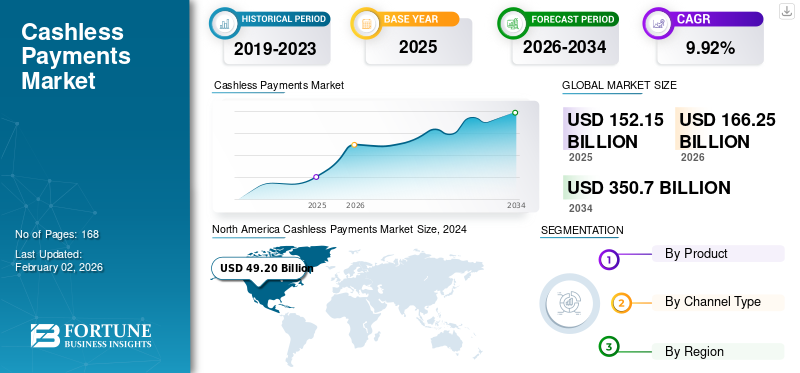
Download Free sample to learn more about this report.
Cashless Payments Market Takeaways
 Global Market Size & Forecast
- 2024 Market Size: USD 139.61 billion
- 2025 Market Size: USD 152.15 billion
- 2032 Forecast Market Size: USD 295.08 billion
- CAGR: 9.92% from 2025–2032
 Market Share
- North America dominated the cashless payments market with a 35.24% share in 2024.
- The groceries segment accounted for the largest market share in 2024.
- The fresh food & beverages segment is projected to grow at the fastest CAGR during the forecast period.
 Key Regional Highlights
North America
North America remained the leading regional market in 2024, supported by strong digital payment adoption, advanced payment infrastructure, and rapid growth in mobile wallets.
Europe
Europe held the second-largest market share in 2024, driven by widespread contactless payment adoption, regulatory support, and increasing use of real-time payment technologies.
Asia Pacific
Asia Pacific is expected to register the fastest CAGR during the forecast period, fueled by rapid digital transformation, expanding mobile wallet usage, and supportive government initiatives.
U.S.
The U.S. leads the North American market, supported by widespread contactless payment terminals, real-time payment systems, and growing adoption of digital wallets and BNPL services.
Japan
Japan is expected to contribute significantly to Asia Pacific's growth through government-led cashless initiatives, increasing smartphone penetration, and expanding digital payment adoption.
Read More

MARKET DYNAMICS
MARKET DRIVERS
Fintech Innovations to Boost Market Growth
Fintech innovations are central to the swift growth of contactless payments by introducing technologies that make transactions faster, safer, and more convenient. Key contributions include mobile payments and digital wallets, which allow users to pay seamlessly through smartphones, eliminating the need for physical cash or cards. Cashless payment solutions, driven by near-field communication (NFC), further enhance speed and hygiene, especially in the retail sector. Fintech has also integrated biometric authentication into payment systems, including fingerprints and facial recognition, boosting security and consumer trust. Blockchain technology and cryptocurrencies enable secure, transparent, and low-cost transactions, while neobanks leverage these fintech advancements to offer efficient, user-friendly online banking and cross-border payments services. Thus, fintech is building advanced infrastructure for a cashless economy, making e-payments more accessible and inclusive for consumers and businesses globally, driving the cashless payments market growth.
MARKET RESTRAINTS
Cybersecurity and Fraud Risks to Hinder Market Expansion
The rapid growth of cashless payments has significantly expanded the attack surface for cybercriminals, making the sector a prime target for increasingly sophisticated threats. Key risks include account takeover (ATO) fraud, data breaches, and payment scams that exploit vulnerabilities in digital wallets, hampering market penetration. Cybercriminals use tactics such as phishing, malware, and AI-powered bots to steal credentials, create synthetic identities, and intercept transactions in real time. In addition, the speed of instant payments leaves little time for fraud detection, enabling scams such as business email compromise (BEC) and authorized push payment fraud to proliferate.
MARKET OPPORTUNITIES
Financial Inclusion in Emerging Markets to Offer Potential Growth Opportunities
Advancing financial inclusion across developing economies provides lucrative growth opportunities in the market. Numerous people in regions, including Africa, Southeast Asia, and Latin America, remain unbanked or underbanked, lacking access to traditional financial services. By leveraging mobile wallets, QR code payments, and agent banking, fintech companies can bridge this gap, enabling secure and convenient transactions for underserved populations. This drives economic participation and growth and opens a vast new customer base for payment providers, fostering innovation and competition in the market.
CASHLESS PAYMENTS MARKET TRENDS
Integration of Biometrics and AI in Contactless Payments is an Emerging Market Trend
A leading trend in the contactless payment market is the rapid integration of biometric authentication and artificial intelligence (AI) to enhance security, user experience, and fraud prevention. Advanced biometrics such as facial recognition and fingerprint scanning are integrated into payment devices and digital wallets, enabling faster and safer transactions. Consequently, AI technologies such as machine learning and real-time analytics are used to detect fraudulent activities, personalize user experience, and automate transaction processes. These innovations are driving consumer trust and convenience, supporting market growth.
Segmentation Analysis
By Product
Last-Minute Needs and Instant Availability of Items Propelled Groceries Segment Growth
Based on product, the market is segmented into groceries, beauty & personal care, fresh food & beverages, electronics & toys, and others.
The groceries segment accounted for the largest cashless payments market share in 2024. It includes products such as breakfast & cereals, pantry staples, frozen foods, snacks, snacks & munchies, instant foods, baked goods, and fresh produce (meat and meat alternatives, dairy, vegetables & fruits). Consumers in urban areas seek time-saving and convenient solutions and rely more on quick home delivery for last-minute needs. Moreover, an increasing number of working individuals further strengthens demand for quick grocery delivery, supplementing the segmental growth.
The fresh food & beverages segment is expected to grow at the fastest CAGR over the forecast period. The growth is attributed to impulse buying due to food cravings and thirst, together with the convenience of ordering and receiving these items quickly. Due to tight work schedules, busy professionals order food outside instead of cooking at home. Thus, instant delivery of fresh food & beverages fills this gap promptly, supporting the segment growth.
By Channel Type
Huge Base of Smartphone Users Boosted Mobile Application Segment Growth
The market is segmented into mobile application and web portal based on channel type.
The mobile application segment contributed the highest revenue share in 2024 due to the easy accessibility of the internet and growing penetration of smartphones. Most of the market’s audience opt for mobile-first solutions as they rely on smartphones for day-to-day activities. Moreover, payments apps are easily integrated with device-specific features, including cameras for QR code scanning, GPS for precise location-based delivery, and mobile wallets for instant payments. GPS integration in quick commerce deliveries enables faster deliveries, boosting segmental growth.
Meanwhile, the web portal segment is anticipated to expand at a considerable CAGR over the forecast period. The segment's growth is likely to be driven by factors such as ease of larger screens with enhanced viewing experience, product details, secure environment, ease of input for complex orders, and perceived professionalism, together with no restriction for app storage.
Cashless Payments Market Regional Outlook
By geography, the market is categorized into North America, Europe, Asia Pacific, South America, and the Middle East & Africa.
North America
North America Cashless Payments Market Size, 2024 (USD Billion)
To get more information on the regional analysis of this market, Download Free sample
North America accounted for the largest share of the global market. The growth is primarily driven by increasing adoption of digital payments, an increase in digital wallets, mobile-first payment behaviors, and rapid e-commerce expansion. This shift is further supported by robust internet penetration, government initiatives, and a highly developed payment infrastructure encouraging merchant readiness and innovation.
The U.S. leads the market in North America as contactless payment terminals are now standard across most U.S. retail outlets, and over 80% of card-present transactions were contactless-enabled by the end of 2023, according to Cashfree Payments India Private Limited, an Indian fintech company. Moreover, the emergence of real-time payment rails, such as FedNow and RTP, along with the popularity of BNPL services and digital wallets such as Apple Pay, has made cashless payments more accessible, propelling the U.S. to the forefront of the global market.
Download Free sample to learn more about this report.
Europe
Europe accounted for the second-largest market share in 2024. The growth is attributed to a rapid shift from cash to digital methods, fueled by widespread smartphone penetration, strong adoption of contactless solutions, and changing consumer preferences, especially among the younger generation who rely on mobile wallets for daily transactions. Furthermore, regulatory support, pan-European integration initiatives, and innovative payment technologies such as real-time and account-to-account (A2A) payments are also accelerating regional market growth. Card payments remain dominant, but instant and seamless payment alternatives are gaining traction, reflecting Europe’s demand for fast, secure, and convenient digital transactions.
Asia Pacific
The Asia Pacific market is expected to expand at the fastest CAGR over the assessment period. The market's growth is propelled by rapid digital transformation, high smartphone and internet penetration, and the explosive rise of mobile wallets and QR code-based payments. Government initiatives in countries such as India, China, and Japan actively promote cashless cultures, while platforms such as Alipay, WeChat Pay, and UPI have revolutionized daily transactions. The booming e-commerce sector and increasing consumer preference for secure cashless payment methods further accelerate its adoption. Moreover, financial inclusion efforts and digital banking innovations are also expanding access, making Asia Pacific the world’s fastest-growing and most dynamic market.
South America and Middle East & Africa
The market in South America and the Middle East & Africa is projected to experience steady growth driven by fintech innovations, government-backed financial inclusion initiatives, and the rise of real-time payments systems such as Brazil’s Pix, which has dramatically increased digital transaction volumes. E-commerce growth and regulatory support are further likely to accelerate this shift, while mobile wallets and instant payment apps reshape consumer behavior. In the Middle East & Africa, government efforts to digitize economies are driving broader adoption of cashless solutions and expanding financial access.
COMPETITIVE LANDSCAPE
Key Industry Players
Continuous Innovation in Product Offerings and Strategic Collaborations is Likely to Help Key Players Gain Increased Market Share
The global cashless payments market is fierce, with leading players such as PayPal, Apple Pay, Google Pay, Alipay, Visa, Mastercard, and Stripe dominating through extensive user bases and broad merchant networks. These companies compete by continuously innovating and launching new features such as BNPL, real-time payments, and AI-driven fraud prevention to enhance user experience and trust. Major growth strategies include expanding digital wallet adoption, integrating biometric authentication, forging strategic partnerships, and scaling up infrastructure for instant, smooth cross-border payments. Additionally, players undertake mergers and acquisitions, enabling them to increase their market share, accelerate technology adoption, and enter new geographic markets. Furthermore, the entry of new market players makes the competitive landscape more aggressive, intensifying the rivalry.
LIST OF KEY CASHLESS PAYMENT COMPANIES PROFILED
- Visa Inc. (U.S.)
- Mastercard Inc. (U.S.)
- Stripe (Ireland)
- PayPal Holdings, Inc. (U.S.)
- Adyen (Netherlands)
- Ant Group (China)
- Shopify Payments (Canada)
- Global Payments Inc. (U.S.)
- Checkout.com (U.K.)
- Square, Inc. (U.S.)
KEY INDUSTRY DEVELOPMENTS
- February 2025: Shopify, a global commerce and integrated payment solution company, renewed its partnership with Affirm, a payment network company, to accelerate its global expansion plans. With early access, Shopify merchants in Canada and the U.K. can now offer shoppers the Shop Pay Installments feature, marking the product’s first availability outside the U.S., and it is exclusively powered by Affirm.
- February 2025: India-based company, Cashfree Payments, raised USD 53 million in a funding round led by Korean digital entertainment giant, KRAFTON, and current investor Apis Growth Fund II. This raised funding is set to broaden Cashfree’s payments portfolio and increase market share.
- December 2024: Visa Inc. announced the acquisition of Featurespace, a real-time machine learning and AI solutions provider that prevents financial crime and fraud. This acquisition aims to enhance Visa’s fraud protection capabilities and improve security for its customers worldwide.
- December 2024: Mastercard Inc. announced the completion of its acquisition of Recorded Future, an advanced cyber threat intelligence company. With this acquisition, Mastercard aims to leverage and add Recorded Future’s AI-driven threat intelligence capabilities to its cybersecurity services, identity solutions, and real-time fraud scoring systems, enabling it to offer better customer support.
- January 2024: Google India Digital Services, Google Pay service provider, and NPCI International Payments Ltd (NIPL) agreed to expand UPI payments to countries outside India. With this development, Indian travelers can make payments using Google Pay in other countries, eliminating the need to carry cash or switch to international payment gateways.
REPORT COVERAGE
The global cashless payments market report provides market size & forecast by all the segments included in the report. It details the market trends and dynamics expected to lead the market over the forecast period. In addition, it provides information on key industry developments, new product launches, and details on partnerships, mergers & acquisitions. It covers a detailed competitive landscape with information on the market share and profiles of key players.
Request for Customization to gain extensive market insights.
Report Scope & Segmentation
|
ATTRIBUTE |
DETAILS |
|
Study Period |
2019-2032 |
|
Base Year |
2024 |
|
Estimated Year |
2025 |
|
Forecast Period |
2025-2032 |
|
Historical Period |
2019-2023 |
|
Growth Rate |
CAGR of 9.92% from 2025-2032 |
|
Unit |
Value (USD Billion) |
|
Segmentation |
By Product
|
|
By Channel Type
|
|
|
By Region
|
Frequently Asked Questions
Fortune Business Insights says that the global market value will stand at USD 152.15 billion in 2025 and is projected to record a valuation of USD 295.08 billion by 2032.
In 2024, the market value stood at USD 139.61 billion.
The market is projected to grow at a CAGR of 9.92% during the forecast period of 2025-2032.
By product, the groceries segment led the market in 2024.
Shifting consumer preferences, mobile adoption, and fintech innovation drive market growth.
Visa Inc., Mastercard Inc., Apple Pay, Google Pay, Samsung Pay, and PayPal are the top players in the market.
North America dominated the market in 2024.
Financial inclusion in emerging markets and integrating AI tools in contactless solutions will likely encourage consumers to opt for digital cashless payments and drive market expansion.



- 2019-2032
- 2024
- 2019-2023
- 168
-
(Offer valid till 30th Sep 2026)
Get 30-60 hrs Free Customization
Expand Regional and Country Coverage, Segments Analysis, Company Profiles, Competitive Benchmarking, and End-user Insights.



















Related Reports
-
US +1 833 909 2966 ( Toll Free )
-
Get In Touch With Us