Cell To Pack Battery Market Size, Share & Industry Analysis, By Battery Type (Lithium Iron Phosphate (LFP), Nickel Manganese Cobalt (NMC), Nickel Cobalt Aluminum (NCA), Solid-State Batteries, and Others), By Cell Format (Prismatic Cells, Cylindrical Cells, and Pouch Cells), By Vehicle Type (Passenger Car, Van, Truck, and Bus), By Propulsion Type ( BEV and HV), By Battery Capacity (Below 50 kWh, 50-100 kWh, and Above 100 kWh), and Regional Forecast, 2026-2034
 Download Free Sample
(Offer valid till 31st Oct 2026)

Cell To Pack Battery Market Size and Future Outlook
 Listen to Audio Version
The global cell to pack battery market size was valued at USD 35.28 billion in 2025 and is projected to grow from USD 45.45 billion in 2026 to USD 143.86 billion by 2034, exhibiting a CAGR of 15.5% during the forecast period. Asia Pacific dominated the cell to pack battery market with a market share of 58.42% in 2025.
The Cell-to-Pack (CTP) battery industry focused on battery pack architectures that eliminate traditional battery module structures and directly integrate cells into the battery pack. This design increases energy density, reduces weight, lowers manufacturing costs, and improves vehicle range and space utilization. CTP technology is widely adopted in electric vehicles (EVs), energy storage systems, and commercial electric transportation. Growing EV production, advancements in lithium-ion battery technology, and demand for higher-performance battery systems are key factors driving market growth globally.
The market is driven by the rapid growth of electric vehicle adoption, increasing demand for high-energy-density batteries, and the need to reduce battery manufacturing costs. Advances in lithium-ion technology, government incentives supporting EV deployment, and automakers’ focus on extending driving range and improving vehicle efficiency further accelerate market expansion.
Major players in the market include CATL, BYD, LG Energy Solution, CALB, SVOLT Energy, Gotion High-Tech, EVE Energy, Panasonic Energy, Samsung SDI, and SK On. They compete through advanced battery architectures, higher energy density solutions, cost-efficient manufacturing, fast-charging capabilities, and strategic partnerships with electric vehicle manufacturers. Companies are increasingly focusing on CTP innovation, battery safety enhancement, and large-scale production capacity expansion to strengthen their market positions.
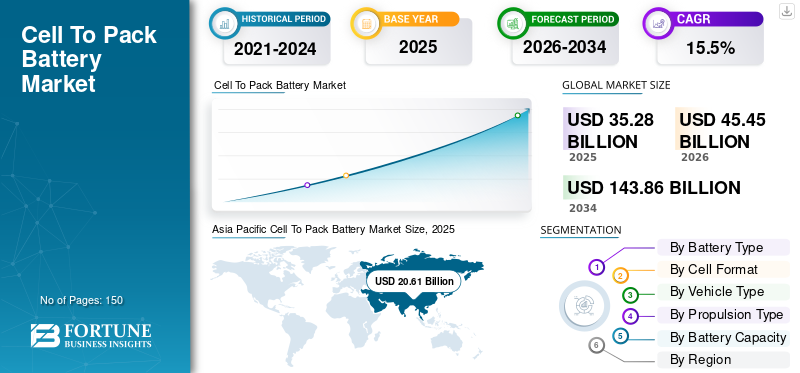
Download Free sample to learn more about this report.
Cell To Pack Battery Market Takeaways
 Global Market Size & Forecast
- 2025 Market Size: USD 35.28 billion
- 2026 Market Size: USD 45.45 billion
- 2034 Forecast Market Size: USD 143.86 billion
- CAGR: 15.5% from 2026–2034
 Market Share
- Asia Pacific dominated the cell to pack battery market with a 58.42% share in 2025.
- The Lithium Iron Phosphate (LFP) segment dominated the market due to its superior thermal stability, long cycle life, and cost efficiency.
- The prismatic cells segment led the market owing to its efficient space utilization and compatibility with cell-to-pack architectures.
 Key Regional Highlights
North America
North America ranked as the third-largest market, driven by rising EV production, battery gigafactory investments, and localized supply chain development.
Europe
Europe held the second-largest market share and is projected to grow at a CAGR of 15.6% during the forecast period.
Asia Pacific
Asia Pacific remains the leading regional market, supported by strong EV production, expanding battery manufacturing capacity, and continuous investments in CTP technology.
U.S.
The market is estimated at around USD 1.46 billion in 2026, supported by expanding EV manufacturing, autonomous mobility development, and battery technology investments.
Japan
The market is estimated at around USD 0.26 billion in 2026, driven by increasing adoption of connected vehicles, software-defined mobility platforms, and automotive technology advancements.
Read More

CELL TO PACK BATTERY MARKET TRENDS
Integration of Structural Battery Designs Emerging as a Key Market Trend
A major trend shaping the market is the evolution toward structural battery systems, where battery packs become load-bearing components of the vehicle chassis. Building on CTP architecture, manufacturers are integrating batteries directly into vehicle structures to reduce weight, improve rigidity, and enhance overall energy efficiency. This approach minimizes material usage while maximizing available interior and battery space. Leading EV manufacturers are increasingly exploring cell-to-chassis and structural battery concepts as the next phase of battery integration. Advances in battery materials, pack design, and manufacturing technologies are supporting this transition. As automakers prioritize lightweight vehicle platforms and longer driving ranges, structural battery integration is expected to become an important industry trend.
MARKET DYNAMICS
MARKET DRIVERS
Download Free sample to learn more about this report.
Rising Electric Vehicle Production and Demand for Higher Energy Density Drives Market Growth
The rapid expansion of the electric vehicle (EV) industry is a primary driver of the cell to pack battery market growth. Automakers are increasingly adopting CTP technology to maximize energy density, reduce battery pack weight, and lower manufacturing costs by eliminating intermediate battery modules. This architecture allows more cells to be integrated into the same pack volume, enhancing vehicle range and performance. Growing consumer preference for long-range EVs, coupled with stringent emissions regulations and government incentives supporting electrification, is accelerating demand for advanced battery solutions. Additionally, leading battery manufacturers and automotive OEMs are investing heavily in CTP innovation to improve vehicle efficiency and competitiveness, further driving market growth.
MARKET RESTRAINTS
Dependence on Advanced Manufacturing Infrastructure is Limiting Widespread Adoption
The implementation of cell-to-pack battery technology requires highly sophisticated manufacturing processes, precision engineering, and significant capital investment in production facilities. CTP systems involve complex thermal management, structural integration, and safety validation requirements, making manufacturing more challenging. Small and mid-sized battery producers often face difficulties in upgrading existing production lines to accommodate CTP architectures. Furthermore, maintaining consistent quality and reliability across large-scale production remains a concern, particularly as battery packs become increasingly integrated. These factors increase operational costs and create barriers for new market entrants. As a result, the adoption of CTP technology may progress unevenly across regions and manufacturers with varying technological capabilities.
MARKET OPPORTUNITIES
Expansion of Grid-Scale Energy Storage Systems Creating New Growth Avenues
The growing deployment of renewable energy sources is creating significant opportunities for cell to pack battery technology in stationary energy storage applications. As utilities and commercial operators seek efficient solutions to store solar and wind energy, CTP batteries offer advantages such as higher energy density, improved space utilization, and lower system costs. The elimination of battery modules enables more compact and scalable energy storage systems, making them suitable for large-scale installations. Increasing investments in smart grids, renewable integration projects, and energy resilience initiatives are further expanding the potential market beyond electric vehicles. As battery manufacturers diversify their application portfolios, the adoption of CTP technology in utility-scale and commercial energy storage is expected to accelerate substantially.
MARKET CHALLENGES
Ensuring Thermal Safety and Reliability in High-Density Battery Architectures Remains a Key Challenge
As cell-to-pack technology increases the number of cells within a compact battery structure, managing heat generation and maintaining safety becomes increasingly complex. High-density battery packs require advanced thermal management systems to prevent overheating, performance degradation, and thermal runaway risks. CTP architectures provide fewer physical barriers between cells, making effective heat dissipation critical. Battery manufacturers must continuously improve cooling technologies, monitoring systems, and safety mechanisms to ensure long-term reliability under diverse operating conditions. Additionally, evolving regulatory requirements for battery safety and transportation add further complexity to product development. Addressing these technical challenges remains essential for achieving broader commercial acceptance of CTP battery solutions.
Segmentation Analysis
By Battery Type
Cost Efficiency and Enhanced Safety Characteristics Propel LFP Segment’s Dominance
By battery type, the market is segmented into Lithium Iron Phosphate (LFP), Nickel Manganese Cobalt (NMC), Nickel Cobalt Aluminum (NCA), solid-state batteries, and others.
The Lithium Iron Phosphate (LFP) segment dominates the market due to its superior thermal stability, longer cycle life, and lower material costs compared to nickel-based chemistries. LFP batteries are increasingly preferred in mass-market electric vehicles, buses, and commercial fleets where safety, durability, and affordability are critical. The compatibility of LFP chemistry with CTP architectures further improves energy utilization and reduces manufacturing complexity. Strong adoption by leading EV manufacturers, particularly in Asia Pacific, combined with expanding production capacities and favorable economics, continues to strengthen the segment’s leadership position in the global market.
The solid-state batteries segment is projected to expand at a CAGR of 16.6% during the forecast period. Growth is driven by ongoing advancements in solid electrolytes, higher energy density potential, faster charging capabilities, and improved safety performance. Increasing investments from automakers and battery manufacturers are accelerating commercialization efforts for next-generation EV battery platforms.
By Cell Format
Prismatic Cells Segment Leads Due to Superior Space Utilization and Structural Compatibility
By cell format, the market is segmented into prismatic cells, cylindrical cells, and pouch cells.
The prismatic cells segment dominates the market due to its efficient packaging design, high volumetric energy density, and seamless integration into CTP architectures. Their rectangular form factor enables optimal space utilization, reducing inactive materials and maximizing battery pack capacity. Automakers increasingly favor prismatic cells for electric passenger vehicles and commercial EVs as they simplify pack assembly and improve structural efficiency. Leading battery manufacturers such as CATL and BYD have extensively adopted prismatic cell-based CTP designs, supporting large-scale production and cost optimization. Growing demand for longer driving ranges and compact battery systems continues to reinforce the segment’s dominant market position.
The cylindrical cells segment is projected to expand at a CAGR of 14.2% during the forecast period. Growth is driven by advancements in large-format cylindrical batteries, improved energy density, and increasing deployment in premium and high-performance electric vehicles. Continuous innovation in cell design and automated manufacturing processes further supports adoption across next-generation EV platforms.
To know how our report can help streamline your business, Speak to Analyst
By Vehicle Type
Rapid Integration of CTP Battery Technology into Passenger Cars to Enhance Driving Range Fuels Segment Growth
By vehicle type, the market is segmented into passenger car, van, truck, and bus.
The passenger car segment dominates the market, owing to the rapid adoption of electric passenger vehicles globally. Automakers are increasingly integrating CTP battery technology into passenger cars to enhance driving range, improve energy density, and reduce battery costs. Rising consumer demand for affordable long-range EVs, supported by government incentives and expanding charging infrastructure, continues to accelerate deployment. Leading EV manufacturers such as BYD, Tesla, and several Chinese OEMs are incorporating advanced CTP designs into passenger vehicle platforms. The large production volume of passenger EVs and continuous model launches reinforce the segment’s dominant position in the global market.
The truck segment is projected to expand at a CAGR of 17.2% during the forecast period. Growth is driven by increasing electrification of freight transportation, logistics fleets, and heavy-duty commercial vehicles. Demand for high-capacity batteries, lower operating costs, and stringent emissions regulations is encouraging fleet operators to adopt electric trucks equipped with advanced cell to pack battery systems.
By Propulsion Type
Rapid Expansion of Pure Electric Mobility Boosts BEV Segment’s Dominance
By propulsion type, the market is segmented into BEV and HV.
The BEV segment dominates the market due to its complete reliance on high-capacity battery systems and the widespread adoption of CTP technology in pure electric vehicles. BEVs benefit significantly from the higher energy density, improved space utilization, and lower manufacturing costs offered by CTP architectures. Strong government incentives, stringent emission regulations, and growing consumer preference for zero-emission transportation continue to accelerate BEV sales globally. Leading EV manufacturers are increasingly deploying CTP battery solutions in mass-market and premium electric vehicles to extend driving range and enhance vehicle performance. The rapid growth of global EV production and charging infrastructure further strengthens the segment’s market leadership.
The HV segment is projected to expand at a CAGR of 16.2% during the forecast period. Growth is driven by rising consumer demand for fuel-efficient vehicles, supportive emission regulations, and the gradual transition toward full electrification. Hybrid vehicles provide a practical solution in regions with developing charging infrastructure, encouraging broader adoption of advanced battery technologies.
By Battery Capacity
Optimal Balance Between Driving Range and Cost Efficiency Bolsters 50–100 kWh Segmental Dominance
By battery capacity, the market is segmented into below 50 kWh, 50-100 kWh, and above 100 kWh.
The 50–100 kWh segment dominates the market as it offers the ideal balance between vehicle range, battery cost, weight, and performance. This capacity range is widely adopted across mainstream passenger electric vehicles, SUVs, and light commercial vehicles, making it the preferred choice for both consumers and automakers. CTP technology enables manufacturers to maximize energy utilization within this capacity band while maintaining competitive vehicle pricing. Growing demand for EVs with ranges between 350 and 600 kilometers further supports adoption. Additionally, the majority of newly launched electric vehicle models globally are equipped with batteries in the 50–100 kWh range, reinforcing the segment’s leading market position.
The above 100 kWh segment is projected to expand at a CAGR of 15.9% during the forecast period. Growth is driven by increasing deployment of electric trucks, buses, premium EVs, and long-range commercial vehicles requiring large-capacity battery systems. Advancements in CTP technology are enabling higher energy storage, improved efficiency, and extended driving ranges, supporting adoption in demanding transportation applications.
Cell To Pack Battery Market Regional Outlook
By geography, the market is categorized into Europe, North America, Asia Pacific, and the Middle East & Africa, and Latin America.
Asia Pacific
Asia Pacific Cell To Pack Battery Market Size, 2025 (USD Billion)
To get more information on the regional analysis of this market, Download Free sample
Asia Pacific dominates the cell to pack battery market share, driven by its position as the global hub for electric vehicle and battery manufacturing. China leads regional growth through the presence of major battery producers such as CATL, BYD, CALB, and Gotion, alongside strong government support for EV adoption. Increasing investments in battery production facilities, abundant raw material processing capabilities, and rapid deployment of electric passenger and commercial vehicles continue to strengthen market demand. Additionally, advancements in CTP technology and large-scale production efficiencies enable regional manufacturers to maintain cost competitiveness. Growing EV penetration across China, Japan, South Korea, and India further reinforces Asia Pacific’s market leadership.
China Cell To Pack Battery Market
The Chinese market in 2026 is estimated at around USD 0.96 billion, supported by rapid electric vehicle expansion, government-backed smart mobility initiatives, increasing OTA update adoption, and strong investments in automotive software ecosystems.
Japan Cell To Pack Battery Market
The Japanese market in 2026 is estimated at around USD 0.26 billion, driven by rising adoption of connected vehicles, software-defined mobility platforms, autonomous driving technologies, and increasing investments in automotive cybersecurity and OTA software management solutions.
Europe
Europe holds the second largest market share and is projected to expand at a CAGR of 15.6% during the forecast period. Stringent carbon emission regulations, ambitious vehicle electrification targets, and increasing investments in domestic battery manufacturing are supporting regional growth. Countries such as Germany, France, and the U.K. are actively expanding EV production and battery gigafactory capacity to reduce supply chain dependence. The growing demand for long-range electric vehicles and sustainable transportation solutions is encouraging automakers to adopt advanced CTP architectures. Continuous innovation and supportive policy frameworks are expected to sustain strong market expansion across the region.
U.K. Cell To Pack Battery Market
The U.K. market in 2026 is estimated at around USD 0.25 billion, supported by strong automotive digitalization, increasing EV production, cloud-based software integration, and growing demand for connected vehicle lifecycle management platforms.
Germany Cell To Pack Battery Market
The German market in 2026 is estimated at around USD 0.43 billion, driven by premium automotive manufacturing, rapid adoption of autonomous driving technologies, and increasing investments in software-defined vehicle architectures and cybersecurity systems.
North America
North America represents the third-largest market, supported by growing electric vehicle production and increasing investments in localized battery supply chains. The U.S. is leading regional demand through large-scale EV manufacturing expansion, battery gigafactory development, and government initiatives promoting clean transportation. Automakers and battery manufacturers are increasingly adopting CTP technology to improve vehicle efficiency and reduce production costs. Growing consumer acceptance of electric vehicles, coupled with investments in charging infrastructure and battery research, is creating favorable market conditions. Strategic partnerships between automotive OEMs and battery suppliers further contribute to the region’s steady market growth.
U.S. Cell To Pack Battery Market
The U.S. market in 2026 is estimated at around USD 1.46 billion, fueled by strong connected vehicle adoption, advanced autonomous mobility development, AI-driven automotive software innovation, and expanding cloud-based lifecycle management deployments.
Middle East & Africa
The Middle East & Africa market is experiencing gradual growth as governments increasingly focus on sustainable mobility and economic diversification. Countries such as the UAE and Saudi Arabia are investing in electric mobility infrastructure, clean energy projects, and smart city developments that support EV adoption. Growing awareness of environmental sustainability and rising investments in renewable energy integration are creating opportunities for advanced battery technologies. While EV penetration remains comparatively low, improving charging infrastructure and supportive policy initiatives are encouraging market development. Increasing participation of global automotive manufacturers is expected to stimulate further demand for cell to pack battery solutions across the region.
UAE Cell To Pack Battery Market
The UAE market in 2026 is estimated at around USD 0.11 billion, driven by smart city projects, connected mobility investments, growing EV adoption, and increasing deployment of intelligent transportation and automotive software management solutions.
Latin America
Latin America is witnessing growing demand for CTP batteries as electric mobility adoption gradually increases across key markets such as Brazil, Mexico, Chile, and Colombia. Government incentives, urban emission reduction initiatives, and investments in sustainable transportation are encouraging the transition toward electric vehicles. The growing use of electric buses, fleet vehicles, and passenger EVs is driving demand for cost-efficient and high-performance battery systems. Additionally, the region’s strong position in critical mineral resources, including lithium, supports long-term battery industry development. As EV infrastructure expands and vehicle affordability improves, cell to pack battery adoption is expected to gain momentum throughout Latin America.
Brazil Cell To Pack Battery Market
The Brazilian market in 2026 is estimated at around USD 0.08 billion, supported by rising automotive digitalization, growing connected vehicle demand, increasing fleet management adoption, and expanding investments in advanced mobility software technologies.
COMPETITIVE LANDSCAPE
Key Industry Players
Technology Innovation and Strategic Partnerships by Leading Companies Intensify Market Competition
The global cell to pack battery market is highly competitive, with leading battery manufacturers focusing on technological innovation, production scale expansion, and strategic collaborations with electric vehicle OEMs. Companies such as CATL, BYD, LG Energy Solution, CALB, SVOLT Energy, Panasonic Energy, Samsung SDI, SK On, and Gotion High-Tech are investing heavily in advanced battery architectures to improve energy density, safety, and cost efficiency. Market leaders leverage vertically integrated supply chains, extensive research and development capabilities, and strong customer relationships to strengthen their competitive positions. Continuous advancements in battery chemistry and manufacturing processes remain key differentiators across the industry.
Competition is increasingly centered on the commercialization of next-generation battery technologies, including enhanced CTP designs, cell-to-chassis integration, and solid-state battery development. Manufacturers are expanding global production footprints through gigafactory investments and regional partnerships to meet growing EV demand while reducing supply chain risks. Strategic alliances between battery producers and automakers are becoming more common, enabling faster technology deployment and long-term supply agreements. Additionally, companies are focusing on thermal management improvements, battery safety enhancements, and sustainable production practices to gain a competitive advantage. The market is expected to witness further consolidation as firms seek scale, technological expertise, and global market access.
LIST OF KEY CELL TO PACK BATTERY COMPANIES PROFILED:
- Contemporary Amperex Technology Co., Limited (CATL) (China)
- BYD Company Ltd. (China)
- LG Energy Solution Ltd. (South Korea)
- Panasonic Holdings Corporation (Japan)
- Samsung SDI Co., Ltd. (South Korea)
- SK On Co., Ltd. (South Korea)
- CALB – China Aviation Lithium Battery Co., Ltd. (China)
- Gotion High-Tech Co., Ltd. (China)
- SVOLT Energy Technology Co., Ltd. (China)
- EVE Energy Co., Ltd. (China)
- Tesla, Inc. (U.S.)
- Envision AESC Group Ltd. (Japan)
- Northvolt AB (Sweden)
- Farasis Energy, Inc. (China)
- Sunwoda Electronic Co., Ltd. (China)
KEY INDUSTRY DEVELOPMENTS
- May 2026: EVE Energy launched high-capacity battery cells optimized for cell-to-pack integration, enabling enhanced energy density and supporting long-range electric commercial vehicle applications.
- April 2026: CATL showcased a fully integrated battery-swapping and supercharging ecosystem, combining next-generation battery technologies with charging infrastructure expansion to support large-scale electric vehicle adoption and energy ecosystem development.
- April 2026: CATL unveiled its third-generation Qilin Battery and Shenxing Superfast Charging Battery, offering up to 1,500 km driving range and charging from 10% to 98% in 6.5 minutes, strengthening its leadership in advanced CTP battery technology.
- March 2026: BYD introduced its second-generation Blade Battery 2.0 alongside FLASH Charging technology, enabling up to 1,500 kW charging power and supporting a 10%–97% recharge in nine minutes for next-generation electric vehicles.
- February 2026: Panasonic announced investments in advanced battery production technologies, including next-generation pack integration solutions designed to improve battery performance, reduce weight, and support long-range electric vehicles.
- January 2026: LG Energy Solution expanded development of CTP battery platforms for global automakers, focusing on increasing pack-level energy density, manufacturing efficiency, and battery safety for EV applications.
- January 2026: Gotion High-Tech announced advancements in large-format LFP CTP battery technology, enhancing battery pack efficiency while reducing manufacturing costs for electric vehicles and energy storage systems.
REPORT COVERAGE
The global cell to pack battery market analysis provides an in-depth study of market size & forecast by all the market segments included in the report. It includes details on the market dynamics and market trends expected to drive the market over the forecast period. It offers information on the technological advancements, new product launches, key industry developments, and details on partnerships, mergers & acquisitions. The market research report also encompasses a detailed competitive landscape, including market share and profiles of key operating players.
Request for Customization to gain extensive market insights.
Report Scope & Segmentation
| ATTRIBUTE | DETAILS |
| Study Period | 2021-2034 |
| Base Year | 2025 |
| Estimated Year | 2026 |
| Forecast Period | 2026-2034 |
| Historical Period | 2021-2024 |
| Growth Rate | CAGR of 15.5% from 2026 to 2034 |
| Unit | Value (USD Billion) |
| Segmentation | By Battery Type, By Cell Format, By Vehicle Type, By Propulsion Type, By Battery Capacity, and By Region |
| By Battery Type |
|
| By Cell Format |
|
| By Vehicle Type |
|
| By Propulsion Type |
|
| By Battery Capacity |
|
| By Region |
|
Frequently Asked Questions
Fortune Business Insights says that the global market value stood at USD 35.28 billion in 2025 and is projected to reach USD 143.86 billion by 2034.
In 2025, the market value in Asia Pacific stood at USD 20.61 billion.
The market is expected to exhibit a CAGR of 15.5% during the forecast period of 2026-2034
The passenger car segment led the market by vehicle type.
Rising electric vehicle production and demand for higher energy density drive market growth.
Asia Pacific dominated the market in 2025.



- 2021-2034
- 2025
- 2021-2024
- 150
-
(Offer valid till 31st Oct 2026)
Get 30-60 hrs Free Customization
Expand Regional and Country Coverage, Segments Analysis, Company Profiles, Competitive Benchmarking, and End-user Insights.




















-
US +1 833 909 2966 ( Toll Free )
-
Get In Touch With Us