Cerebral Oximetry Monitoring Market Size, Share & Industry Analysis, By Product Type (Monitoring Systems & Modules, Sensors & Probes, and Accessories), By Application (Cardiac Surgery, Vascular Surgery, Neurosurgery & Neurocritical Care, General Surgery & Anesthesia Monitoring, and Others), By Age Group (Adult and Pediatric), By End-user (Hospitals & ASCs, Specialty Clinics, Academic & Research Institutes, and Others), and Regional Forecast, 2026-2034
 Download Free Sample
Cerebral Oximetry Monitoring Market Size and Future Outlook
 Listen to Audio Version
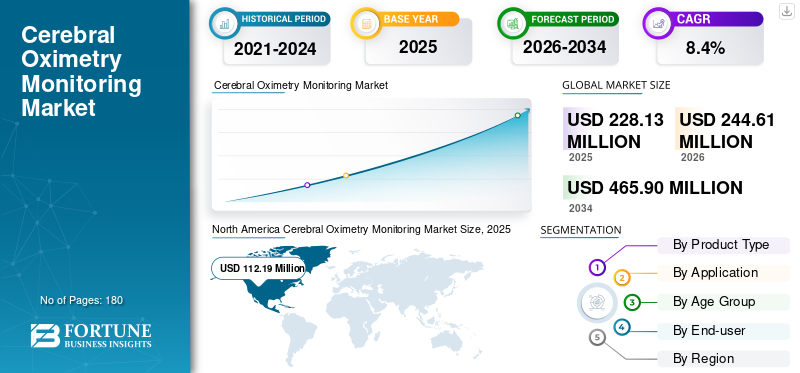
The global cerebral oximetry monitoring market size was valued at USD 228.13 million in 2025 and is projected to grow from USD 244.61 million in 2026 to USD 465.90 million by 2034, exhibiting a CAGR of 8.4% during the forecast period. North America dominated the cerebral oximetry monitoring market with a market share of 49.17% in 2025.
Cerebral oximetry monitoring is a non-invasive technology used to continuously measure regional cerebral oxygen saturation, commonly through near-infrared spectroscopy sensors placed on the forehead. It helps clinicians assess the balance between oxygen delivery and oxygen consumption in the brain, especially when standard pulse oximetry alone may not accurately reflect cerebral perfusion status. The rising use of cerebral monitoring during cardiac surgery, neurosurgery, vascular surgery, anesthesia, neonatal care, and critical care is anticipated to drive the growth of the global market.
BD, Medtronic, and Masimo held the highest market share in 2025 due to their strong global presence. Moreover, these companies are focused on advancing their product portfolios and increasing investments for expanding their market share.
Download Free sample to learn more about this report.
CEREBRAL OXIMETRY MONITORING MARKET TRENDS
Advancement of Clinical Decision-Support and Monitroing Parameters to Emerge as a Key Trend
Currently, companies are increasingly focusing on advanced parameters, decision-support tools, and integrated analytics to improve how clinicians interpret cerebral and tissue oxygenation. For instance, in August 2025, the FDA granted Masimo 510(k) clearance for expanded indications of its delta hemoglobin parameters on the O3 regional oximetry platform. The expansion indications allowed clinicians to use these parameters for spediatric and neonatal patients, in addition to adults.
Furthermore, the trend is supported by the growing integration of cerebral oximetry systems with hospital monitoring systems, enabling cerebral oxygenation data to be viewed alongside hemodynamics, ventilation, anesthesia depth, and pulse oximetry. This is expected to improve workflow efficiency and support more personalized perioperative and critical-care decision-making.
MARKET DYNAMICS
MARKET DRIVERS
Download Free sample to learn more about this report.
Rising Burden of Cardiovascular Diseases, Cardiac Surgery, Vascular Surgery, and Neurocritical-Care Cases to Fuel Market Expansion
Over the past few years, there has been a growing burden of cardiovascular diseases and an increasing number of cardiac surgery, vascular surgery, and neurocritical-care cases globally. In such a scenario, cerebral oximeters are increasingly used in high-risk procedures where cerebral oxygen saturation can fall due to changes in perfusion pressure, blood flow, oxygen delivery, ventilation, anesthesia, or cardiopulmonary bypass.
This is particularly important in coronary artery bypass grafting, valve replacement, carotid procedures, aortic surgery, neurosurgery, and the management of ICU patients with unstable hemodynamics. Such a scenario is anticipated to fuel market expansion during the forecast period.
- For instance, according to the data published by Mass General Brigham Incorporated in November 2024, over 900,000 cardiac surgeries, including coronary bypass surgeries, were performed in the U.S. each year.
|
Rank |
Market Driver |
Overall Impact Rank |
CAGR Contribution (2026-2034) |
Impact: 2026-2028 |
Impact: 2029-2031 |
Impact: 2032-2034 |
|
1 |
Rising burden of cardiovascular, cardiac surgery, vascular surgery, and neurocritical-care cases |
High |
+2.65% |
High |
High |
High |
|
2 |
Increasing adoption of non-invasive cerebral oxygenation monitoring in ORs and ICUs |
High |
+2.20% |
High |
High |
High |
|
3 |
Integration with multi-parameter patient monitoring platforms and connected-care systems |
Medium-High |
+1.85% |
Medium |
High |
High |
|
4 |
Product innovation, expanded indications, and pediatric/neonatal monitoring adoption |
Medium-High |
+1.55% |
Medium |
High |
High |
|
5 |
Growing recurring demand for sensors and probes across installed monitor bases |
Medium |
+1.20% |
Medium |
Medium |
High |
|
6 |
Others |
Low |
+0.80% |
Low |
Low |
Medium |
|
|
Total Positive Growth Contribution |
|
+10.25% |
|
|
|
MARKET RESTRAINTS
High Recurring Consumables Costs Limits Product Use
Despite growing demand for cerebral oximetry solutions, their high cost is expected to limit adoption, especially in resource-limited settings. Additionally, many cerebral oximetry sensors are designed for single-patient-use. This creates a recurring consumable cost for hospitals, particularly in operating rooms, ICUs, and neonatal units with high patient turnover.
In addition, hospitals must justify the clinical value of cerebral oximetry against competing monitoring priorities, reimbursement limitations, and budget constraints. Adoption may also be slower in smaller hospitals and ambulatory surgical centers, where complex cardiac, neurocritical, and vascular procedures are less frequent.
- For instance, according to the data published by the National Center for Biotechnology Information (NCBI) in September 2024, the average cost of replacing existing pulse oximetry hardware is approximately USD 6,834.61 per bed. Total replacement and integration expenses across an entire medical system are estimated to range between USD 14.2 million and USD 17.4 million.
|
Rank |
Market Restraint |
Overall Impact Rank |
Negative CAGR Contribution (2026-2034) |
Impact: 2026-2028 |
Impact: 2029-2031 |
Impact: 2032-2034 |
|
1 |
High Recurring cost of consumables |
High |
-0.75% |
High |
Medium |
Medium |
|
2 |
Limited standardization of clinical thresholds and intervention protocols |
Medium |
-0.50% |
Medium |
Medium |
Low |
|
3 |
Accuracy concerns and device-to-device variability in NIRS-based readings |
Medium-Low |
-0.40% |
Medium |
Medium |
Low |
|
4 |
Others |
Low |
-0.20% |
Low |
Low |
Low |
|
|
Total Negative Growth Impact |
|
-1.85% |
|
|
|
MARKET OPPORTUNITIES
Rising Need for Integrated Patient Monitoring to Create Market Potential
In recent years, hospitals have been increasingly preferring systems that combine cerebral oxygen saturation, pulse oximetry, capnography, hemodynamics, sedation monitoring, and tissue oxygenation into a single workflow, reducing the equipment burden in operating rooms and ICUs. This is expected to create significant opportunities for cerebral oximetry suppliers to partner with major patient-monitoring platform providers.
- For instance, in June 2023, Koninklijke Philips N.V. received FDA clearance to integrate Masimo SedLine, O3 regional oximetry, and CO2 measurements into selected IntelliVue monitors.
Such initiatives by key players are anticipated to expand the use of product across cardiac surgery, critical care, neonatal care, and complex anesthesia workflows.
MARKET CHALLENGES
Measurement Accuracy and Lack of Standardized Clinical Protocols to Challenge Market Expansion
Despite growing adoption, cerebral oximetry monitoring still faces challenges related to measurement accuracy, device-to-device variability, and clinical interpretation. Near-infrared spectroscopy signals are influenced by extracerebral tissues, such as the scalp and skull, which can affect the accuracy of cerebral oxygenation readings.
Moreover, differences in patient anatomy, age, skin pigmentation, tissue thickness, probe placement, and underlying disease condition can also affect readings. This makes standardization difficult, especially when comparing values across devices, patient groups, or clinical settings. In addition, there is still variation in how clinicians define intervention thresholds for cerebral desaturation, and few hospitals lack standardized cerebral oximetry protocols.
Segmentation Analysis
By Product Type
Repeated Demand for Disposable Products Boosted Sensors & Probes Segment’s Growth
Based on product type, the market is segmented into monitoring systems & modules, sensors & probes, and accessories.
The sensors & probes segment accounted for the largest global cerebral oximetry monitoring market share in 2025. Unlike monitoring systems, which are capital equipment and are replaced less frequently, sensors and probes are purchased repeatedly due to single-patient-use requirements, infection-control practices, adhesion limitations, and the need for reliable signal quality. Their use is especially high in cardiac surgery, neonatal care, neurocritical care, and anesthesia monitoring.
To know how our report can help streamline your business, Speak to Analyst
The monitoring systems & modules segment is projected to grow at a 6.3% CAGR during the forecast period.
By Application
Increase Number of Cardiac Surgeries Boosted Segment Growth
By application, the market is segmented into cardiac surgery, vascular surgery, neurosurgery & neurocritical care, general surgery & anesthesia monitoring, and others.
The cardiac surgery segment accounted for the largest market share in 2025. The segment’s growth is attributed to the increasing number of cardiac surgeries performed globally. During these surgeries, changes in blood flow, oxygen delivery, hemoglobin level, temperature, and perfusion pressure can affect brain oxygenation, driving demand for the product. Moreover, the segment is estimated to hold a 50.1% share in 2026.
- For instance, according to the data from ScienceDirect in June 2024, it is projected that 1 to 1.5 million cardiac surgical procedures were performed every year worldwide.
The neurosurgery & neurocritical care segment is anticipated to grow at a CAGR of 10.1% over the forecast period.
By Age Group
Increasing Geriatric Population and Rising Number of Cardiac And Vascular Procedures to Drive the Adult Segment’s Growth
By age group, the market is classified into adult and pediatric.
The adult segment accounted for the largest market share in 2025. The segment’s growth is attributed to the increasing number of cardiac and vascular surgeries and hospital admissions among older people. Furthermore, a rise in the aging population is also projected to contribute to the segment’s growth. Moreover, the segment is projected to hold a 79.5% share in 2026.
- For instance, the World Health Organization (WHO) stated in February 2025 that the global population aged 60 and above is anticipated to rise from 1.1 million in 2023 to 1.4 million by 2030.
The pediatric segment is expected to grow at a CAGR of 10.1% during the forecast period.
By End-user
High Patient Volume Boosted Hospitals & ASCs Segment Growth
On the basis of end-user, the market is segmented into hospitals & ASCs, specialty clinics, academic & research institutes, and others.
In 2025, hospitals & ASCs dominated the market. Hospitals utilize large volumes of cerebral oximetry monitoring systems, sensors & probes, and accessories due to higher patient visits to these settings. ASCs also contribute to demand due to the availability of expertise and resources. Moreover, an increasing number of ASCs and hospitals worldwide is projected to support this demand, further driving the segment’s growth. Furthermore, the segment is set to hold an 85.9% market share in 2026.
- For instance, in March 2025, the Ambulatory Surgery Center Association (ASCA) reported that there were around 6,500 Medicare-certified ASCs in the U.S.
The specialty clinics segment is projected to grow at a CAGR of 11.3% during the forecast period.
Cerebral Oximetry Monitoring Market Regional Outlook
Based on geography, the market is classified into North America, Europe, Asia Pacific, Latin America, and the Middle East & Africa.
North America
North America Cerebral Oximetry Monitoring Market Size, 2025 (USD Million)
To get more information on the regional analysis of this market, Download Free sample
North America accounted for the largest share in 2024, valued at USD 105.35 million, and maintained its leading position in 2025, with USD 112.19 million. The region’s dominance is supported by high cardiac surgery volumes, strong adoption of advanced patient monitoring in operating rooms and ICUs, higher healthcare spending, and early availability of advanced monitoring platforms.
U.S. Cerebral Oximetry Monitoring Market
In 2026, the U.S. is anticipated to reach USD 116.17 million, accounting for approximately 47.5% of the global sales.
Europe
Europe is projected to record a CAGR of 8.0% during the forecast period, the second-highest globally. The market is expected to reach USD 66.83 million in 2026. Countries such as Germany, France, the U.K., Italy, and Spain have well-established infrastructure and advanced critical-care monitoring practices, which are anticipated to support the adoption of cerebral oximetry products in the region.
U.K. Cerebral Oximetry Monitoring Market
The U.K. market is projected to reach USD 8.13 million in 2026, representing approximately 3.3% of global revenues.
Germany Cerebral Oximetry Monitoring Market
Germany's market is expected to reach USD 23.99 million in 2026, accounting for approximately 9.8% of global revenues.
Asia Pacific
In 2026, the market in Asia Pacific is projected to reach approximately USD 54.45 million, making it the second-largest market worldwide. The growth is attributed to a large aging population in the region, contributing to medical procedures that require cerebral oximetry monitoring.
- For instance, according to the United Nations Population Fund’s 2023 India Aging Report, India’s population aged 80 years and above is projected to increase by nearly 279% between 2022 and 2050.
Japan Cerebral Oximetry Monitoring Market
Japan is projected to reach approximately USD 24.00 million in revenue in 2026, representing nearly 9.8% of the global sales.
China Cerebral Oximetry Monitoring Market
China’s market is anticipated to reach around USD 16.44 million in 2026, accounting for nearly 6.7% of global revenues.
India Cerebral Oximetry Monitoring Market
India’s market is expected to reach approximately USD 2.04 million in 2026, accounting for around 0.8% of global revenues.
Latin America and Middle East & Africa
Latin America and the Middle East & Africa are anticipated to witness moderate growth during the forcast period. The Latin America market is estimated to reach approximately USD 2.03 million in 2026. The cerebral oximetry monitoring market growth is due to the expansion of private hospital chains and increasing use of advanced anesthesia and critical-care monitoring in major urban hospitals. Moreover, the increasing investments in emerging countries are also anticipated to drive the region’s growth. The market growth of Middle East & Africa is mainly due to key players entering this region for expanding their offerings in untapped areas, as well government investments for bringing advanced medical technologies in the region.
GCC Cerebral Oximetry Monitoring Market
In 2026, the GCC market is estimated to reach approximately USD 1.16 million, representing around 0.5% of global revenues.
COMPETITIVE LANDSCAPE
Key Industry Players
Industry Participants Are opting Partnerships & Acquisitions Strategies to Boost their Market Share
In 2025, BD, Medtronic, and Masimo held the largest global cerebral oximetry monitoring market share. This leardership is attributed to their advanced product portfolios, large installed patient-monitoring bases, and strong brand reputation globally.
Moreover, other key players, including Nonin Medical and Hamamatsu Photonics K.K., are focusing on boosting their market share through strategic initiatives such as geographic expansion, partnerships, new facility launches, acquisitions, and collaborations with other companies.
LIST OF KEY CEREBRAL OXIMETRY MONITORING COMPANIES PROFILED
- Masimo (U.S.)
- BD (U.S.)
- Nonin Medical (U.S.)
- Hamamatsu Photonics K.K. (Japan)
- Mespere LifeSciences (Canada)
- Shenzhen Mindray Bio-Medical Electronics Co., Ltd. (China)
- ISS, Inc. (U.S.)
- Medtronic (Ireland)
- TECHEN, INC. (U.S.)
- BIOPAC Systems Inc. (U.S.)
KEY INDUSTRY DEVELOPMENTS
- April 2025: BD launched HemoSphere Alta, an advanced hemodynamic monitoring platform with AI-driven clinical decision support.
- September 2024: Nonin Medical and Corscience announced a partnership to co-promote OEM patient-monitoring solutions.
- September 2024: BD completed the acquisition of Edwards’ Critical Care business and renamed it BD Advanced Patient Monitoring. This strengthened BD’s position in advanced patient and tissue oxygenation monitoring.
- November 2023: GE HealthCare and Masimo collaborated to bring Masimo SET pulse oximetry to GE’s Portrait Mobile wireless monitoring platform.
- June 2022: GE HealthCare and Medtronic announced integration of INVOS regional oximetry and Microstream capnography into GE’s CARESCAPE platform.
- May 2022: Masimo’s O3 Regional Oximetry received FDA clearance for absolute regional oxygen saturation monitoring for somatic sites.
- December 2021: Medtronic received FDA 510(k) clearance for pediatric indications for the INVOS 7100 cerebral/somatic oximetry system.
REPORT COVERAGE
The report provides a comprehensive assessment of the global cerebral oximetry monitoring market across all major segments, highlighting the key growth drivers, emerging trends, opportunities, restraints, and challenges shaping market development. It also examines technological advancements, recent industry developments, market share analysis, and detailed profiles of leading companies operating in the market.
Request for Customization to gain extensive market insights.
Report Scope & Segmentation
| ATTRIBUTE | DETAILS |
| Study Period | 2021-2034 |
| Base Year | 2025 |
| Estimated Year | 2026 |
| Forecast Period | 2026-2034 |
| Historical Period | 2021-2024 |
| Growth Rate | CAGR of 8.4% from 2026-2034 |
| Unit | Value (USD Million) |
| Segmentation | By Product Type, Application, Age Group, End-user, and Region |
| By Product Type |
|
| By Application |
|
| By Age Group |
|
| By End-user |
|
| By Geography |
|
Frequently Asked Questions
Fortune Business Insights says that the global market value stood at USD 228.13 million in 2025 and is projected to reach USD 465.90 million by 2034.
In 2025, the market value stood at USD 112.19 million.
The market is expected to exhibit a CAGR of 8.4% during the forecast period.
By product type, the sensors & probes segment led the market.
The key factor driving the market is the rising burden of cardiovascular, cardiac surgery, vascular surgery, and neurocritical-care cases.
BD, Medtronic, and Masimo are among the top players in the market.
North America dominated the market in 2025.



- 2021-2034
- 2025
- 2021-2024
- 180
Get 30-60 hrs Free Customization
Expand Regional and Country Coverage, Segments Analysis, Company Profiles, Competitive Benchmarking, and End-user Insights.













.webp)






Related Reports
-
US +1 833 909 2966 ( Toll Free )
-
Get In Touch With Us