Cervical Cancer Vaccines Market Size, Share & Industry Analysis, By Vaccine Type (Preventive Vaccine and Therapeutic Vaccine), By Technology (Molecular-based, Vector-based, and Others), By Distribution Channel (Hospital Pharmacies, Government & Organization Supply, and Others), and Regional Forecast, 2026-2034
 Download Free Sample
KEY MARKET INSIGHTS
 Listen to Audio Version
The global cervical cancer vaccines market size was valued at USD 12.36 billion in 2025. The market is projected to grow from USD 14.16 billion in 2026 to USD 54.1 billion by 2034, exhibiting a CAGR of 18.70% during the forecast period. North America dominated the cervical cancer vaccines market with a market share of 34.50% in 2025.
Cervical cancer is one of the most common cancer types in women, affecting the cervix, which is the lower part of the uterus (womb). Women associated with other diseases, such as HIV, are more prone to develop cervical cancer than healthy women. Mainly, cervical cancer is caused by persistent infection and has the presence of high-risk types of the human papillomavirus (HPV). In most cases, HPV is a sexually transmitted infection that leads to the development of progressive cervical cancer.
The market expansion is primarily driven by the increasing prevalence of cervical cancer and prolonged vaccination coverage. Additionally, the rise in awareness about cervical cancer and HPV prevention supports the market growth.
- For instance, according to the data published by the World Health Organization (WHO) in March 2024, cervical cancer is the fourth most common cancer type in women, and HIV-positive women have 6 times higher chances of developing cervical cancer as compared to HIV-negative women.
The market is expected to show prominent growth in the future due to the high R&D investment and a robust pipeline of major players, such as GSK plc., Merck & Co., Inc., and Serum Institute of India Pvt. Ltd.
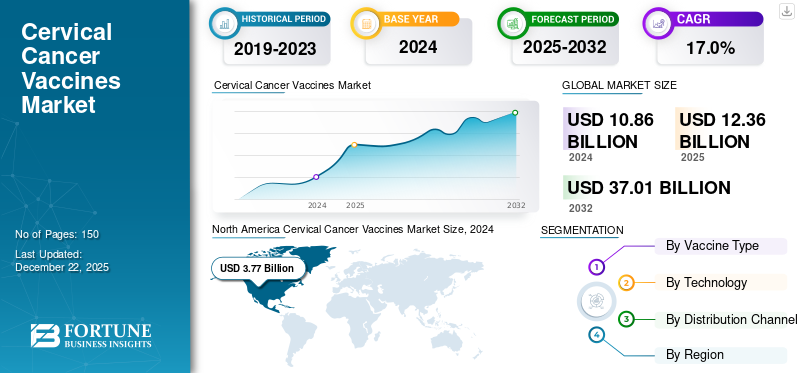
Download Free sample to learn more about this report.
CERVICAL CANCER VACCINES MARKET KEY TAKEAWAYS
 Global Market Size & Forecast
- 2025 Market Size: USD 12.36 billion
- 2026 Market Size: USD 14.16 billion
- 2034 Forecast Market Size: USD 54.10 billion
- CAGR: 18.70% from 2026–2034
 Market Share
- North America dominated the market with a 34.50% share in 2025.
- The Molecular-based segment is expected to dominate the market in 2026.
- The Hospital Pharmacies segment is expected to dominate the market in 2026.
 Key Regional Highlights
North America
The market reached USD 4.26 billion in 2025 and is projected to grow to USD 4.85 billion in 2026.
Europe
The market reached USD 3.63 billion in 2025 and is projected to grow to USD 4.15 billion in 2026.
Asia Pacific
The market reached USD 4.00 billion in 2025 and is projected to grow to USD 4.62 billion in 2026.
U.S.
The market is projected to witness steady growth by 2026.
Japan
The market is projected to witness steady growth by 2026.
Read More

MARKET DYNAMICS
MARKET DRIVERS
Rise in Prevalence of Cervical Cancer Drives Market Growth
The cervical cancer vaccines market growth is driven by the rise in the prevalence of cervical cancer. The cases of cervical cancer are increasing due to several factors, such as lack of awareness, increasing incidence of HPV, and socio-economic disparities. Additionally, the growth in population, aging, smoking, and weakened immune systems also play crucial roles in the rising prevalence of cervical cancer. This rise in the prevalence of cervical cancer increases the adoption rate of preventive and therapeutic vaccines, leading to a boost in market growth over the forecast period.
- For instance, according to the data published by the World Health Organization (WHO), in March 2024, approximately 6,60,000 new cases of cervical cancer were found in 2022, causing 3,50,00 deaths.
MARKET RESTRAINTS
Vaccine Hesitancy and Misinformation to Decline the Market Growth
The vaccine hesitancy and misinformation about vaccines may hinder the market growth during the forecast period. The vaccine hesitancy is due to several factors, such as cultural stigma and misinformation about the side effects of the vaccine. Additionally, false impression about adolescent vaccination contributes to the reluctance among parents and guardians, especially in conservative societies. These factors show a negative impact on market growth by lowering the adoption rate of cervical cancer vaccines.
- For instance, according to the data published by Ecancer Medical Science in August 2024, the adoption rate of cervical cancer vaccines is low due to myths and misconceptions, such as these vaccines cause infertility in adolescent girls.
MARKET OPPORTUNITIES
Public-Private Partnerships Expected to Boost Market Growth in the Future
The rise in public-private partnerships is anticipated to create opportunities for the growth of the market during the forecast period. This is due to the growing collaborations among governments, NGOs, and pharmaceutical companies to support HPV-based vaccination in underserved regions through campaigns, including GAVI and WHO-led campaigns. The public and private partnerships play an important role in mobilizing resources. To educate the population about HPV cervical cancer, investing in culturally appropriate public awareness campaigns is highly crucial.
- For instance, in December 2024, Unitaid and Gavi, an international healthcare organization, entered into a partnership to increase access to cervical cancer preventive vaccines.
MARKET CHALLENGES
Limited Healthcare Infrastructure in LMICs to Pose a Significant Market Challenge
Limited healthcare infrastructure in low and middle-income countries (LMICs) has a significant impact on the cervical cancer vaccines market growth. Due to limited infrastructure and healthcare facilities, marketers face several challenges, such as limited power access and difficulties in maintaining temperature control throughout the supply chain. These distribution-concerned challenges lead to limited vaccination coverage, which increases incidence and mortality rates in LMICs as compared to high-income countries.
- For instance, according to the data published in the Journal of Clinical Obstetrics and Gynecology in September 2022, in low and middle-income countries (LMIC), cervical cancer is the most common cancer type that affects women.
- Additionally, implementing HPV DNA screening requires a high cost per test and developed infrastructure that may limit the market growth.
CERVICAL CANCER VACCINES MARKET TRENDS
Single-Dose Vaccination Revolution is a Prominent Market Trend
Two or three-dose series are required to get protection against cervical cancer, leading to low patient compliance. In recent years, single-dose vaccines, such as the HPV vaccine, provide a solid protection against HPV, which is a prominent trend in the market. The new clinical evidence supports the effectiveness of a single dose of HPV vaccines, simplifying immunization schedules and enhancing global compliance. This is especially effective for low-middle-income countries where multi-dose follow-ups are logistically challenging. Additionally, the single-dose vaccination is cost-effective and time-saving, leading to enhanced patient compliance.
- For instance, according to the data published by the World Health Organization (WHO) in April 2022, the Strategic Advisory Group of Experts on Immunization (SAGE) concluded that a single dose of HPV vaccine provides solid protection against cervical cancer.
Additionally, the ongoing research on HPV vaccines by key market players further promotes market growth. The single-dose vaccination effectively reduces the burden of cervical cancer due to different advantages, such as a small concentration of antibodies in a single-dose vaccine that protects against the development of cervical cancer.
Other Market Trends
Gender-Neutral Vaccination Strategies
Gender-neutral vaccination strategies for HPV aim to protect both boys and girls from HPV-related diseases, such as cervical, penile, and oropharyngeal cancers. This strategy leads to reduced overall transmission and prevalence of HPV. Many developed countries, such as the U.S., Australia, and the U.K., are expanding vaccination programs to include boys to prevent HPV transmission and related cancers such as penile and oropharyngeal cancers.
Rise of Indigenous and Affordable Vaccines:
The rise of indigenous and affordable vaccines leads to secure global health, particularly in poor-resource regions. These vaccines play a crucial role in developing universal childhood immunization and preventing millions of deaths. This trend is growing due to several factors, such as an increase in collaboration between government and vaccine producers and a rise in production capacity.
- For instance, in January 2023, India's Serum Institute launched CERVAVAC, the nation’s first domestically developed HPV vaccine, at a price significantly lower than existing global vaccines, potentially transforming vaccine accessibility.
Download Free sample to learn more about this report.
Segmentation Analysis
By Vaccine Type
High Efficacy and Availability Drive the Dominance of Preventive Vaccine Segment
On the basis of vaccine type, the market is classified into preventive vaccines and therapeutic vaccines.
The preventive vaccine type dominated the market in 2025. The preventive vaccines are also known as prophylactic vaccines, as they protect against a disease or infection before exposure to it. Preventive vaccines are administered to build immunity. The dominance is due to their effectiveness in preventing humans from viruses, which cause diseases. In the current scenario, preventive vaccines are the only approved vaccines for cervical cancer, leading to the dominance of the segment. Additionally, government support and new product development support segmental growth.
- For instance, in October 2021, Xiamen Innovax Biotech CO., LTD. received prequalification for Cecolin, a vaccine designed to protect against cervical cancer caused by HPV infection from the World Health Organization (WHO).
Therapeutic vaccines are the fastest-growing segment with a higher CAGR during the forecast period due to several pipeline candidates and ongoing research by key market players.
- For instance, according to the data published by the World Health Organization (WHO) in July 2024, more than 20 therapeutic HPV vaccine candidates are at different stages of clinical development.
By Technology
Availability and Ease of Manufacturing Contributes to the Dominance of Molecular-based Segment
Based on technology, the market is segmented into molecular-based, vector-based, and others.
The molecular-based segment is expected to dominate the market during the forecast period. Molecular-based technology contains virus-like particles (VLPs) but does not contain the infectious viral genome. These VLPs induce immunity against specific HPV types and utilize the L1 protein of the HPV genome to create antibodies, which prevent infection after exposure. The molecular-based technology is dominating as it is primarily used in the preparation of cervical cancer vaccines. Additionally, the molecular-based technology has several advantages, such as easy manufacturing, safety, efficacy, and others. These advantages lead to the development of more effective vaccines, which increases segmental growth.
- For instance, according to the data published by Microorganisms in April 2025, molecular-based therapies and HPV vaccines with early diagnosis represent the most effective method to manage cervical cancer.
The vector-based segment held a significant portion of the market. The growth of the segment is attributed to its ability to trigger a strong immune response and provide long-lasting protection against disease or infection. Additionally, vector-based vaccines are highly effective against cervical cancer caused by HPV.
By Distribution Channel
Increase in Patient Visits Boosts the Dominance of Hospital Pharmacies Segment
Based on distribution channel, the market is segmented into hospital pharmacies, government & organization supply, and others.
The hospital pharmacies segment dominated the cervical cancer vaccines market in 2025. Vaccination is a short-duration procedure and is often conducted in hospitals. Due to this, patients visit the nearby hospitals for vaccination, leading to an increase in the patient flow in hospitals, which supports the growth of the segment.
- For instance, one of the largest hospital chains of India, Apollo Hospitals provides the cervical cancer vaccine in India.
The government & organization supply segment held a significant market share. The segment is growing due to several factors, such as public health initiatives, equitable access, and others. Additionally, the government often collaborated with other organizations, such as WHO for awareness campaigns, in turn driving the segmental growth.
The others segment also held a substantial market share and is expected to witness considerable growth during the forecast period. This is due to the rise in preference of individuals toward online pharmacies for purchasing vaccines.
Cervical Cancer Vaccines Market Regional Outlook
North America
North America Cervical Cancer Vaccines Market Size, 2025 (USD Billion)
To get more information on the regional analysis of this market, Download Free sample
The North America region captured 34.50% of the global market in 2025, generating USD 4.26 billion in revenue, and is projected to reach USD 4.85 billion in 2026. The high prevalence of cervical cancer drives the growth of the market in this region. Additionally, fast regulatory approvals and high adoption rate to new treatment options supports the market growth.
U.S. market dominated the North America region in 2024. The dominance of the U.S. is due to the rise in prevalence of cervical cancer. This high prevalence of cervical cancer results in a rise in demand for effective treatment options, which supports the market growth across the region. Additionally, government initiatives, such as vaccination drives, awareness programs, and immunization programs, also boost market growth.
- For instance, in January 2025, the American Cancer Society estimates that approximately 13,360 new cervical cancer cases will be diagnosed in 2025, and about 4,320 deaths might occur due to cervical cancer.
Europe
Europe maintained a strong presence in the global market, reaching USD 3.63 billion in 2025, accounting for 29.30% share, and is expected to reach USD 4.15 billion in 2026. Europe held significant shares of the market. The growth of the region is due to the rising patient flow in hospitals with HPV infection, which causes cervical cancer. Additionally, Europe has a mature market with universal healthcare systems, enabling wide access to cervical cancer vaccines. Moreover, the European governments actively procure HPV vaccines through centralized systems, boosting the regional market growth.
- For instance, according to the data published by the European Commission, in July 2024, to support EU countries in raising the uptake of vaccination against HPV and other diseases, the commission presented a proposal for a council recommendation on vaccine-preventable cancers.
Asia Pacific
In 2025, Asia Pacific generated USD 4 billion, contributing 32.30% to global market revenue, and is projected to grow to USD 4.62 billion in 2026. Asia Pacific held substantial share and is the fastest-growing region in the market. The demand for cervical cancer’s preventive and therapeutic vaccines rises due to the high incidence of cervical cancer and HPV infection. Additionally, an increase in awareness and government initiatives also drives the market growth in this region.
- For instance, in 2020, the Government of India initiated a ‘Cervical Cancer Mukt Bharat’ mission, which aims to eliminate cervical cancer by 2070 through HPV vaccination.
Middle East & Africa
Middle East & Africa recorded a market size of USD 0.2 billion in 2025, capturing 1.60% of the global market share, and is projected to reach USD 0.21 billion in 2026. Middle East & Africa regions are expected to have a considerable share of the market in the near future. The rise in awareness about HPV infection and cervical cancer, with the growing demand for advanced vaccines, supports the regional growth.
Latin America
The Latin America market generated USD 0.28 billion in 2025, representing 2.30% of the global market landscape, and is expected to reach USD 0.32 billion in 2026.
COMPETITIVE LANDSCAPE
Key Industry Players
New Product Development and High R&D Investment by Key Companies Resulted in their Dominating Positions in the Market
The market is concentrated with companies such as GSK plc., Merck & Co., Inc., and Serum Institute of India Pvt. Ltd., accounting for a significant market share.
GSK plc. held a significant share in the market. The dominance of the company is due to its widely adopted Cervarix vaccine, the first commercially available human papillomavirus HPV vaccines. Additionally, GSK plc., has a strong global presence, and collaboration with other global organizations leading to the growth of the company in the market. Cervarix was one of the first approved HPV vaccines for cervical cancer, resulting in GSK plc., being an early leader in the market. Due to this early access, it established a strong brand image which further supports its growth in this market.
- For instance, in May 2022, GSK plc. received approval for the Cervarix, a two-dose vaccine schedule for the prevention of cervical cancer in girls, from China’s National Medical Products Administration (NMPA).
Merck & Co., Inc. accounted for a notable share in 2024. This growth is attributed to several factors, such as commercial success with Gardasil, a cervical cancer vaccine, and its robust global presence. Additionally, pipeline products and clinical success further drives the growth of the company.
Furthermore, Serum Institute of India Pvt. Ltd., THERAVECTYS, ViciniVax, Walvax Biotechnology Co., Ltd., and DCVMN International are among the other major key players in the market. These key players are focusing on the development of therapeutic cervical cancer vaccines and have significantly invested in the research & development of innovative products that have supported the companies’ share in the market.
LIST OF KEY CERVICAL CANCER VACCINES COMPANIES PROFILED
- GSK plc. (U.K.)
- Merck & Co., Inc. (U.S.)
- Serum Institute of India Pvt. Ltd. (India)
- THERAVECTYS (U.S.)
- ViciniVax (Europe)
- Walvax Biotechnology Co., Ltd. (China)
- Xiamen Innovax Biotech CO., LTD. (China)
KEY INDUSTRY DEVELOPMENTS
- May 2025: Merck & Co., introduced their alternate dosing regimens for GARDASIL 9 (Human Papillomavirus 9-valent Vaccine, Recombinant), used for the prevention of cervical cancer.
- August 2024: Walvax Biotechnology Co., Ltd., announced that the World Health Organization (WHO) accepted pre-qualification for Walrinvax, an HPV vaccine used for the treatment of cervical cancer.
- November 2023: TheraVectys received clearance from the U.S. Food and Drug Administration for the initiation of phase 1 for its therapeutic vaccine, Lenti-HPV-07, cervical cancer vaccine.
- September 2023: A public and private collaboration was launched Kuala Lumpur in Malaysia to focus on prevention of Human Papillomavirus (HPV) and eliminating cervical cancer. The Sabin Vaccine Institute would lead this consortium.
- June 2020: Merck & Co., reconfirmed its commitment to supply HPV vaccines to Gavi and help organization to achieve its goal of vaccinating 84 million girls.
- May 2020: Innovax, received the license for the use of Cecolin, HPV vaccine used to treat cervical cancer in China. It is prequalified by the World Health Organization (WHO) in 2021.
REPORT COVERAGE
Request for Customization to gain extensive market insights.
Report Scope & Segmentation
|
ATTRIBUTE |
DETAILS |
|
Study Period |
2021-2034 |
|
Base Year |
2025 |
|
Estimated Year |
2026 |
|
Forecast Period |
2026-2034 |
|
Historical Period |
2021-2024 |
|
Growth Rate |
CAGR of 18.70% from 2026-2034 |
|
Unit |
Value (USD Billion) |
|
Segmentation |
By Vaccine Type
|
|
By Technology
|
|
|
By Distribution Channel
|
|
|
By Region
|
Frequently Asked Questions
Fortune Business Insights says that the global market value stood at USD 14.16 billion in 2026 and is projected to reach USD 54.1 billion by 2034.
In 2025, the market value stood at USD 12.36 billion.
The market is expected to exhibit a CAGR of 18.70% during the forecast period.
The preventive vaccine segment led the market by vaccine type.
The key factors driving the market are the increasing burden of cervical cancer and rise in demand for the advance treatment options.
GSK plc., Merck & Co., Inc. and Serum Institute of India Pvt. Ltd. are the top players in the market.
North America dominated the market in 2024.
Increased awareness about the cervical cancer and HPV infection, the novel pipeline products, and a surge in the demand for preventive vaccines in developing markets are some of the factors that are expected to favor product adoption.



- 2021-2034
- 2025
- 2021-2024
- 150
Get 30-60 hrs Free Customization
Expand Regional and Country Coverage, Segments Analysis, Company Profiles, Competitive Benchmarking, and End-user Insights.













.webp)






Related Reports
-
US +1 833 909 2966 ( Toll Free )
-
Get In Touch With Us