Chemical Indicators Market Size, Share & Industry Analysis, By Product (Steam Chemical Indicators, Hydrogen Peroxide Chemical Indicators, and Others), By Parameter (Single-Variable Indicators and Multi-Variable Indicators), By Sterilization Method (Steam Sterilization, Hydrogen Peroxide Sterilization, Ethylene Oxide Sterilization, and Others), By End-user (Hospital & Clinics, Pharmaceutical & Medical Device Manufacturers, and Others), and Regional Forecast, 2026-2034
 Download Free Sample
KEY MARKET INSIGHTS
 Listen to Audio Version
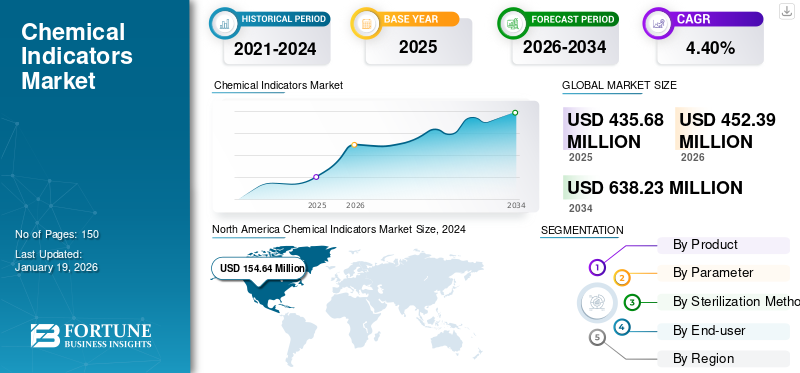
The global chemical indicators market size was valued at USD 435.68 million in 2025. The market is projected to grow from USD 452.39 million in 2026 to USD 638.23 million by 2034, exhibiting a CAGR of 4.40% during the forecast period. North America dominated the chemical indicators market with a market share of 24.39% in 2025.
Chemical indicators (CIs) are the sterilization consumables used to verify whether the parameters required to achieve sterilization processes, such as steam sterilization or vaporized hydrogen peroxide sterilization, have been achieved or not. These indicators undergo physical or chemical changes visible to the human eye when exposed to predetermined critical parameters, including temperature, time, or the presence of sterilant. These indicators are widely used in steam sterilization and hydrogen peroxide sterilization, among others.
The market growth is driven by an increasing number of hospital-acquired infection cases and the increasing launch of CIs for sterility assurance processes. For example, in October 2023, ASP (Fortive) announced the launch of the VERISURE chemical indicator, which was designed for rapid and easy monitoring of sterilization processes in healthcare settings.
Moreover, the market consists of several small and mid-size companies such as STERIS, Getinge, Solventum, Tuttnauer, and Propper Manufacturing Co., Inc. These key players are participating in medical conferences to create product awareness among consumers.
Download Free sample to learn more about this report.
Chemical Indicators Market Key Takeaways
 Global Market Size & Forecast
- 2025 Market Size: USD 435.68 million
- 2026 Market Size: USD 452.39 million
- 2034 Forecast Market Size: USD 638.23 million
- CAGR: 4.40% from 2026–2034
 Market Share
- North America dominated the market with a 24.39% share in 2025.
- Steam Chemical Indicators segment held the largest market share in 2024.
- Hospitals & Clinics segment held the largest market share in 2024.
 Key Regional Highlights
North America
The market reached USD 154.64 million in 2025, driven by advanced healthcare infrastructure.
Asia Pacific
The market reached USD 104.07 million in 2025, supported by expanding sterilization facilities.
Europe
The market reached USD 113.97 million in 2025, driven by increasing awareness of sterilization products.
U.S.
The market is driven by the rising burden of hospital-acquired infections and demand for sterilization monitoring products.
Japan
The market is driven by expanding sterilization infrastructure and increasing adoption of advanced sterilization monitoring solutions.
Read More

MARKET DYNAMICS
Market Drivers
Increasing Hospital Admissions and Rising Cases of Hospital-acquired Infections are Driving Market Growth
The hospitalization rate for treating several chronic diseases has risen over the past few years. As the number of hospital admissions increases, the chances of developing hospital-acquired infections also increase, in turn driving the chemical indicators market growth. For example, as per the data provided by the Australian Institute of Health and Welfare in May 2025, the number of hospitalizations in Australian hospitals increased from 11.1 million in 2019 to 12.6 million in 2024.
Also, the growing number of cases of hospital-acquired infections (HAI), including sepsis, urinary tract infections, and surgical site infections, among others, is increasing substantially across the world.
- For instance, as per the data provided by the Government of Canada in June 2024, the number of hospital-acquired Clostridioides difficile infection cases was 3,643 in 2021 and increased to 3,846 in 2022.
Rising Demand for Biologics and Biosimilars has been Fueling Demand for Effective Sterilization
Biological drugs captured the attention of major industry players as they target diseases that had very limited treatment options available, including several types of cancer, autoimmune diseases, and other non-communicable diseases. The increasing prevalence of these diseases is anticipated to influence the demand for biological drugs.
Several pharmaceutical and biopharmaceutical companies are strategizing for new drug approvals and research and development of biological drugs to meet this rising demand. For example, as per an article published by MDPI in January 2025, in 2024, the U.S. Food and Drug Administration (FDA) approved 16 biologics, whereas in 2021, 14 biologics were approved.
Biologics are required to be sterilized and should be manufactured under sterile conditions. The equipment used in handling and manufacturing biologics requires regular sterilization. Therefore, the increasing production of biologics has been fueling the demand for sterilization products, fueling market growth.
Market Restraints
Limited Adherence to Sterilization Monitoring in Developing Countries
Sterilization consumables are extensively used in developed nations due to stringent sterilization protocols in manufacturing companies and other healthcare facilities. However, in low- and middle-income countries, the sterilization process remains inconsistent, limits the adoption of sterilization products, and affects market growth.
In developed nations, strict adherence to sterilization protocols is driven by stringent regulatory requirements and regular audits of manufacturing and healthcare facilities. On the other hand, in developing countries, the adoption of regulatory guidelines and sterilization norms is limited due to the negligence and absence of strict policies toward sterilization monitoring and routine evaluation of sterilizers. The healthcare settings, including hospitals, clinics, nursing homes, and diagnostic laboratories, focus on limited usage of the sterilization consumables as a cost-cutting practice, leading to various health concerns, including hospital-acquired infections.
Additionally, the limited awareness and ignorance of sterilization standards by healthcare facilities have hampered the demand for sterilization products. For instance, as per the data published by the National Centers for Biotechnology Information (NCBI) in November 2023, in India, out of every 100 patients admitted to hospitals, 15 acquire some hospital-acquired infection (HAI).
Thus, the limited adherence toward sterilization monitoring and routine evaluation of sterilizers in low and middle-income countries has been restraining the market growth.
Market Opportunities
Substantial Growth in Pharmaceutical and Medical Devices Manufacturing in Developing Countries Provides Lucrative Opportunities
Developing nations of Europe, Asia Pacific, and Latin America are experiencing significant growth in the pharmaceutical and medical devices industries. This is driven by rising demand for medical devices and healthcare services in these countries. Also, the increasing focus of pharmaceutical and medical device companies on expanding their manufacturing capacity is expected to create growth opportunities for the market.
- For example, in February 2024, Terumo Corporation announced the opening of its new medical device manufacturing facility at its Caguas, Puerto Rico site. With the opening of the new facility, the company aimed to produce devices and technologies to improve patient care within healthcare settings.
Moreover, the growing awareness among healthcare providers, including hospitals, clinics, and clinical laboratories, regarding sterilization processes is anticipated to enhance the adoption of sterilization processes. The above-mentioned factors are anticipated to create significant growth opportunities for the market.
Market Challenges
Availability of Alternatives to Chemical Indicators to Limit Their Adoption in Sterilization Process
The availability of other sterilization validation indicators, including biological indicators and indicator tapes, may limit the adoption of chemical indicators(CIs), thereby hindering market growth.
The biological indicators are considered a gold standard for sterilization validation, owing to the direct test of the sterilization process's effectiveness by using highly resistant microbial spores. Also, the biological indicators confirm the killing of microorganisms, which CIs cannot. The market players are increasingly focusing on the launch of biological indicators to validate the sterilization process. For example, in December 2020, STERIS announced the global launch of Spordex self-contained biological indicator (SCBI) ampoules to confirm sterilization of liquids in steam autoclave cycles.
Although chemical indicators are widely used in resource-limited settings, their adoption can be restricted in healthcare settings where more precise, automated, and biologically reliable alternatives are available.
Download Free sample to learn more about this report.
CHEMICAL INDICATORS MARKET TRENDS
Increasing Focus of Market Players on New Product Launches
The increasing number of hospital admissions, the growing number of surgical procedures globally, and the high burden of hospital-acquired infections have been fueling the demand for effective sterilization. As a result, market players have been focusing on developing and launching novel sterilization consumables, including chemical indicators, to enhance the sterilization process.
- For example, in June 2025, Solventum announced the launch of its Attest Super Rapid Vaporized Hydrogen Peroxide (VH2O2) Clear Challenge Pack in the global market. The ready-to-use test integrates two previously FDA-cleared indicators: a chemical indicator (CI) for verifying proper sterilizer function and a biological indicator (BI) for confirming microbial neutralization.
SEGMENTATION ANALYSIS
By Product
High Adoption Rate of Steam Sterilizers at Healthcare Facilities is Responsible for Dominance of Steam Chemical Indicators Segment
Based on the product, the market is divided into steam chemical indicators, hydrogen peroxide chemical indicators, and others.
The steam chemical indicators segment dominated the global market in 2024 and is expected to grow at a moderate CAGR during the forecast period. The dominant share is primarily attributed to the rising adoption of steam sterilizers at healthcare facilities. For example, in June 2023, idsMED Taiwan installed Steelco steam sterilizers at the Ministry of Health and Welfare Taipei Hospital in New Taipei City, Taiwan, to enhance sterilization capabilities and ensure top-tier patient care and safety.
The hydrogen peroxide chemical indicators segment is expected to grow at the highest CAGR from 2025 to 2032. The rising adoption of the hydrogen peroxide sterilization method by manufacturers and service providers for effective sterilization of pharmaceuticals and medical devices is one of the major factors enhancing segmental growth. For example, in June 2020, STERIS Applied Sterilization Technologies (AST) started providing vaporized hydrogen peroxide (VHP) sterilization services in its Tullamore, Ireland, facility as part of its contract sterilization offering.
By Parameter
Benefits Provided by Multi-Variable Indicators Responsible for their Dominance
Based on the parameter, the market is divided into single-variable indicators and multi-variable indicators.
The multi-variable indicators segment is expected to dominate the market throughout the forecast period. The growth of the segment is mainly attributed to the fact that the multi-variable indicators offer several advantages in sterilization monitoring, due to their ability to verify multiple critical parameters simultaneously. These indicators provide a clear, visual confirmation that the sterilization process has reached the desired conditions, ensuring the effectiveness of the sterilization cycle.
On the other hand, the single-variable indicators segment is anticipated to grow considerably throughout the forecast period, owing to the higher adoption of single-variable indicators in healthcare facilities.
By Sterilization Method
Expansion of Steam Sterilization Services Globally Enhanced Steam Sterilization Segment's Growth
In terms of sterilization method, the market is segmented into steam sterilization, hydrogen peroxide sterilization, ethylene oxide sterilization, and others.
The steam sterilization segment held a dominant global chemical indicators market share in 2024 and is estimated to grow at the second-largest CAGR from 2025 to 2032. The expansion of steam sterilization services globally is driving the segment's growth. For instance, in March 2023, Servizi Italia Spa announced the inauguration of its first sterilization plant in São Paulo, Brazil. This facility provides steam sterilization services to the hospitals located in São Paulo.
Moreover, the hydrogen peroxide sterilization segment accounted for the second-largest market share in 2024 and is estimated to grow at the highest CAGR from 2025 to 2032. The increasing regulatory authorities' focus on creating awareness about the greater effectiveness of the hydrogen peroxide sterilization method is increasing its adoption in healthcare facilities, thereby driving segmental growth.
- For example, in January 2024, the U.S. Food and Drug Administration announced that it considered vaporized hydrogen peroxide (VHP) an established sterilization method for medical devices, recognizing VHP's long history of safety and effectiveness.
Furthermore, the other segment is anticipated to grow at a stagnant CAGR during the forecast period. Opening new sterilization facilities and expanding existing sterilization services facilities, including ionizing sterilization, are important factors driving segmental growth.
- For example, in June 2024, STERIS completed the expansion of its existing facility, the Illinois gamma processing facility, to include x-ray processing.
By End-user
Hospital & Clinics Segment Dominated Market Due to Opening of a New State-of-the-art Sterilization Facilities
In terms of end users, the market is segmented into hospitals & clinics, pharmaceutical & medical device manufacturers, and others.
The hospitals & clinics segment dominated the global market in 2024 and is expected to grow at the highest CAGR from 2025 to 2032, owing to the increasing launch of state-of-the-art sterilization facilities in hospitals and clinics. For example, in November 2021, Northumbria Sterile Processing Center, a USD 10.2 million state-of-the-art healthcare sterilization facility, was officially opened in Northumbria Specialist Emergency Care Hospital in Cramlington, England.
The pharmaceutical & medical device manufacturers segment is expected to grow moderately during the forecast period. The opening of manufacturing facilities for pharmaceuticals and biologics production by major market players also increases the demand for sterilization monitoring products, thus driving the market growth.
- For example, in November 2023, Bayer AG opened a new manufacturing facility in Berlin, Germany, with an investment of USD 140.7 million to produce innovative parenteral products. The facility features state-of-the-art technology, innovative production, and automated processes. Such strategic initiatives by the pharmaceutical companies have led to a rise in demand for sterilization monitoring products in their facilities, thereby driving the segment's growth.
Furthermore, the other segment is expected to grow at a stagnant CAGR throughout the forecast period. The increasing utilization of these indicators during the sterilization process by academic and research institutes for research purposes is one of the prominent factors driving the segmental growth.
CHEMICAL INDICATORS MARKET REGIONAL OUTLOOK
In terms of regions, the global market can be divided into North America, Europe, Asia Pacific, Latin America, and the Middle East & Africa.
North America
North America Chemical Indicators Market Size, 2024 (USD Million)
To get more information on the regional analysis of this market, Download Free sample
The North America market accounted for USD 154.64 million in 2025, representing 24.39% of the global industry, and is expected to reach USD 160.67 million in 2026. The North America region accounted for a market size of USD 154.64 million in 2025 and dominated the market with a share of 24.39% in 2025. The market growth in this region was mainly attributed to the presence of advanced healthcare infrastructure and a large number of market players providing chemical indicators for the sterilization process.
Furthermore, the growing burden of hospital-acquired infections in the U.S. has been increasing the demand for sterilization products in these healthcare centers, fueling the market growth. For example, as per the data provided by the Centers for Disease Control and Prevention (CDC) in January 2024, around 30,100 central line-associated bloodstream infections (CLABSI) occur in intensive care units and wards in the U.S. every year.
Europe
Europe recorded a market size of USD 113.97 million in 2025, capturing 24.37% of the global market share, and is projected to reach USD 118.27 million in 2026 and is anticipated to grow at the second-largest CAGR during the forecast period. The increasing market players' focus on participating in medical conferences to create awareness about sterilization products among consumers is one of the important factors driving market growth across European nations.
- For example, in June 2024, Getinge was present at the ACHEMA 2024 medical conference held in Frankfurt, Germany. During the event, the company showcased its sterilization solutions, including chemical indicators, to create consumer awareness and enhance its brand image in the global market.
Asia Pacific
In 2025, Asia Pacific represented USD 104.07 million, accounting for 24.40% of the worldwide market, and is projected to grow to USD 108.78 million in 2026 and is anticipated to grow at the highest CAGR throughout the forecast period. The increasing market players' focus on expanding their sterilization facilities is one of the main factors driving market growth in this region.
- For example, in April 2024, STERIS announced the expansion of its existing Suzhou, China EO processing facility to include X-ray processing. In addition to the Suzhou, China facility, STERIS supports medical device manufacturing in Asia through its electron beam, ethylene oxide, gamma, and X-ray processing sterilization services in Malaysia and Thailand.
Latin America and the Middle East & Africa
The Latin America market was valued at USD 44.74 million in 2025, capturing 40.81% of global revenue, and is estimated to reach USD 46.03 million in 2026. Middle East & Africa contributed 26.56% to the global market in 2025, with a valuation of USD 18.26 million, and is projected to reach USD 18.64 million in 2026. The market in Latin America and the Middle East & Africa is expected to grow steadily throughout the forecast period. The market growth in these regions is mainly due to their developing healthcare infrastructure for sterilization services across Latin America and the Middle East & Africa.
Also, rising market players' focus on creating awareness about sterilization products among consumers is another factor supplementing market growth in these regions. For example, in January 2025, LISTER BIOMEDICAL CO., LTD. was present at Arab Health 2025, an event held in Dubai, UAE. During the event, the company was present at booth Z7.G10-02 and showcased its sterilization consumables to create awareness among healthcare professionals, who visited the company's booth.
COMPETITIVE LANDSCAPE
Key Industry Players
Market Players Focus on Attending Medical Events to Create Brand Awareness among Consumers, Leading to Companies' Revenue Growth
The market is fragmented, with several small and mid-sized companies. The market comprises major players, such as Solventum, STERIS, and ASP (Fortive). The substantial proportion of these companies in the market is mainly due to their strong focus on attending medical conferences to create product awareness among consumers.
- For example, in November 2024, Solventum was present at Piper Sandler's 36th annual healthcare conference held in New York, U.S. During the event, the company provided detailed information about its sterilization products to create awareness among consumers.
Moreover, other players in the market include Getinge, BiomatiQ Scientific Pvt. Ltd., Terragene, Propper Manufacturing Co., Inc., etc. These companies have been focusing on new product launches to enhance their portfolio and expand their footprint in the global market.
List of Key Companies Profiled
- STERIS (U.S.)
- Getinge (Sweden)
- ASP (Fortive) (U.S.)
- Solventum (U.S.)
- Terragene (Argentina)
- BiomatiQ Scientific Pvt. Ltd. (India)
- Tuttnauer (Netherlands)
- LISTER BIOMEDICAL CO., LTD (China)
- BEYA Medical Machinery Equipments CO.(Turkey)
- Propper Manufacturing Co., Inc. (U.S.)
KEY INDUSTRY DEVELOPMENTS
- May 2025 - STERIS announced the opening of an ethylene oxide processing facility in Batu Kawan, Malaysia.
- November 2023 - STERIS announced that its applied sterilization technologies (AST) business participated in the U.S. Food and Drug Administration (FDA) Radiation Sterilization Master File Pilot Program.
- November 2021: Getinge acquired the U.S.-based medical device company Verrix for an undisclosed amount. This acquisition enhanced Getinge's sterilization portfolio and strengthened its footprint in the U.S. market.
- October 2020 - Propper Manufacturing Co., Inc. announced a new partnership with Medical Supply Company, a medical supply company to expand its sterilization product offerings in the European market.
- April 2019 - Fortive acquired the Advanced Sterilization Products (ASP) Business from Ethicon, Inc., a Johnson & Johnson Services, Inc. subsidiary, for almost USD 2.7 billion in cash.
REPORT COVERAGE
The global market analysis report provides a detailed competitive landscape and market insights. In addition to the global chemical indicators market size, it covers regional analysis of different market segments, profiles of key market players, and market dynamics. Moreover, the market report encompasses several factors contributing to the market's growth over recent years.
Request for Customization to gain extensive market insights.
REPORT SCOPE & SEGMENTATION
|
ATTRIBUTE |
DETAILS |
|
Study Period |
2021-2034 |
|
Base Year |
2025 |
|
Estimated Year |
2026 |
|
Forecast Period |
2026-2034 |
|
Historical Period |
2021-2024 |
|
Growth Rate |
CAGR of 4.40% from 2026-2034 |
|
Unit |
Value (USD million) |
|
Segmentation
|
By Product
|
|
By Parameter
|
|
|
By Sterilization Method
|
|
|
By End-user
|
|
|
By Region
|
Frequently Asked Questions
The global chemical indicators market size was valued at USD 435.68 million in 2025. The market is projected to grow from USD 452.39 million in 2026 to USD 638.23 million by 2034, exhibiting a CAGR of 4.40% during the forecast period.
In 2025, the market value stood at USD 154.64 million.
The market will exhibit steady growth at a CAGR of 4.4% during the forecast period.
By product, the steam chemical indicators segment is leading the market.
The growing prevalence of hospital-acquired infections and the rising demand for biologics and biosimilars drive the market growth.
Solventum, STERIS, ASP (Fortive), and Getinge are the top players operating in the market.



- 2021-2034
- 2025
- 2021-2024
- 150
Get 30-60 hrs Free Customization
Expand Regional and Country Coverage, Segments Analysis, Company Profiles, Competitive Benchmarking, and End-user Insights.













.webp)






Related Reports
-
US +1 833 909 2966 ( Toll Free )
-
Get In Touch With Us