Ethylene Oxide Market Size, Share & Industry Analysis, By Derivative (Ethylene Glycol, Ethoxylates, Ethanolamine, Glycol Ethers, and Others), By End-Use Industry (Detergents & Surfactants, Food & Beverages, Automotive, Personal Care & Cosmetics, Textiles, and Others), and Regional Forecast, 2026-2034
 Download Free Sample
(Offer valid till 30th Sep 2026)

Ethylene Oxide Market Overview
 Listen to Audio Version
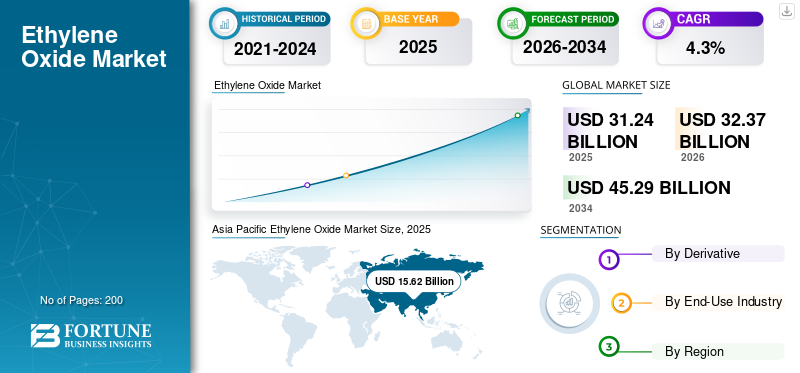
The global ethylene oxide market size was valued at USD 31.24 billion in 2025 and is projected to grow from USD 32.37 billion in 2026 to USD 45.29 billion by 2034, exhibiting a CAGR of 4.3% during the forecast period. Asia Pacific dominated the ethylene oxide market with a market share of 50.00% in 2025.
Ethylene oxide is a highly reactive organic chemical produced mainly by the oxidation of ethylene. It is a colorless, flammable gas at room temperature and is widely used as an intermediate chemical rather than as a direct-use product. Its strong reactivity makes it suitable for producing several important downstream derivatives, including ethylene glycol, ethoxylates, ethanolamines, and glycol ethers.
They act as a key building-block chemical for industries such as automotive, textiles, personal care, detergents, surfactants, food processing, and industrial manufacturing. A large share of ethylene oxide consumption is linked to ethylene glycol production, especially for polyester fibers, PET resins, and antifreeze applications, while other derivatives support cleaning products, cosmetics, solvents, and specialty chemicals. The market growth is driven by the growing consumption of antifreeze, personal care products, and medical sterilization materials.
Furthermore, the market comprises several major players, including INEOS Group, BASF, Shell, Dow, and Reliance Industries Limited.
Download Free sample to learn more about this report.
Ethylene Oxide Market Key Takeaways
 Global Market Size & Forecast
- 2025 Market Size: USD 31.24 billion
- 2026 Market Size: USD 32.37 billion
- 2034 Forecast Market Size: USD 45.29 billion
- CAGR: 4.3% from 2026-2034
 Market Share
- Asia Pacific dominated the ethylene oxide market with a 50.00% share in 2025.
- The ethylene glycol segment accounted for the largest share of 73.8% in 2025.
- The textiles segment accounted for the largest share of 44.7% in 2025.
 Key Regional Highlights
North America
North America reached USD 6.25 billion in 2025, supported by strong demand for ethylene oxide across chemical and industrial applications.
Asia Pacific
Asia Pacific held the leading position at USD 15.62 billion in 2025 and is expected to reach USD 16.25 billion in 2026.
Europe
Europe reached USD 5.60 billion in 2025 and is projected to grow at approximately 3.8%.
U.S.
The market is estimated to reach USD 5.76 billion in 2026, reflecting its significant contribution to North American demand.
Japan
The market is projected to reach approximately USD 1.97 billion in 2026, supported by demand across chemical and textile applications.
Read More

ETHYLENE OXIDE MARKET TRENDS
Shift Toward Low-Carbon, Integrated, and High-Value Derivative Production to Drive Market Growth
Manufacturers are increasingly focusing on converting ethylene oxide into downstream products such as ethylene glycol, ethoxylates, ethanolamines, glycol ethers, alkoxylates, and specialty intermediates to serve detergents, surfactants, personal care, textiles, automotive, packaging, coatings, and industrial applications. The market is also shifting from basic volume-driven production toward more sustainable and application-specific solutions. Bio-attributed ethylene oxide, mass-balanced feedstocks, and energy-efficient EO/EG technologies are gaining attention as customers seek lower product carbon footprints and improved sustainability credentials. At the same time, demand for EO-based surfactants, cleaning ingredients, coolant fluids, PET packaging materials, and textile intermediates continues to support long-term growth. This trend is encouraging producers to expand integrated EO derivative capacity, improve catalyst efficiency, reduce emissions, and develop differentiated products for high-growth consumer and industrial markets.
MARKET DYNAMICS
MARKET DRIVERS
Download Free sample to learn more about this report.
Rising Consumption of Ethylene Glycol in Polyester Fibers, PET Resins, and Packaging Applications to Drive Market Growth
Polyester continues to dominate global fiber production due to its cost efficiency, durability, versatility, and large-scale use in apparel, home textiles, technical textiles, carpets, and industrial fabrics. According to Textile Exchange, polyester accounted for 59% of global fiber production in 2024, increasing from 57% in 2023, while polyester fiber production rose from 71 million tons in 2023 to 78 million tons in 2024. This is highly relevant for the market as polyester production depends heavily on MEG, which is produced from ethylene oxide. As polyester remains the most widely produced fiber globally, the EO-to-MEG route continues to receive support from large textile-producing economies, especially China, India, South Korea, and other Asia Pacific countries.
PET is widely used in bottles, containers, food packaging, beverage packaging, fibers, strapping, films, upholstery fabrics, and automotive parts. PET Europe describes PET as a versatile material used in bottles, containers, carpet, clothing, industrial strapping, upholstery fabrics, automotive parts, construction materials, and several other applications. This broad application base supports steady ethylene glycol consumption, especially in packaging and consumer goods. Beverage bottles, food containers, rigid packaging, and thermoformed packaging remain important PET outlets as PET offers clarity, strength, lightweight performance, and recyclability.
MARKET RESTRAINTS
Strict Environmental and Safety Regulations Can Restrict Market Expansion
The ethylene oxide market growth faces restraints due to strict environmental and safety regulations governing its handling, storage, and emissions. It is a highly reactive and flammable compound, requiring specialized infrastructure and compliance with safety protocols. Regulatory agencies impose strict limits on emissions and workplace exposure, increasing operational costs for manufacturers. These regulations affect production planning and limit facility expansion in some regions. Companies must invest in emission control technologies, monitoring systems, and worker safety programs, which raises compliance expenses. These regulatory burdens can slow new project approvals and create entry barriers for smaller producers in the industry.
MARKET OPPORTUNITIES
Expansion of Low-Carbon, Bio-Attributed, and Renewable Derivative Chains is Creating Lucrative Growth Opportunities
Ethylene oxide is traditionally produced from fossil-based ethylene, but producers now have an opportunity to differentiate by offering bio-attributed EO, renewable MEG, and lower-emission derivative products through certified mass-balance or bio-feedstock routes. This is significant as many EO derivatives are embedded in large consumer-facing value chains, including PET bottles, polyester fibers, cleaning products, personal care ingredients, antifreeze, coatings, adhesives, and specialty solvents.
Technip Energies’ Bio-2-Glycols technology is another example, as the company acquired Shell glycol purification technology to accelerate bio-based MEG production from glucose. These examples indicate that the opportunity is not limited to one derivative; it can extend from EO itself to MEG, ethoxylates, PEGs, glycol ethers, and other specialty products. For market participants, the strongest opportunity is to position EO derivatives as lower-carbon building blocks for brands and manufacturers that want to reduce Scope 3 emissions, improve sustainability claims, and meet procurement requirements from global packaging, textile, home care, and cosmetics companies.
MARKET CHALLENGES
Feedstock Price Volatility and Pressure on Production Margins Can Hamper Market Growth
Ethylene oxide is primarily produced through the oxidation of ethylene, making its production economics highly dependent on ethylene availability, crude oil prices, natural gas prices, naphtha costs, and regional energy conditions. Any fluctuation in feedstock or utility prices directly affects production costs and margins for manufacturers. This challenge is more significant for non-integrated producers that depend on external ethylene supply, as they have limited control over raw material pricing. In contrast, integrated petrochemical companies have better cost control but are still exposed to global energy and commodity cycles. Price volatility can also affect downstream derivatives such as ethylene glycol, ethoxylates, ethanolamines, and glycol ethers, making pricing less predictable for customers in detergents, textiles, packaging, automotive, and personal care industries. As a result, unstable feedstock costs may reduce profitability, delay investment decisions, and create pricing pressure across the value chain.
Segmentation Analysis
By Derivative
Ethylene Glycol Segment Dominated Due to Broad Use in Polyester Fibers, PET Resins, and Industrial Applications
Based on derivative, the market is segmented into ethylene glycol, ethoxylates, ethanolamine glycol ethers, and others.
The ethylene glycol segment accounted for the largest ethylene oxide market share of 73.8% in 2025. The segment's growth is driven by strong demand from the textile, packaging, and automotive industries, where monoethylene glycol is a key raw material for polyester and polyethylene terephthalate production. Rising consumption of polyester-based apparel, home textiles, technical textiles, and packaging bottles continues to support ethylene glycol demand.
The ethoxylates segment is expected to grow significantly, driven by their extensive use as nonionic surfactants in detergents, household cleaners, industrial cleaning products, personal care formulations, agrochemicals, textile chemicals, and oilfield applications. These products are produced by reacting ethylene oxide with alcohols, fatty acids, amines, or phenols, giving formulators strong flexibility in designing materials with specific wetting, emulsifying, dispersing, and cleaning properties. Demand is increasing as consumers and industries require more effective cleaning, hygiene, and surface-active products. The segment is projected to grow at a CAGR of 3.8% during the forecast period.
By End-Use Industry
To know how our report can help streamline your business, Speak to Analyst
Textiles Segment Dominated the Market Due to its Wide Usage in Fashion, Affordability, and Durability
By end-use industry, the market is categorized into detergents & surfactants, food & beverages, automotive, personal care & cosmetics, textiles, and others.
The textiles segment accounted for the largest share of 44.7% in 2025. The segment's growth is driven by rising demand for affordable, durable, wrinkle-resistant, and easy-care fabrics, which continues to support polyester consumption globally. The demand from fashion, home furnishing, sportswear, technical textiles, and industrial fabric applications supports the segment. The continued dominance of polyester makes textiles a major structural driver for demand.
The detergents & surfactants segment is expected to grow favorably over the projected period. The segment's growth is driven by the rising demand for effective hygiene, sanitation, and cleaning products across household, commercial, and industrial environments. Urbanization, higher disposable income, increased use of packaged cleaning products, and growing institutional cleaning requirements are supporting demand in both developed and emerging markets. The segment is expected to grow at a CAGR of 3.9% over the forecast period.
Ethylene Oxide Market Regional Outlook
By region, the market is categorized into North America, Europe, Asia Pacific, Latin America, and the Middle East & Africa.
Asia Pacific
Asia Pacific Ethylene Oxide Market Size, 2025 (USD Billion)
To get more information on the regional analysis of this market, Download Free sample
Asia Pacific held the dominant share in 2025, valued at approximately USD 15.62 billion, and is expected to maintain its leading share in 2026, valued at around USD 16.25 billion. The region benefits due to its large polyester, PET resin, textile, packaging, automotive, detergent, and personal care manufacturing base. China is the leading demand center, supported by large-scale polyester fiber production, PET packaging, chemical manufacturing, and downstream consumer goods industries. India is also emerging strongly due to growth in textiles, detergents, personal care, automotive production, and packaged goods consumption. Japan and South Korea contribute through advanced chemical manufacturing, electronics, automotive materials, and specialty derivatives.
China Ethylene Oxide Market
In 2026, the China market is estimated to reach USD 7.63 billion. China's market demand is supported by the rising consumption of laundry detergents, dishwashing liquids, shampoos, body washes, and household cleaners, which supports ethoxylate and ethanolamine demand. PET packaging is growing due to bottled water, soft drinks, edible oils, dairy products, and packaged foods.
To know how our report can help streamline your business, Speak to Analyst
India Ethylene Oxide Market
The Indian market value in 2026 is estimated at around USD 2.64 billion, representing approximately 8.2% of the global market revenues.
Japan Ethylene Oxide Market
The Japan market size is projected to reach approximately USD 1.97 billion by 2026, accounting for about 6.1% of global sales.
North America
North America was also a significant contributor to the market, reaching a market value of USD 6.25 billion in 2025. The market's growth is driven by strong demand from detergents, surfactants, personal care, automotive coolants, medical sterilization, and specialty chemical applications. The U.S. remains a significant regional contributor due to its mature petrochemical industry, integrated ethylene and EO derivative production base, and strong downstream demand from household care, healthcare, and industrial manufacturing.
U.S. Ethylene Oxide Market
In 2026, the U.S. market is estimated to reach USD 5.76 billion. The U.S. dominates regional consumption due to its strong petrochemical production base, integrated ethylene value chain, and great downstream demand from detergents, surfactants, automotive coolants, personal care, healthcare sterilization, and specialty chemicals.
Europe
Europe is expected to experience steady growth in the coming years. During the forecast period, the European region is projected to grow at approximately 3.8%, reaching a valuation of USD 5.60 billion in 2025. The growth of the market in the region is driven by demand from surfactants, detergents, personal care, coatings, automotive, textiles, and specialty chemical applications. The region has a mature but technologically advanced chemical industry, where EO derivatives are used in high-performance and regulated applications such as ethanolamines, glycol ethers, ethoxylates, polyether polyols, and specialty intermediates.
U.K. Ethylene Oxide Market
The U.K. market in 2026 is estimated at around USD 0.57 billion, representing approximately 1.8% of global revenues.
Germany Ethylene Oxide Market
Germany’s market is projected to reach approximately USD 1.58 billion by 2026, accounting for about 4.9% of global sales.
Latin America
Latin America is experiencing steady growth and reached a valuation of USD 1.50 billion in 2025. The growth is driven by increasing demand from detergents, personal care, packaging, automotive maintenance, textiles, and industrial chemicals. Brazil and Mexico are the main contributors due to their relatively larger manufacturing bases, urban consumer markets, automotive industries, and chemical distribution networks.
Brazil Ethylene Oxide Market
Brazil’s market is estimated to reach approximately USD 0.74 billion by 2026, equivalent to around 2.3% of global sales.
Middle East & Africa
The Middle East & Africa region is gradually expanding, supported by rising demand for detergents and personal care products and increasing downstream chemical diversification. GCC countries benefit from feedstock availability, large petrochemical complexes, and investment in ethylene and derivative value chains, which support EO-based products such as ethylene glycol, ethanolamines, and surfactants.
GCC Ethylene Oxide Market
The GCC market is expected to reach USD 1.28 billion by 2026, accounting for approximately 4.0% of global revenues.
COMPETITIVE LANDSCAPE
Key Industry Players
Key Players Focus on Strengthening EO/EG Capacity, Derivative Portfolios, and Low-Carbon Feedstock Routes to Maintain Market Positioning
The market includes a mix of integrated petrochemical producers, ethylene oxide and ethylene glycol manufacturers, EO derivative suppliers, catalyst and process technology providers, and regional chemical distributors that supply products for detergents and surfactants, textiles, automotive coolants, personal care, packaging, coatings, industrial cleaning, pharmaceuticals, and specialty chemical applications. Competition is shaped by access to ethylene feedstock, production scale, captive EO conversion, derivative integration, process safety expertise, emission-control capabilities, product purity, logistics infrastructure, and the ability to serve region-specific downstream demand. As ethylene oxide is highly reactive and regulated, companies with integrated production assets, advanced safety systems, strong derivative portfolios, and reliable regional supply chains maintain a stronger competitive advantage.
Leading companies differentiate through ethylene oxide and ethylene glycol production capacity, alkoxylates and surfactant platforms, ethanolamines, glycol ethers, low-carbon EO initiatives, process licensing, catalyst technologies, and strategic acquisitions. Some key market players include INEOS Group, BASF, Shell, Dow, and Reliance Industries Limited.
LIST OF KEY ETHYLENE OXIDE COMPANIES PROFILED
- BASF (Germany)
- Shell (U.K.)
- INEOS Group (U.K.)
- Vizag Chemicals (India)
- DOW (U.S.)
- Reliance Industries Limited (India)
- PetroChina Company Limited (China)
- Nippon Shokubai Co. Ltd. (Japan)
- LOTTE Chemical CORPORATION (South Korea)
- PETRONAS Chemicals Group Berhad (Malaysia)
KEY INDUSTRY DEVELOPMENTS
- April 2026: Syensqo and Shell Chemicals Europe B.V. partnered to supply mass-balanced, low-carbon ethylene oxide solutions for agricultural and industrial markets. Shell's lower-carbon feedstocks enable up to 51% lower product carbon footprint than conventional EO, signaling commercialization of lower-carbon EO value chains for industrial formulations.
- October 2025: Dow and MEGlobal expanded their strategic ethylene supply agreement. Under the agreement, Dow will supply an additional equivalent of 100 KTA of ethylene from its Gulf Coast operations to MEGlobal’s ethylene glycol facility at Oyster Creek. Further, signaling stronger feedstock integration for EO/EG-linked ethylene glycol production.
- March 2025: LOTTE Chemical announced additional funding of USD 457.2 million through a PRS contract involving shares of PT Lotte Chemical Indonesia. The company also noted that it had previously secured USD 464.2 million through Lotte Chemical Louisiana LLC, its U.S.-based ethylene glycol production subsidiary, as part of its asset-light strategy and debt-reduction plan.
- May 2024: INEOS completed the acquisition of LyondellBasell’s Ethylene Oxide & Derivatives business at Bayport, Texas. Further, adding high-purity ethylene oxide and associated derivatives to its portfolio, signaling completion of its strategic expansion into the U.S. EO market and stronger regional supply capability.
- March 2024: Dow announced its intent to invest in new world-scale carbonate solvents capacity on the U.S. Gulf Coast as part of its broader ethylene derivatives capacity. The facility is designed to capture a significant portion of CO₂ from manufacturing processes, signaling expansion into high-value ethylene-derived solvents for lithium-ion battery applications.
- February 2024: LOTTE Chemical and LOTTE Fine Chemical completed the Yeosu HEC plant and began commercial production. LOTTE Chemical enabled safer EO supply through pipelines instead of overland transportation, while the plant created demand for EO products and enabled about 10,000 tons of HEC production.
- October 2023: BASF started up its expanded ethylene oxide and ethylene oxide derivatives complex at the Antwerp Verbund site. The investment exceeded EUR 500 million (~USD 541 million) and added approximately 400,000 metric tons per year of production capacity. Further, signaling major European capacity expansion in EO, purified EO, and EO derivatives such as alkoxylates for home care, industrial cleaning, automotive, and construction applications.
REPORT COVERAGE
The global market analysis provides an in-depth study of market size & forecast by all the market segments included in the report. It includes details on market dynamics and trends expected to drive the market during the forecast period. It offers information on technological advancements, new product launches, key industry developments, and partnerships, mergers & acquisitions. The market research report also includes a detailed competitive landscape, providing market share and profiles of key players.
Request for Customization to gain extensive market insights.
Report Scope & Segmentation
| ATTRIBUTE | DETAILS |
| Study Period | 2021-2034 |
| Base Year | 2025 |
| Estimated Year | 2026 |
| Forecast Period | 2026-2034 |
| Historical Period | 2021-2024 |
| Growth Rate | CAGR of 4.3% from 2026 to 2034 |
| Unit | Value (USD Billion), Volume (Kiloton) |
| Segmentation | By Derivative, End-Use Industry, and Region |
| By Derivative |
|
| By End-Use Industry |
|
| By Region |
|
Frequently Asked Questions
Fortune Business Insights estimates that the global market size was USD 31.24 billion in 2025 and is projected to reach USD 45.29 billion by 2034.
Recording a CAGR of 4.3%, the market is slated to exhibit steady growth during the forecast period.
By end-use industry, the textiles segment led in 2025.
Asia Pacific held the highest market share in 2025.
INEOS Group, BASF, Shell, Dow, and Reliance Industries Limited are some of the prominent players in the market.
The key factor driving the market growth is rising demand for ethylene oxide derivatives in ethylene glycol, detergents, surfactants, textiles, automotive coolants, personal care, and packaging applications
Strong downstream use in polyester/PET, cleaning products, sterilization, glycol ethers, ethanolamines, and specialty chemical formulations is expected to favor product adoption.



- 2021-2034
- 2025
- 2021-2024
- 200
-
(Offer valid till 30th Sep 2026)
Get 30-60 hrs Free Customization
Expand Regional and Country Coverage, Segments Analysis, Company Profiles, Competitive Benchmarking, and End-user Insights.


















Related Reports
-
US +1 833 909 2966 ( Toll Free )
-
Get In Touch With Us