Ethanolamine Market Size, Share & Industry Analysis, By Type (Monoethanolamine (MEA), Triethanolamine (TEA), and Diethanolamine (DEA)), By Application (Detergents, Ethyleneamines, Gas Purification, Metal Cleaning, Herbicide Intermediate, Textile, and Others), and Regional Forecast, 2026-2034
 Download Free Sample
Ethanolamine Market Size
 Listen to Audio Version
The global ethanolamine market size was valued at USD 4.00 billion in 2025 and is projected to grow from USD 4.20 billion in 2026 to USD 6.40 billion by 2034 at a CAGR of 5.20% during the forecast period. Asia Pacific dominated the ethanolamine market with a market share of 44.70% in 2025.
Ethanolamine is a highly versatile organic compound that can be synthesized from ammonia by sequentially replacing hydrogen atoms with hydroxyethyl radicals. Ethanolamine and its derivatives are extensively used in various industries, particularly as absorbents for acidic components, such as carbon dioxide in natural gas and petroleum-refinery gas streams. They are also used as emulsifiers in numerous household and industrial products. When combined with fatty acids, they form salts (soaps) used as emulsifiers in cosmetics, detergents, and other personal care products.
The COVID-19 pandemic had an adverse impact on the market’s progress as a major slowdown in the global economic activities resulted in reduced demand for this product in many sectors, including metal, oil & gas, and textile. In addition, supply chain disruptions and extreme changes in raw material prices had a major impact on the market’s outlook. However, countries are opening their borders for international trade, resulting in an increased demand for industrial chemicals. This factor is expected to help the market grow in the future.
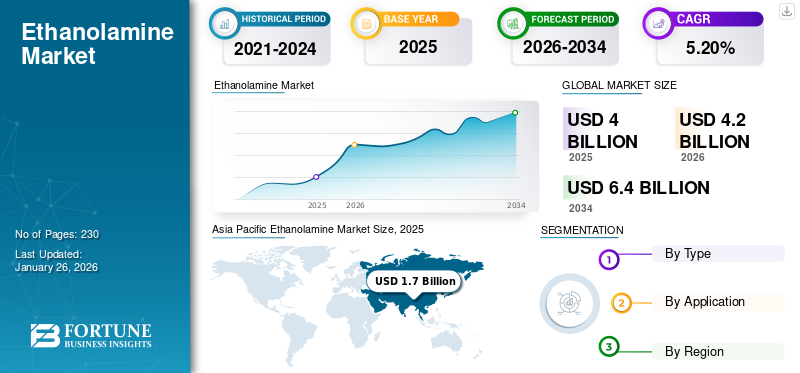
Download Free sample to learn more about this report.
ETHANOLAMINE MARKET KEY TAKEAWAYS
 Global Market Size & Forecast
- 2025 Market Size: USD 4.00 billion
- 2026 Market Size: USD 4.20 billion
- 2034 Forecast Market Size: USD 6.40 billion
- CAGR: 5.20% from 2026–2034
 Market Share
- Asia Pacific led with a 44.70% share in 2025.
- MEA held a 40.48% share in 2026.
- Detergents dominated with a 30.95% share in 2026.
 Key Regional Highlights
North America
North America accounted for USD 0.9 billion in 2025 and is projected to reach USD 1.0 billion in 2026.
Asia Pacific
Asia Pacific led with USD 1.7 billion in 2025 and is projected to reach USD 1.8 billion in 2026.
Europe
Europe held a 19.40% share in 2025 and is projected to reach USD 0.8 billion in 2026.
U.S.
U.S.: The market is expected to reach USD 0.9 billion by 2026.
Japan
Japan: The market is expected to reach USD 0.1 billion by 2026.
Read More

Ethanolamine Market Trends
Demand for Herbicide Intermediate in Agrochemical Sector Creating Key Market Trend
The increasing product demand in the agrochemical sector, particularly for producing herbicides, highlights a significant trend in the chemical and agriculture industries. Ethanolamines, which are versatile organic compounds acting as weak bases, are extensively used to formulate herbicides that effectively control weeds and promote crop growth. This surge in demand is attributed to a combination of factors.
- Asia Pacific witnessed a ethanolamine market growth from USD 1.55 billion in 2022 to USD 1.63 billion in 2023.
Moreover, advancements in agricultural practices and the need for sustainable farming methods have encouraged the development of innovative herbicides that can target specific weeds without harming the crops. Ethanolamine’s' versatility and compatibility with other compounds make them ideal for producing specialized herbicide formulations. This has led to increased research and development activities that are focused on ethanolamine-based herbicides, further driving their demand in the agrochemical sector.
Download Free sample to learn more about this report.
Ethanolamine Market Growth Factors
Growing Demand in Surfactants and Chemical Intermediates is Fostering Market Growth
Ethanolamines are crucial in the production of surfactants and chemical intermediates. The demand for this type of amines is driven by its ability to emulsify or disperse water-insoluble substances, making them indispensable in many products. The expanding personal care, home cleaning, and agriculture industries will contribute to the increased product demand. Ethanolamines are also utilized to synthesize various chemicals, including agrochemicals and drugs. The ongoing developments in pharmaceutical and construction industries necessitate a steady supply of these amines. Overall, the versatility and efficiency of this amine type make it a critical component in a diverse array of chemical reactions and products.
RESTRAINING FACTORS
Stringent Regulations Related to Product Use and Their Environmental Impact May Pose Challenges to Market’s Growth
The market is facing challenges due to concerns related to its environmental and health impact. Ethanolamine is used in various applications, but its use has been associated with concerns about toxicity and carcinogenicity. Regulatory restrictions have led to a shift toward more eco-friendly alternatives. Additionally, the production of this type of amines generates greenhouse gas emissions, prompting companies to focus on more sustainable practices. These challenges present opportunities for innovation and collaboration toward a more sustainable future.
Ethanolamine Market Segmentation Analysis
By Type Analysis
Monoethanolamine (MEA) Holds Dominant Share Due to Its Increasing Adoption in Various Chemical Intermediates
Based on type, the market is segmented into Monoethanolamine (MEA), Triethanolamine (TEA), and Diethanolamine (DEA).
The Monoethanolamine (MEA) segment is expected to account for 40.48% of the market in 2026. MEA is widely used across various industries due to its versatility and effectiveness as a feedstock for producing detergents, emulsifiers, polishes, pharmaceuticals, and chemical intermediates. Its significant role in gas treatment, particularly in the removal of Carbon Dioxide (CO2) and Hydrogen Sulfide (H2S) from natural gas and refinery streams, further underscores its importance in the chemical industry. The demand for MEA is influenced by its applications in cleaning agents, personal care products, textile processing, and gas treatment technologies. As industries continue to expand and new product applications emerge, MEA’s market share is expected to remain substantial, reflecting its critical role in meeting the diverse needs of the global market.
Triethanolamine (TEA) is anticipated to lead with a considerable growth rate during the study period. It is a versatile organic compound widely used in various industrial and cosmetic applications. It is a viscous and colorless liquid that can appear as white granules. TEA is formed by the reaction of ethylene oxide with aqueous ammonia, resulting in a compound that exhibits properties of both amines and alcohols. This dual functionality makes TEA an effective surfactant and a common ingredient in formulations requiring pH adjustment or buffering, making it valuable in many industries.
By Application Analysis
To know how our report can help streamline your business, Speak to Analyst
Detergents Segment Holds Major Market Share as They Inhibit Surfactant Properties and are Excellent Emulsifiers
Based on application, the market is segmented into detergents, ethyleneamines, gas purification, metal cleaning, herbicide intermediate, textile, and others.
The detergents segment is projected to dominate the market with a share of 30.95% in 2026. Ethanolamines are chemical compounds that play a significant role in the formulation of detergents due to their surfactant properties, emulsifying capabilities, pH adjustment abilities, compatibility with other ingredients, and biodegradability. They are crucial in the production of detergents as they contribute to their cleaning effectiveness, stability, and overall performance.
Ethanolamines can be involved in the synthesis of ethyleneamines. The segment is likely to acquire 5.3% of the market share in 2025. These products are versatile chemicals used in a variety of industrial processes. In the production of ethylene amines, the product can undergo reactions that lead to the formation of ethylene amines, a class of chemicals that include ethylenediamine, among others. These reactions typically involve complex processes, including amination, where ammonia reacts with ethanolamines. Ethyleneamines are valuable in many applications, such as in manufacturing chelating agents, pharmaceuticals, agricultural chemicals, and epoxy-curing agents.
REGIONAL INSIGHTS
Regionally, the market is studied across North America, Europe, Asia Pacific, Latin America, and the Middle East & Africa.
Asia Pacific
Asia Pacific Ethanolamine Market Size, 2025 (USD Billion)
To get more information on the regional analysis of this market, Download Free sample
Asia Pacific held a dominant position in the global market in 2025 due to the strong growth of the detergents and ethyleneamines sectors. Asia Pacific accounted for USD 1.7 billion in 2025, representing 44.70% of the global market share, and is projected to reach USD 1.8 billion in 2026. China is leading the regional market as the country is considered a manufacturing hub. This trend will propel the growth of the market in the region. Moreover, the market in India is also growing at a notable pace due to the increasing use of this product in textile industries. The market size in China is likely to be USD 0.9 billion in 2026. On the other hand, the market value for Japan is expected to be USD 0.1 billion and India is projected to be USD 0.9 billion in 2026.
To know how our report can help streamline your business, Speak to Analyst
North America
North America is projected to grow significantly in the coming years as the U.S. holds a prominent position in the market, capturing a substantial portion of the region's total market share. The North America market generated USD 0.9 billion in 2025, representing 24.50% of the global market landscape, and is expected to reach USD 1 billion in 2026. The North American market is characterized by a rising demand for gas purification and metal cleaning applications, which, in turn, will drive the consumption of ethanolamines in the region. The U.S. market size is expected to be USD 0.9 billion in 2026.
Europe
Europe is poised to witness steady growth in the coming years, attributable to the widespread product application across several industries, including detergents and textiles. Europe contributed 19.40% to the global market in 2025, with a valuation of USD 0.7 billion, and is projected to reach USD 0.8 billion in 2026. Notably, Germany, France, and the U.K. are the major contributors to the ethanolamine market growth in Europe. The market size for U.K. is expected to be USD 0.08 billion in 2026. On the other hand, the Germany market is likely to be USD 0.2 billion in 2026 and France is likely to hit USD 0.1 billion in 2025.
Latin America
Latin America contributed approximately USD 0.1 billion to the global market in 2025, accounting for 3.80% share, and is expected to reach USD 0.1 billion in 2026. The market’s growth in Latin America is linked to the increasing product demand in sectors, such as home cleaning and gas purification. The demand for these products is exceptionally high in Brazil, Mexico, and Argentina, which are among the region's most prominent market drivers for intermediate chemicals.
Middle East & Africa
During the forecast period, the market in the Middle East & Africa is expected to experience significant growth. In 2025, Middle East & Africa held 7.60% of the global market, reaching a valuation of USD 0.3 billion, and is projected to grow to USD 0.4 billion in 2026. This growth is due to the increasing oil & gas exploration activities in the region, which have led to a surge in the demand for monoethanolamine for purification activities. As a result, the market in these regions will witness notable growth during the forecast period. The GCC market size is estimated to be USD 0.19 billion in 2025.
List of Key Companies in Ethanolamine Market
Key Players Adopted Product Development and Capacity Expansion Strategies to Maintain Market Dominance
The market is highly competitive and consolidated. Some of the key market players are increasing their investments in creating novel technologies to enhance the performance of their products. This strategy will help them accelerate their growth in the global market. They are also engaging in mergers, acquisitions, and production expansion activities to expand their presence in the market.
LIST OF KEY COMPANIES PROFILED:
- BASF SE (Germany)
- DOW (U.S)
- Indorama Ventures Public Company Limited (Thailand)
- INEOS (U.K)
- Nouryon (Netherlands)
- SABIC (Saudi Arabia)
- Sintez OKA Group of Companies (Russia)
- OUCC (Taiwan)
- Kanto Kagaku (Japan)
- Jay Dinesh Chemicals (India)
KEY INDUSTRY DEVELOPMENTS:
- November 2023 – BASF and SINOPEC expanded their downstream chemical plants at the Verbund site operated by BASF-YPC Co., Ltd. in Nanjing. This was a strategic move to meet the increasing demand from various industries in the Chinese market. The expansion will enable BASF-YPC to produce high-quality chemical intermediates, such as propionic acid, propionic aldehyde, purified ethylene oxide, ethyleneamines, and ethanolamines.
REPORT COVERAGE
The report provides a detailed analysis of the market and focuses on key aspects, such as leading companies, types, and top applications. Besides this, it offers insights into the market trends and highlights key industry developments. In addition to the aforementioned factors, the report encompasses several factors that have contributed to the growth of the market in recent years.
Request for Customization to gain extensive market insights.
Report Scope & Segmentation
|
ATTRIBUTE |
DETAILS |
|
Study Period |
2021-2034 |
|
Base Year |
2025 |
|
Estimated Year |
2026 |
|
Forecast Period |
2026-2034 |
|
Historical Period |
2021-2024 |
|
Unit |
Value (USD Billion), Volume (Million Ton) |
|
Growth Rate |
CAGR of 5.20% from 2026 to 2034 |
|
Segmentation |
By Type
|
|
By Application
|
|
|
By Region
|
Frequently Asked Questions
Fortune Business Insights says that the global market size was valued at USD 4.20 billion in 2026 and is projected to reach USD 6.40 billion by 2034.
Recording a CAGR of 5.20%, the market will exhibit steady growth during the forecast period of 2026-2034.
The Asia Pacific region held the largest market value of USD 1.8 billion in 2026.
In 2026, the detergent segment is the leading application segment in the market.
Increasing use of detergents and chemical intermediates is the crucial factor driving the market.
BASF SE, DOW, INEOS, Nouryon, and SABIC are the top players in the market.
Asia Pacific dominated the ethanolamine market with a market share of 44.70% in 2025.
Rising demand from the surfactants and agrochemical sectors will support the product’s adoption.



- 2021-2034
- 2025
- 2021-2024
- 230
Get 30-60 hrs Free Customization
Expand Regional and Country Coverage, Segments Analysis, Company Profiles, Competitive Benchmarking, and End-user Insights.


















Related Reports
-
US +1 833 909 2966 ( Toll Free )
-
Get In Touch With Us