Chlorine Trifluoride Market Size, Share & Industry Analysis, By Application (Semiconductor, Manufacturing, Nuclear Fuel Processing, Rocket Propellant Systems, and Others), and Regional Forecast, 2026-2034
 Download Free Sample
Chlorine Trifluoride Market Size and Future Outlook
 Listen to Audio Version
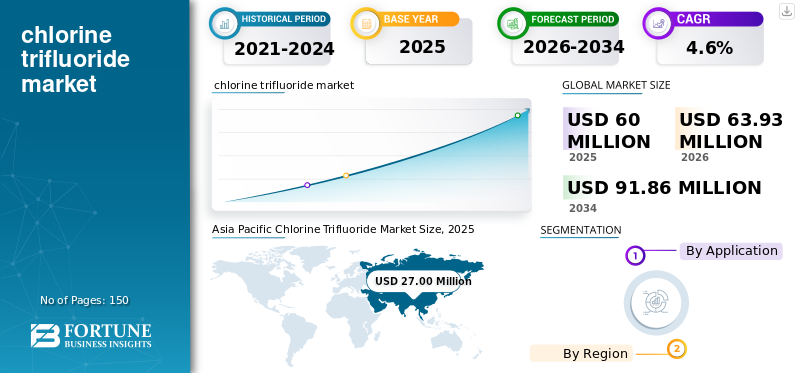
The global chlorine trifluoride market size was valued at USD 60.00 million in 2025 and is projected to grow from USD 63.93 million in 2026 to USD 91.86 million by 2034, exhibiting a CAGR of 4.6% during the forecast period. Asia Pacific dominated the chlorine trifluoride market with a market share of 45% in 2025.
Chlorine trifluoride is a highly reactive inorganic compound composed of chlorine and fluorine, known for its exceptional oxidizing strength and durability to react with most materials, including metals and non-combustible substances. Due to its extreme chemical reactivity, chlorine trifluoride is used exclusively in highly controlled, specialized industrial environments. The market serves niche applications such as semiconductor manufacturing, nuclear fuel processing, and rocket propulsion systems. Among these, semiconductor manufacturing represents the leading application due to the compound’s effectiveness in cleaning chemical vapor deposition chambers and removing residues without plasma assistance. Growth in advanced electronics, miniaturization of semiconductor devices, and expansion of fabrication facilities are reinforcing market relevance. Additionally, its use in uranium processing and aerospace propulsion supports limited but critical demand. The market remains small in volume but high in value, driven by stringent performance requirements and technical barriers to substitution.
Download Free sample to learn more about this report.
Chlorine Trifluoride Market Key Takeaways
 Market Size & Forecast
- 2025 Market Size: USD 60.00 million
- 2026 Market Size: USD 63.93 million
- 2034 Forecast Market Size: USD 91.86 million
- CAGR: 4.6% from 2026-2034
 Market Share
- Asia Pacific dominated the chlorine trifluoride market with a 45.0% share in 2025.
- Semiconductor manufacturing held the largest market share in 2025.
- Nuclear fuel processing is projected to grow at a CAGR of 4.3% during the forecast period.
 Key Regional Highlights
Asia Pacific
Asia Pacific led the market due to rapid expansion of semiconductor fabrication facilities across China, South Korea, Taiwan, and Japan.
North America
North America reached USD 18.00 million in 2025, supported by strong semiconductor and advanced manufacturing activities.
Europe
Europe was valued at USD 11.10 million in 2025 and is expected to witness steady market growth.
U.S.
The market reached USD 16.20 million in 2025, accounting for approximately 27.0% of regional revenue.
Japan
Ongoing investments in semiconductor manufacturing and electronics production are supporting market demand.
Read More

CHLORINE TRIFLUORIDE MARKET TRENDS
Advanced in High-Tech Manufacturing Requirements Shaping Market Evolution
The market is characterized by evolving trends linked to advancements in high-technology manufacturing rather than volume expansion. A key trend is the increasing use of chlorine trifluoride in next-generation semiconductor fabrication processes, particularly for advanced logic and memory nodes requiring ultra-clean processing environments. Another notable trend is the emphasis on improved handling, storage, and delivery systems to enhance operational safety due to the compound’s hazardous nature. Manufacturers are also focusing on producing ultra-high-purity grades to meet stringent semiconductor industry specifications. Additionally, limited but ongoing research into alternative fluorinating agents continues, although chlorine trifluoride remains irreplaceable in certain applications. These trends indicate a shift toward higher purity, safety-focused deployment, and application-specific usage within the market.
MARKET DYNAMICS
MARKET DRIVERS
Download Free sample to learn more about this report.
Compound’s Unique & Irreplaceable Chemical Properties Leads to Market Growth
The primary driver of the market is the compound’s unique and irreplaceable chemical reactivity. In semiconductor manufacturing, chlorine trifluoride enables efficient cleaning of deposition chambers without plasma, reducing downtime and improving process efficiency. Its ability to react with stable compounds such as tungsten and silicon residues makes it indispensable in advanced fabrication processes. In nuclear applications, chlorine trifluoride is used for fluorination and handling of uranium compounds, supporting critical fuel cycle operations. Additionally, its high energy release characteristics enable niche use in rocket propulsion systems. These specialized functional advantages ensure continued usage despite strict safety requirements, thus sustaining long-term product demand.
MARKET RESTRAINTS
Extreme Hazard Profile Limiting Broader Adoption in Several Application
A major restraint in the market is its extreme hazardous nature, which significantly limits widespread adoption. Chlorine trifluoride reacts violently with water, organic materials, and most metals, requiring specialized infrastructure, trained personnel, and stringent safety protocols. Regulatory oversight related to storage, transport, and handling further increases operational complexity and costs. These factors restrict usage to a limited number of industrial users with advanced safety capabilities. Additionally, high insurance and compliance costs discourage entry of new players. As a result, despite its performance advantages, the compound remains confined to niche applications, hence constraining overall market expansion.
MARKET OPPORTUNITIES
Semiconductor Capacity Expansion and Strategic Applications Creating Growth Potential
The market presents selective growth opportunities driven primarily by expansion in semiconductor manufacturing capacity. Rising investments in advanced fabrication facilities across Asia Pacific, North America, and Europe are driving demand for specialized chamber-cleaning chemicals. Another opportunity lies in nuclear fuel processing, where chlorine trifluoride is used in uranium enrichment and handling processes requiring strong fluorinating agents. Additionally, emerging space and defense programs create opportunities in rocket propulsion systems, albeit on a limited scale. Development of safer containment technologies and specialized delivery systems further supports market adoption. While overall demand remains niche, these high-value applications provide sustained growth avenues, therefore strengthening the long-term outlook of the market.
MARKET CHALLENGES
Safety Management and Supply Constraints Affecting Market Stability
The market faces challenges related to safety management and supply limitations. Manufacturing, transporting, and storing chlorine trifluoride require specialized materials and containment systems that can withstand its reactivity. Any disruption in production or logistics can significantly impact downstream users due to limited supplier availability. Ensuring consistent supply while maintaining strict safety compliance poses operational challenges. Additionally, emergency response preparedness and workforce training are critical but costly requirements. These challenges increase barriers to market participation and limit scalability, therefore influencing long-term market stability and supply resilience.
RESEARCH AND DEVELOPMENT ACTIVITIES
R&D activities in the market focus primarily on improving handling safety, delivery systems, and application precision rather than new end uses. Efforts include development of advanced containment materials, automated delivery systems, and monitoring technologies to minimize human exposure. Improvements in purity control also support semiconductor applications. These innovations enhance operational reliability and regulatory compliance.
Segmentation Analysis
By Application
Increasing Chamber Cleaning and Residue Removal Led to Semiconductor Manufacturing Segment’s Growth
By application, the market is segmented into semiconductor manufacturing, nuclear fuel processing, rocket propellant systems, and others.
Semiconductor manufacturing held the leading chlorine trifluoride market share in 2025, due to its critical role in chamber cleaning and residue removal. As device geometries shrink and process complexity increases, effective non-plasma cleaning solutions are essential to maintain yield and throughput. Chlorine trifluoride enables faster cleaning cycles and reduced equipment downtime, directly supporting productivity. Expansion of advanced fabs and increased chip demand reinforce segment dominance, thus maintaining leadership.
To know how our report can help streamline your business, Speak to Analyst
In nuclear fuel processing, chlorine trifluoride is used for fluorination and handling of uranium compounds. Its strong oxidizing properties enable efficient chemical conversion processes required in the nuclear fuel cycle. Demand is limited but stable, hence supporting consistent niche consumption. The segment is expected to grow at a CAGR of 4.3% over the forecast period.
Chlorine trifluoride has also been explored in rocket propulsion systems due to its hypergolic properties. Usage remains limited to experimental and defense-related applications, therefore contributing marginal but strategic demand. The segment is growing at CAGR of 2.9% in the global market.
Chlorine Trifluoride Market Regional Outlook
By region, the market is categorized into North America, Europe, Asia Pacific, Latin America, and the Middle East & Africa.
Asia Pacific
Asia Pacific Chlorine Trifluoride Market Size, 2025 (USD Million)
To get more information on the regional analysis of this market, Download Free sample
Asia Pacific dominates the market due to rapid expansion of semiconductor fabrication capacity across countries such as China, South Korea, Taiwan, and Japan. The region hosts a large concentration of memory and logic chip manufacturers, driving strong demand for specialized chamber-cleaning chemicals. Continuous investments in advanced-node fabrication and increased electronics production reinforce consumption. Additionally, high-volume manufacturing environments require efficient cleaning solutions to minimize downtime, favoring chlorine trifluoride usage. Despite strict safety requirements, well-developed industrial infrastructure supports handling and deployment. These factors collectively position Asia Pacific as the leading regional market, hence accounting for the largest share of global chlorine trifluoride demand.
China Chlorine Trifluoride Market
The China market was valued at USD 9.72 million in 2025, accounting for approximately 16.2% of global revenues. Strong demand for phosphate fertilizers driven by intensive crop cultivation, government-backed food security programs, and efforts to improve agricultural productivity continues to support chlorine trifluoride market growth.
To know how our report can help streamline your business, Speak to Analyst
India Chlorine Trifluoride Market
The India market in 2025 was accounted for USD 2.16 million. The growth in this country is supported by the early-stage buildup of domestic semiconductor ecosystems, rising capability in handling hazardous specialty chemicals, and increased focus on strategic industrial self-reliance.
North America
North America remains a significant regional market for and reached USD 18 million in 2025. North America represents a significant market for chlorine trifluoride, driven primarily by advanced semiconductor manufacturing and established nuclear infrastructure. The United States leads regional consumption due to the presence of semiconductor fabrication facilities focused on logic, memory, and specialty devices. Increasing investments in domestic chip manufacturing to strengthen supply chain resilience are supporting demand for high-purity chamber-cleaning chemicals such as chlorine trifluoride.
U.S. Chlorine Trifluoride Market
The U.S. market in 2025 was accounted for USD 16.20 million, representing approximately 27.0% of regional revenues. Growth is driven by expansion of advanced semiconductor fabrication facilities, increasing demand for high-purity chamber-cleaning chemicals, and continued nuclear and defense-related industrial activity.
Europe
Europe is projected to record modest growth in the market, reached a valuation of USD 11.10 million in 2025. Europe’s market is characterized by controlled but consistent demand, supported by precision semiconductor manufacturing and nuclear fuel processing activities. Countries such as Germany and France play a key role due to their semiconductor research, specialty manufacturing, and nuclear energy operations. European manufacturers emphasize high-purity chemicals and strict compliance with safety and environmental regulations, influencing procurement patterns. Demand growth remains moderate due to stringent regulatory oversight, but stable usage in critical applications sustains consumption.
Germany Market
Germany’s market reached around USD 2.88 million in 2025, representing approximately 4.8% of regional demand. The growth is driven by advanced semiconductor manufacturing, strong demand for ultra-high-purity specialty chemicals, and established nuclear research and precision industrial processing capabilities.
U.K. Chlorine Trifluoride Market
The U.K market in 2025 is estimated at USD 1.72 million, accounting for roughly 2.9% of regional revenues. The growth in this country is supported by demand from advanced semiconductor research, specialty chemical processing, and nuclear fuel handling activities, alongside strong regulatory compliance infrastructure for hazardous materials.
Latin America, and the Middle East & Africa
The Latin America and Middle East & Africa regions are expected to witness moderate growth in the market over the forecast period. Latin America represents a small and emerging market for chlorine trifluoride due to limited presence of advanced semiconductor manufacturing and nuclear fuel processing facilities. Demand is largely restricted to research institutions, specialty chemical users, and limited industrial applications.
The Middle East & Africa region accounts for a very limited share of the chlorine trifluoride market, with demand confined to niche industrial and research applications. Lack of semiconductor fabrication facilities and minimal nuclear fuel processing activity restrict widespread usage. The Middle East & Africa market reached USD 1.50 million in 2025.
Saudi Arabia Chlorine Trifluoride Market
The Saudi Arabia market accounted for around USD 0.60 million in 2025, representing approximately 1.0% of regional revenues. Growth is driven by investments in nuclear fuel cycle capabilities, expansion of high-purity specialty chemical production, and growing demand from advanced industrial and defense-related applications.
COMPETITIVE LANDSCAPE
Key Industry Players
Entry Barriers and Safety Requirements Concentrating Market Competition
The market is highly consolidated, dominated by a small number of manufacturers with the technical expertise, safety infrastructure, and regulatory clearances required to handle this extremely reactive compound. Competition is driven by product purity, reliability of supply, and the ability to meet stringent safety and compliance standards. Leading players focus on ultra-high-purity grades for semiconductor manufacturing and invest in advanced containment and delivery systems. Additionally, high capital costs, complex logistics, and strict regulatory oversight create significant entry barriers, limiting new participants.
LIST OF KEY CHLORINE TRIFLUORIDE COMPANIES PROFILED
- Air Products and Chemicals, Inc. (U.S.)
- Linde plc (Ireland)
- Kanto Denka Kogyo Co., Ltd. (Japan)
- Central Glass Co., Ltd. (Japan)
- AB Enterprises (India)
- China Isotope Development Co., Ltd (China)
- Smolecule Inc. (U.S.)
- Inhance Technologies (U.S.)
- RIKEN KEIKI CO., LTD. (Japan)
- Moniba Anand Electricals Pvt. Ltd. (India)
REPORT COVERAGE
The global market analysis provides an in-depth study of market size & forecast by all the market segments included in the report. It includes details on the market dynamics and market trends expected to drive the market in the forecast period. It offers information on technological advancements, new product launches, key industry developments, and partnerships, mergers & acquisitions. The chlorine trifluoride market research report also encompasses a detailed competitive landscape, including market share and profiles of key operating players.
Request for Customization to gain extensive market insights.
Report Scope & Segmentation
| ATTRIBUTE | DETAILS |
| Study Period | 2021-2034 |
| Base Year | 2025 |
| Estimated Year | 2026 |
| Forecast Period | 2026-2034 |
| Historical Period | 2021-2024 |
| Growth Rate | CAGR of 4.6% from 2026-2034 |
| Unit | Value (USD Million) |
| Segmentation | By Application and Region |
| By Application |
|
| By Region |
|
Frequently Asked Questions
Fortune Business Insights says that the global market size was valued at USD 60.00 million in 2025 and is projected to reach USD 91.86 million by 2034.
Recording a CAGR of 4.6%, the market is slated to exhibit steady growth during the forecast period.
The semiconductor manufacturing segment led in 2025.
Asia Pacific held the highest market share in 2025.
Irreplaceable chemical properties sustaining product demand in many applications.



- 2021-2034
- 2025
- 2021-2024
- 150
Get 30-60 hrs Free Customization
Expand Regional and Country Coverage, Segments Analysis, Company Profiles, Competitive Benchmarking, and End-user Insights.


















Related Reports
-
US +1 833 909 2966 ( Toll Free )
-
Get In Touch With Us