Clarified Butter Market Size, Share & Industry Analysis, By Source (Cattle, Sheep, Goat, and Camel), By Nature (Conventional and Organic), By Packaging (Glass Jars, PET/Plastic Jars, and Pouches/Sachets), and By Distribution Channel (Online and Offline), and Regional Forecast, 2026-2034
 Download Free Sample
(Offer valid till 31st Oct 2026)

KEY MARKET INSIGHTS
 Listen to Audio Version
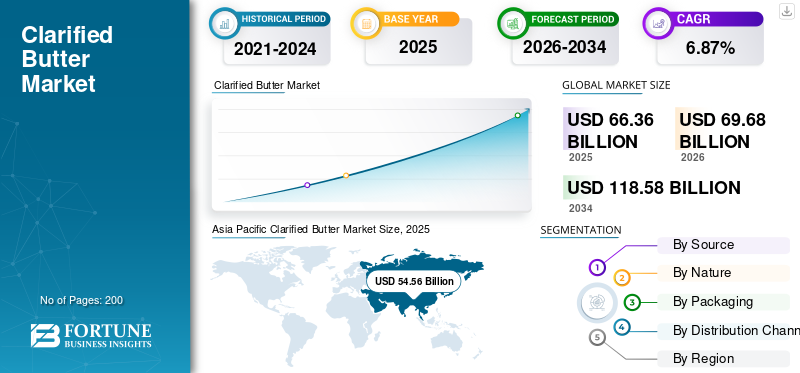
The global clarified butter market size was valued at USD 66.36 billion in 2025. The market is projected to grow from USD 69.68 billion in 2026 to USD 118.58 billion by 2034, exhibiting a CAGR of 6.87% during the forecast period. Asia Pacific dominated the global market with a market share of 82.22% in 2025.
Clarified butter, derived through the removal of water and milk solids from butter, offers extended shelf life, higher smoke point, and concentrated milk fat, making it a preferred fat source across culinary, food processing, nutraceutical, and traditional medicine applications. The market growth is supported by rising dairy fat consumption, growing acceptance of natural saturated fats, increasing ethnic food penetration, and expanding premium and organic ghee demand in both developed and emerging markets. Consumers favor clarified butter for its natural profile, removal of milk solids, lactose-free, and fat-soluble vitamin content, aligning with demands for clean-label fats in South Asian cuisines and beyond. The global market grows due to rising consumer preferences for natural dairy products, particularly in regions such as the Middle East and Africa, where extended shelf life suits traditional cooking, and North America, where health benefits drive adoption in food service.
The global industry is dominated by major players, including Amul (GCMMF), Mother Dairy (NDDB Group), Nanak Foods, Verka (Punjab Milkfed), and Fonterra Co-operative Group.
Download Free sample to learn more about this report.
Clarified Butter Market Key Takeaways
 Global Market Size & Forecast
- 2025 Market Size: USD 66.36 billion
- 2026 Market Size: USD 69.68 billion
- 2034 Forecast Market Size: USD 118.58 billion
- CAGR: 6.87% (2026–2034)
 Market Share
- Asia Pacific dominated the market with an 82.22% share in 2025.
- The cattle segment led the market, accounting for 93.63% of the global market in 2025.
- The conventional segment dominated the market with a 95.97% share in 2025.
 Key Regional Highlights
Asia Pacific
Asia Pacific generated USD 54.56 billion in 2025, maintaining its leading market position.
North America
North America accounted for USD 3.98 billion in 2025 and is projected to register the fastest CAGR of 9.09% during 2026–2034.
Europe
Europe held USD 2.57 billion in 2025 and is projected to grow at a 7.61% CAGR during 2026–2034.
U.S.
U.S. market is projected to grow at a CAGR of 8.99% during the forecast period.
Japan
Japan market was valued at USD 2.11 billion in 2025.
Read More

Clarified Butter Market Trends
Emergence of Non-Cow Ghee as a Niche Health Trend
Goat and camel ghee are gaining traction due to perceived digestive benefits and suitability for lactose-sensitive consumers. Although these segments represent a small share of global volume, they exhibit double-digit growth rates, with camel ghee demand expanding notably in the Middle East and parts of Africa. These products are increasingly marketed as premium, functional options, leading to higher prices per unit. These aspects are anticipated to drive clarified butter market growth.
- For instance, in September 2025, Milkio Foods Limited, a New Zealand-based premium dairy manufacturer, showcased its grass-fed high-aroma ghee, sheep ghee, goat ghee, ghee blends, pure butter, buttery spread, and lactic butter at the Dubai World Trade Centre's Shk Rashid Hall. These products emphasize nutrition such as CLA, Omega-3s, and vitamins, with lactose-free suitability for keto/paleo diets and high smoke points for cooking and are exported to over 28 countries.
Download Free sample to learn more about this report.
MARKET DYNAMICS
Market Drivers
Rising Global Acceptance of Natural Dairy Fats to Support Market Expansion
The global market is benefiting from a measurable shift toward natural dairy fats as consumers move away from hydrogenated oils and industrial trans-fats. According to FAOSTAT and national dairy boards, the global butter and ghee consumption volumes increased steadily between 2018 and 2024, with milk fat utilization rising faster than liquid milk consumption in both developed and emerging markets. In parallel, Western markets are witnessing an increased adoption of ghee as a cooking fat in ketogenic, paleo, and low-carbohydrate diets, contributing to high growth potential. These trends collectively reinforce the long-term demand for clarified butter across household, foodservice, and industrial food applications.
- According to the National Institute of Health, the per capita consumption of ghee and butter in India has increased to 4.48 kg/yr in the year 2020 from 2.7 kg/yr in 2007.
Market Restraints
Volatility in Milk Fat Supply and Pricing to Limit Short-Term Margin Stability
Clarified butter production is directly linked to milk fat availability, which is sensitive to climatic conditions, feed costs, and regional dairy productivity. The Food and Agriculture Organization dairy outlook data shows that the global milk production growth slowed to below 1.5% in select years due to heat stress, feed inflation, and water scarcity, particularly in South Asia and parts of Europe. In India, seasonal milk procurement variability can lead to short-term ghee price fluctuations of 8–12% annually, affecting both processors and export pricing. Similarly, in export-oriented regions such as New Zealand, butterfat prices are closely tied to global dairy commodity cycles, limiting the pricing predictability for clarified butter manufacturers.
Market Opportunities
Rising Use of Clarified Butter in Industrial Food Processing and Bakery Applications to Unlock New Growth Opportunities
The rising use of clarified butter (also known as ghee or anhydrous milk fat) in industrial food processing and bakery applications is creating significant growth opportunities in the global market. This is driven by its high smoke point, lactose-free properties, and flavor-enhancing qualities. This butter serves as a premium fat in bakery products such as croissants, puff pastries, Danish pastries, and ice cream, providing superior texture, aroma, and stability without water content that could affect lamination or baking. In food processing, clarified butter acts as a frying fat, formula oil, and flavor carrier for quick-service restaurants, confectionery, and ready-to-eat products, with fast-food chains increasingly adopting it for natural ingredient demands. Its long shelf life and heat stability support global food aid programs and processed foods, while organic/grass-fed variants cater to health-conscious innovations. Its high smoke point supports versatile high-heat cooking without burning, while health advantages such as anti-inflammatory properties enhance appeal among wellness-centered buyers.
- According to Milkio Foods Ltd, New Zealand, one of the leading manufacturers and exporters of premium grass-fed ghee and dairy products, Ghee's high smoke point of around 485°F (250°C) makes it an excellent, stable substitute for butter (350°F), coconut oil (around 350°F), and even some olive oils for high-heat cooking such as sautéing, frying, and roasting, preventing burning and breakdown, unlike lower-heat fats.
SEGMENTATION ANALYSIS
By Source
Dominance of Cattle-Based Ghee Driven by Large Scale Cow Milk Availability and Extensive Consumption
On the basis of source, the global market is segmented into cattle, sheep, goat, and camel.
The cattle segment dominates the global clarified butter market share, accounting for USD 62.13 billion in 2025, representing 93.63% of the global market value. This dominance is driven by large-scale cow milk availability, established dairy infrastructure, and widespread consumer acceptance across Asia Pacific, Europe, and North America. The segment is projected to grow at a CAGR of 6.59% over 2026–2034, supported by stable household consumption and rising industrial usage in bakery and foodservice.
The goat segment is expected to witness strong growth at a CAGR of 11.53% over the forecast period. This is driven by increasing global clarified butter demand for digestible dairy fats and premium health-positioned products, particularly in Europe and urban Asia Pacific.
To know how our report can help streamline your business, Speak to Analyst
By Nature
Affordability and High-Volume Consumption to Sustain Conventional Segment Leadership
On the basis of nature, the market is segmented into conventional and organic.
The conventional segment holds the dominant share, valued at USD 63.69 billion in 2025, accounting for 95.97% of the global market. Growth is supported by price competitiveness, widespread availability, and extensive use in household cooking, foodservice, and packaged foods. The segment is expected to grow at a CAGR of 6.65% over 2026–2034.
The organic segment, while smaller, is gaining momentum due to rising health consciousness, clean-label demand, and residue-free dairy preferences. Valued at USD 2.68 billion in 2025, the segment is projected to expand at a CAGR of 11.28% over the analysis period, significantly outpacing the conventional segment and reflecting strong premiumization trends.
By Packaging
Cost-Efficient Flexible Packaging to Drive Pouches/Sachets Segment’s Dominance
On the basis of packaging, the market is segmented into glass jars, PET/plastic jars, and pouches/sachets.
The pouches/sachets segment leads the market, valued at USD 28.32 billion in 2025, accounting for 42.68% of the global demand. High penetration in price-sensitive markets, ease of storage, and suitability for small retail packs support its dominance. The segment is expected to grow at a CAGR of 6.39% over the analysis period.
The PET/plastic jars segment accounted for USD 23.84 billion in 2025, supported by durability, mid-range pricing, and retail convenience. The segment is poised to grow at a CAGR of 5.93% over the forecast period.
By Distribution Channel
Traditional Retail to Drive Offline Segment’s Leadership despite Rapid Online Growth
On the basis of distribution channel, the market is segmented into online and offline.
The offline distribution channel dominates the global market, valued at USD 61.23 billion in 2025, accounting for 92.27% of the total sales. The dominance is driven by traditional retail outlets, cooperative dairy networks, wholesalers, and foodservice buyers that rely on established procurement systems. The segment is projected to grow at a CAGR of 6.21% over 2026–2034. Offline channels such as supermarkets dominate for accessibility and brand visibility, complemented by expanding e-commerce and food service outlets catering to household and professional needs.
The online segment, valued at USD 5.13 billion in 2025, is expected to grow at a CAGR of 12.75% over the forecast period. This is supported by premium product launches, cross-border e-commerce, and rising direct-to-consumer adoption, particularly in North America and Europe.
Clarified Butter Market Regional Outlook
Regionally, the report covers the market analysis across North America, Europe, Asia Pacific, South America, and the Middle East and Africa.
Asia Pacific
Asia Pacific Clarified Butter Market Size, 2025 (USD Billion) To get more information on the regional analysis of this market, Download Free sample
The Asia Pacific dominates the global market and was valued at USD 54.56 billion in 2025, accounting for 82.22% of the global market share. The region is projected to grow at a CAGR of 6.55% during 2026–2034, supported by entrenched dietary usage, a large population base, and strong dairy production capacity.
China Clarified Butter Market
China’s market remains niche but expanding, valued at approximately USD 4.07 billion in 2025, driven by bakery usage, premium dairy imports, and growing Western-style food.
India Clarified Butter Market
India represents the backbone of global ghee consumption, with an estimated market size of USD 43.74 billion in 2025, accounting for 80.15% of the Asia Pacific demand. The growth is supported by high per-capita consumption, religious and cultural usage, and expanding packaged ghee penetration. The Indian ghee market is projected to grow at a CAGR of 5.92% over 2026–2034.
Japan Clarified Butter Market
The Japan market was valued at around USD 2.11 billion in 2025, supported by bakery and confectionery applications rather than household cooking. The product demand is expected to grow at a CAGR of 5.92% over the analysis period, driven by premium dairy fats and foodservice usage.
North America
North America was valued at USD 3.98 billion in 2025, accounting for 6.00% of the global market share, and is projected to register the fastest CAGR of 9.09% during 2026–2034. The regional growth is driven by the rising adoption of ghee as a clean-label cooking fat, increasing ethnic food consumption, and strong growth in organic and grass-fed ghee variants.
U.S. Clarified Butter Market
The U.S. market was valued at approximately USD 3.41 billion in 2025, representing over 86% of the regional demand. Growth is supported by ketogenic diets, gluten-free cooking trends, and premium dairy branding. The U.S. market is projected to grow at a CAGR of 8.99% over the forecast period, outperforming the global average.
Europe
Europe accounted for USD 2.57 billion in 2025, representing 3.87% of the global market, and is projected to grow at a CAGR of 7.61% during 2026–2034. The regional growth is driven by rising ethnic food adoption, premium butterfat usage in bakery, and increasing consumer acceptance of clarified butter as a cooking and baking fat.
U.K. Clarified Butter Market
The U.K. market was valued at approximately USD 0.38 billion in 2025, supported by strong consumption by Indian diaspora and specialty retail expansion. The market is projected to grow at a CAGR of 8.70% over the analysis period.
South America and the Middle East and Africa
The South America and the Middle East & Africa regions are expected to witness moderate growth in this market during the forecast period. South America represents a smaller but growing market, valued at USD 1.18 billion in 2025 and accounting for 1.78% of the global market share. The regional market is projected to grow at a CAGR of 6.92% over 2026–2034. Growth is supported by bakery usage, limited ethnic food adoption, and increasing exposure to clarified butter through foodservice. The Middle East & Africa market is valued at USD 4.07 billion in 2025, accounting for 6.13% of the global demand, and is projected to grow at a CAGR of 8.22% during 2026–2034.
UAE Clarified Butter Market
The UAE market was valued at approximately USD 0.53 billion in 2025, driven by expatriate population demand, foodservice usage, and premium imported ghee brands. The market is expected to grow at a CAGR of 10.01% over the analysis period, supported by retail modernization and tourism-driven food consumption.
COMPETITIVE LANDSCAPE
Key Industry Players
Leading Players Emphasize Innovation and Organic Variants to Consolidate Market Positions
The global clarified butter market is moderately consolidated, with leadership driven by sourcing scale, brand trust, and distribution reach. Competition centers on milk procurement efficiency, product differentiation, and premium branding. Leading players also emphasize organic variants and innovation amid fragmented competition, focusing on premium positioning through quality control and expanded regional presence.
Key Players in the Clarified Butter Market
|
Rank |
Company Name |
|
1 |
Gujarat Cooperative Milk Marketing Federation (Amul) |
|
2 |
Mother Dairy Fruit & Vegetable Pvt. Ltd. |
|
3 |
Fonterra Co-operative Group Limited |
|
4 |
Nanak Foods Inc. |
|
5 |
Verka (Punjab State Cooperative Milk Producers’ Federation) |
List of Key Clarified Butter Companies Profiled
- Gujarat Cooperative Milk Marketing Federation (Amul) (India)
- Mother Dairy Fruit & Vegetable Pvt. Ltd. (NDDB Group) (India)
- Fonterra Co-operative Group Limited (New Zealand)
- Verka (Punjab State Cooperative Milk Producers’ Federation) (India)
- Nanak Foods Inc. (U.S.)
- Patel Brothers / Swad Foods (U.S.)
- ITC Limited (Aashirvaad Ghee) (India)
- Britannia Industries Limited (India)
- Almarai Company (Saudi Arabia)
- Nestlé S.A. (Switzerland)
KEY INDUSTRY DEVELOPMENTS
- December 2025: Sunfeast Mom’s Magic introduced new Ghee Roasted Nuts cookies, supported by a nostalgia-led TVC conceptualized by Ogilvy and rolling out pan-India across retail and e-commerce.
- November 2025: Karnataka Chief Minister Siddaramaiah launched the export of Nandini ghee, produced by the Karnataka Milk Federation (KMF), to the U.S., Saudi Arabia, and Australia. This marks the first shipment of the product to these markets, driven by the growing international demand from Indian diaspora communities.
- November 2025: Annapurna Group, a legacy FMCG brand with over 70 years in Eastern India, expanded its cow ghee offerings. The company emphasizes a "purity-first" approach through traditional methods, grass-fed cow milk, and rigorous quality checks to meet the rising demand for authentic, nutritious products.
- September 2024: Farmery, a direct-to-consumer brand focused on farm-to-fork organic foods, launched authentic Cow Ghee and Buffalo Ghee to appeal to health-conscious modern consumers while honoring traditional methods.
- February 2022: Tetra Pak partnered with Warana Dairy to launch India's first locally manufactured holographic packaging, known as Tetra Pak Reflect, for 1-liter ghee packs. This innovation, produced at Tetra Pak's Chakan facility in Maharashtra, enhances shelf appeal and combats adulteration through tamper-evident features.
REPORT COVERAGE
The global clarified butter market industry report analyzes the market in depth and highlights crucial aspects such as global market trends, market dynamics, prominent companies, investment in research and development, and end-use. Besides this, the report also provides insights into the global market analysis and highlights significant industry developments.
Request for Customization to gain extensive market insights.
Report Scope & Segmentation
|
ATTRIBUTE |
DETAILS |
|
Study Period |
2021-2034 |
|
Base Year |
2025 |
|
Estimated Year |
2026 |
|
Forecast Period |
2026-2034 |
|
Historical Period |
2021-2024 |
|
Growth Rate |
CAGR of 6.87% from 2026 to 2034 |
|
Unit |
Value (USD Billion) |
|
Segmentation |
By Source
|
|
By Nature · Conventional · Organic |
|
|
By Packaging
|
|
|
By Distribution Channel · Online · Offline |
|
|
By Region · North America (By Source, Nature, Packaging, Distribution Channel, and Country) • U.S. (By Distribution Channel) • Canada (By Distribution Channel) • Mexico (By Distribution Channel) · Europe (By Source, Nature, Packaging, Distribution Channel, and Country) • Germany (By Distribution Channel) • Spain (By Distribution Channel) • Italy (By Distribution Channel) • France (By Distribution Channel) • U.K. (By Distribution Channel) • Rest of Europe (By Distribution Channel) · Asia Pacific (By Source, Nature, Packaging, Distribution Channel, and Country) • China (By Distribution Channel) • Japan (By Distribution Channel) • India (By Distribution Channel) • Australia (By Distribution Channel) • Rest of Asia Pacific (By Distribution Channel) · South America (By Source, Nature, Packaging, Distribution Channel, and Country) • Brazil (By Distribution Channel) • Argentina (By Distribution Channel) • Rest of South America (By Distribution Channel) · Middle East & Africa (By Source, Nature, Packaging, Distribution Channel, and Country) • South Africa (By Distribution Channel) • UAE (By Distribution Channel) • Rest of the Middle East & Africa (By Distribution Channel) |
Frequently Asked Questions
Fortune Business Insights says that the global market was USD 66.36 billion in 2025 and is anticipated to reach USD 118.58 billion by 2034.
The global market will exhibit steady growth at a CAGR of 6.87% over the forecast period.
By source, the cattle segment leads the market.
Asia Pacific holds the largest market share.
The rising global acceptance of natural dairy fats is a key factor driving the market growth.
Amul (GCMMF), Mother Dairy (NDDB Group), Nanak Foods, Verka (Punjab Milkfed), and Fonterra Co-operative Group are the leading companies in the market.
The emergence of non-cow ghee is a niche health trend in the industry.



- 2021-2034
- 2025
- 2021-2024
- 200
-
(Offer valid till 31st Oct 2026)
Get 30-60 hrs Free Customization
Expand Regional and Country Coverage, Segments Analysis, Company Profiles, Competitive Benchmarking, and End-user Insights.



















-
US +1 833 909 2966 ( Toll Free )
-
Get In Touch With Us