Closed-loop Prosthetics Market Size, Share & Industry Analysis, By Product Type (Integrated Closed-Loop Prosthetic System, Standalone Feedback Devices, Implantable Feedback Interfaces, and Others), By Limb Type (Upper Limb Prosthetics and Lower Limb Prosthetics), By End-user (Prosthetic & Orthotic Clinics, Hospitals & Rehabilitation Centers, Academic & Research Institutes, and Others), and Regional Forecast, 2026-2034
 Download Free Sample
Closed-loop Prosthetics Market Size and Future Outlook
 Listen to Audio Version
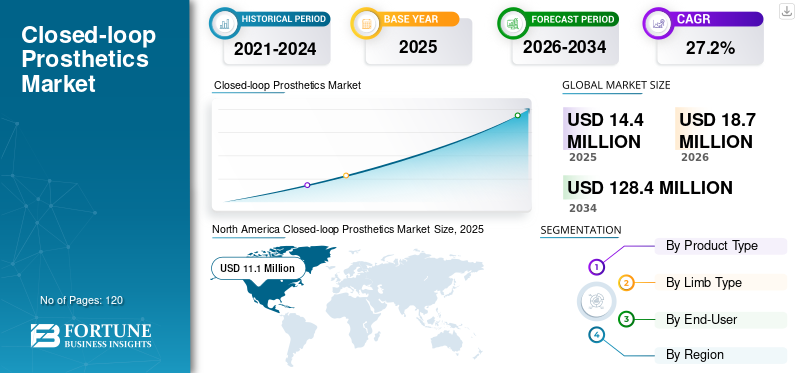
The global closed-loop prosthetics market size was valued at USD 14.4 million in 2025. The market is projected to grow from USD 18.7 million in 2026 to USD 128.4 million by 2034, exhibiting a CAGR of 27.2% during the forecast period. North America dominated the closed-loop prosthetics market with a market share of 77.08% in 2025.
The closed-loop prosthetics include advanced prosthetic systems that enable two-way communication between the user and the artificial limb. Unlike conventional prostheses, these systems capture user commands through EMG, nerve signals, implanted electrodes, or AI-based control systems and provide feedback such as grip force, touch, pressure, position, vibration, or temperature. Market growth is attributed to the rising demand for natural limb movement, increasing upper-limb amputations, advances in neuroprosthetics, and growing adoption of bionic prosthetic hands. Moreover, technological advancements coupled with new product approvals are estimated to accelerate market growth during the forecast period.
Many key industry players, such as PSYONIC, Inc., COVVI Ltd., Mobius Bionics, DEKA Integrated Solutions, and Integrum AB, operating in the market, are focusing on developing various innovative technologies to offer better products with improved accuracy and efficiency.
Download Free sample to learn more about this report.
CLOSED-LOOP PROSTHETICS MARKET KEY TAKEAWAYS
 Global Market Size & Forecast
- 2025 Market Size: USD 14.4 million
- 2026 Market Size: USD 18.7 million
- 2034 Forecast Market Size: USD 128.4 million
- CAGR: 27.2% from 2026–2034
 Market Share
- North America dominated the market with a 77.08% share in 2025.
- The Integrated Closed-loop Prosthetic System segment held the largest market share in 2025.
- The Upper Limb Prosthetics segment held the largest market share in 2025.
 Key Regional Highlights
North America
North America reached USD 11.1 million in 2025, supported by advanced technology adoption, favorable reimbursement policies, and increasing product approvals.
Europe
Europe projected to reach USD 2.4 million by 2026, growing at a 26.0% rate, driven by regulatory support and robust healthcare funding.
Asia Pacific
Asia Pacific projected to reach USD 1.4 million by 2026, supported by developing healthcare infrastructure and the rising prevalence of accidental trauma.
U.S.
The market is projected to reach USD 14.0 million by 2026, accounting for approximately 74.8% of global sales.
Japan
The market is projected to reach USD 0.4 million by 2026, accounting for approximately 2.1% of global revenues.
Read More

CLOSED-LOOP PROSTHETICS MARKET TRENDS
Integration of Artificial Intelligence and Advanced Sensory Feedback is One of the Important Trends Observed in Market
A prominent trend in the market is the integration of artificial intelligence with multimodal sensory feedback technologies. Manufacturers are increasingly incorporating machine learning algorithms, pressure sensors, motion tracking, haptic interfaces, and predictive control systems to improve prosthetic responsiveness and adaptability. These technologies enable prosthetic devices to automatically adjust grip strength, recognize movement patterns, and provide enhanced user interaction. In addition, a strong focus on research and development activities is also projected to drive the global closed-loop prosthetics market growth.
MARKET DYNAMICS
MARKET DRIVERS
Download Free sample to learn more about this report.
Increasing Demand for Functional and Natural Prosthetic Control to Drive Market Growth
The growing demand for prosthetic devices that closely replicate natural limb function is a major driver of the market. Conventional prostheses often require users to rely heavily on visual feedback, limiting precision and increasing cognitive effort during daily activities. Closed-loop technologies improve control by delivering real-time sensory feedback, enabling users to perform complex movements with greater confidence and accuracy. Continuous improvements in neural interfaces, myoelectric control systems, sensor technologies, and artificial intelligence are further enhancing device performance, encouraging healthcare providers and patients to adopt advanced prosthetic solutions.
|
Rank |
Drivers |
CAGR Contribution, 2026–2034 |
Overall Impact |
2026–2028 |
2029–2031 |
2032–2034 |
|
1 |
Increasing commercialization of sensory-feedback and closed-loop prosthetic systems |
9.40% |
High |
Medium |
High |
High |
|
2 |
Advancements in sensors, haptic feedback, AI-based control, and neural-interface technologies |
8.10% |
High |
High |
High |
High |
|
3 |
Expanding Need for Realistic and Functional Prosthetic Performance to Boost Market Growth |
6.70% |
High |
Medium |
High |
High |
|
4 |
Expansion of advanced prosthetic fitting centers, rehabilitation infrastructure, and clinical adoption |
5.80% |
Medium |
Medium |
Medium |
High |
|
5 |
Growing clinical trials, R&D investments, and product development for neuroprosthetic feedback systems |
5.10% |
Medium |
High |
Medium |
Medium |
|
6 |
Others |
3.50% |
Low |
Low |
Low |
Medium |
|
|
Total Positive Growth Contribution |
38.60% |
|
|
|
|
MARKET RESTRAINTS
High Development Costs and Limited Commercial Availability to Restrain Market Growth
The market faces significant restraints due to the high costs associated with developing, manufacturing, and implementing advanced closed-loop prosthetic systems. Many technologies require sophisticated electronics, implantable components, customized fittings, and extensive rehabilitation, resulting in high overall treatment costs. Additionally, true neural closed-loop prosthetic systems remain in the early stages of commercialization, limiting product availability across global markets. Complex regulatory pathways, reimbursement challenges, and the shortage of specialized clinical expertise further slow adoption, particularly in developing countries where access to advanced prosthetic technologies remains limited.
|
Rank |
Restraint |
CAGR Contribution, 2026–2034 |
Overall Impact |
2026–2028 |
2029–2031 |
2032–2034 |
|
1 |
High cost of closed-loop prosthetic systems and limited reimbursement coverage |
-4.40% |
High |
High |
High |
Medium |
|
2 |
Limited number of approved and commercially available closed-loop prosthetic products |
-3.20% |
High |
High |
Medium |
Low |
|
3 |
Technical complexity, fitting challenges, durability concerns, and user training requirements |
-2.40% |
Medium |
Medium |
Medium |
Low |
|
4 |
Others |
-1.40% |
Low |
Low |
Low |
Low |
|
|
Total Negative Restraint Contribution |
-11.40% |
|
|
|
|
MARKET OPPORTUNITIES
Expansion of Neuroprosthetics and Personalized Rehabilitation to Offer Substantial Market Opportunities
Advancements in neuroprosthetics, artificial intelligence, and personalized rehabilitation technologies present significant growth opportunities for the market. The integration of intelligent control algorithms, wearable sensors, digital health platforms, and remote monitoring solutions enables more individualized prosthetic performance and rehabilitation outcomes. Increasing investments in biomedical engineering, brain-computer interfaces, peripheral nerve stimulation, and regenerative medicine are expected to accelerate innovation. As healthcare systems increasingly focus on improving long-term patient mobility and quality of life, demand for next-generation prosthetic technologies is expected to create substantial market opportunities over the forecast period.
MARKET CHALLENGES
Clinical Validation and Regulatory Complexity to Offer Considerable Challenge to Market Growth
One of the major challenges facing the market is the need for extensive clinical validation and regulatory approval. Advanced prosthetic systems must demonstrate long-term safety, reliability, durability, and meaningful functional improvements before achieving widespread clinical adoption. Integrating neural interfaces, implantable electronics, wireless communication, and artificial intelligence increases technical complexity and extends product development timelines. Additionally, ensuring device durability, cybersecurity, battery performance, patient training, maintenance requirements, and reimbursement support remains challenging, delaying the large-scale commercialization of fully integrated closed-loop prosthetic systems.
Segmentation Analysis
By Product Type
Integrated Closed-Loop Prosthetic Systems to Lead as They Offer Superior Coordination Between User Intent and Prosthetic Movement
Based on the product type, the market is divided into Integrated closed-loop prosthetic system, standalone feedback devices, implantable feedback interfaces, and others.
Integrated closed-loop prosthetic systems are expected to account for the largest closed-loop prosthetics market share due to their ability to combine sensing, control, processing, and feedback functions within a single platform. These systems offer superior coordination between user intent and prosthetic movement, resulting in improved functionality, precision, and user comfort. Integration minimizes compatibility issues between individual components while simplifying calibration, maintenance, and rehabilitation processes. Continuous technological advancements in embedded electronics, intelligent sensors, artificial intelligence, and wireless communication are further improving system performance.
- For instance, in January 2026, researchers at Northwestern University announced the development of an AI-powered vision system that enables prosthetic hands to automatically recognize objects and adjust grip patterns and force in real time.
The implantable feedback interfaces segment is anticipated to rise with a CAGR of 31.0% over the forecast period.
To know how our report can help streamline your business, Speak to Analyst
By Limb Type
Upper Limb Prosthetics Led Market Due to Its Wide Availability and Rising Rehabilitation Efforts
Based on limb type, the market is segmented into upper limb prosthetics and lower limb prosthetics.
In 2025, the upper limb prosthetics segment held the largest market share, as sensory feedback and precise motor control are particularly critical for hand and arm functions. In addition, activities such as grasping, lifting, writing, eating, and manipulating objects require accurate control and continuous feedback, making closed-loop technology highly valuable for upper-limb applications. Advances in myoelectric control, neural interfaces, and multi-articulating prosthetic hands have significantly improved functional outcomes for upper-limb amputees. Additionally, the growing availability of advanced upper-limb prosthetic technologies and increasing rehabilitation efforts continue to strengthen the dominance of this segment within the global market.
The lower limb prosthetics segment is anticipated to rise with a CAGR of 25.7% over the forecast period.
By End-User
Prosthetic & Orthotic Clinics Dominated Market Due to Availability of Prosthetic Assessments and Orthotic Rehabilitations
Based on end-user, the market is segmented into prosthetic & orthotic clinics, hospitals & rehabilitation centers, academic & research institutes, and others.
In 2025, prosthetic & orthotic clinics held the highest market share due to their central role in prosthetic assessment, customization, fitting, rehabilitation, and long-term patient support. Closed-loop prosthetic systems require individualized calibration, regular adjustments, functional training, and continuous monitoring to achieve optimal performance. In addition, increasing adoption of personalized rehabilitation programs, improved clinical infrastructure, and growing demand for specialized prosthetic services are expected to further strengthen the position of prosthetic and orthotic clinics as the leading end users in the market. Furthermore, the segment is set to hold a 47.8% share in 2026.
The hospitals & rehabilitation centers segment is projected to grow at a CAGR of 28.1% during the forecast period.
Closed-loop Prosthetics Market Regional Outlook
By geography, the market is categorized into Europe, North America, Asia Pacific, Latin America, and the Middle East & Africa.
North America
North America Closed-loop Prosthetics Market Size, 2025 (USD Million)
To get more information on the regional analysis of this market, Download Free sample
North America held the substantial share in 2024, valued at USD 8.4 million, and also maintained the leading share in 2025, with USD 11.1 million. The regional growth is attributed to advanced technological adoption and favorable reimbursement policies. In addition, an increasing number of product approvals are expected to drive regional growth.
U.S. Closed-loop Prosthetics Market
Based on North America’s strong contribution and the U.S. dominance within the region, the U.S. market can be analytically approximated at around USD 14.0 million in 2026, accounting for roughly 74.8% of global sales.
Europe
Europe is projected to record a growth rate of 26.0% in the coming years and reach a valuation of USD 2.4 million in 2026. The region is estimated to witness considerable market growth due to strong regulatory support and robust healthcare funding.
U.K. Closed-loop Prosthetics Market
The U.K. market in 2026 is estimated at around USD 0.3 million, representing roughly 1.5% of global revenues.
Germany Closed-loop Prosthetics Market
Germany’s market is projected to reach approximately USD 0.5 million in 2026, equivalent to around 2.4% of global sales.
Asia Pacific
Asia Pacific is estimated to reach USD 1.4 million in 2026 and secure the dominant position in the market. Asia Pacific is expected to experience strong growth in the market due to rapidly developing infrastructure and rising prevalence of accidental trauma.
Japan Closed-loop Prosthetics Market
The Japan market in 2026 is estimated at around USD 0.4 million, accounting for roughly 2.1% of global revenues.
China Closed-loop Prosthetics Market
China’s market is projected to be one of the largest globally, with 2026 revenues estimated at around USD 0.6 million, representing roughly 3.3% of global sales.
India Closed-loop Prosthetics Market
The Indian market in 2026 is estimated at around USD 0.1 million, accounting for roughly 0.5% of global revenues.
Latin America and Middle East & Africa
The Latin America and Middle East & Africa regions are expected to witness moderate growth in this market space during the forecast period. The Latin America market is set to reach a valuation of USD 0.2 million in 2026. In the Middle East & Africa, the GCC is set to reach a value of USD 0.1 million in 2026.
South Africa Closed-loop Prosthetics Market
The South African market is projected to reach around USD 0.02 million in 2026, representing roughly 0.12% of global revenues.
COMPETITIVE LANDSCAPE
Key Industry Players
Strong Focus on Research & Innovation Coupled with Product Launches by Key Players to Boost Market Progress
The global closed-loop prosthetics market holds a semi-consolidated market structure, constituting prominent players such as PSYONIC, Inc., COVVI Ltd., Mobius Bionics, DEKA Integrated Solutions, and Integrum AB. The significant global market share of these companies is due to numerous strategic activities, including distribution collaborations and implementation of new programs.
- For instance, in November 2024, PSYONIC partnered with the Limbs for Life Foundation to launch the Ability Fund. This initiative expands access to advanced prosthetic technologies by providing Ability Hands, prosthetic legs, and comprehensive clinical support to individuals whose insurance does not cover these devices, improving accessibility to next-generation bionic prostheses.
Other notable players in the global market include Biologic Input Output Systems, Inc., SensArs Neuroprosthetics, Phantom Neuro, Blackrock Neurotech, and Ottobock SE & Co. KGaA. These companies are expected to prioritize collaborations to increase their global market share during the forecast period.
LIST OF KEY CLOSED LOOP PROSTHETICS COMPANIES PROFILED
- PSYONIC, Inc. (U.S.)
- COVVI Ltd. (U.K.)
- Mobius Bionics (U.S.)
- DEKA Integrated Solutions (U.S.)
- Integrum AB (Sweden)
- Biologic Input Output Systems, Inc. (U.S.)
- SensArs Neuroprosthetics (Switzerland)
- Phantom Neuro (U.S.)
- Blackrock Neurotech (U.S.)
- Ottobock SE & Co. KGaA (Germany)
KEY INDUSTRY DEVELOPMENTS
- June 2026: A group of researchers at Sant’Anna School of Advanced Studies and Cleveland Clinic developed dual brain-machine interfaces that restore prosthetic kinesthesia by enabling users to perceive coordinated hand movements through implanted magnetic and neural interfaces.
- April 2026: Phantom Neuro received approval to initiate its first-in-human CYBORG Early Feasibility Study in Australia to evaluate the safety, efficacy, and usability of its Phantom X muscle-machine interface.
- February 2026: Blue Arbor Technologies entered a strategic partnership with Ottobock, supported by a USD 5 million Series A investment, to accelerate clinical validation and commercialization of the RESTORE Neuromuscular Interface System, an FDA Breakthrough Device–designated platform designed to deliver intuitive, natural control of advanced prosthetic limbs through implanted neuromuscular interfaces.
- April 2023: TASKA expanded the commercialization of its TASKA CX prosthetic hand, featuring a smaller anatomical design, faster movement, and enhanced functionality for users with smaller hands.
- February 2022: Össur launched the next-generation POWER KNEE, the world's first actively powered microprocessor prosthetic knee, featuring advanced algorithms that detect movement patterns and provide real-time powered assistance to improve mobility, stair navigation, and overall functional performance for individuals with above-knee limb loss.
REPORT COVERAGE
The global closed-loop prosthetics market analysis includes a comprehensive study of the market size & forecast by all the segments included in the report. It includes details on the market dynamics and market trends expected to drive the market over the forecast period. It provides information on key aspects, including an overview of technological advancements, the regulatory environment, and product launches. Additionally, it details partnerships, mergers & acquisitions, as well as key industry developments and investments by key regions. The global market research report also provides a detailed competitive landscape with information on the market share and profiles of key operating players.
Request for Customization to gain extensive market insights.
Report Scope & Segmentation
| ATTRIBUTE | DETAILS |
| Study Period | 2021-2034 |
| Base Year | 2025 |
| Estimated Year | 2026 |
| Forecast Period | 2026-2034 |
| Historical Period | 2021-2024 |
| Growth Rate | CAGR of 27.2% from 2026 to 2034 |
| Unit | Value (USD Million) |
| Segmentation | By Product Type, Limb Type, End-User, and Region |
| By Product Type |
|
| By Limb Type |
|
| By End-User |
|
| By Region |
|
Frequently Asked Questions
According to Fortune Business Insights, the global market value stood at USD 14.4 million in 2025 and is projected to reach USD 128.4 million by 2034.
In 2025, the market value stood at USD 11.1 million.
The market is expected to exhibit a CAGR of 27.2% during the forecast period of 2026-2034.
By product type, the integrated closed-loop prosthetic system segment is expected to lead the market.
Increasing demand for functional and natural prosthetic control is driving market expansion.
PSYONIC, Inc., COVVI Ltd., Mobius Bionics, DEKA Integrated Solutions, and Integrum AB are the major players in the global market.
North America dominated the market in 2025.



- 2021-2034
- 2025
- 2021-2024
- 120
Get 30-60 hrs Free Customization
Expand Regional and Country Coverage, Segments Analysis, Company Profiles, Competitive Benchmarking, and End-user Insights.













.webp)






Related Reports
-
US +1 833 909 2966 ( Toll Free )
-
Get In Touch With Us