Cloud FinOps and Cost Optimization Software Market Size, Share & Industry Analysis, By Component (Software, Services), By Cloud Type (Single Cloud, Multi-Cloud, Hybrid Cloud), By Enterprise Type (Large, Small & Medium Enterprises) By Application (Cost Visibility & Reporting, Cost Management & Optimization, Budgeting & Forecasting, Cost Allocation, Showback & Chargeback, Resource Planning & Capacity Management), By End-user Industry (IT, BFSI, Retail, Healthcare, Manufacturing, Media, Government, Energy & Utilities), and Regional Forecast, 2026 – 2034
 Download Free Sample
Cloud FinOps and Cost Optimization Software Market Size and Future Outlook
 Listen to Audio Version
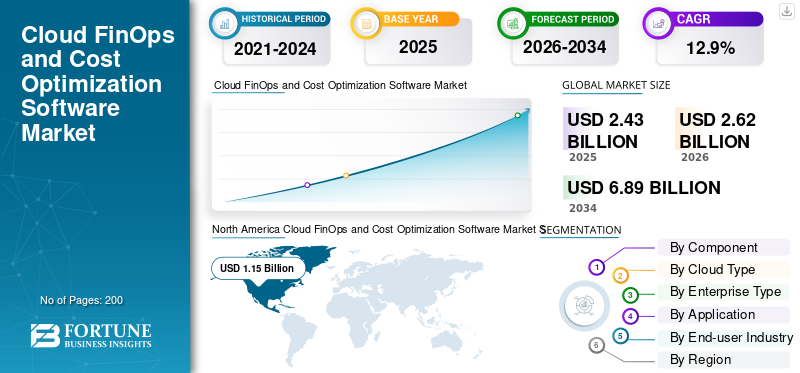
The global cloud FinOps and cost optimization software market size was valued at USD 2.43 billion in 2025. The market is projected to grow from USD 2.62 billion in 2026 to USD 6.89 billion by 2034, exhibiting a CAGR of 12.9% during the forecast period. North America dominated the cloud FinOps and cost optimization software market with a market share of 47.33% in 2025.
Cloud FinOps and cost optimization software are advanced platforms that help organizations monitor, allocate, forecast, govern, and optimize their cloud spending across public cloud, multi-cloud, hybrid cloud, Kubernetes, SaaS, AI workloads, and enterprise technology environments. Going beyond traditional spreadsheets, native billing dashboards, or manual cost reviews, these platforms provide centralized visibility into cloud usage, cost trends, resource utilization, budget deviations, idle infrastructure, and optimization opportunities across teams, applications, business units, and geographies.
The rapid expansion of enterprise cloud adoption, AI workloads, Kubernetes environments, SaaS usage, and multi-cloud infrastructure is driving demand for intelligent cloud cost management solutions. Organizations are investing in Cloud FinOps and Cost Optimization Software to reduce cloud waste, improve budgeting accuracy, optimize reserved commitments, allocate costs through showback and chargeback models, and connect cloud spending with business outcomes. As cloud bills become more variable and difficult to control, FinOps platforms are becoming essential for improving financial accountability, engineering efficiency, governance, and operational discipline across modern cloud environments.
Key players such as Amazon Web Services, Microsoft, Google, and IBM are strengthening their cloud financial management and FinOps capabilities through native cost management tools, AI-assisted cost analysis, cloud spend forecasting, Kubernetes cost optimization, billing data standardization, and automated recommendations. These vendors focus on delivering platforms that support real-time cost visibility, workload optimization, budget control, cost allocation, anomaly detection, and policy-based governance for enterprises managing increasingly complex cloud and AI-driven infrastructure.
Download Free sample to learn more about this report.
Cloud FinOps and Cost Optimization Software Market Key Takeaways
 Global Market Size & Forecast
- 2025 Market Size: USD 2.43 billion
- 2026 Market Size: USD 2.62 billion
- 2034 Forecast Market Size: USD 6.89 billion
- CAGR: 12.9% (2026–2034)
 Market Share
- North America dominated the global market with a market share of 47.33% in 2025.
- The multi-cloud segment held the majority market share of 47.3% in 2025.
- The cost management & optimization segment held the majority share of 29.9% in 2025.
 Key Regional Highlights
North America
The market in North America was valued at USD 1.15 billion in 2025.
Europe
Asia Pacific
Asia Pacific reached a valuation of USD 0.64 billion in 2025 and is expected to grow at the highest CAGR in the coming years due to rapid cloud migration.
U.S.
The U.S. market was valued at USD 0.99 billion in 2025, accounting for roughly 40.7% of sales.
Japan
The Japanese market in 2025 was valued at around USD 0.08 billion, accounting for roughly 3.2% of global revenues.
Read More

IMPACT OF GENERATIVE AI
Rising GenAI Workloads Drive Demand for Cloud Cost Visibility and Optimization
Generative AI is creating a strong impact on the market by making cloud spending more complex, unpredictable, and difficult to allocate. Enterprises using GenAI need high-cost resources such as GPUs, model training environments, inference engines, vector databases, data pipelines, and AI APIs, which can quickly increase cloud bills if not monitored properly. This is creating demand for FinOps platforms that can track GenAI costs by model, application, customer, product feature, team, and business unit. The key need is AI cost visibility, where companies can understand which GenAI use case is consuming the most budget.
Another major need is AI cost optimization, where platforms help improve GPU utilization, reduce idle AI infrastructure, forecast inference costs, and connect GenAI spending with business value.
Cloud FinOps and Cost Optimization Software Market Trends
Shift Toward Automated Optimization and Policy-Based Remediation Transform FinOps Practices
Automated optimization and policy-based remediation are becoming a major trend in the market, as enterprises can no longer rely solely on manual cloud cost reviews. Modern cloud environments include thousands of resources across public cloud platforms, hybrid cloud setups, Kubernetes clusters, databases, AI workloads, storage systems, SaaS tools, and multiple regions. In such environments, manual reviews are slow, inconsistent, and often reactive, meaning cost issues are identified only after the bill has already increased.
As a result, enterprises are increasingly adopting FinOps platforms that can automatically detect idle resources, recommend rightsizing, optimize reserved commitments, schedule non-production workloads, identify anomalies, and enforce budget guardrails through predefined policies. This trend is important as cloud cost optimization is shifting from a reporting activity to an operational control layer, where finance, engineering, and cloud operations teams can approve or automate corrective actions before waste becomes recurring. For instance,
- Microsoft’s April 2025 Cost Management update also reflects this direction, as it emphasized helping users understand where cloud costs are accruing, identify and prevent poor spending patterns, and optimize costs more effectively.
This is increasing demand for DCIM platforms that can provide real-time visibility into rack-level power consumption, UPS and PDU load, cooling performance, temperature, humidity, airflow, and overall energy efficiency. Therefore, demand is expected to rise for FinOps tools that show savings opportunities, support safe execution through approval workflows, policy controls, automated remediation, and governance rules.
MARKET DYNAMICS
MARKET DRIVERS
Download Free sample to learn more about this report.
Rising Enterprise Cloud Spending Drives Demand for FinOps-Based Cost Governance
Rising cloud spending is one of the strongest drivers of the cloud FinOps and cost optimization software market growth, as enterprises are increasingly shifting critical workloads to public, hybrid, and multi-cloud environments. Companies are using cloud platforms for application hosting, data storage, analytics, cybersecurity, digital commerce, SaaS delivery, databases, AI workloads, and business applications. As usage expands across compute, storage, networking, databases, containers, and AI infrastructure, monthly cloud bills grow larger, become more variable, and are harder to forecast. This is creating strong demand for FinOps tools that help organizations monitor spending, identify unused or overprovisioned resources, optimize cloud commitments, allocate costs to business units, and improve cloud efficiency. For instance,
- Amazon reported that AWS segment sales increased 20% year-over-year to USD 128.7 billion in 2025, while AWS Q4 2025 sales increased 24% year-over-year to USD 35.6 billion, reflecting continued enterprise demand for cloud services.
As AI deployments expand across hyperscale, colocation, and enterprise facilities, DCIM platforms are becoming essential for monitoring rack-level power, liquid cooling performance, asset health, environmental conditions, and available capacity. This enables operators to prevent overloads, reduce downtime risk, optimize cooling, and manage high-density AI infrastructure more efficiently.
MARKET RESTRAINTS
Data Security and Access Concerns Hinder Third-Party FinOps Platform Adoption
Data security, privacy, and access concerns are likely to restrain the adoption of cloud FinOps and cost optimization software, especially among large enterprises and regulated sectors such as BFSI, healthcare, government, and public services. FinOps platforms usually require access to cloud billing data, usage records, tagging structures, account hierarchies, resource metadata, and, sometimes, workload-level information to generate accurate cost allocation, support showback and chargeback, forecast, and provide optimization recommendations.
Although this data may not always contain direct customer information, it can still reveal sensitive operational details such as cloud architecture, application ownership, business-unit spending, resource utilization, vendor relationships, and workload patterns.
Therefore, enterprises often conduct detailed security reviews, vendor risk assessments, role-based access evaluations, data residency checks, and compliance validations before allowing a third-party FinOps platform to connect to their cloud environment. This can extend procurement cycles and slow platform deployment. The concern is well-founded, as security and compliance remain major barriers to cloud adoption. For instance,
- The 2024 Cloud Security Report noted that 59% of respondents considered security and compliance concerns as critical roadblocks to faster multi-cloud adoption, while IBM reported that the global average cost of a data breach reached USD 4.88 million in 2024, the highest level recorded in its annual study.
These risks make enterprises more cautious when granting third-party tools access to cloud cost and usage environments, thereby limiting faster market adoption.
MARKET OPPORTUNITIES
Rising AI Workload Costs Creating Opportunities for Advanced FinOps Platforms
The rising adoption of AI workloads is creating a strong opportunity for Cloud FinOps and Cost Optimization Software vendors, as enterprises increasingly struggle to monitor and control spending on GPUs, model training, inference, data pipelines, AI APIs, and high-performance storage. AI workloads differ from traditional cloud workloads as their costs can change rapidly based on GPU utilization, model size, token consumption, inference volume, data movement, and experimentation cycles.
This creates a need for FinOps platforms that can provide granular visibility into AI costs by model, application, product feature, customer, team, and business unit. The opportunity is becoming increasingly relevant as major cloud providers and enterprises continue to invest heavily in AI infrastructure. For instance,
- Microsoft stated in its FY2025 annual report that Azure surpassed USD 75 billion in revenue, growing 34% and driven partly by demand for AI services, while Google Cloud reported strong growth, supported by AI infrastructure and generative AI
This indicates that AI-led cloud consumption is becoming a major cost category for enterprises. As a result, FinOps vendors have an opportunity to develop AI-specific cost allocation, GPU optimization, inference cost forecasting, and ROI measurement tools that help organizations connect AI spending with business value rather than only tracking total cloud bills.
Segmentation Analysis
By End-user Industry
IT & Telecommunications Dominated Market Due to High Cloud Dependency and Large-Scale Digital Infrastructure
Based on end-user industry, the market is segmented into IT & telecommunications, BFSI, retail & e-commerce, healthcare & life sciences, manufacturing, media & entertainment, government & public sector, energy & utilities, and others.
IT & telecommunications held the majority market share of 23.4% in 2025, as this sector depends most on cloud infrastructure, SaaS delivery, data centers, telecom networks, digital platforms, and cloud-native applications. These companies operate large and complex cloud environments across multiple regions, customers, and workloads, making cost visibility, allocation, forecasting, and optimization highly critical. Since cloud cost directly affects service margins and operational efficiency, IT and telecom firms are among the earliest and largest adopters of cloud FinOps and cost optimization software.
The media & entertainment segment is expected to witness the second-highest CAGR of 17.8% during the forecast period.
To know how our report can help streamline your business, Speak to Analyst
By Component
Software Dominated Market Driven by Continuous Cloud Cost Monitoring and Automated Optimization Needs
Based on the component, the market is segmented into software and services.
The software segment held the majority market share in 2025, as enterprises need a continuous control layer over cloud spending, not a one-time advisory engagement. Cloud bills change daily with usage, workloads, regions, AI compute, storage, and Kubernetes activity, so buyers depend on software platforms for real-time visibility, automated alerts, rightsizing recommendations, commitment optimization, and cost allocation.
The services segment is expected to witness the second-highest CAGR of 11.5% during the forecast period.
By Cloud Type
Multi-cloud Led Market with Rising Complexity of Cross-Platform Cost Management
Based on cloud type, the market is categorized into single cloud, multi-cloud, and hybrid cloud.
The multi-cloud segment held the majority market share of 47.3% in 2025, as enterprises increasingly use different cloud providers for different workloads, such as AWS for infrastructure, Azure for enterprise applications, Google Cloud for analytics/AI, and Oracle Cloud for databases. This creates fragmented billing, different pricing models, duplicate resources, inconsistent tagging, and complex cost allocation across teams and regions. As a result, companies need FinOps software to provide a centralized view of cloud spending, compare costs across providers, optimize commitments, and enforce governance across the full cloud environment.
The hybrid cloud is expected to witness the second-highest CAGR of 12.5% during the forecast period.
By Enterprise Type
Large Enterprises Dominated Market Owing to High Cloud Spending and Complex Multi-Cloud Operations
Based on enterprise type, the market is categorized into large enterprises and Small & Medium Enterprises (SMEs).
Large enterprises held the largest market share in 2025, as cloud spending is usually spread across many departments, applications, regions, and business units, making cost allocation, showback, chargeback, forecasting, and governance more critical. They are also more likely to run AI workloads, Kubernetes clusters, data platforms, and hybrid cloud environments, which require advanced FinOps software rather than basic native cloud dashboards.
Small & Medium Enterprises (SMEs) are expected to witness the second-highest CAGR of 15.7% during the forecast period.
By Application
Cost Management & Optimization Led Market Due to Rising Need for Reducing Cloud Waste
Based on application, the market is categorized into cost visibility & reporting, cost management & optimization, budgeting & forecasting, cost allocation, showback & chargeback, resource planning & capacity management, governance, policy & compliance, workload optimization & automation, and others.
The cost management & optimization segment held the majority share of 29.9% share in 2025, as it delivers the clearest and most measurable value to enterprises by directly reducing rising cloud bills and avoidable cloud waste. While visibility and reporting only show where spending is happening, optimization helps organizations act on that information through rightsizing, shutting down idle resources, improving storage usage, optimizing reserved instances or savings plans, and reducing overprovisioned compute, database, Kubernetes, and AI workloads.
The workload optimization & automation segment is expected to witness the second-highest CAGR of 16.9% during the forecast period.
Cloud FinOps and Cost Optimization Software Market Regional Outlook
By region, the market is categorized into North America, South America, Europe, the Middle East & Africa, and Asia Pacific.
North America
North America Cloud FinOps and Cost Optimization Software Market Size, 2025 (USD Billion)
To get more information on the regional analysis of this market, Download Free sample
North America holds the largest cloud FinOps and cost optimization software market share due to its mature cloud ecosystem, a strong base of SaaS and cloud-native companies, early FinOps adoption, and a high concentration of large enterprises using multi-cloud, Kubernetes, AI, analytics, and digital infrastructure workloads. The market in North America was valued at USD 1.15 billion in 2025. Enterprises in the U.S. and Canada typically manage cloud spending across multiple business units, applications, regions, and providers, creating strong demand for tools that provide cost visibility, allocation, forecasting, governance, and automated optimization. The region also benefits from the presence of leading cloud providers and third-party FinOps vendors, which support faster adoption of advanced cost management platforms. For instance,
- Statistics Canada reported that cloud computing was the most commonly used ICT among Canadian businesses in 2023, with 48% of businesses using cloud computing, up from 45% in 2021, indicating strong enterprise cloud adoption in the region and supporting demand for cloud cost governance solutions.
U.S. Cloud FinOps and Cost Optimization Software Market
Given North America’s strong contribution and the U.S. dominance in the region, the U.S. market was valued at USD 0.99 billion in 2025, accounting for roughly 40.7% of sales.
Europe
Europe reached a valuation of USD 0.33 billion in 2025 and is projected to grow at a CAGR of 11.5% in the coming years as the region already has a mature cloud adoption base, strong regulatory discipline, and a growing enterprise focus on cost governance rather than solely on rapid cloud migration.
Large enterprises across the U.K., Germany, France, Benelux, and the Nordics are steadily expanding multi-cloud, hybrid cloud, SaaS, data analytics, and AI workloads, which supports continued demand for FinOps tools. At the same time, Europe’s growth is likely to remain more stable than explosive as cloud adoption is already relatively advanced in several countries, while strict data protection, sovereignty, procurement, and compliance requirements can lengthen technology adoption cycles.
- According to the European Commission, 45.2% of EU businesses used cloud services in 2023, with adoption much higher among large enterprises at 77.6%, indicating a strong, already established cloud base that supports steady demand for cost visibility, allocation, forecasting, governance, and optimization solutions.
U.K. Cloud FinOps and Cost Optimization Software Market
The U.K. market in 2025 was valued at around USD 0.09 billion, representing roughly 3.7% of global revenues.
Germany Cloud FinOps and Cost Optimization Software Market
Germany’s market was valued at USD 0.08 billion in 2025, equivalent to around 3.2% of global sales.
Asia Pacific
Asia Pacific reached a valuation of USD 0.64 billion in 2025 and is expected to grow at the highest CAGR in the coming years due to rapid cloud migration. Expanding digital economies, strong AI adoption, growing e-commerce platforms, and increasing enterprise modernization across India, China, ASEAN, Japan, South Korea, and Oceania are boosting market expansion in the region. In contrast to North America and Europe, where FinOps adoption is already more mature, many Asia Pacific enterprises are still scaling from basic cloud adoption to complex multi-cloud, Kubernetes, SaaS, and AI-driven environments, creating a larger growth runway for cost visibility, budgeting, allocation, governance, and optimization tools.
The region also has a strong base of cloud-native startups, IT services firms, telecom operators, digital banks, super apps, online retailers, and manufacturing companies that are increasing cloud consumption rapidly. For instance,
- CAICT’s 2024 white paper stated that China’s cloud computing market was entering a new growth cycle, with AI accelerating industry reshaping and cloud adoption enthusiasm rising across industries, while India’s public digital infrastructure continues to expand through cloud computing, AI, machine learning, and digital governance initiatives.
These factors make Asia Pacific the fastest-growing region as cloud spending rises and enterprises increasingly require structured FinOps platforms to control cost leakage and improve cloud efficiency.
Japan Cloud FinOps and Cost Optimization Software Market
The Japanese market in 2025 was valued at around USD 0.08 billion, accounting for roughly 3.2% of global revenues.
China Cloud FinOps and Cost Optimization Software Market
China’s market is projected to be one of the largest worldwide, with 2025 revenues valued at around USD 0.33 billion, representing roughly 13.6% of global sales.
India Cloud FinOps and Cost Optimization Software Market
The Indian market in 2025 was valued at around USD 0.10 billion, accounting for roughly 4.1% of global revenues.
South America and Middle East & Africa
The Middle East & Africa region is expected to grow at the second-highest CAGR over the forecast period, driven by rapid cloud adoption across the GCC, Israel, South Africa, Turkey, and North Africa. Government-led digital transformation, smart city projects, AI initiatives, and sovereign cloud investments are increasing demand for cloud cost visibility and governance. The region is also growing from a smaller base, so adoption of FinOps tools is expected to rise faster as enterprises move from basic cloud usage to multi-cloud and hybrid cloud environments.
South America is expected to grow at a slow and steady CAGR over the forecast period, as cloud adoption increases. However, the region still has a smaller enterprise cloud spending base than North America, Europe, and the Asia Pacific. Brazil leads the market, while Argentina and other South American countries are gradually expanding cloud usage across BFSI, retail, telecom, and public-sector digitalization.
GCC Cloud FinOps and Cost Optimization Software Market
The GCC market reached around USD 0.04 billion in 2025, representing roughly 1.6% of global revenues.
COMPETITIVE LANDSCAPE
Key Industry Players
Major Companies Emphasize Innovation and Strategic Expansion to Maintain Their Dominance
Key players in the cloud FinOps and cost optimization software market are enhancing their platforms to address the growing demand for cloud cost visibility, automated optimization, AI-driven workload cost management, and multi-cloud financial governance. Leading companies are focusing on AI-assisted cost analysis, Kubernetes cost optimization, budget forecasting, showback and chargeback models, billing data standardization, and policy-based remediation to help enterprises control rising cloud spending. Vendors are also expanding their solutions to support public, hybrid, and multi-cloud environments, as well as SaaS and AI-driven environments, where cloud billing complexity, resource waste, and cost accountability requirements are increasing.
List of Key Cloud FinOps and Cost Optimization Software Companies Profiled
- Amazon Web Services, Inc. (U.S.)
- Microsoft Corporation (U.S.)
- Google LLC (U.S.)
- IBM (U.S.)
- Flexera Software LLC (U.S.)
- Broadcom Inc. (U.S.)
- Harness Inc. (U.S.)
- CloudZero Inc. (U.S.)
- DoiT International USA, Inc. (U.S.)
- Finout Ltd. (U.S.)
- VNTG Inc. (U.S.)
- nOPS, Inc. (U.S.)
- Cast AI Group Inc. (U.S.)
KEY INDUSTRY DEVELOPMENTS
- May 2026: CloudZero launched its financial control plane for AI, strengthening its FinOps capabilities for AI workload cost management. The platform focuses on multi-dimensional allocation of AI costs by customer, product, feature, team, and business unit. This helps enterprises understand which AI use cases are driving cloud and infrastructure spending. The development is relevant to the market as companies increasingly need visibility, accountability, and optimization for AI-related cloud costs.
- December 2025: The FinOps Foundation launched FOCUS 1.3, adding capabilities for contract commitment tracking, split-cost allocation, and data freshness/completeness dimensions. This is important for the market as it improves standardization of billing and usage data across cloud, SaaS, and technology spend.
- December 2025: CloudZero announced new AI-native FinOps capabilities, including support for AI cost management and natural-language cost analysis. The update expanded the platform in two areas: FinOps for AI and AI for FinOps, helping users track AI workload spending and ask cost questions in plain English.
- June 2025: AWS enhanced Cost Optimization Hub with smarter recommendations that consider Savings Plans, Reserved Instances, and payment preferences. This development strengthens AWS’s native cost-optimization capabilities and helps customers improve their cloud savings decisions.
- February 2025: Microsoft released Microsoft Cost Management updates, highlighting FOCUS as an open billing data format designed to help organizations understand cost and usage patterns and optimize spending across cloud, SaaS, and on-premises services.
- September 2024: IBM acquired Kubecost to expand its hybrid cloud cost management and Kubernetes cost optimization capabilities. The acquisition strengthened IBM’s FinOps position by combining IBM Cloudability with Kubernetes cost visibility and optimization capabilities.
REPORT COVERAGE
The cloud FinOps and cost optimization software market report provides a comprehensive analysis of the industry, focusing on key market players and the overall competitive landscape. It offers valuable insights into current market trends, technological advancements, and significant industry developments. The report further examines key growth drivers, restraints, opportunities, and challenges influencing market expansion.
Request for Customization to gain extensive market insights.
Report Scope & Segmentation
| ATTRIBUTE | DETAILS |
| Study Period | 2021-2034 |
| Base Year | 2025 |
| Estimated Year | 2026 |
| Forecast Period | 2026-2034 |
| Historical Period | 2021-2024 |
| Growth Rate | CAGR of 12.9% from 2026 to 2034 |
| Unit | Value (USD Billion) |
| Segmentation | By Component, Cloud Type, Enterprise Type, Application, End-user Industry, and Region |
| By Component |
|
| By Cloud Type |
|
| By Enterprise Type |
|
| By Application |
|
| By End-user Industry |
|
| By Region |
|
Frequently Asked Questions
According to Fortune Business Insights, the global market value stood at USD 2.43 billion in 2025 and is projected to reach USD 6.89 billion by 2034.
In 2025, the market value in North America stood at USD 1.15 billion.
The market is expected to grow at a CAGR of 12.9% over the forecast period.
By end-user industry, the IT & Telecommunications segment led the market in 2025.
Rising enterprise cloud spending is driving demand for FinOps-based cost governance.
Amazon Web Services, Microsoft, Google, and IBM are the major players in the global market.
North America dominated the market in 2025.



- 2021-2034
- 2025
- 2021-2024
- 200
Get 30-60 hrs Free Customization
Expand Regional and Country Coverage, Segments Analysis, Company Profiles, Competitive Benchmarking, and End-user Insights.




















Related Reports
-
US +1 833 909 2966 ( Toll Free )
-
Get In Touch With Us