Cloud Seeding Market Size, Share & Industry Analysis, By Type (Aerial Cloud Seeding and Ground Cloud Seeding), By Technique (Glaciogenic and Hygroscopic), By Target Area (Drought-Prone Area, Urban Area, Agriculture & Water Supply, and Others), By Cloud Seeding Agent (Silver Iodide, Dry Ice & Potassium Iodide, Sodium Chloride, and Others), and Regional Forecast, 2026-2034
 Download Free Sample
KEY MARKET INSIGHTS
 Listen to Audio Version
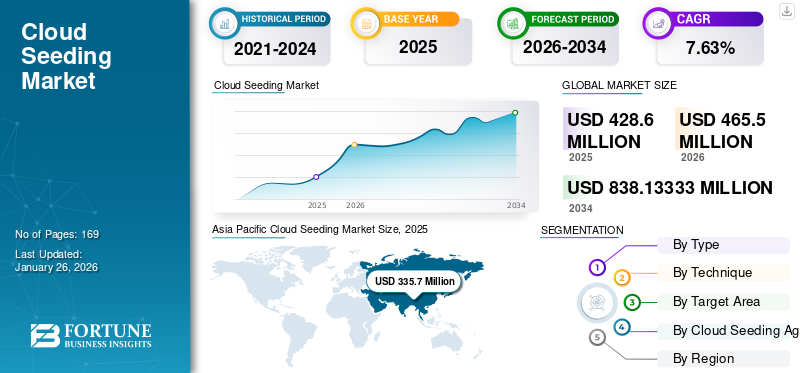
The global cloud seeding market size was valued at USD 428.6 million in 2025 and is projected to grow from USD 465.50 million in 2026 to USD 838.13 million by 2034, exhibiting a CAGR of 7.63% during the forecast period. Asia Pacific dominated the cloud seeding market with a market share of 78.32% in 2025.
Cloud seeding is done through the dispersal of substances such as silver iodide, potassium iodide, or dry ice into the atmosphere. The materials introduced act as cloud condensation nuclei, a necessary agent to increase precipitation. On introduction to supercooled clouds (the clouds with temperatures below freezing) these particles aid in initiating the development of ice crystals. With time, they collect enough moisture and grow to fall as rain.
The environmental and health impact of seeding is alleged to be minimal as very low concentrations of chemicals are involved. Studies have shown the concentration of substances such as silver iodide in rainwater is significantly lower than the acceptable levels found in common diet sources, such as in iodized salt. However, there are still debates about ecological effects, as well as long-term changes to weather patterns. Rising awareness and adoption of this latest technology is a major driver for this market growth. Additionally, major market players such as- RHS Consulting Inc. (U.S.), North America Weather Consultants Inc. (U.S.), and Snowy Hydro Limited (Australia) are continuously driving the market by integrating emerging technologies into their operations.
Download Free sample to learn more about this report.
Cloud Seeding Market Key Takeaways
 Global Market Size & Forecast
- 2025 Market Size: USD 428.6 million
- 2026 Market Size: USD 465.5 million
- 2034 Forecast Market Size: USD 838.13 million
- CAGR: 7.63% from 2026–2034
 Market Share
- Asia Pacific dominated the market with a 78.32% share in 2025.
- Ground Cloud Seeding dominated the market with a 66.94% share (2026).
- Silver Iodide dominated the market with a 52.14% share (2026).
 Key Regional Highlights
North America
North America reached USD 40.4 million in 2025 and is projected to reach USD 43.1 million in 2026.
Asia Pacific
Asia Pacific dominated the market, reaching USD 335.7 million in 2025 and USD 365.5 million in 2026.
Europe
Europe reached USD 11.8 million in 2025 and is projected to reach USD 12.5 million in 2026.
U.S.
The U.S. market is projected to reach USD 38.6 million by 2026.
Japan
The Japan market is driven by growing weather modification research and climate resilience initiatives.
Read More

Market Dynamics
Market Drivers
Increasing Government Investments Coupled with Rising Adoption of Cloud Seeding Boosts Market Growth
Governments and industries are seeking innovative solutions to accomplish water resources by adopting seeding. As awareness about seeding and its potential benefits increase, acceptance of this technology among governments, communities, and industries will also increase. The growing adoption of seeding is linked to heightened awareness and a positive shift in public perception, indicating a broader acceptance of this weather modification technique. This collective trend is likely to propel the market forward, fostering technological advancements and broader integration of seeding solutions across various industries, including agriculture, water resource management, and disaster preparedness.
For instance, in August 2023, the UAE initiated a month-long cloud-seeding campaign with the goal of advancing technologies employed to increase rainfall nationwide.
Collaborating with Stratton Park Engineering Company, a climate research specialist based in the U.S., the National Centre of Meteorology (NCM) is undertaking pivotal experiments. By dubbing the Cloudix initiative, focused on cloud-aerosol-electrical interactions to generate artificial rain, the campaign aims to assess the efficacy of diverse cloud-seeding methods. Equipping the NCM's cloud-seeding aircraft and Spec's learjet with sophisticated instruments and sensors, this initiative seeks to collect essential data for analysis and improvement.
Market Restraints
Regulatory and Environment Concerns are Anticipated to Hamper Cloud Seeding Market Growth
While climate change has been a core of the global agenda in recent years, attempts to manipulate weather patterns and mitigate solar heat have received comparatively less attention, despite their potential to intensify regional tensions. Nations are increasingly deploying technological interventions in the atmosphere, oceans, and ice to either enhance their local weather conditions or mitigate global warming. However, the concerns of such interventions often exceed national borders, leading to scenarios where one country’s benefit may not align with the interests of its neighbors.
Cloud seeding operations in one region may impact neighboring areas, leading to potential cross-border conflicts and complicating regulatory oversight. The transboundary nature of weather systems raises challenges in establishing international agreements and protocols, contributing to concerns about the broader geopolitical impact of cloud seeding activities. However, this is not a theoretical concern. For instance, Iran has accused Israel of appropriating its water resources through cloud-seeding, a practice that diminishes rainfall over Iranian territory. China, known for artificially modifying weather in major cities, aims to extend this capability to over half of its territory by 2025, causing apprehension among neighboring countries such as India. Additionally, Middle Eastern rivals, the UAE and Saudi Arabia, are increasing their rain-making operations.
Market Opportunities
Laser Equipped Drones, Agricultural Enhancement, and Wildfire Prevention are Prominent Opportunities
Diverse approaches have been employed to introduce seeding chemicals into clouds, incorporating dispersal methods from aircraft, ground generators, rockets, and even anti-aircraft guns. However, the UAE is employing both a novel delivery vehicle and an innovative method to enhance seeding.
For instance, in February 2025, the UAE boosted seeding to combat water shortage. Currently, the UAE is exploring the use of drones and AI to zap the clouds, says Abdulla Al Mandous, director general at the National Centre of Meteorology (NCM) in Abu Dhabi.
Since March 2021, the UAE has been conducting experiments involving aerial drones that discharge electric charges into clouds. While salt had been widely utilized in seeding experiments, with approximately 200 instances in 2020 alone, the UAE adopted a less intrusive and intensive approach in 2021. The electric charges discharged by the drones serve the same purpose as traditional seeding compounds, as the drones target specific clouds and apply a laser beam to 'zap' them. This electric shock induces water droplets to converge, resulting in rainfall. Initial experiments showed potential, with drones using electric charges to generate a substantial rainstorm, yielding 6.9 millimeters of rain in a single day in Al Ain. Considering the UAE's average annual rainfall is only 100 millimeters, this marks a significant achievement. The UAE aspires for this technology to increase rainfall by 30 percent annually.
Cloud Seeding Market Trends
Nanomaterial and Drone Cloud Seeding are Prominent Trends in the Market
Product innovations and technological advancements are key trends gaining popularity in the cloud seeding market growth. Major players in the market are developing new technologies to make the seeding process eco-friendly. This includes focusing advanced seeding agents and reducing the initial and operating costs of seeding process.
Conventional seeding materials predominantly consist of a hydroscopic salt mixture capable of transforming from salt crystals into water droplets under specific conditions. These salts are vaporized through ignition via a flare device, with the resulting salt vapor recondensing into small particles. However, due to the inherent randomness and uncertainty of this process, controlling the form and size of the particles is challenging, and most end up too small to effectively seed clouds. Activation of conventional seeding materials requires very high relative humidity levels, exceeding 75% in the cloud atmosphere. Modifications have been made to the material's surface to enhance reactivity, enabling activation at lower and more varied comparative humidity levels.
For instance, in September 2024, Saudi Arabia took foremost steps in cloud seeding to combat water shortage. The development includes aircraft and drones scattering environmentally safe materials into clouds over selected areas. In 2023, the program targeted six regions in Saudi Arabia, leading 415 cloud-seeding flights and scattering 7,876 flares with four aircraft for over 1,300 hours.
To achieve this advancement, nanotechnology has been employed to deposit titanium dioxide nanoparticles as a shell layer around sodium chloride crystal cores. This Nano engineered shell-core structure allows activation at broader relative humidity conditions, approximately 65%.
Download Free sample to learn more about this report.
SEGMENTATION ANALYSIS
By Type
Ground Cloud Seeding Leads Due to its Efficiency and Affordability
By type, the market is segmented into aerial cloud seeding and ground cloud seeding.
The ground cloud seeding segment is projected to dominate the market with a share of 66.94% in 2026 as growing populations and climate change are putting immense pressure on traditional water sources. Cloud seeding offers a way to increase precipitation and replenish reservoirs, rivers, and other water bodies, which is crucial for agriculture, hydropower, and urban water supply. Innovations in cloud seeding equipment and techniques are making it more efficient and cost-effective.
- For instance, in December 2022, Arizona started exploring a myriad of solutions to stem the worsening drought, including seeding. The Salt River Seeding project, which provides water and electricity to central Arizona, has partnered with the White Mountain Apache Tribe to study the feasibility of terrestrial cloud seeding in the White Mountains of eastern Arizona.
Currently, SRP is in the early stages of seeding research and is a ground-based seeding program which will help to produce more snow in the White Mountains. The state also funds seeding programs in Colorado aimed at increasing the flow of the Colorado River. The research comes at a critical time. According to Nature Climate Change, the mega drought that has hit Arizona since 2000 is the driest in more than 1,200 years and is expected to last for the foreseeable future.
Aerial cloud seeding is expected to be the fastest growing segment in the forecast period. Growth in drone technology, and increase in the need for real time weather analytics are some major reasons for the growth of this segment. Aerial seeding is particularly well-suited for mountainous or otherwise difficult-to-access areas, where ground-based seeding methods may not be feasible. Investments in cloud modification programs and weather forecasting, including aerial cloud seeding.
By Technique
Glaciogenic Technique Dominates as it Improves Precipitation in Water Scarce Regions
The market is segmented into glaciogenic and hygroscopic, based on technique.
Glaciogenic segment is projected to dominate the market with a share of 73.94% in 2026 as this technique is designed to enhance precipitation, particularly in cold cloud systems. The growth of this segment is primarily driven by the need for drought mitigation and the effectiveness of glaciogenic seeding in cold-season orographic clouds. This technique, which introduces ice-nucleating particles such as silver iodide into supercooled clouds, is considered a promising method for enhancing precipitation, especially in regions with water scarcity.
Hygroscopic is estimated to be the fastest growing segment in the forecast period supported by the increasing demand for advanced hygroscopic seeding techniques coupled with rising investment from developed countries.
- For instance, in December 2023, as a case study, UAEREP (UAE Research Program for Rain Enhancement Science) provided financial and technical support to approximately 11 pioneering research projects around the world.
These projects involve more than 64 researchers from 35 research centers spread across 11 countries. Their common goal is to advance theoretical understanding of seeding technology and apply this knowledge to improve operational efficiency.
By Target Area
Drought-prone Area are Most Affected with Water Scarcity Leading to Malnutrition
Based on target area, the market is segmented into, drought-prone area, urban area, agriculture & water supply, and others.
The drought-prone area segment is projected to dominate the market with a share of 35.96% in 2026, owing to the growing demand for mitigating natural hazards. Every year, about 55 million people are affected by drought and water shortages. Drought threatens livestock and crops, increases illness and death, and leads to increased migration. About 40% of the world's population is affected by water scarcity. Water is essential for agriculture, which means a lack of water can lead to malnutrition and food insecurity. In addition, women are excessively affected by water scarcity. Each year, more than 40 billion hours are lost fetching water in sub-Saharan Africa, a task largely assigned to women. These women are then forced to drop out of school or even quit studying. This leaves them trapped in a cycle of poverty with few opportunities.
Additionally, urban area is projected to be the fastest growing segment in the forecast period due to rising scarcity of water which poses a major threat to civilization.
To know how our report can help streamline your business, Speak to Analyst
By Cloud Seeding Agent
Silver Iodide is the Preferred Cloud Seeding Agent Owing to its Key Properties
Based on cloud seeding agent, the market is segmented into silver iodide, dry ice & potassium iodide, sodium chloride, and others.
Among the cloud seeding agents, silver iodide segment is projected to dominate the market with a share of 52.14% in 2026. The growing demand for innovative weather control technologies is expected to bolster the growth of this segment in the forecast period. Silver iodide is a key component in cloud seeding operations due to its ability to act as an ice nucleus, promoting the formation of ice crystals and subsequently increasing precipitation. Cloud seeding using silver iodide is a well-established technique for modifying weather patterns, including increasing rainfall and snowfall, which can be beneficial in agriculture and other water-dependent sectors, and therefore accounts for a dominating of market share.
- For instance, in June 2023, Japanese universities teamed up to develop a technology that can manipulate weather conditions to limit damage caused by heavy rains, which are becoming more common due to climate change.
The team is researching methods to prevent the development of cumulonimbus clouds, with the goal of putting this technology into practice by 2050.
Six universities, including Kyoto University and Ehime University, as well as research institutions such as the National Research Institute for Earth Science and Disaster Resilience, are collaborating to study five different control methods. The Weather Control Project aims to combat linear rain zones using the concept of cloud seeding, the classic approach to artificial rain generation.
The sodium chloride is anticipated to be the fastest growing segment from 2025-2032. The growth of sodium chloride as a cloud seeding agent is primarily driven by its effectiveness in promoting precipitation from warm clouds, especially in regions experiencing drought or water scarcity. Sodium chloride, along with other hygroscopic salts such as calcium chloride, is used in warm cloud seeding to enhance rainfall by increasing the size of cloud droplets, causing them to coalesce and fall as rain. This method is particularly relevant in areas where warm clouds predominate and where there's a need to augment water resources, thereby leading to a high demand and growth in the forthcoming years.
PORTERS FIVE FORCES ANALYSIS
Threat of Substitute: Moderate to Low: The threat of substitutes in this industry is low. Seeding, as a weather modification technique, has limited direct substitutes. While other forms of weather modification exist, such as hail suppression, cloud seeding is the primary method for increasing precipitation.
Bargaining Power of Supplier: Low to Moderate: The bargaining power of suppliers in the market is low to moderate. Suppliers of seeding equipment and technology hold some power due to the specialized nature of the industry. However, as technology becomes more standardized, the power of individual suppliers may decrease.
Bargaining Power of Buyer: Moderate to High: The buyers have moderate to high bargaining power. The number of companies providing seeding services are limited, giving them some leverage. However, buyers, often governments or large agricultural entities, have the option to choose among existing providers.
Threat of New Entrant: Low to Moderate: The threat of new entrants in the market is low to moderate. This industry requires specialized knowledge in meteorology, atmospheric science, and technology. Firms need significant expertise to understand weather patterns, employ seeding techniques, and manage the associated risks. Seeding operations involve substantial investments in aircraft, seeding equipment, and research. This acts as a deterrent to new entrants.
Competitive Rivalry: Moderate to High: The competitive rivalry is considered to be moderate in the market. The number of companies specializing in seeding services are limited which helps in reducing the direct competition. However, as the industry grows, competition may intensify. Continuous innovation in technology and techniques can lead to a competitive advantage for the companies.
CLOUD SEEDING MARKET REGIONAL OUTLOOK
The global cloud seeding market is divided into the following regions: North America, Europe, Asia Pacific, the Middle East & Africa, and Latin America.
North America
Asia Pacific Cloud Seeding Market Size, 2025 (USD Million)
To get more information on the regional analysis of this market, Download Free sample
North America recorded a market size of USD 40.4 million in 2025, capturing 9.43% of the global market share, and is projected to reach USD 43.1 million in 2026. North American companies such as Weather Modification Inc., RHS Consulting Inc., and others are heavily investing in seeding technology to capture maximum share and increase their market presence. Moreover, growing concerns about water scarcity, particularly in drought-prone regions, with increasing advancements in technology also drives the market growth in the region. The U.S. dominated North America’s cloud seeding market share in 2024 and is expected to maintain dominance over the forecast period due to the presence of major market players, and highly advanced systems. The U.S. market is projected to reach USD 38.6 billion by 2026.
Europe
Europe's cloud market is gradually growing, driven by government initiatives to address water shortages and climate change impacts, alongside advancements in weather modification technologies such as drone use. France and Italy are actively testing seeding techniques to enhance precipitation for agricultural stability. In 2025, Europe represented USD 11.8 million, accounting for 2.75% of the worldwide market, and is projected to grow to USD 12.5 million in 2026.
Asia Pacific
Asia Pacific accounted for the largest share in 2024 and is likely to remain dominant throughout the forecast period. This region's growth is due to increasing demand for seeding services due to environmental concerns such as water scarcity, heat waves and others. For instance, consistent with previous climate projections and expectations from IPCC reports, heat waves events are no longer uncommon. Heat waves have become increasingly common in North America, Europe, and China in recent years due to global warming caused by human activities. The China market is projected to reach USD 273.8 billion by 2026, and the India market is projected to reach USD 23.4 billion by 2026. The Asia Pacific market generated USD 335.7 million in 2025, representing 78.32% of the global market landscape, and is expected to reach USD 365.5 million in 2026.
Middle East & Africa
The Middle East & Africa regions are anticipated to show the fastest growth during the forecast periods. This region's growth is attributed to extensive water scarcity. Parched climates and growing populations create a significant demand for additional water sources, which increases the potential demand for seeding to improve rainfall and manage water supplies. Middle East & Africa accounted for USD 29.9 million in 2025, representing 6.98% of the global market share, and is projected to reach USD 33 million in 2026.
For instance, in June 2024, Textron Aviation was awarded a contract by AvMet International for a Beechcraft King Air 360CHW (cargo door, heavyweight) and four Beechcraft King Air 260 aircraft to support Saudi Arabia’s National Center for Meteorology program for seeding.
Latin America
Latin America’s market growth is driven by the increasing frequency and harshness of droughts across the region. This drives a critical need for water resource management, especially in agriculture. Growing concerns about water shortage and the desire to increase precipitation through weather variation techniques such as seeding also contribute to the regional growth. In 2025, Latin America held 2.54% of the global market, reaching a valuation of USD 10.9 million, and is projected to grow to USD 11.5 million in 2026.
The current heat waves are not uncommon, and are expected to occur approximately every 15 years in the U.S./Mexico region, every 10 years in Southern Europe, and every 5 years in China.
- In July 2023, the Mexican government announced an unprecedented seeding program aimed to boost rainfall as the nation experienced a record heat wave and drought. The effort will put aircraft in the skies releasing silver iodide particles, which attracts water droplets in the atmosphere, leading to precipitation. Such efforts illustrate a proactive measure to curtail the effects of water scarcity for agriculture and urban water consumption.
Competitive Landscape
Key Industry Players
Companies Focus on Technological Advancements to Enhance Various Applications for Cloud Seeding Technology
The cloud seeding market is relatively consolidated with key players operating in this industry. It is observed that key players offer different types of innovative technologies with a wide range of applications. Key organizations such as Weather Modification Inc., RHS Consulting Inc., North America Weather Consultants Inc., and others are actively investing in seeding technology and are focusing their efforts on technological advancements that enhance its various uses. These innovations are being designed to successfully generate artificial precipitation (artificial rain), which is essential in tackling water shortages and boosting agricultural output. These leading companies aim to refine the procedures related to seeding by utilizing cutting-edge methods and investigations. Their ultimate goal is to sustain water resources while alleviating the effects of drought and climate change.
LIST OF KEY CLOUD SEEDING COMPANIES PROFILED
- Weather Modification Inc. (U.S.)
- RHS Consulting Inc. (U.S.)
- North America Weather Consultants Inc. (U.S.)
- Snowy Hydro Limited (Australia)
- Mettech S.P.A (Chile)
- 3D S.A (Belgium)
- Cloud Technologies GmbH (Germany)
- Seeding Operations and Atmospheric Research (SOAR) (U.S.)
- Ice Crystal Engineering (ICS), LLC (U.S.)
- Charter Flights Aviation (India)
KEY INDUSTRY DEVELOPMENTS
- In January 2024, SoCal (Southern Californian) water officials tested cloud seeding to increase the region's water supply. The four-year pilot program launched in November 2023 aims to increase precipitation by 5% to 15%.
- In January 2024, the Zimbabwe government launched a USD 400,000 cloud seeding program to induce more rain and boost agriculture productivity across the country. This was part of efforts to mitigate the adverse effects of El Nino weather conditions.
- In July 2023, Textron Aviation received an order from AvMet International for one Beechcraft King Air 360CHW and four Beechcraft King Air 260 aircraft to support the Kingdom of Saudi Arabia's National Meteorological Center's cloud seeding program. AvMet and its partners Weather Modification International (WMI) and Fargo Jet Center (FJC) are working together to equip four King Air 260 aircraft with cloud water inertial probes (CWIP), aircraft tracking data loggers, and cloud seeding devices.
- In June 2023, The Indian Institute of Technology Kanpur successfully conducted a cloud seeding test flight. The flight reached an altitude of approximately 5,000 feet. The test was carried out with the consent of the Directorate General of Civil Aviation (DGAC). A Cessna aircraft with cloud-seeding props purchased from a manufacturer in the US took flight from IIT Kanpur's flight laboratory. The modifications made to the aircraft were approved by the aircraft manufacturers and DGCA.
- In April 2023, The National Center of Meteorology announced that it had signed an agreement with Calidus Aerospace in Abu Dhabi to purchase its advanced aircraft. MCN said the Wx-80 turboprop aircraft can carry larger quantities of cloud-forming material and is equipped with sophisticated safety equipment and other systems. Previously, NCM mainly used Beechcraft KingAir C90 aircraft for seeding missions.
- In March 2023, The Southern Nevada Water Authority voted to approve a USD 2.4 million grant from the U.S. Bureau of Reclamation to fund cloud seeding in other Western states with flowing rivers into dry desert areas. The weather modification method uses aircraft and ground artillery to shoot silver iodide crystals into the clouds, attracting moisture so that the particles fall as more snow and rain fall.
REPORT COVERAGE
The report provides an in-depth market analysis and comprises all major aspects, such as research and development capabilities, supply chain management, competitive landscape, and optimization of the manufacturing capabilities and operating services. Moreover, the report offers insights into the global cloud seeding market trends, growth analysis, and size and highlights key industry developments. In addition to the above-mentioned factors, it mainly focuses on several factors that have contributed to the growth of the global market in recent years.
Request for Customization to gain extensive market insights.
REPORT SCOPE & SEGMENTATION
|
ATTRIBUTE |
DETAILS |
|
Study Period |
2021-2034 |
|
Base Year |
2025 |
|
Estimated Year |
2026 |
|
Forecast Period |
2026-2034 |
|
Historical Period |
2021-2024 |
|
Growth Rate |
CAGR of 7.63% from 2026 to 2034 |
|
Unit |
Value (USD Million) |
|
Segmentation |
By Type
|
|
By Technique
|
|
|
By Target Area
|
|
|
By Cloud Seeding Agent
|
|
|
By Region
|
Frequently Asked Questions
As per a study by Fortune Business Insights, the market size was USD 428.60 million in 2025.
The market is likely to grow at a CAGR of 7.63% over the forecast period (2026-2034).
Based on cloud seeding agent, silver iodide is the leading segment in the market.
Asia Pacific dominated the cloud seeding market with a market share of 78.32% in 2025.
Rising climate anomalies globally is a crucial factor driving market growth.



- 2021-2034
- 2025
- 2021-2024
- 169
Get 30-60 hrs Free Customization
Expand Regional and Country Coverage, Segments Analysis, Company Profiles, Competitive Benchmarking, and End-user Insights.




















-
US +1 833 909 2966 ( Toll Free )
-
Get In Touch With Us