Sodium Chloride Market Size, Share & Industry Analysis By Grade (Industrial Grade, Food Grade, and Others), By End-Use Industry (Chemical Manufacturing, De-icing, Food & Beverage, Water Treatment, and Others), and Regional Forecast, 2026-2034
 Download Free Sample
Sodium Chloride Market Overview
 Listen to Audio Version
The global sodium chloride market size was valued at USD 19.11 billion in 2025. The market is projected to grow from USD 20.10 billion in 2026 to USD 29.53 billion by 2034, exhibiting a CAGR of 4.9% during the forecast period. Asia Pacific dominated the sodium chloride market with a market share of 32.70% in 2025.
Sodium chloride is a widely used inorganic chemical with important roles in chlor-alkali production, water treatment, food processing, de-icing, and other industrial operations. The demand for the compound is closely connected to its use in producing caustic soda and chlorine, treating municipal water, preserving food, and supporting winter road safety. Its value comes from low cost, easy availability, and reliable performance across essential applications. Globally, the market is supported by stable demand from chemical manufacturing, public utilities, and food industries. The market growth remains steady, mainly driven by regular downstream consumption rather than sharp or rapid volume increases.
The market is dominated by a mix of large integrated salt producers, chlor-alkali-linked suppliers, and established regional manufacturers with broad production and distribution networks. Major players such as Merck KGaA, Global Calcium, K+S Aktiengesellschaft, Uralkali, Morton Salt, Inc., and other regional producers focus on supply reliability, product quality, logistics efficiency, and consistent customer support. This results in a moderately consolidated market characterized by steady bulk demand, strong buyer relationships, and capacity shaped by industrial and seasonal requirements.
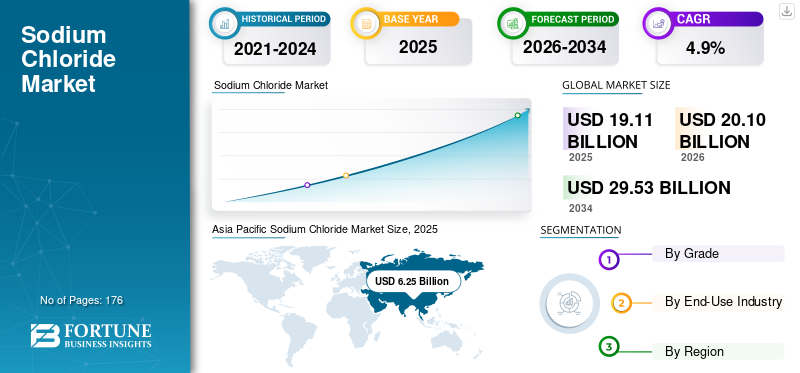
Download Free sample to learn more about this report.
SODIUM CHLORIDE MARKET KEY TAKEAWAYS
 Market Size & Forecast
- 2025 Market Size: USD 19.11 Billion
- 2026 Market Size: USD 20.10 Billion
- 2034 Forecast Market Size: USD 29.53 Billion
- CAGR: 4.9% from 2026–2034
 Market Share
- Asia Pacific dominated the sodium chloride market with a 32.70% share in 2025.
- The industrial grade segment accounted for the largest market share in 2025.
- The chemical manufacturing segment held the largest market share in 2025.
 Key Regional Highlights
Asia Pacific
Asia Pacific led the market with a value of USD 6.25 billion in 2025.
Europe
Europe reached USD 6.00 billion in 2025, supported by steady industrial demand.
North America
North America accounted for USD 4.47 billion in 2025, driven by chemical manufacturing and water treatment.
U.S.
The market reached USD 3.66 billion in 2025, supported by strong industrial and de-icing demand.
Japan
The market is witnessing steady growth, supported by demand from chemical manufacturing and food processing.
Read More

SODIUM CHLORIDE MARKET TRENDS
Rising Preference for High-Purity and Application-Specific Salt Grades
A key trend in the market is the growing preference for high-purity and application-specific salt grades across food processing, pharmaceuticals, water treatment, and selected industrial uses. Buyers are giving more attention to purity, product consistency, and supply reliability, alongside bulk availability. This is pushing producers to improve refining, grading, and packaging capabilities to meet more specific customer needs. From a business perspective, the market is gradually moving beyond standard bulk supply toward more quality-focused offerings, helping suppliers improve differentiation and create better value across end-use segments.
- According to the U.S. Geological Survey (USGS), vacuum pan salt made up 11% of the U.S. salt sold or used in 2023, showing steady demand for more refined product grades.
MARKET DYNAMICS
MARKET DRIVERS
Download Free sample to learn more about this report.
Rising Demand from Chlor-Alkali Production and Water Treatment to Support Product Consumption
Sodium chloride market growth is primarily driven by its large-scale use in chlor-alkali production and water treatment across industrial and municipal applications. It is a key raw material in the production of caustic soda and chlorine, which are widely used in chemicals, pulp and paper, textiles, water disinfection, and cleaning products. At the same time, the compound remains essential in water softening and treatment processes, where consistent supply and cost efficiency are important. This broad downstream dependence creates a steady demand base for sodium chloride, as growth in these essential sectors directly supports continued consumption.
- According to the USGS, the chemical industry accounted for about 39% of the total U.S. salt sales in 2024, with chlorine and caustic soda manufacturers being the main consumers within that segment.
MARKET RESTRAINTS
High Dependence on Industrial Activity and Weather Patterns to Create Volatility in Product Demand
The product demand is constrained by its strong dependence on industrial activity and seasonal weather conditions, particularly in chlor-alkali production, de-icing, water treatment, and food processing. Slowdowns in chemical manufacturing or weaker industrial output can reduce bulk salt consumption, while mild winters can significantly lower demand from road de-icing applications. Unlike specialty chemicals with more value-added differentiation, sodium chloride is a bulk commodity with its demand closely tied to operating rates and seasonal needs. This makes the market vulnerable to fluctuations in industrial cycles, weather variability, and public infrastructure spending.
MARKET OPPORTUNITIES
Rising Demand for High-Purity and Pharmaceutical-Grade Salt to Create New Growth Opportunities
The sodium chloride demand is expected to benefit from the growing use of high-purity and pharmaceutical-grade salt in healthcare, dialysis, intravenous solutions, and other quality-sensitive applications. Compared with bulk industrial salt, these segments require better purity, stricter quality standards, and a more reliable supply. The product demand is also increasing in processed food and selected chemical applications where product consistency is important. As these end-use industries expand, salt producers have an opportunity to move into higher-value product categories. This supports product diversification and creates better growth potential beyond traditional bulk consumption markets.
- According to the National Institute of Diabetes and Digestive and Kidney Diseases (NIDDK), more than 808,000 people in the U.S. are living with end-stage kidney disease and 68% receive dialysis, supporting the demand for high-purity sodium chloride in medical use.
MARKET CHALLENGES
Limited Product Differentiation and Strong Price Competition Put Pressure on Producer Margins
Sodium chloride producers face an ongoing challenge from limited product differentiation and strong price competition in bulk supply markets. Since the compound is widely sold as a commodity across industrial and de-icing applications, producers often have limited pricing power and must compete mainly on cost, logistics, and supply reliability. This makes it difficult to protect margins, especially when buyers focus more on price and contract terms than on brand. As a result, producers depend heavily on scale, efficient distribution, and stable customer relationships to remain competitive in a highly volume-driven market.
Segmentation Analysis
By Grade
Large-Volume Industrial Applications to Drive the Dominance of the Industrial Grade Segment
Based on grade, the market is segmented into industrial grade, food grade, and others.
To know how our report can help streamline your business, Speak to Analyst
The industrial grade segment accounted for a dominant market share in 2025. The segment leads as the grade is widely used in chlor-alkali production, water treatment, de-icing, and other bulk industrial processes where cost efficiency, supply reliability, and large-volume availability are critical. The product demand from these applications remains structurally strong, especially in chemical manufacturing and public utility operations that require a continuous and dependable salt supply. As a result, industrial grade remains the most established and volume-driven segment in the market, supported by its broad use across essential industrial and infrastructure-related applications.
The food grade segment is expected to grow at a CAGR of 4.4% over the forecast period.
By End-Use Industry
Chemical Manufacturing Led the Market due to Large-Scale Chlor-Alkali and Chemical Processing Needs
In terms of end-use industry, the market is categorized into chemical manufacturing, de-icing, food & beverage, water treatment, and others.
The chemical manufacturing segment accounted for the largest sodium chloride market share in 2025. The segment leads as the compound is the main feedstock for chlor-alkali production, where salt is used to produce caustic soda and chlorine for a wide range of industrial applications. These downstream chemicals are essential in sectors such as pulp and paper, textiles, soaps and detergents, plastics, and water disinfection. This creates a stable and large-volume demand base for the compound, making chemical manufacturing the most established and structurally important end-use segment in the market.
The water treatment segment is expected to grow at a CAGR of 5.3% over the forecast period.
Sodium Chloride Market Regional Outlook
By geography, the market is categorized into North America, Europe, Asia Pacific, Latin America, and the Middle East & Africa.
Asia Pacific
Asia Pacific Sodium Chloride Market Size, 2025 (USD Billion)
To get more information on the regional analysis of this market, Download Free sample
Asia Pacific held the dominant position in 2025, valued at USD 6.25 billion, and is expected to retain its leading role in 2026, reaching USD 6.63 billion. The region’s leadership is driven by its large industrial base, high chlor-alkali production capacity, and strong demand from chemical manufacturing, water treatment, food processing, and de-icing-related supply needs in key markets. Broad consumption across essential industries and public utility applications supports sustained product demand, particularly in high-volume and cost-sensitive end uses where supply reliability and consistent availability are important.
China Sodium Chloride Market
Based on Asia Pacific’s strong contribution and China’s large industrial base, the China market is analytically estimated to have touched USD 3.00 billion in 2025, accounting for approximately 48.1% of global revenues. The product demand is supported by extensive chlor-alkali production, broad chemical manufacturing activity, and large-scale product use in water treatment, food processing, and other essential industrial applications, strengthening the country’s market position.
India Sodium Chloride Market
The India market touched around USD 0.97 billion in 2025. The market growth is supported by the strong chemical manufacturing activity, rising demand from water treatment and food processing, and steady product consumption across essential industrial applications. Broad domestic demand continues to support market expansion.
North America
North America remains a significant regional market, reaching USD 4.47 billion in 2025. The product demand is supported by strong product consumption in chemical manufacturing, water treatment, food processing, and seasonal de-icing applications. The region benefits from established industrial infrastructure and stable utility-related demand across major end uses. However, growth remains moderate as the market is mature and bulk consumption patterns are relatively stable across most industries.
U.S. Sodium Chloride Market
The U.S. market reached a value of USD 3.66 billion in 2025, representing approximately 82.0% of regional revenues. The product consumption is driven by product use in chlor-alkali production, water treatment, food processing, and winter road de-icing. Strong industrial demand and established chemical manufacturing infrastructure continue to support the country’s significant market position.
Europe
The Europe market, which reached a valuation of USD 6.00 billion in 2025, is projected to record modest growth over the forecast period. The region is marked by mature industrial demand, strict environmental standards, and relatively high energy and logistics costs. Despite these constraints, continued product consumption in chemical manufacturing, water treatment, food processing, and selected de-icing applications supports steady market demand across essential end-use sectors.
Germany Sodium Chloride Market
The Germany market reached a value of approximately USD 2.28 billion in 2025, equivalent to around 38.0% of the global market. The product demand is supported by strong chemical manufacturing, steady water treatment needs, food processing activity, and broad use across essential industrial applications in the country.
U.K. Sodium Chloride Market
The U.K. market reached a value of USD 0.91 billion in 2025, accounting for roughly 15.1% of the global revenues. The product consumption is concentrated in chemical manufacturing, water treatment, food processing, and selected de-icing applications. Stable demand from essential industrial and public utility sectors continues to support product use nationwide.
Latin America and the Middle East and Africa
The Latin America and Middle East & Africa markets are expected to witness moderate growth during the forecast period. The Latin America market reached a valuation of USD 1.17 billion in 2025, supported by the demand from chemical manufacturing, water treatment, food processing, and other essential industrial uses. In the Middle East & Africa, the product consumption is driven by chemical processing, desalination-related treatment needs, and broad industrial applications. Continued use across utility and manufacturing sectors supports steady market expansion in both regions. The Middle East & Africa market reached USD 1.22 billion in 2025, supported by the rising industrial demand and infrastructure-related consumption across key economies.
GCC Sodium Chloride Market
The GCC market accounted for around USD 0.56 billion in 2025, representing approximately 45.7% of regional revenues. The product demand is supported by chemical manufacturing activity, desalination and water treatment needs, food processing, and the region’s strong role in industrial production and bulk material distribution.
COMPETITIVE LANDSCAPE
Key Industry Players
Major Industry Participants Focus on Asset Optimization to Consolidate their Footing
The market is volume-intensive and relatively consolidated, as large-scale production, access to salt resources, and broad distribution networks create substantial entry barriers. These aspects put limitations on new participation and result in supply concentration among a mix of global salt producers, integrated chemical companies, and established regional suppliers with strong production and logistics capabilities.
Major players such as Merck KGaA, Global Calcium, K+S Aktiengesellschaft, Uralkali, Morton, and Salt, Inc., focus primarily on the optimization of existing assets and reinforcing supply reliability rather than capacity expansion at an aggressive pace. Recent activities by these players underscore a strategic emphasis on cost competitiveness, operational efficiency, and gradual improvement in product quality and distribution capabilities for supporting market positioning in the long term.
LIST OF KEY SODIUM CHLORIDE COMPANIES PROFILED
- Merck KGaA (Germany)
- Global Calcium (India)
- K+S Aktiengesellschaft (Germany)
- Cargill, Incorporated (U.S.)
- Uralkali (Russia)
- Salinen Austria Aktiengesellschaft (Austria)
- Südwestdeutsche Salzwerke AG (Germany)
- Dominion Salt (New Zealand)
- Morton Salt, Inc. (U.S.)
- Compass Minerals (U.S.)
REPORT COVERAGE
The global market analysis provides an in-depth study of the market size & forecast by all the market segments included in the report. It includes details on market dynamics and trends expected to drive the market during the forecast period. It offers information on technological advancements, new product launches, key industry developments, and partnerships, mergers & acquisitions. The market research report also includes a detailed competitive landscape, including market share and profiles of key players.
Request for Customization to gain extensive market insights.
Report Scope & Segmentation
| ATTRIBUTE | DETAILS |
| Study Period | 2021-2034 |
| Base Year | 2025 |
| Estimated Year | 2026 |
| Forecast Period | 2026-2034 |
| Historical Period | 2021-2024 |
| Growth Rate | CAGR of 4.9% from 2026-2034 |
| Unit | Value (USD Billion), Volume (Kiloton) |
| Segmentation | By Grade, End-Use Industry, and Region |
| By Grade |
|
| By End-Use Industry |
|
| By Region |
|
Frequently Asked Questions
Fortune Business Insights says that the global market size was valued at USD 19.11 billion in 2025 and is projected to reach USD 29.53 billion by 2034.
The market is slated to exhibit steady growth at a CAGR of 4.9% during the forecast period of 2026-2034.
By end-use industry, the chemical manufacturing segment led the market in 2025.
Asia Pacific held the highest market share in 2025.
Strong demand from chemical processing, water treatment, and de-icing applications is a key factor supporting market growth.



- 2021-2034
- 2025
- 2021-2024
- 176
Get 30-60 hrs Free Customization
Expand Regional and Country Coverage, Segments Analysis, Company Profiles, Competitive Benchmarking, and End-user Insights.


















Related Reports
-
US +1 833 909 2966 ( Toll Free )
-
Get In Touch With Us