CNG Compressor Market Size, Share & Industry Analysis, By Compressor Type (Reciprocating Compressors, Hydraulic Compressors, Rotary Screw Compressors, and Others), By Application (CNG Refueling Stations, Industrial Applications, Pipeline Injection & Gas Distribution, and Fleet Refueling Stations), By End-user (Oil & Gas Companies, Natural Gas Utilities, Transportation Sector, and Industrial Users), and Regional Forecast, 2026-2034
 Download Free Sample
CNG Compressor Market Size and Future Outlook
 Listen to Audio Version
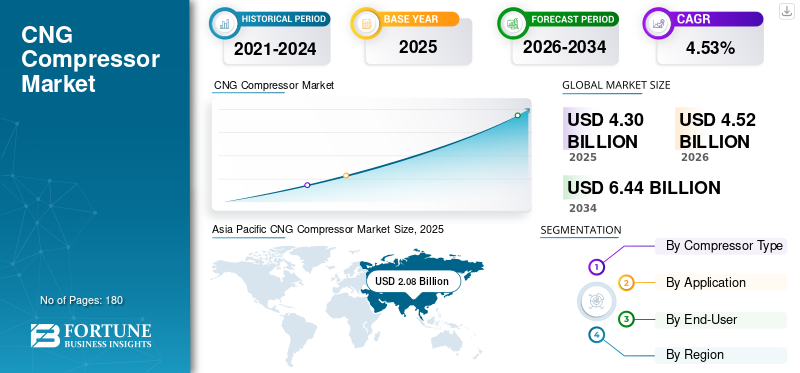
The CNG compressor market size was valued at USD 4.30 billion in 2025. The market is projected to grow from USD 4.52 billion in 2026 to USD 6.44 billion by 2034, exhibiting a CAGR of 4.53% during the forecast period. Asia Pacific dominated the CNG compressor market with a market share of 48.37% in 2025.
A Compressed Natural Gas (CNG) compressor is a specialized mechanical device designed to compress natural gas to high pressures and increase the pressure of natural gas (primarily methane) from a low-pressure supply line (typically 0.1–20 MPa) to a high-pressure storage level (usually 200 to 250 bar or 2,900–3,600 psi). Compressor systems are essential for storing, transporting, and dispensing natural gas for use as a cleaner fuel in automobiles, buses, and industrial applications. Key drivers include strict environmental regulations, increased adoption of Natural Gas Vehicles (NGVs), and technological advancements improving compressor efficiency.
The Asia Pacific market dominates the global market, driven by surging demand for clean, low-emission transportation fuels in India, China, and others. As a global leader in installations, the region’s market growth is fueled by massive investments in CNG infrastructure and government initiatives.
- For instance, in March 2024, Government of India inaugurated 201 CNG stations across 17 states by 15 CGD entities, led by GAIL with its first small-scale LNG unit at Vijaipur. This advances gas-based economy goals, boosting cleaner fuel access and infrastructure nationwide.
Atlas Copco holds a prominent, leading position in the global market, driven by its focus on energy-efficient, oil-free, and smart compression technologies. The market is characterized by intense competition among several major players, including Ariel Corporation, Ingersoll Rand Inc., Bauer Compressors Inc., and Siemens Energy AG, with a strong push toward digitalization and IoT-enabled solutions.
Download Free sample to learn more about this report.
CNG COMPRESSOR MARKET KEY TAKEAWAYS
 Global Market Size & Forecast
- 2025 Market Size: USD 4.30 billion
- 2026 Market Size: USD 4.52 billion
- 2034 Forecast Market Size: USD 6.44 billion
- CAGR: 4.53% from 2026-2034
 Market Share
- North America represented 41.64% of the cloud EDA market in 2025.
- In 2025, reciprocating compressors accounted for 63.03% of the market due to their reliability, cost-effectiveness, and high-pressure performance.
- CNG refueling stations accounted for 45.05% of the market in 2025.
 Key Regional Highlights
North America
North America generated USD 0.75 billion in 2025, ranking as the third-largest regional market.
Europe
Europe is projected to reach USD 0.78 billion in 2026, growing at a 3.50% CAGR.
Asia Pacific
Asia Pacific generated USD 2.08 billion in 2025 and is expected to reach USD 2.21 billion in 2026.
U.S.
The U.S. market generated USD 0.63 billion in 2025, representing 14.57% of the global market.
Japan
Japan recorded a market size of USD 0.12 billion in 2025, representing 2.81% of global revenue.
Read More

CNG COMPRESSOR MARKET TRENDS
Expansion of CNG Refueling Infrastructure is Emerging Market Trend
The expansion of CNG refueling infrastructure is profoundly shaping market trends for CNG compressors, fueling robust demand as natural gas vehicles gain traction worldwide. Rapid deployment of refueling stations, particularly in urban hubs and along key highways, requires reliable, high-capacity compressors to ensure efficient gas compression and swift vehicle turnaround.
- In February 2025, SETC and Torrent Gas launched a CNG refueling station at Nagapattinam depot to promote green mobility in Tamil Nadu. It serves 70 buses transitioning from diesel, cutting emissions and costs while supporting public, private, and commercial vehicles.
This infrastructure push drives innovation in compressor designs, emphasizing compact, energy-efficient models suited for both public stations and fleet depots. Manufacturers respond by enhancing durability and integration with renewable natural gas sources, aligning with sustainability goals. As governments incentivize cleaner transport alternatives, this growth accelerates compressor adoption, bolstering supply chains and encouraging investments in advanced compressor technologies for seamless CNG ecosystem expansion.
MARKET DYNAMICS
MARKET DRIVERS
Download Free sample to learn more about this report.
Growing Adoption of Natural Gas Vehicles is Driving Market Growth
The growing adoption of natural gas vehicles is reshaping the CNG compressors market growth, propelling demand as fleets and consumers shift toward cleaner, cost-effective alternatives to traditional fuels. Heavy-duty trucks, buses, and passenger cars increasingly rely on CNG, necessitating high-performance compressors at refueling stations to deliver rapid, consistent gas compression. This surge prompts manufacturers to innovate with quieter, more efficient units that minimize downtime and integrate smart monitoring for optimal operations.
- In January 2026, AVG Logistics, Nestlé India, and Ashok Leyland launched India's first CNG green logistics corridor with 50 CNG trucks serving Nestlé's supply chain. Covering 2.75 lakh km monthly, it cuts CO₂ emissions by 1.1 lakh kg annually while boosting efficiency.
Environmental regulations and fuel price advantages further accelerate vehicle uptake, expanding compressor deployments in commercial and public networks. As natural gas infrastructure matures, this trend strengthens market dynamics, fostering technological advancements and broader accessibility for sustainable mobility solutions.
MARKET RESTRAINTS
Limited Natural Gas Infrastructure in Some Regions to Restraint Market Expansion
Limited natural gas infrastructure in certain regions poses a significant restraint on the market, hindering widespread adoption despite rising vehicle demand. Sparse pipeline networks and underdeveloped supply chains restrict gas availability, curbing the viability of new refueling stations that rely on compressors for efficient delivery. Remote or emerging markets face elevated costs for infrastructure retrofits, delaying compressor installations and slowing market penetration. This gap exacerbates supply inconsistencies, deterring investors and fleet operators wary of unreliable fueling options. Until governments and utilities expand pipelines and distribution hubs, this bottleneck stifles compressor growth, confining opportunities to well-served urban corridors and limiting the sector's potential in underserved areas.
MARKET OPPORTUNITIES
Growth of Renewable Gas and Bio-CNG Creates Lucrative Market Opportunities
The growth of renewable gas and bio-CNG presents a compelling opportunity for the market, opening doors to sustainable fueling solutions amid the global push for decarbonization. As biogas from organic waste transforms into bio-CNG, compressors become essential for purifying and compressing this green alternative, enabling its seamless integration into existing natural gas vehicle networks. This shift attracts eco-conscious fleets and regulators, driving demand for specialized, corrosion-resistant compressors optimized for variable gas compositions. Manufacturers can capitalize by upgrading designs for higher efficiency and compatibility with renewable feedstocks, tapping into subsidies and incentives for low-carbon infrastructure. This evolution positions compressors as pivotal enablers of circular energy systems, expanding market reach beyond fossil-based CNG.
MARKET CHALLENGES
Operational and Maintenance Requirements Challenges Market Growth
Operational and maintenance requirements emerge as a persistent challenge for the market, complicating deployment and escalating long-term operating costs. High-pressure systems demand rigorous upkeep to prevent leaks, corrosion, and efficiency losses, requiring skilled technicians and specialized parts in often remote refueling locations. Frequent servicing intervals disrupt station operations, while harsh environments accelerate wear on seals, valves, and lubrication systems. This complexity deters smaller players from entering the market and burdens fleets with unplanned downtime. Overcoming these hurdles calls for robust, low-maintenance designs and predictive analytics, yet current limitations restrain scalability, particularly in regions lacking technical expertise or service networks.
Segmentation Analysis
By Compressor Type
Reciprocating Compressors Dominant Due to its Higher Reliability and Cost-Effectiveness
Based on compressor type, the market is classified into reciprocating compressors, hydraulic compressors, rotary screw compressors, and others.
In 2025, reciprocating compressors dominate the market with 63.03% of the share due to their proven reliability, cost-effectiveness, and ability to handle high-pressure requirements essential for efficient natural gas fueling.
Meanwhile, hydraulic compressors are emerging as the fastest-growing segment with CAGR of 5.60%, driven by their superior energy efficiency, lower noise levels, and reduced maintenance needs, making them ideal for urban refueling stations and expanding bio-CNG applications.
By Application
CNG Refueling Stations Segment Leads Due to Increasing CNG Transportation Demand
Based on application, the market is classified into CNG refueling stations, industrial applications, pipeline injection & gas distribution, and fleet refueling stations.
In 2025, CNG refueling stations dominated with a market share of 45.05%, leveraging widespread public infrastructure to meet rising vehicle demand with high-capacity, reliable compression for quick fueling.
Meanwhile, fleet refueling stations are emerging as the fastest-growing segment with CAGR of 6.06%, fueled by commercial adoption in trucking and buses, where customized, on-site compressors offer cost savings, minimal downtime, and scalability for dedicated operations.
By End-User
To know how our report can help streamline your business, Speak to Analyst
Oil & Gas Companies Segment Dominates Owing to Their Extensive Natural Gas Expertise
Based on end-user segmentation, the market is classified into oil & gas companies, natural gas utilities, transportation sector, and industrial users.
In 2025, oil & gas companies have dominated with highest CNG compressor market share of 34.96%, capitalizing on their extensive natural gas expertise, established supply chains, and infrastructure to deploy compressors at scale for vehicle fueling.
Meanwhile, the transportation sector is emerging as the fastest-growing segment with CAGR of 6.06%, propelled by fleet electrification alternatives, regulatory pushes for emissions cuts, and cost efficiencies in buses, trucks, and logistics.
CNG Compressor Market Regional Outlook
By geography, the market is categorized into North America, Europe, Asia Pacific, Latin America, and Middle East & Africa.
Asia Pacific
Asia Pacific CNG Compressor Market Size, 2025 (USD Billion)
To get more information on the regional analysis of this market, Download Free sample
Asia Pacific held the dominant share in 2025, valued at USD 2.08 billion, and is also expected to lead in 2026, with USD 2.21 billion. Asia Pacific leads market through rapid urbanization, natural gas vehicle adoption, and supportive government policies, especially in China and India. Industrial expansion and refueling infrastructure investments drive demand, positioning the region as the fastest-growing market fueled by cleaner transport initiatives.
China CNG Compressor Market
The China market in 2025 reached USD 0.81 billion, accounting for roughly 18.75% of the global market revenues. China dominates Asia Pacific market through massive dual-fuel vehicle adoption in buses and taxis, strict emission policies, and rapid refueling station expansions amid urbanization. Industrial growth in chemicals and transport further accelerates market leadership.
India CNG Compressor Market
India's market is projected to be one of the largest worldwide. The market’s 2025 revenues reached at USD 0.58 billion, representing 13.49% of the global market.
Japan CNG Compressor Market
The Japan market in 2025 was valued at USD 0.12 billion, accounting for approximately 2.81% of global revenues.
North America
The North America market reached USD 0.75 billion in 2025, securing its position as the third-largest market globally. North America sustains steady CNG compressor market growth via fleet conversions in trucking, school buses, and public transit, backed by shale gas abundance and emissions regulations. U.S. leads with expanding station networks.
U.S. CNG Compressor Market
With North America's strong contribution, the U.S. market was valued at USD 0.63 billion in 2025, accounting for 14.57% of the global market. U.S. market thrives on fleet adoption in trucking, transit buses, and refuse vehicles, fueled by low shale gas prices, emissions standards, and public-private station expansions. California leads regional growth.
Europe
Europe is projected to grow at 3.50 % over the coming years, the second-highest among all regions, and to reach a valuation of USD 0.78 billion by 2026. Europe's market grows steadily, driven by natural gas vehicles in public transport, heavy-duty fleets, and urban refueling networks. Germany, Italy, and Poland lead adoption amid EU decarbonization goals and gas pipeline expansions.
Germany CNG Compressor Market
The German market in 2025 was valued at USD 0.63 billion. It is projected to reach USD 0.66 billion by 2026, representing approximately 3.22%% of the global revenues.
Latin America
Latin America is expected to witness moderate growth in this market during the forecast period. The Latin America market is set to reach a valuation of USD 0.68 billion in 2026. This market expands through vehicle adoption in Brazil and Argentina, supported by cost-effective natural gas, fleet conversions in transport, and government incentives for cleaner fuels amid growing urbanization. Brazil leads infrastructure investments.
Brazil CNG Compressor Market
Brazil's market reached USD 0.28 billion by 2025, accounting for a very minor share of the global market.
Middle East & Africa
The Middle East & Africa are expected to witness significant growth during the forecast period. The Middle East & Africa market reached a valuation of USD 0.13 billion in 2025. This market sees gradual growth in Iran and Nigeria through natural gas vehicle pilots, oil-to-gas shifts, and urban fleet trials. Infrastructure lags limits scale, but energy abundance supports emerging station networks.
GCC CNG Compressor Market
The GCC market reached USD 0.04 billion in 2025, accounting for 1.01% of the global market sales.
COMPETITIVE LANDSCAPE
Key Industry Players
Growing Partnerships, Business Expansion, and Technological Advancements Increases Market Competition
The global CNG Compressor industry is considered consolidated, featuring a mix of major global players and numerous regional compressor manufacturers. While top-tier companies such as Atlas Copco AB, Ariel Corporation, Bauer Compressors Inc., Siemens Energy AG, and Ingersoll Rand Inc.
For instance, in March 2025, Gasboy (Vontier) secured a Sourcewell contract with partners ANGI, Teletrac Navman, Veeder-Root, and Konect, granting 50,000+ U.S. government agencies easy access to advanced fleet fueling systems including CNG, EV charging, and fuel management at competitive prices. Such developments are expected to fuel market growth during the forecast period.
LIST OF KEY CNG COMPRESSOR COMPANIES PROFILED
- Atlas Copco AB (Sweden)
- Ariel Corporation (U.S.)
- Bauer Compressors Inc. (U.S.)
- Siemens Energy AG (Germany)
- Ingersoll Rand Inc. (U.S.)
- Gardner Denver Holdings Inc. (U.S.)
- Corken Inc. (U.S.)
- Galileo Technologies S.A. (Argentina)
- ANGI Energy Systems LLC (U.S.)
- Fornovo Gas S.p.A. (Italy)
KEY INDUSTRY DEVELOPMENTS
- December 2025: Wärtsilä Water & Waste becomes Fornovo Gas's sole service partner in UK & Ireland for bio-gas, bio-methane, and CNG reciprocating compressors. Services include spare parts, commissioning, and maintenance by five factory-trained engineers, supporting cleaner fuel transitions.
- September 2025: Puma Energy launched Tanzania's first hybrid CNG retail station at Tangi Bovu, Bagamoyo Road, Dar es Salaam, offering CNG alongside petrol, diesel, LPG, lubricants, and a supermarket. Equipped with high-flow dispensers and a 250 HP compressor, it supports up to 50 vehicles hourly, marking a cleaner fuel milestone.
- May 2025: Williams' Transco announced the expansion plans of the Power Express pipeline expansion from Pittsylvania County's Chatham compressor station northward, adding 950 million cubic feet daily capacity by 2030. It targets Virginia's surging power demand from data centers using existing rights-of-way for faster permitting.
- March 2025: Atlas Copco inaugurated a 270,000 sq ft Industry 4.0 manufacturing plant in Pune, India, producing CNG, biogas, hydrogen compressors, dryers, and generators. Featuring 80% solar energy and sustainability certifications, it boosts local innovation, jobs, and market responsiveness.
- December 2024: Asian Energy Services secured BOOT contract from Assam Gas Company for natural gas compressor stations, spanning three years. initial mobilization in Q4 FY25 supports India's energy transition goals.
REPORT COVERAGE
The global CNG compressor market analysis provides an in-depth study of the market size & forecast by all the market segments included in the report. It contains details on the market dynamics and industry trends expected to drive the market in the forecast period. It offers information on technological advancements, new product launches, key industry developments, and partnerships, mergers & acquisitions. The market report also encompasses a detailed competitive landscape, including market share and profiles of key market players.
Request for Customization to gain extensive market insights.
Report Scope & Segmentation
| ATTRIBUTE | DETAILS |
| Study Period | 2021-2034 |
| Base Year | 2025 |
| Estimated Year | 2026 |
| Forecast Period | 2026-2034 |
| Historical Period | 2021-2024 |
| Growth Rate | CAGR of 4.53% from 2026-2034 |
| Unit | Value (USD Billion) |
| Segmentation | By Compressor Type, Application, End-User, and Region |
| By Compressor Type |
|
| By Application |
|
| By End-User |
|
| By Geography |
|
Frequently Asked Questions
Fortune Business Insights says that the market value stood at USD 4.30 billion in 2025 and is projected to reach USD 6.44 billion by 2034.
In 2025, the Asia Pacific market value stood at USD 2.08 billion.
The market is expected to exhibit a CAGR of 4.53% during the forecast period of 2026-2034.
The oil & gas companies sector led the application segment.
Growing adoption of natural gas vehicles is driving the market growth.
Atlas Copco AB, Ariel Corporation, Bauer Compressors Inc., Siemens Energy AG, and Ingersoll Rand Inc. are some of the top players in the market.
Asia Pacific dominated the market.



- 2021-2034
- 2025
- 2021-2024
- 180
Get 30-60 hrs Free Customization
Expand Regional and Country Coverage, Segments Analysis, Company Profiles, Competitive Benchmarking, and End-user Insights.
















Related Reports
-
US +1 833 909 2966 ( Toll Free )
-
Get In Touch With Us