Coding & Marking Equipment Market Size, Share & Industry Analysis, By Technology (Continuous Inkjet (CIJ), Thermal Inkjet (TIJ), Laser Marking, Thermal Printing, and Others (Print and Apply Labeling)), By End User Industry (Food and Beverage, Pharmaceuticals and Healthcare, Automotive, Electronics, Aerospace and Defense, Material and Chemicals, and Others (Packaging)), and Regional Forecast, 2026-2034
 Download Free Sample
Coding and Marking Equipment Market Overview
 Listen to Audio Version
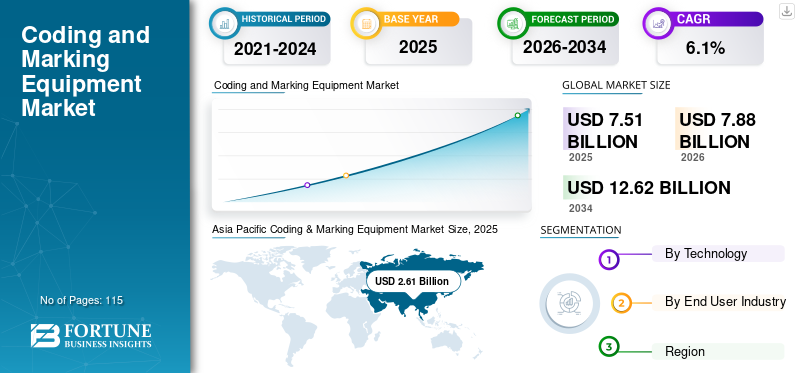
The global coding & marking equipment market size was valued at USD 7.51 billion in 2025. The market is projected to grow from USD 7.88 billion in 2026 to USD 12.62 billion by 2034, exhibiting a CAGR of 6.1% during the forecast period. Asia Pacific dominated the coding & marking equipment market with a market share of 34.75% in 2025.
The market is witnessing steady expansion as manufacturers increasingly adopt advanced solutions to support product identification, traceability, and quality control across industries. Growth is driven by rising demand for packaged goods, particularly in sectors such as food, personal care, and pharmaceuticals, along with increasing emphasis on regulatory compliance. Technologies enabling variable data printing are gaining importance for real-time coding and serialization applications. In addition, the shift toward laser technology is improving durability and cost-effectiveness by reducing reliance on consumables.
Key players such as Dover Corporation, Hitachi Limited, and Veralto are actively enhancing their portfolios with high-speed, precision marking solutions to strengthen their market share and support evolving industrial requirements. As competition intensifies, investments in automated marking systems are expected to support long-term market growth.
Download Free sample to learn more about this report.
Coding and Marking Equipment Market Key Takeaways
 Market Size & Forecast
- 2025 Market Size: SD 7.51 billion
- 2026 Market Size: USD 7.88 billion
- 2034 Forecast Market Size: USD 12.62 billion
- CAGR: 6.1% from 2026-2034
 Market Share
- Asia Pacific dominated the coding & marking equipment market with a 34.75% share in 2025.
- The laser marking segment is projected to grow at a CAGR of 6.8% during the forecast period.
- The pharmaceuticals and healthcare segment is expected to grow at a CAGR of 6.6% during the forecast period.
 Key Regional Highlights
Asia Pacific
Asia Pacific maintained its leading position in 2025 with a market valuation of USD 2.61 billion.
Europe
Europe is projected to reach a market size of USD 2.22 billion in 2026.
North America
North America is estimated to record a market valuation of USD 1.81 billion in 2026.
U.S.
The market is estimated to reach USD 1.36 billion by 2026, driven by demand from packaged food, pharmaceuticals, and manufacturing sectors.
Japan
The market is estimated to reach USD 0.48 billion by 2026, accounting for around 6.0% of global revenue.
Read More

CODING & MARKING EQUIPMENT MARKET TRENDS
Increasing Shift toward Laser-Based Marking Solutions is a Key Market Trend
The market is experiencing a growing transition toward laser marking technologies due to their ability to deliver permanent, high-quality, and precise markings without the need for consumables such as ink or solvents. Manufacturers are increasingly adopting laser systems to improve operational efficiency, reduce maintenance costs, and ensure compliance with stringent labeling standards. Additionally, laser marking offers advantages such as high-speed processing, minimal downtime, and compatibility with a wide range of materials, making it highly suitable for modern automated production environments. This trend is expected to continue as industries focus on sustainability and cost optimization.
- For instance, in 2026, Domino Printing Sciences plc, part of Brother Industries, has expanded its portfolio of laser marking systems to support high-speed packaging lines across the food and beverage and pharmaceutical industries.
MARKET DYNAMICS
MARKET DRIVERS
Download Free sample to learn more about this report.
Rising Demand for Product Traceability and Regulatory Compliance is Driving Market Growth
The increasing need for product traceability across industries such as food and beverage, pharmaceuticals, and electronics is significantly driving demand for the product. Regulatory authorities are mandating clear labeling, batch coding, and serialization to ensure product safety and authenticity. This has led manufacturers to invest in advanced marking solutions that can deliver consistent, accurate, and durable codes. Additionally, the expansion of global supply chains and e-commerce is further increasing the need for reliable product identification systems, thereby boosting demand for high-performance coding and marking equipment.
- For example, pharmaceutical regulations such as serialization requirements have led to increased adoption of coding and marking systems for tracking and authentication purposes.
MARKET RESTRAINTS
High Initial Investment and Maintenance Requirements to Limit Product Adoption Among Small Manufacturers
Despite growing demand, the market faces challenges due to the high initial cost associated with advanced coding and marking equipment, particularly laser systems and automated printing solutions. Small and medium-sized manufacturers often face budget constraints and may hesitate to invest in high-end equipment. Additionally, maintenance requirements, system integration challenges, and the need for skilled operators can further limit product adoption. These factors can slow down coding & marking equipment market growth, especially in developing regions where cost sensitivity remains a key concern.
MARKET OPPORTUNITIES
Expansion of Smart Packaging and Digital Printing Technologies is Creating Growth Opportunities
The growing adoption of smart packaging and digital printing technologies is creating significant opportunities for the coding & marking equipment market. Manufacturers are increasingly integrating digital solutions such as QR codes, barcodes, and data matrix codes to enhance product traceability and consumer engagement. This is driving demand for advanced coding systems capable of handling variable data and high-speed printing requirements. Furthermore, advancements in Industry 4.0 and connected manufacturing are enabling real-time monitoring and integration of coding equipment into automated production lines, supporting long-term market expansion.
- For instance, SATO Holdings has been focusing on smart labeling and auto-identification solutions to support connected packaging and traceability systems across industries.
Segmentation Analysis
By Technology
Continuous Inkjet (CIJ) Segment Held the Largest Share Due to Its Ability to Non-Contact Codes on a Wide Range of Substrates
Based on technology, the market is divided into continuous inkjet (CIJ), thermal inkjet (TIJ), laser marking, thermal printing, and others.
In 2025, the continuous inkjet (CIJ) segment accounted for the highest coding & marking equipment market share due to its ability to print high-speed, non-contact codes on a wide range of substrates and product surfaces. CIJ systems are widely used across industries such as food & beverages, pharmaceuticals, chemicals, and personal care, where continuous production lines require reliable batch numbers, expiry dates, barcodes, and traceability codes. The segment’s dominance is further supported by its suitability for curved, uneven, porous, and non-porous surfaces, along with its ability to operate efficiently in demanding manufacturing environments. Additionally, the relatively high versatility, ease of integration into production lines, and strong adoption across mass-production facilities continue to support the growth of continuous inkjet technology.
The laser marking segment is anticipated to grow at a CAGR of 6.8% over the forecast period.
To know how our report can help streamline your business, Speak to Analyst
By End User Industry
Food and Beverage Segment Held the Largest Market Share Due to High Volume Production and Stringent Labeling Requirements
Based on end user industry, the market is segmented into food & beverage, pharmaceuticals & healthcare, automotive, electronics, aerospace & defense, materials & chemicals, and others.
In 2025, the food and beverage segment accounted for the highest market share due to large-scale production volumes and strict regulatory requirements for labeling and traceability. Manufacturers in this industry rely heavily on coding and marking equipment to print expiration dates, batch numbers, and product information. The increasing demand for packaged and processed food products globally is further driving the need for reliable and high-speed marking solutions. Additionally, the expansion of retail and e-commerce channels is supporting continued growth in this segment.
The pharmaceuticals and healthcare segment is expected to grow at a CAGR of 6.6% over the forecast period.
Coding & Marking Equipment Market Regional Outlook
By geography, the market is categorized into Europe, North America, Asia Pacific, South America, and the Middle East & Africa.
North America
Asia Pacific Coding & Marking Equipment Market Size, 2025 (USD Billion)
To get more information on the regional analysis of this market, Download Free sample
North America is estimated to record a market valuation of USD 1.81 billion in 2026. The market is driven by advanced manufacturing practices, strict regulatory requirements, and high adoption of automation technologies. Industries such as food processing and pharmaceuticals are key contributors to demand.
U.S. Coding & Marking Equipment Market
The U.S. market is estimated to reach around USD 1.36 billion by 2026, supported by strong demand from packaged food, pharmaceuticals, and industrial manufacturing sectors. Increasing focus on traceability, labeling compliance, and automation is driving the adoption of advanced coding and marking solutions across production lines.
Europe
Europe is expected to reach USD 2.22 billion by 2026. Market growth is supported by strong regulatory frameworks and increasing demand for traceability solutions across industries such as food and beverage and pharmaceuticals.
U.K. Coding & Marking Equipment Market
The U.K. market is estimated to reach around USD 0.50 billion by 2026, representing roughly 6.4% of global revenues.
Germany Coding & Marking Equipment Market
Germany’s market is projected to reach USD 0.63 billion by 2026, equivalent to around 8.0% of global sales.
Asia Pacific
Asia Pacific held a dominant position in the market in 2024 and continued to maintain its leading position in 2025, with a market valuation of USD 2.61 billion. The region’s dominance is driven by rapid industrialization, expansion of manufacturing industries, and high demand for packaged goods. Countries such as China, India, and Japan are witnessing strong growth in food processing, pharmaceuticals, and electronics manufacturing, which is driving demand for coding and marking equipment.
Japan Coding & Marking Equipment Market
The Japanese market is estimated to reach around USD 0.48 billion by 2026, accounting for roughly 6.0% of global revenue.
China Coding & Marking Equipment Market
The Chinese market is estimated to reach around USD 13.9 billion by 2026, accounting for roughly 13.9% of global revenue.
India Coding & Marking Equipment Market
The Indian market is estimated to touch around USD 0.45 billion by 2026, accounting for roughly 5.7% of the global market.
South America and Middle East & Africa
The South America and Middle East & Africa regions are expected to witness moderate growth in this market during the forecast period. South America is projected to reach a market valuation of USD 0.70 billion by 2026, driven by expanding food processing and packaging industries along with increasing adoption of automated labeling and marking technologies. The Middle East & Africa market is expected to reach a valuation of USD 0.39 billion by 2026, supported by rising investments in industrial development, packaging infrastructure, and increasing demand for product traceability across key sectors.
GCC Coding & Marking Equipment Market
The GCC market is projected to reach around USD 0.25 billion by 2026, representing roughly 3.2% of global market.
COMPETITIVE LANDSCAPE
Key Industry Players
Key Industry Players Focus on Advanced Printing Technologies and Automation to Strengthen Market Position
The coding & marking equipment market is moderately competitive, with key players focusing on innovation, automation, and high-speed printing solutions to strengthen their market position. Companies such as Dover Corporation, Hitachi Limited, Illinois Tool Works, and Veralto are investing in advanced coding technologies, including laser and inkjet systems, to meet evolving industry requirements. Market participants are also emphasizing integration with automated production lines and digital tracking systems to enhance efficiency and compliance. Additionally, strategic partnerships, product innovation, and expansion into emerging markets are enabling companies to boost competitiveness and capture growing demand across industries.
LIST OF KEY CODING & MARKING EQUIPMENT COMPANIES PROFILED
- Brother Industries Ltd. (Japan)
- Dover Corporation (U.S.)
- Illinois Tool Works Inc. (U.S.)
- Matthews International Corporation (U.S.)
- SATO Holdings Corporation (Japan)
- Control Print Ltd. (India)
- Hitachi Limited (Japan)
- Leibinger Group (Germany)
- REA Elektronik GmbH (Germany)
- Veralto (U.S.)
KEY INDUSTRY DEVELOPMENTS
- February 2025: Markem-Imaje, located in Dover, introduced the SmartLase UV500, a novel 5-watt UV laser printer designed for marking and coding on delicate and high-density materials. This printer focuses on quick coding for traceability, including sophisticated text messages, logos, and intricate 2D codes on materials such as rigid plastics, recyclable films, metal, and glass.
- February 2025: Domino Printing Sciences plc showcased its implementation of GS1 QR codes at the GS Global Forum. This initiative highlights the company’s commitment to advancing industry standards and providing cutting-edge solutions for product identification and traceability.
- September 2024: Markem-Imaje unveiled its innovation, the white MW2440 ink, specifically developed for challenging-to-code polyethylene (PE) cables, including low-smoke and zero-halogen variants. This innovative ink allows manufacturers to print on tough PE cables, ensuring that the markings are high-quality, durable, and environmentally friendly.
- August 2024: Domino printing launched a Bottle Closure Printing Station designed for label-less water bottles. This solution addresses sustainability concerns by reducing the need for traditional labels, thereby minimizing waste and promoting eco-friendly packaging
- March 2024: Control Print secured a 50.49% ownership in Codeology Group Ltd., a U.K.-based company, for USD 1.08 million (1 million euros). Codeology focuses on label printing and end-of-line automation systems. This strategic acquisition is intended to broaden Control Print's product range and establish a presence in the U.K. market.
REPORT COVERAGE
The global coding & marking equipment market analysis includes a comprehensive study of the market size & forecast by all the market segments included in the report. It includes details on the market dynamics and market trends expected to drive the market over the forecast period. It provides information on key aspects, including an overview of technological advancements, pipeline candidates, the regulatory environment, and product launches. Additionally, it details partnerships, mergers & acquisitions, and key industry developments and prevalence by key regions. The global market research report also provides a detailed competitive landscape with information on the market share and profiles of key operating players.
Request for Customization to gain extensive market insights.
Report Scope & Segmentation
| ATTRIBUTE | DETAILS |
| Study Period | 2021-2034 |
| Base Year | 2025 |
| Estimated Year | 2026 |
| Forecast Period | 2026-2034 |
| Historical Period | 2021-2024 |
| Growth Rate | CAGR of 6.1% from 2026 to 2034 |
| Unit | Value (USD Billion) |
| Segmentation | By Technology, End User Industry, and Region |
| By Technology |
|
| By End User Industry |
|
| By Region |
|
Frequently Asked Questions
According to Fortune Business Insights, the global market value stood at USD 7.51 billion in 2025 and is projected to reach USD 12.62 billion by 2034.
In 2025, the market value stood at USD 2.61 billion.
The market is expected to exhibit a CAGR of 6.1% during the forecast period.
By end user industry, the food and beverage segment led the market.
Rising adoption of advanced marking technologies, such as laser and inkjet systems, is supporting market growth.
Dover Corporation, Hitachi Limited, Illinois Tool Works, and Veralto are the top players in the global market.
Asia Pacific dominated the market.


- 2021-2034
- 2025
- 2021-2024
- 115
Get 30-60 hrs Free Customization
Expand Regional and Country Coverage, Segments Analysis, Company Profiles, Competitive Benchmarking, and End-user Insights.




Related Reports
-
US +1 833 909 2966 ( Toll Free )
-
Get In Touch With Us