Commercial Airport Lighting Market Size, Share & Industry Analysis, By Type (Runway Lighting, Taxiway Lighting, Apron Lighting, Terminal Lighting, and Others) , By Technology (LED, Halogen/Incandescent, and HID), By Control System (Conventional Control System, Smart Control (CMS/ACML)), By Position (Inset Airfield Lights, Elevated Airfield Lights, and Precision Approach Path Indicator (PAPI), By End User (International Airports, Domestic Airports, and Regional Airports), By Airport Type (Greenfield and Brownfield), and Regional Forecast, 2026-2034
 Download Free Sample
KEY MARKET INSIGHTS
 Listen to Audio Version
The global commercial airport lighting market size was valued at USD 1.20 billion in 2025. The market is projected to grow from USD 1.28 billion in 2026 to USD 2.14 billion by 2034, exhibiting a CAGR of 6.7% during the forecast period. Asia Pacific dominated the global market with a market share of 35.83% in 2025.
Commercial airport lighting comprises the full range of lighting that guides aircraft and ground vehicles on and around an airport, so operations stay safe in darkness and low visibility. It includes runway lighting (edge, centerline, threshold, end, touchdown‑zone lights), taxiway lighting systems (blue edge and green centerline), approach lighting systems in front of the runway, and visual guidance systems such as PAPI that provide pilots with correct glide-path information.
Major players in the commercial airport lighting industry include ADB SAFEGATE, Honeywell International Inc., OCEM Airfield Technology, Eaton Corporation, and Carmanah Technologies. These companies supply complete airfield lighting suites covering runway, taxiway, apron, and approach lighting, typically based on high‑efficiency LED fixtures combined with centralized control and monitoring systems. ADB SAFEGATE provides comprehensive AGL solutions, including LED runway edge, threshold, and taxiway lights with advanced control systems for remote monitoring. Honeywell delivers intelligent AGL systems with automation, exemplified by deployments at Noida International Airport, which is integrated with surveillance data for automatic light activation.
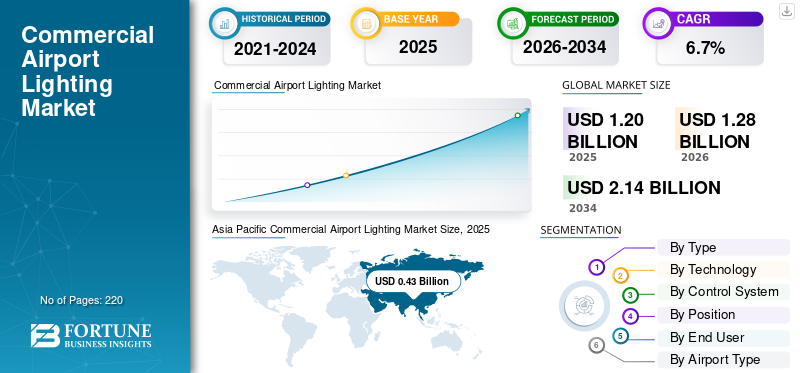
Download Free sample to learn more about this report.
Commercial Airport Lighting Market Key Takeaways
 Global Market Size & Forecast
- 2025 Market Size: USD 1.20 billion
- 2026 Market Size: USD 1.28 billion
- 2034 Forecast Market Size: USD 2.14 billion
- CAGR: 6.7% (2026–2034)
 Market Share
- Asia Pacific dominated the market with a 35.83% share in 2025.
- The runway lighting segment accounted for the largest market share.
- The conventional control system segment dominated the global market.
 Key Regional Highlights
Asia Pacific
Asia Pacific held the largest regional market, valued at approximately USD 0.43 billion in 2025.
North America
North America is projected to witness strong growth, driven by airport expansion projects.
Europe
Europe is expected to experience steady growth due to investments in airport modernization, rising tourism.
U.S.
The U.S. market is forecast to grow steadily during the forecast period.
Japan
Japan market is projected to witness steady growth during the forecast period.
Read More

MARKET DYNAMICS
MARKET DRIVERS
Increasing Runway Capacity Expansion, Airport Expansion, and Safety Upgrades to Drive Market Growth
A key driver for the commercial airport lighting market is the global push to expand runway capacity and upgrade airfield safety infrastructure at busy hubs and regional airports, driven by an increase in passenger traffic and aircraft movements across the globe.
- For instance, according to the International Air Transport Association (IATA), total full-year air traffic in 2024 rose 10.4% compared to 2023. Moreover, the International Civil Aviation Organization (ICAO) forecasts that global passenger traffic is forecast to exceed 12 billion by 2030.
This sustained growth is encouraging airports to add new runways, extend existing ones, and upgrade from basic halogen fixtures to high‑intensity LED systems that comply with updated ICAO/FAA standards. Expansion of airport projects is also increasing the procurement of bundled suites of runway, taxiway, approach, apron, and obstruction lighting with modern control and monitoring systems for large, multi‑year procurement programs.
MARKET RESTRAINTS
High Capital Cost and Complex Installation to Limit Market Expansion
A major restraint for the market is the high upfront capital expenditure and installation complexity associated with large‑scale airfield lighting upgrades. Converting from old halogen circuits to LED‑based, fully controlled systems often requires new Constant Current Regulators (CCRs), cabling, transformers, and control software, not just fixture replacement. Additionally, many airports schedule work around limited night closures and stringent safety procedures, which increases labor costs and stretches project timelines, which hampers the commercial airport lighting market growth during the forecast period.
MARKET OPPORTUNITIES
Adoption of Smart, Networked, and Energy‑Efficient Lighting Presents Growth Opportunities for Market Growth
The shift toward smart lighting systems, networked lighting, and sustainability targets presents a strong opportunity for vendors in the commercial airport lighting industry. Airports are increasingly searching for systems that combine LED fixtures with centralized or cloud‑enabled control platforms, predictive maintenance, and real‑time monitoring to reduce downtime and operating costs. Additionally, deeper integration with surface‑movement guidance systems and A‑SMGCS enables more precise control of stop bars, runway guard lights, and taxiway routes, improving safety, which is expected to provide lucrative opportunities for market development.
COMMERCIAL AIRPORT LIGHTING MARKET TRENDS
Integration of Smart Airport Is a Significant Trend in the Market
A notable trend in the market is the integration of airport lighting into broader smart‑airport and advanced surface‑movement guidance ecosystems. Next‑generation ALCMS/ILCMS platforms are increasingly linked with surveillance, weather, and air traffic‑management systems. This helps the lighting intensity, stop bars, and route indications align automatically with real‑time conditions. Suppliers and airport operators are using AI‑enabled analytics that detect failures, optimize maintenance schedules, and fine‑tune lighting levels, which is propelling market growth.
MARKET CHALLENGES
Regulatory Compliance and Standardization Act as a Challenge for Market Development
One of the main challenges for the commercial airport lighting market is navigating complex certification, standardization, and regulatory requirements. Airfield lighting must comply with detailed ICAO Annex 14, FAA, and regional standards for photometrics, colors, redundancy, electromagnetic compatibility, and environmental robustness, which necessitate extensive type testing and documentation, which pose challenges for market expansion over the forecast period.
Download Free sample to learn more about this report.
Segmentation Analysis
By Type
Increase in Demand for Runway Lighting For Visual Guidance Drives Runway Lighting Segment Growth
By type, the market is segmented into runway lighting, taxiway lighting, apron lighting, terminal lighting, and others.
The runway lighting segment holds the largest commercial airport lighting market share as the airports expand runway capacity, upgrade to CAT II/III operations, and modernize to meet stricter ICAO/FAA safety standards for low‑visibility approaches. Moreover, there is an increase in demand for runway lighting for visual guidance for safe aircraft operations.
- For instance, in October 2024, Honeywell Automation India Limited secured a contract to supply advanced Airfield Ground Lighting (AGL) systems for Noida International Airport. The project explicitly covers supply, installation, and commissioning on runway 10L-28R and associated taxiways.
The terminal lighting segment is growing at a steady rate during the forecast period. The factors responsible for segment growth are rapid investment in terminal expansions, refurbishments, and smart airport upgrades focused on passenger experience and energy efficiency. Operators are replacing fluorescent and halogen fixtures with LED ceiling lighting that reduces power consumption and maintenance costs, which supports segment growth.
To know how our report can help streamline your business, Speak to Analyst
By Technology
LED Retrofit Programs and Energy Efficiency Mandates Push LED Segment Growth
Based on technology, the market is segmented into LED, halogen/incandescent, and High-Intensity Discharge (HID).
LED account for the largest market share of the industry as airports are increasingly replacing old halogen and HID fixtures with energy‑efficient, long‑life LED solutions across runways, taxiways, aprons, terminals, and obstruction lighting. LEDs significantly cut power consumption and maintenance visits compared to traditional lighting sources, which is attractive for large hubs facing rising electricity costs and tight operational windows. These factors are expected to drive the demand for a shift toward energy-efficient, long-life LED systems for various airports across the globe.
- For instance, in 2024, OCEM Airfield secured an LED Airfield Ground Lighting upgrade project for Semera Airport in Ethiopia's Afar Region.
The halogen segment is expected to grow with a steady growth rate, owing to the previous legacy installations, its use is declining in some regions. Many existing airfields still operate halogen runway and taxiway circuits or HID floodlights, creating steady but replacement‑driven demand for lamps, spare parts, and others. However, high energy use, shorter lifetimes, and more frequent maintenance make these technologies less attractive compared with LED.
By Control System
Periodic Refurbishments and Safety‑Driven Upgrades Fuel Conventional Control System Segment Growth
Based on control system, the market is segmented into conventional control system and smart control (CMS/ACML).
The conventional control system segment dominates the market due to its widespread use at small and mid‑size airports where budgets are limited and operating patterns are relatively simple. The conventional control system segment covers traditional switch panels, mimic boards, and basic programmable logic that operate runway, taxiway lighting systems, and apron lighting systems in grouped circuits. The growth of this segment is driven by periodic refurbishments and safety‑driven upgrades.
The smart control segment, including Computerized Monitoring Systems and advanced Airport Lighting Control & Monitoring Systems (ALCMS), is expanding at the fastest growth rate as the airports are increasingly integrating digitalization and smart‑airport strategies. Airports are adopting smart control to improve safety in low‑visibility conditions and optimize energy use through adaptive dimming, which drives segment growth.
- For instance, in August 2025, Noida International Airport (NIA) deployed Panitek Smart Energy's advanced lighting system across its campus, featuring dynamic dimming, remote monitoring, and fault alerts via smart controllers and motion sensors.
By Position
High‑Intensity, Low‑Profile Requirements for Busy Pavements Accelerate Inset Airfield Lights Segment Growth
Based on position, the market is segmented into Inset airfield lights, elevated airfield lights, and Precision Approach Path Indicator (PAPI).
The inset airfield lights segment accounts for the largest market share, driven by the need for high‑intensity, low‑profile fixtures on busy runways and taxiways where wheels, snowplows, and sweepers must pass directly over the lights. Airports around the world are upgrading to CAT II/III operations or adding centerline, touchdown‑zone, and stop‑bar lighting, typically specifying inset LED fixtures to ensure durability and precise beam control in all weather. Numerous airports are installing advanced airfield lighting as part of airport upgrade or modernization programs, which supports airfield lights system growth.
- For instance, in August 2023, ADB SAFEGATE published a Lima Airport upgrade note stating the new runway will be equipped with LED airfield ground lighting.
The Precision Approach Path Indicator (PAPI) is the fastest-growing segment due to the installation and modernization of visual glide‑slope guidance at commercial airports to support safer landings and reduce unstable approaches. Traffic growth, pilot workload concerns, and regulator emphasis on stabilized approaches encourage airports to add PAPI to runways, which fuels segment growth.
By End User
Domestic Connectivity Targets and Government‑Backed Infrastructure Programs Fuel Domestic Airports Segment Growth
Based on end user, the market is segmented into international airports, domestic airports, and regional airports.
The domestic airports segment accounts for the largest market share as countries expand internal connectivity between major cities, tier‑2/tier‑3 urban centers, and remote regions. Governments often fund runway and terminal upgrades at these airports to support regional development and relieve congestion at primary international hubs. This drives procurement of cost‑effective runway, taxiway, apron, and basic terminal lighting.
The regional airports segment is growing at the fastest rate due to rising point‑to‑point services, low‑cost carriers opening new routes, and public‑service obligations in remote or underserved areas. These airports frequently modernize from minimal visual aids to more complete airfield lighting packages. As regional networks become more important for domestic tourism, cargo, and medical or emergency services, investment in reliable, compliant lighting in these fields is expected to remain a key driver for the segment’s growth.
By Airport Type
Rising Modernization Fuels Brownfield Segment Growth
Based on airport type, the market is segmented into greenfield and brownfield.
The brownfield segment accounts for the largest market share owing to an increase in brownfield projects at existing airports, focused on expansions, modernizations, and capacity enhancements. Such projects drive the need for new installations of airport lighting alongside upgrades to aging infrastructure. In addition, runway extensions, new terminals, and apron additions are expected to push the growth of the segment.
The greenfield segment is growing at the fastest rate due to a surge in airport developments and new airport construction across various countries worldwide. Moreover, rapid infrastructure expansion in emerging regions such as Asia Pacific and the Middle East also accelerates segment growth.
Commercial Airport Lighting Market Regional Outlook
By geography, the market is segmented into North America, Europe, Asia Pacific, Latin America and the Middle East & Africa.
Asia Pacific Commercial Airport Lighting Market Size, 2025 (USD Billion) To get more information on the regional analysis of this market, Download Free sample
Asia Pacific holds the largest share in the market, valued at USD 04.3 billion in 2025, and is expected to grow at a significant CAGR during the forecast period. The market in the region grows at a rapid rate due to airport infrastructure expansion to meet the needs of the rising passenger air traffic in the region.
- For instance, as per Airports Council International (ACI), the Asia-Pacific passenger traffic will grow 4.8% annually from 2025-2028, driven by recovery, new capacity, airlines, and aircraft.
Moreover, as air travel increases, there is a surge in airport expansions in countries such as China, India, Japan, and Australia. In addition, the governments invest heavily in aviation infrastructure to handle escalating traffic and meet safety rules, with projects such as LED runway lighting at airports.
The North America region holds a significant share in the market due to its extensive network of busy airports and FAA investments in capacity expansions and reconstructions. The expansion of airports in the region for increased capacity and safer night operations drives the adoption of modern LED systems and controls.
- For instance, in December 2025, Austin-Bergstrom International Airport secured FAA reimbursement of USD 108 million for major airfield improvements, including expansions that integrate lighting and control upgrades.
Rising air travel demand and the upgrades to aging infrastructure and stringent safety regulations drive demand for modern, efficient LED systems.
- For instance, according to the International Air Transport Association (IATA), North American airports witnessed passenger traffic rise 4.5% in 2024 over 2023, with international up 8.7% and domestic up 3.8%; cargo grew 2.8%.
The market in Europe is expanding due to heavy investments in new airports and modernizations for accommodating the surging passenger traffic in tourism-dependent nations such as Portugal, Poland, and Greece. Moreover, the strict aviation safety standards and sustainability goals push the adoption of eco-friendly LED and advanced lighting technologies, which drive market growth in the region.
The market in Latin America advances due to the expansion of air travel and infrastructure upgrades. With the rising passenger numbers, there is an increase in demand for enhanced safety and operational efficiency.
In the Middle East and Africa, the rapid development of aviation hubs and ambitious infrastructure projects, airport expansion, and support for surging air traffic, which fuels market growth.
- For instance, in November 2025, King Salman International Airport advanced partnerships and contracts for the mega-airport program and building a 40-million-passenger terminal with the installation of Airfield ground lighting across multiple runways and aprons.
Such mega-projects demand vast lighting networks, favoring advanced commercial systems for multi-runway operations. In addition, the huge investments in smart city initiatives and energy-efficient LED lighting drive further growth of the market in the region.
COMPETITIVE LANDSCAPE
Key Industry Players
Key Players Are Adopting Control and Monitoring Platforms to Boost Their Product Portfolio
Key players in the market include ADB SAFEGATE, TKH Airport Solutions, OCEM Airfield Technology, Eaton Crouse‑Hinds, Honeywell, and specialized providers such as Carmanah/Aviation Renewables (Canada) and S4GA (Poland). These companies supply complete airfield ground lighting portfolios covering LED runway and taxiway lights, approach and PAPI systems, apron floodlighting, obstruction lights, and associated control and monitoring platforms. These lighting systems are designed for use at international hubs, regional airports, and greenfield developments.
These suppliers focus on high‑efficiency LED optics, fully integrated lighting control and monitoring systems, and solutions that support CAT II/III low‑visibility operations and surface‑movement guidance. Compliance with ICAO/FAA standards, proven reliability in harsh climates, and strong project/after‑sales support remain key differentiators in the competitive landscape of the market.
LIST OF KEY COMMERCIAL AIRPORT LIGHTING COMPANIES PROFILED
- ADB SAFEGATE (Belgium)
- TKH Airport Solutions BV (Netherlands)
- OCEM Airfield Technology (Italy)
- Honeywell International Inc. (U.S.)
- Eaton Corporation PLC (U.S.)
- Astronics Corporation (U.S.)
- ATG Airports Ltd (U.K.)
- Abacus Lighting Ltd (U.K.)
- Carmanah Technologies Corp. (Canada)
- Youyang Airport Lighting Equipment Inc. (South Korea)
KEY INDUSTRY DEVELOPMENTS
- May 2025- ADB SAFEGATE launched the AXON High-Intensity Elevated airfield light as part of its AXON portfolio. The launch targets high-intensity elevated lighting needs and positions AXON as a modernization option for airfield operators.
- September 2024- North Carolina DOT announced federal grants supporting airport projects, including runway/taxiway lighting upgrades to LED.
- July 2024- Bhogapuram Airport (India) awarded an Airfield Ground Lighting (AGL) contract to ADB SAFEGATE.
- June 2024- DeKalb County (Georgia, U.S.) issued a Notice of Award for Airfield Lighting LED Design. It indicates a funded program step toward LED conversion and later construction execution.
- January 2024- Maryland DOT / Martin State Airport received Board of Public Works approval for a runway improvement project that includes LED airfield lighting and signage.
REPORT COVERAGE
Request for Customization to gain extensive market insights.
Report Scope & Segmentation
|
ATTRIBUTE |
DETAILS |
|
Study Period |
2021-2034 |
|
Base Year |
2025 |
|
Estimated Year |
2026 |
|
Forecast Period |
2026-2034 |
|
Historical Period |
2021-2024 |
|
Growth Rate |
CAGR of 6.7% from 2026-2034 |
|
Unit |
Value (USD Billion) |
|
Segmentation |
By Type, By Technology, By Control System, By Position, By End User, By Airport Type, and Region |
|
By Type |
· Runway Lighting · Taxiway Lighting · Apron Lighting · Terminal Lighting · Others |
|
By Technology |
· LED · Halogen / Incandescent · High-Intensity Discharge (HID) |
|
By Control System |
· Conventional Control System · Smart Control (CMS/ACML) |
|
By Position |
· Inset Airfield Lights · Elevated Airfield Lights · Precision Approach Path Indicator (PAPI) |
|
By End User |
· International Airports · Domestic Airports · Regional Airports |
|
By Airport Type |
· Greenfield · Brownfield |
|
By Geography |
· North America (By Type, By Technology, By Control System, By Position, By End Use, By Airport Type, and Country) o U.S. (By End User) o Canada (By End User) · Europe (By Type, By Technology, By Control System, By Position, By End User, By Airport Type, and Country) o U.K. (By End User) o Germany (By End User) o France (By End User) o Russia (By End User) o Rest of Europe (By End User) · Asia Pacific (By Type, By Technology, By Control System, By Position, By End User, By Airport Type, and Country) o China (By End User) o Japan (By End User) o India (By End User) o South Korea (By End User) o Rest of Asia Pacific (By End User) · Latin America (By Type, By Technology, By Control System, By Position, By End User, By Airport Type and Country) o Brazil (By End User) o Mexico (By End User) o Argentina (By End User) o Rest of Latin America (By Aircraft Type) · Middle East & Africa (By Type, By Technology, By Control System, By Position, By End User, By Airport Type, and Country) o UAE (By End User) o Saudi Arabia (By End User) o Rest of Middle East & Africa (By End User) |
Frequently Asked Questions
Fortune Business Insights says that the global market value stood at USD 1.20 billion in 2025 and is projected to reach USD 2.14 billion by 2034.
In 2025, the market value stood at USD 0.43 billion.
The market is growing at a CAGR of 6.7% during the forecast period (2026-2034).
The runway lighting segment leads the market by type.
The key factors driving the growth of the market are increasing runway capacity expansion and safety upgrades.
ADB SAFEGATE (Belgium), TKH Airport Solutions BV (Netherlands), and OCEM Airfield Technology (Italy) are some of the prominent players in the market.
Asia Pacific dominates the market.



- 2021-2034
- 2025
- 2021-2024
- 220
Get 30-60 hrs Free Customization
Expand Regional and Country Coverage, Segments Analysis, Company Profiles, Competitive Benchmarking, and End-user Insights.




















Related Reports
-
US +1 833 909 2966 ( Toll Free )
-
Get In Touch With Us