Commercial Greenhouse Market Size, Share & Industry Analysis, By Crop Type (Vegetables & Fruits, Ornamentals and Flowers, Herbs & Specialty Edibles, and Others), By Type (Glass Greenhouse and Plastic Greenhouse), By Equipment Type (Hybrid, Software, and Services), By Size (Large Scale, Small Scale, and Medium Scale), By End-Use (Commercial Growers, Research Institutes, and Nurseries & Garden Centers), and Regional Forecast, 2026-2034
 Download Free Sample
(Offer valid till 15th Oct 2026)

KEY MARKET INSIGHTS
 Listen to Audio Version
The global commercial greenhouse market size was valued at USD 37.78 billion in 2025 and is projected to grow from USD 41.87 billion in 2026 to USD 96.13 billion by 2034, exhibiting a CAGR of 10.95% during the forecast period. Europe dominated the global commercial greenhouse market with a market share of 17.13% in 2025.
The global commercial greenhouse industry is undergoing rapid transformation driven by advancements in greenhouse technologies, rising concerns over food security, and the need for year-round controlled environment agriculture. Modern commercial greenhouses, equipped with climate control systems that manage temperature, humidity, CO₂ concentration, and lighting, enable stable food production even under unpredictable climatic conditions. Growing population pressure, shrinking arable land, and accelerated urbanization are increasing the global dependency on greenhouse-grown produce. These facilities support large-scale cultivation while minimizing water usage, reducing chemical inputs, and ensuring real-time monitoring for optimal yield output.
The market is also strengthened by strong investments from agritech companies, expansion of hydroponic and vertical greenhouse systems, and government support for protected cultivation across North America, Europe, and the Asia Pacific. The global market is dominated by leading companies, including Richel Group, Heliospectra AB, Agra Tech, Inc., GreenTech Agro, and Logiqs B.V.
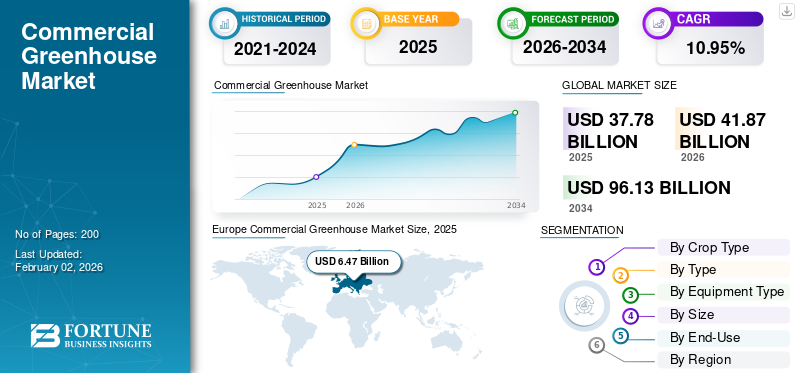
Download Free sample to learn more about this report.
Commercial Greenhouse Market Key Takeaways
 Market Size & Forecast
- 2025 Market Size: USD 37.78 billion
- 2026 Market Size: USD 41.87 billion
- 2034 Forecast Market Size: USD 96.13 billion
- CAGR: 10.95% from 2026–2034
 Market Share
- Asia Pacific dominated the commercial greenhouse market with a 69.84% share in 2025.
- The vegetables & fruits segment held a significant share of the global commercial greenhouse market in 2025.
- The glass greenhouse segment is expected to grow significantly at a CAGR of 10.44% during the forecast period.
 Key Regional Highlights
Asia Pacific
Asia Pacific held the largest market share of 69.84% in 2025, driven by rapid agricultural modernization, expanding hydroponic farming, and strong government support for protected cultivation.
Europe
Europe accounted for 17.13% of the global market in 2025, supported by advanced greenhouse technologies and widespread adoption of sustainable farming practices.
North America
North America represented 6.53% of the global market in 2025, benefiting from increasing investments in controlled-environment agriculture and year-round crop production.
U.S.
The U.S. commercial greenhouse market is projected to expand at a CAGR of 9.61% from 2026–2034, supported by rising demand for locally grown produce and precision farming technologies.
Japan
Japan continues to strengthen its commercial greenhouse industry through smart agriculture initiatives, advanced greenhouse automation, and growing demand for high-quality vegetables and fruits.
Read More

MARKET DYNAMICS
Market Drivers
Rising Importance of Food Security and Year-Round Production to Drive Market Growth
Food security is rising in importance as hundreds of millions of people still face hunger, while climate change, conflict, and price shocks threaten future supplies, which is pushing governments and industry toward technologies that can produce food reliably for the entire year. Year‑round production systems such as greenhouses, indoor farming, and broader controlled environment agriculture (CEA) are growing rapidly as strategic tools to stabilize supply, reduce climate risk, and support urban and national food security agendas.
- According to the United Nations report, in 2024, around 673 million people, 8.2% of the world's population, were undernourished, a slight decrease from 8.7% in 2022.
Market Restraints
High Capital Investment and Operational Costs to Impede Market Growth
Commercial greenhouse construction, particularly glass greenhouse and hybrid structures, requires high upfront capital. Costs associated with climate control, irrigation automation, sensors, and energy consumption limit adoption among small growers. Additionally, maintenance of climate systems regulating temperature, humidity, and CO₂ levels increases long-term operating expenses.
- According to Get Farms, an Indian company that provides managed farmland, primarily for mango cultivation, the upfront cost to establish a greenhouse is a significant investment that can range from USD 20,000 to USD 50,000 per acre. This cost is influenced by a wide variety of infrastructure components, including the structures themselves, climate control and irrigation systems, and technology integration.
Market Opportunities
Rising Automation and Digitalization in Greenhouse Technologies to Unlock New Growth Opportunities
Rising automation and digitalization in greenhouse technologies are creating significant new opportunities in the market by enhancing efficiency, productivity, and sustainability. These advancements integrate AI, IoT, advanced sensors, and automation systems to optimize climate control, resource use, and nursery crop yields, driving demand for high-tech, data-driven greenhouse solutions. These innovations significantly enhance yield output and reduce labor dependency across large-scale greenhouse farms, further fueling commercial greenhouse market growth.
- For instance, in February 2025, MECO launched Iran’s first IoT-enabled smart greenhouse in Nazarabad County, Alborz Province. This smart greenhouse is integrated with the MAPNA MIND platform, which enables remote monitoring and management of environmental parameters such as irrigation, temperature, humidity, and nutrient supply through IoT sensors.
Commercial Greenhouse Market Trends
Rising Adoption of Hydroponics and Soilless Cultivation to Shape Industry
Hydroponics, aeroponics, and aquaponics are increasingly used within commercial greenhouses to reduce water use by up to 90% and achieve faster crop cycles. This trend is strongest in North America, Europe, and Asia Pacific.
- For instance, in May 2025, Brio Hydroponics, a pioneer in innovative hydroponics solutions, scaled its commercial hydroponics parks through a structured, investor-driven model centered on its 100-acre “Unnati Hi-Tech Hydroponics Park” in Talod, Gujarat. The park focuses on high-value vegetables such as lettuce, bell peppers, cucumbers, cherry tomatoes, and herbs, targeting 6-8 crop cycles per year and aggregate output in the low thousands of tons annually, illustrating the yield-intensity potential of the model.
Download Free sample to learn more about this report.
SEGMENTATION ANALYSIS
By Crop Type
Year-Round Production and Controlled Environment Management to Lead Vegetables & Fruits Segment’s High Market Proportion
By crop type, the market is segmented into vegetables & fruits, ornamentals and flowers, herbs & specialty edibles, and others.
The vegetables & fruits segment is expected to hold a significant global commercial greenhouse market share. The market is expected to be approximately USD 20.12 billion by 2025 to around USD 50.07 billion by 2034, with the fastest CAGR of about 10.67% between 2026 and 2034. It is the largest segment due to high ROI per square meter, strong demand for tomatoes, leafy greens, cucumbers, berries, and peppers. Greenhouses allow year-round production and controlled environment management of temperature, humidity, and CO₂, enabling growers to meet retail supply contracts and reduce import dependency.
The ornamentals and flowers segment is expected to grow significantly in the forecast period with a CAGR of 11.64% in 2026.
To know how our report can help streamline your business, Speak to Analyst
By Type
Low-Cost and Flexibility Appeal to Lead Plastic Greenhouse Segment Growth
On the basis of type, the market is segmented into glass greenhouse and plastic greenhouse.
The plastic greenhouse segment dominates a significant portion of the global market. The segment is dominant due to low installation cost, flexibility, and suitability for warm climates such as the Asia Pacific, Latin America, and Middle East. Polyfilm and polycarbonate houses support rapid greenhouse expansion in cost-sensitive markets.
The glass greenhouse segment is expected to grow significantly at a CAGR of 10.44% during the forecast period.
By Equipment Type
Versatility and Efficiency to Fuel Hybrid Segment Market Leadership
On the basis of equipment type, the market is segmented into hybrid, software, and services.
The hybrid segment dominated the market with a value of approximately USD 16.57 billion in 2025, expected to rise to around USD 42.05 billion by 2034. The hybrid segment dominates the global market mainly due to its versatility and efficiency in combining traditional and advanced farming technologies. Hybrid greenhouses integrate both passive systems, such as natural ventilation and shading, with active systems such as automated climate control and energy-efficient lighting, balancing cost with performance.
The software segment is anticipated to grow at a CAGR of 11.60% during the global commercial greenhouse market forecast period.
By Size
Flexibility & Cost Efficiency Fuels Medium-Scale Segment Market Leadership
On the basis of size, the market is segmented into large-scale, small-scale, and medium-scale.
The medium-scale segment holds a dominant share of 36.50% in 2025 in the global market. Medium-scale facilities balance infrastructure investment and operational costs, making them accessible to commercial growers without the high capital requirements of large-scale complexes. These greenhouses efficiently support vegetables, fruits, and ornamentals, the top-producing segments in global greenhouse agriculture, due to optimal size for climate control and mechanization. The medium-sized greenhouse segment itself is expected to grow from approximately USD 13.79 billion in 2025 to over USD 36.54 billion by 2034, representing a solid CAGR of 11.45% and highlighting this group’s ongoing relevance within global market share.
The small-scale segment is anticipated to grow at a CAGR of 10.97% during the forecast period.
By End-Use
Flexibility & Cost Efficiency Fuels Medium-Scale Segment Market Leadership
Based on end-use, the market is segmented into commercial growers, research institutes, and nurseries & garden centers.
Nurseries & garden centers lead the global commercial greenhouse end-use segment due to their focus on propagating high-value young plants, trees, shrubs, and ornamentals in controlled environments, which supports landscaping, retail, and wholesale markets. The global commercial growers’ greenhouse market is estimated to be USD 13.49 billion in 2025, with a CAGR growth of 10.40% in the forecast period.
The research institutes segment is anticipated to grow at a CAGR of 10.97% during the forecast period.
Commercial Greenhouse Market Regional Outlook
Regionally, the report covers the global market analysis across North America, Europe, Asia Pacific, South America, and the Middle East & Africa.
Asia Pacific
Europe Commercial Greenhouse Market Size, 2025 (USD Billion) To get more information on the regional analysis of this market, Download Free sample
Asia Pacific holds the largest share of the global market, accounting for 69.84% in 2025, supported by rapid agricultural modernization, high consumption of vegetables & fruits, and expanding hydroponic production in China, Japan, India, and South Korea. Government-led incentives for protected cultivation and climate-resilient farming accelerate adoption, resulting in the region achieving the highest CAGR of 11.23% from 2026 to 2034.
North America
North America represents 6.53% of the global market in 2025, driven by automation, technology-driven farming, and a strong push for pesticide-free, locally produced vegetables and flowers. The U.S. dominates the region, with Canada expanding climate-adaptive greenhouse clusters to meet the growing global commercial greenhouse market demand. With advancements in robotics, AI-based climate systems, and controlled-environment agriculture, the region is projected to grow at a robust CAGR of 9.61% during 2026–2034.
Europe
Europe accounts for 17.13% of the market in 2025 and remains a technologically advanced and mature region led by the Netherlands, Spain, Italy, and Germany. Europe’s strong emphasis on sustainability, energy-efficient greenhouse systems, and advanced horticultural engineering keeps it at the forefront of innovation. Market maturity and high energy costs moderate growth, resulting in a steady CAGR of 10.69% between 2026 and 2034.
South America
South America holds approximately 4.53% of the global market in 2025, with increasing adoption driven by strong export demand for tomatoes, peppers, berries, and ornamentals. Mexico, Chile, and Brazil continue expanding greenhouse acreage to improve consistency and competitiveness in global produce markets. Strengthening agribusiness investments in hydroponics and plastic greenhouses supports a healthy CAGR of 10.04% from 2026 to 2034.
Middle East & Africa
The Middle East & Africa accounts for 1.97% of the market in 2025, supported by heavy reliance on controlled-environment farming in countries such as the UAE, Saudi Arabia, Qatar, and Israel due to harsh climates and limited arable land. The region is rapidly integrating solar-powered climate systems, desalination-based irrigation, and advanced cooling technologies. With rising investments in high-tech greenhouse infrastructure, MEA is expected to experience one of the fastest expansions globally with a CAGR of 9.30% through 2026–2034.
COMPETITIVE LANDSCAPE
Key Industry Players
Innovation and Automation to Support Global Market Growth
The players in the market include a mix of global horticulture manufacturers, climate-control technology providers, and turnkey greenhouse builders. The competitive environment is influenced by innovation capabilities, energy-efficient system integration, and automation.
Key Players in the Commercial Greenhouse Market
|
Rank |
Company Name |
|
1 |
Richel Group |
|
2 |
Heliospectra AB |
|
3 |
Agra Tech, Inc. |
|
4 |
Netafim Ltd. |
|
5 |
Logiqs B.V. |
List of Key Commercial Greenhouse Companies Profiled
- Richel Group (France)
- Heliospectra AB (Sweden)
- Agra Tech, Inc. (U.S.)
- Logiqs B.V. (Netherlands)
- GreenTech Agro (Netherlands)
- Certhon BV (Netherlands)
- Priva Holding BV (Netherlands)
- Rough Brothers Inc. (U.S.)
- Netafim Ltd. (Israel)
- Harford Greenhouses (Canada)
KEY INDUSTRY DEVELOPMENTS
- December 2024: Mucci Farms, one of the leading North American greenhouse produce grower under Cox Farms, acquired Greenhill Produce, boosting its total greenhouse operations beyond 650 acres across Canada and the U.S.
- October 2023: Pure Harvest Smart Farms entered into a three-year exclusive strategic partnership with Richel Group to deploy over USD 150 million worth of smart growing systems. The partnership focuses on expanding in the Middle East and Asia, with ongoing projects in Singapore, Kuwait, and Saudi Arabia. This collaboration aims to industrialize and professionalize the controlled-environment agriculture (CEA) industry, reducing build costs and project timelines while enabling rapid growth in target markets.
- October 2023: Orbia’s Precision Agriculture business, Netafim, partnered with Vermillion Growers to develop the first large-scale commercial vegetable greenhouse in Manitoba, Canada, located in Dauphin. The facility spans 10 acres and targets 10 million pounds of annual tomato production to address Central Canada's reliance on imported vegetables, where over 75% of vegetables and 50% of tomatoes come from abroad.
- October 2023: Eden Green Technology, a U.S. based company, invested USD 40 million in the expansion of its Cleburne, Texas campus, adding two greenhouses and triple production to nearly 6 million pounds of lettuce annually.
- January 2022: Intermediate Capital Group (ICG) acquired three mission-critical industrial and logistics sites in a primary sale and leaseback transaction from BOAL International BV, a prominent designer and manufacturer of specialized aluminum components used in commercial greenhouses. This acquisition aligns with growing demand for sustainable and reliable food production, emphasizing the expansion of BOAL's position in the high-tech commercial greenhouse sector.
REPORT COVERAGE
The global commercial greenhouse industry report analyzes the market in depth and highlights crucial aspects such as global market trends, market dynamics, prominent companies, investment in research and development, and end-use. Besides this, the report also provides insights into the global commercial greenhouse market analysis and highlights significant industry developments.
Request for Customization to gain extensive market insights.
Report Scope & Segmentation
|
ATTRIBUTE |
DETAILS |
|
Study Period |
2021-2034 |
|
Base Year |
2025 |
|
Estimated Year |
2026 |
|
Forecast Period |
2026-2034 |
|
Historical Period |
2021-2024 |
|
Growth Rate |
CAGR of 10.95% from 2026 to 2034 |
|
Unit |
Value (USD Billion) |
|
Segmentation |
By Crop Type
|
|
By Type · Glass Greenhouse · Plastic Greenhouse |
|
|
By Equipment Type
|
|
|
By Size · Large Scale · Small Scale · Medium Scale |
|
|
By End-Use · Commercial Growers · Research Institutes · Nurseries & Garden Centers |
|
|
By Region · North America (By Crop Type, Type, Equipment Type, Size, End-Use, and Country) • U.S. (By Crop Type) • Canada (By Crop Type) • Mexico (By Crop Type) · Europe (By Crop Type, Type, Equipment Type, Size, End-Use, and Country) • Germany (By Crop Type) • Spain (By Crop Type) • Italy (By Crop Type) • France (By Crop Type) • U.K. (By Crop Type) • Rest of Europe (By Crop Type) · Asia Pacific (By Crop Type, Type, Equipment Type, Size, End-Use, and Country) • China (By Crop Type) • Japan (By Crop Type) • India (By Crop Type) • Australia (By Crop Type) • Rest of Asia Pacific (By Crop Type) · South America (By Crop Type, Type, Equipment Type, Size, End-Use, and Country) • Brazil (By Crop Type) • Argentina (By Crop Type) • Rest of South America (By Crop Type) · Middle East & Africa (By Crop Type, Type, Equipment Type, Size, End-Use, and Country) • South Africa (By Crop Type) • Saudi Arabia (By Crop Type) • Rest of the Middle East & Africa (By Crop Type) |
Frequently Asked Questions
Fortune Business Insights says that the global market was USD 37.78 billion in 2025 and is anticipated to reach USD 96.13 billion by 2034.
At a CAGR of 10.95%, the global market will exhibit steady growth over the forecast period.
By crop type, the vegetables & fruits segment leads the market.
Asia Pacific held the largest market share in 2025.
The rising importance of food security and year-round production drives the global market growth.
Richel Group, Heliospectra AB, Agra Tech, Inc., GreenTech Agro, and Logiqs B.V. are the leading companies in the market.
The rising adoption of hydroponics and soilless cultivation is shaping the industry.



- 2021-2034
- 2025
- 2021-2024
- 200
-
(Offer valid till 15th Oct 2026)
Get 30-60 hrs Free Customization
Expand Regional and Country Coverage, Segments Analysis, Company Profiles, Competitive Benchmarking, and End-user Insights.














-
US +1 833 909 2966 ( Toll Free )
-
Get In Touch With Us