Hydroponics Market Size, Share & Industry Analysis, By Hydroponic System Type (NFT, DWC (Raft), Drip Hydroponics, Ebb & Flow, and Wick), By Growing Environment (Controlled Greenhouse Hydroponics and Fully Indoor Hydroponics), By Crop Type (Leafy Greens, Tomatoes, Herbs, Cucumbers, Peppers, and Others), By End User (Large Commercial Growers, Protected Agriculture Enterprises, Urban Vertical Farm Operators, Institutional / Research Facilities, and Residential / Hobby Growers), and Regional Forecast, 2026-2034
 Download Free Sample
(Offer valid till 30th Sep 2026)

Hydroponics Market Size and Future Outlook
 Listen to Audio Version
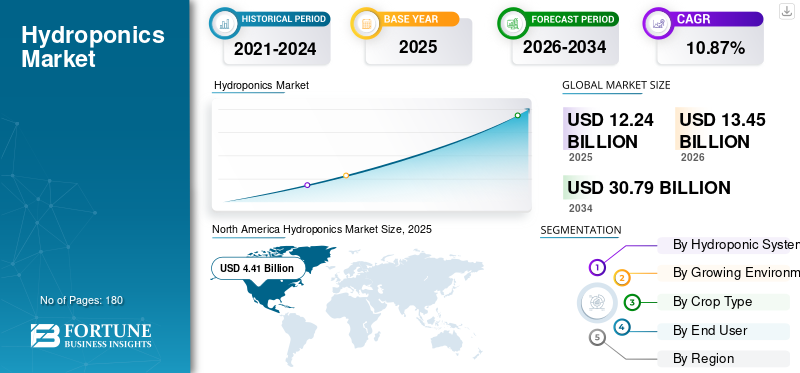
The global hydroponics market size was valued at USD 12.24 billion in 2025 and is projected to grow from USD 13.45 billion in 2026 to USD 30.79 billion by 2034, exhibiting a CAGR of 10.87% during the forecast period. North America dominated the hydroponics market with a market share of 36.02% in 2025.
Hydroponics is a way of growing plants without soil, using water mixed with nutrients instead. The roots are either held in a neutral medium or left to hang in moving, nutrient-rich water. This method lets growers carefully manage nutrients, water, and the environment, plant growth and use resources more efficiently. Hydroponic crop cultivation enhances yield consistency and resource efficiency by delivering precisely controlled nutrients directly to plant root systems.
Companies such as Netafim Ltd., Richel Group, Priva Holding B.V., and others are some of the key players operating in this market. Market expansion is the key strategy which is boosting product sales and supporting the market growth.
Download Free sample to learn more about this report.
HYDROPONICS MARKET Key Takeaways
 Market Size & Forecast
- 2025 Market Size: USD 12.24 billion
- 2026 Market Size: USD 13.45 billion
- 2034 Forecast Market Size: USD 30.79 billion
- CAGR: 10.87% from 2026–2034
 Market Share
- North America dominated the hydroponics market with a market share of 36.02% in 2025.
- Drip hydroponics held the second-largest market share due to its efficient nutrient delivery and suitability for fruiting crops.
- Large commercial growers is another major segment that has a CAGR of 11.22% during the forecast period.
 Key Regional Highlights
North America
North America generated USD 4.41 billion in 2025, supported by widespread indoor vertical farming, advanced greenhouse infrastructure, and strong demand for locally produced crops.
Europe
Europe reached USD 3.46 billion in 2025, benefiting from extensive greenhouse cultivation, advanced horticulture technologies, and export-oriented vegetable production.
Asia Pacific
Asia Pacific accounted for USD 2.86 billion in 2025 and remains one of the fastest-growing regions, driven by urbanization, food security initiatives, and expanding controlled-environment agriculture.
U.S.
The market was valued at USD 3.49 billion in 2025, supported by large-scale indoor farming, greenhouse vegetable production, and growing demand for year-round pesticide-controlled produce.
Japan
The market reached approximately USD 0.44 billion in 2025, with strong adoption of indoor plant factory systems focused on consistent leafy green production in controlled environments.
Read More

HYDROPONICS MARKET TRENDS
Automation Integration Accelerate Transition Toward Technology-Driven Hydroponic Production Models
A major trend in the market is the move toward automation and the use of data to guide cultivation. Growers are increasingly integrating sensors, climate-control software, automated nutrient dosing, and remote-monitoring to ensure higher yields consistency and reduce labor dependency. Advanced technology such as deep water culture systems support rapid plant growth by suspending roots in oxygenated nutrient solutions, improving uptake efficiency and yield stability. Another important trend is that commercial operations are becoming more consolidated and professional. The operators and vertically integrated indoor farms are expanding capacity through multi-site networks, leveraging economies of scale in procurement, distribution, and branding. As a result, the market is slowly moving away from many small growers toward larger, more organized commercial businesses.
MARKET DYNAMICS
MARKET DRIVERS
Water Scarcity and Land Constraints Accelerate Hydroponic Adoption Across Urban and Climate-Stressed Agricultural Markets
The global market growth is driven by challenges faced in traditional farming, advances in farming technologies, and government efforts to improve food production. One of the primary drivers is increasing pressure on arable land and freshwater resources. Hydroponic systems use much less water than traditional farming and produce more crops in the same space. This makes them appealing in places where land is limited or the climate is unpredictable. This is especially important in cities and areas with water shortages, such as the Middle East, parts of Asia Pacific, and crowded regions in North America and Europe which is contributing to the hydroponics market growth globally.
Download Free sample to learn more about this report.
MARKET RESTRAINTS
High Capital Intensity Constrain Market Expansion and Limit Adoption Among Small and Mid-Sized Commercial Growers
The market faces structural challenges that may slow its growth, even as demand remains strong. The biggest challenge is the high upfront cost. Setting up commercial hydroponic systems needs a large investment in greenhouses or indoor spaces, irrigation, climate control, lighting, and automation. Owing to these high costs, small and mid-sized growers are less likely to adopt hydroponics.
MARKET OPPORTUNITIES
Growth in Food Demand Supports Market Expansion
Rapid urbanization, combined with rising consumer demand for locally grown, traceable produce, is driving market demand for decentralized cultivation models. Hydroponic systems let growers produce more food in cities, which reduces transport costs, post-harvest food waste, and environmental impact. This approach also supports retailers’ sustainability goals and helps cities strengthen their food supply plans. Another key opportunity lies in using new technologies and data to improve growing methods. Artificial intelligence and precision nutrient dosing allow growers to maximize yield consistency while minimizing input waste. As sensors become cheaper and software becomes easier to use at scale, operations run more smoothly, and commercial growers see better returns.
Segmentation Analysis
By Hydroponic System Type
Continuous Nutrient Flow and High Crop Turnover Boosted Nutrient Film Technique (NFT) Segment Leadership
The market is segmented by hydroponic system type into NFT, DWC (Raft), drip hydroponics, ebb & flow, and wick.
The Nutrient Film Technique (NFT) segment held the largest hydroponics market share in 2025 as it is efficient, scalable, and works well for fast-growing crops. NFT systems continuously move a thin layer of nutrient solution over plant roots. This keeps roots well-oxygenated and reduces water and nutrient waste. This setup enables precise nutrient control and supports rapid growth, especially for commercial indoor farms and vertical growing facilities.
As NFTs use less water and have a modular design, they are a great choice for urban spaces with limited space, where maximizing yield per square meter matters.
The drip hydroponics holds the second-largest market share, and is expected to grow at a CAGR of 10.69% during the forecast period owing to its versatility and its success in growing fruiting crops such as tomatoes, peppers, and cucumbers. Unlike NFT systems, drip systems deliver nutrients directly to the roots via emitters. This setup lets growers control water and fertilizer more precisely, resulting in bigger, longer-growing plants.
By Growing Environment
Lower Energy Costs and Large-Scale Crop Suitability Propelled Controlled Greenhouse Hydroponics Segment Dominance
Based on growing environment, the market is segmented into controlled greenhouse hydroponics and fully indoor hydroponics.
Controlled greenhouse hydroponics segment accounted for the largest market share in 2025 as it combines climate control, scalability, and cost efficiency. Unlike fully indoor systems, greenhouses use natural sunlight, reducing the energy needed for artificial lighting. This setup lowers operating costs and makes long-term operations more sustainable, especially for fruiting crops such as tomatoes, cucumbers, and peppers, which require more light and longer growing seasons. Greenhouse infrastructure is already common in key horticulture areas in Europe, North America, and parts of Asia. This makes it easier to adopt hydroponic systems within existing protected agriculture setups.
Fully indoor hydroponics segment make up the second-largest share of the market and is expected to grow at a CAGR of 11.42% during the forecast period as it offers better environmental control and works well for high-density urban farming. Fully enclosed systems do not rely on outside weather, so crops can be grown all year, no matter the location or season. This makes indoor hydroponics especially appealing in areas with harsh weather, not enough water, or little farmland. Indoor farms are set up to grow quick-growing crops such as leafy greens and herbs, which meet the demand for fresh, pesticide-free produce in stores.
By End User
Large-Scale Controlled Infrastructure and Year-Round Supply Contracts Boosted Protected Agriculture Enterprise Segment Dominance
The market is segmented, by end user into large commercial growers, protected agriculture enterprises, urban vertical farm operators, institutional / research facilities, and residential / hobby growers.
The protected agriculture enterprises segment led the global market in 2025 as they are the main users in the market. They work in well-organized, high-investment greenhouses and controlled environments built for efficient crop production. Their business models are aligned with retail contracts, export markets, and year-round supply commitments, requiring reliable, scalable production. Hydroponics enables precise nutrient delivery, reduced water consumption, and predictable output critical factors for enterprises operating under tight quality and volume standards.
Large commercial growers is another major segment that has a CAGR of 11.22% during the forecast period as they use hydroponic systems on a large scale to boost productivity and use resources more efficiently. These growers usually manage a variety of crops and use hydroponics to achieve better yields from high-value crops such as leafy greens and tomatoes.
By Crop Type
To know how our report can help streamline your business, Speak to Analyst
Short Growth Cycles and High Plant Density Fueled Leafy Greens Segment Leadership
The market is segmented, by crop type into leafy greens, tomatoes, herbs, cucumbers, peppers, and others.
The leafy greens segment led the global market in 2025. Leafy greens are the top crop in the market as they grow quickly, can be planted densely, and work well with controlled-environment systems. Lettuce, spinach, arugula, and mixed salad greens grow well in nutrient film and deep-water culture systems, where steady nutrient and oxygen levels help them develop quickly. As they are light and have small root systems, these greens are ideal for vertical stacking in indoor farms, increasing output per square meter. Leafy greens also have steady retail demand, as health-conscious consumers buy them year-round.
Tomatoes segment accounted for the second largest market share in 2025 and are expected to register a CAGR of 10.85% during the forecast period since they are the main fruiting crop grown in greenhouse hydroponic systems. Unlike leafy greens, tomatoes require longer growth cycles and more structural support, making drip hydroponic systems in protected greenhouses particularly suitable. Hydroponic growing lets small scale farmers closely control nutrient levels during flowering and fruiting, resulting in more consistent yields, larger fruit, and better quality.
Hydroponics Market Regional Outlook
By geography, the market is categorized into Europe, North America, Asia Pacific, South America, and the Middle East & Africa.
North America
North America Hydroponics Market Size, 2025 (USD Billion)
To get more information on the regional analysis of this market, Download Free sample
The market in North America reached a valuation of USD 4.41 billion in 2025 and it is the leading region in the world due to widespread indoor vertical farming and well-developed greenhouse systems. The U.S. also leads the region in demand due to its large commercial production of leafy greens and advanced controlled-environment agriculture. Canada adds to the market with its greenhouse tomato farms, while Mexico focuses on growing protected vegetables for export. Widespread automation and strong retail demand for local produce have helped the market mature.
U.S. Hydroponics Market
In 2025, the U.S. market reached USD 3.49 billion. The U.S. has the world’s largest market, owing to widespread indoor vertical farming and well-developed greenhouse vegetable production. Leafy greens are the main crops grown indoors, while tomatoes and cucumbers are the top choices in greenhouses. High-tech integration, retail localization strategies, and the increasing demand for pesticide-controlled, year-round produce continue to support steady commercial expansion.
Asia Pacific
The Asia Pacific market was valued at USD 2.86 billion in 2025 and is one of the fastest-growing areas for hydroponics. This growth is driven by more people moving to cities, efforts to improve food security, and a greater use of controlled environments. China and India are increasing their use of greenhouse hydroponics. At the same time, Japan and Singapore are leading the way with indoor plant factory models. The region uses both greenhouse and indoor systems in a balanced way. Leafy greens and tomatoes are the main crops produced. Hydroponics enables year-round production by eliminating seasonal dependency through controlled nutrient delivery and environment management systems.
India Hydroponics Market
The Indian market was valued around USD 0.32 billion in 2025, accounting for roughly 2.58% of global market revenues. India’s market is emerging, driven by the expansion of protected cultivation and growing interest in urban hydroponics farming, with greenhouse drip systems leading early adoption.
China Hydroponics Market
China’s market was valued around USD 0.97 billion in 2025, representing roughly 7.89% of global market share. China is expanding its use of large greenhouse hydroponics and urban indoor farms. These efforts are helping the market grow quickly.
Japan Hydroponics Market
The Japan market reached a valuation of around USD 0.44 billion in 2025, accounting for roughly 3.58% of global market revenues. Japan relies heavily on indoor farming, using advanced plant factory systems to maintain steady leafy green production in controlled settings.
Europe
The European market reached a valuation of USD 3.46 billion in 2025. Greenhouses are widely used across Europe, especially in the Netherlands, Spain, and France, where advanced protected horticulture systems support production. Drip hydroponics is common for growing tomatoes and peppers. Indoor hydroponics is also becoming more popular in Germany and the U.K. The region uses advanced technology and has strong export-focused vegetable supply chains, but its growth is moderate compared to emerging markets.
Germany Hydroponics Market
The market in Germany reached around USD 0.36 billion in 2025, representing roughly 2.92% of global market revenues. Germany focuses on advanced indoor farms and organized greenhouse cultivation methods.
U.K. Hydroponics Market
The U.K. market reached approximately USD 0.31 billion in 2025, equivalent to around 2.56% of global market sales. In the U.K., both greenhouse farming and indoor hydroponics are used, mainly as retailers want to source food more locally.
South America and Middle East & Africa
Over the forecast period, South America is expected to experience significant growth in this market. The South America market recorded USD 0.75 billion in 2025. Most hydroponic vegetable farming in South America takes place in greenhouses, with Brazil, Argentina, and Chile leading the way. The focus on exporting tomatoes and peppers is encouraging more growers to use hydroponics, especially with drip irrigation systems. Indoor hydroponics is less common as it costs more to set up, but as cities grow, this method is slowly becoming more popular in large urban areas. The Middle East & Africa region reached a valuation of USD 0.76 billion in 2025. Food security and water scarcity are the main factors shaping the market. Saudi Arabia and the UAE are investing in greenhouse and indoor hydroponic systems to rely less on imports. Indoor systems are becoming increasingly popular in Gulf countries due to harsh climate conditions. Greenhouse farming is still the main method used in horticulture across the wider region.
UAE Hydroponics Market
UAE market is set to grow at a CAGR of 11.83% during the forecast period. The UAE has a high rate of indoor farming owing to its challenging climate and efforts to improve food security.
COMPETITIVE LANDSCAPE
Key Industry Players
Technological Differentiation and Integrated Solutions Intensify Competitive Dynamics Across Hydroponics Value Chain
The hydroponics market includes a range of players, including global technology providers, greenhouse builders, irrigation experts, nutrient manufacturers, and local system integrators. The market is moderately fragmented. Most competition occurs at different points in the value chain, rather than among companies that focus solely on hydroponics from start to finish. Firms that focus on drip irrigation, climate control, LED lighting, and fertigation systems compete by offering better technology, greater reliability, and better integration of their products.
LIST OF HYDROPONICS COMPANIES PROFILED IN REPORT
- Netafim Ltd. (Israel)
- Richel Group (Richel Serres de France) (France)
- Priva Holding B.V. (Netherlands)
- Signify N.V. (Philips Horticulture LED Solutions) (Netherlands)
- Argus Control Systems Ltd. (Canada)
- AmHydro (American Hydroponics) (U.S.)
- LumiGrow Inc. (U.S.)
- Hydrofarm Holdings Group, Inc. (U.S.)
- Nutriculture UK Ltd. (U.K.)
- Haifa Group (Israel)
KEY INDUSTRY DEVELOPMENTS
- July 2025: Hydrobuilder Holdings LLC bought New England Hydroponics, which helped the company grow its retail presence in the Northeastern U.S. With this acquisition, Hydrobuilder Holdings gained five retail stores and one warehouse in Massachusetts and Maine. This deal made Hydrobuilder a stronger leader in the U.S. hydroponics, Controlled Environment Agriculture (CEA), and specialty agriculture equipment market.
- April 2025: Blue River Financial Group acquired Simply Hydroponics, LLC, one of the leading hydroponics companies. This acquisition helped the company broaden its product offering, strengthen its online presence, and expand its reach across both commercial and enthusiast grower segments.
- January 2025: AeroGarden has introduced new products to the market. The new product line offers better performance and shows AeroGarden’s commitment to sustainability.
- November 2024: GrowGeneration Corp., a leading retailer and distributor of hydroponic and organic gardening products in the U.S., has launched three new premium product lines under its own brands. The new product lines include grow lights, key accessories, and media made for indoor and greenhouse hydroponics.
- April 2023: AYR Wellness Inc., a leading vertically integrated U.S. multi-state cannabis operator, acquired Tahoe Hydroponics Company, LLC (“Tahoe Hydro”), one of the leading producer of high-quality cannabis flower.
REPORT COVERAGE
The global hydroponics market research provides an in-depth study of market size & forecast by all the market segments included in the report. The market forecast includes details on the market dynamics and market trends expected to drive the market during the forecast period. It offers information on the technological advancements, new product launches, key industry developments, and details on partnerships, mergers & acquisitions. The hydroponics industry also encompasses detailed competitive landscape on the market segmentation, market share and profiles of key operating players.
Request for Customization to gain extensive market insights.
Report Scope & Segmentation
| ATTRIBUTE | DETAILS |
| Study Period | 2021-2034 |
| Base Year | 2025 |
| Estimated Year | 2026 |
| Forecast Period | 2026-2034 |
| Historical Period | 2021-2024 |
| Growth Rate | CAGR of 10.87% from 2026-2034 |
| Unit | Value (USD Billion) |
| Segmentation | By Hydroponic System Type , By Growing Environment , By Crop Type, By End User, and Region |
| By Hydroponic System Type |
|
| By Growing Environment |
|
| By Crop Type |
|
| By End User |
|
| By Region |
|
Frequently Asked Questions
Fortune Business Insights says that the global market value stood at USD 12.24 billion in 2025 and is projected to reach USD 30.79 billion by 2034.
In 2025, the North Americas market value stood at USD 4.41 billion.
The market is expected to exhibit a CAGR of 10.87% during the forecast period.
By end user, protected agriculture enterprises segment led the global market in 2025.
Water scarcity and land constraints accelerate hydroponic adoption across urban and climate-stressed agricultural markets.
Netafim Ltd. and Richel Group are a few of the players in the market.
North America held the largest market share in 2025.
Automation integration accelerate the transition toward technology-driven hydroponic production models.



- 2021-2034
- 2025
- 2021-2024
- 180
-
(Offer valid till 30th Sep 2026)
Get 30-60 hrs Free Customization
Expand Regional and Country Coverage, Segments Analysis, Company Profiles, Competitive Benchmarking, and End-user Insights.




















Related Reports
-
US +1 833 909 2966 ( Toll Free )
-
Get In Touch With Us