Feed Enzymes Market Size, Share & Industry Analysis, By Type (Phytase, Protease, Carbohydrase {Amylase, Cellulase, Xylanase, β-glucanase, Mannanase}, Lipase and Others), By Source (Microbial-derived enzymes, Plant-derived enzymes and Animal-derived enzymes), By Form (Dry form and Liquid form), By Livestock (Poultry, Swine, Ruminants, Aquaculture and Others) and Regional Forecast, 2026-2034
 Download Free Sample
(Offer valid till 30th Sep 2026)

KEY MARKET INSIGHTS
 Listen to Audio Version
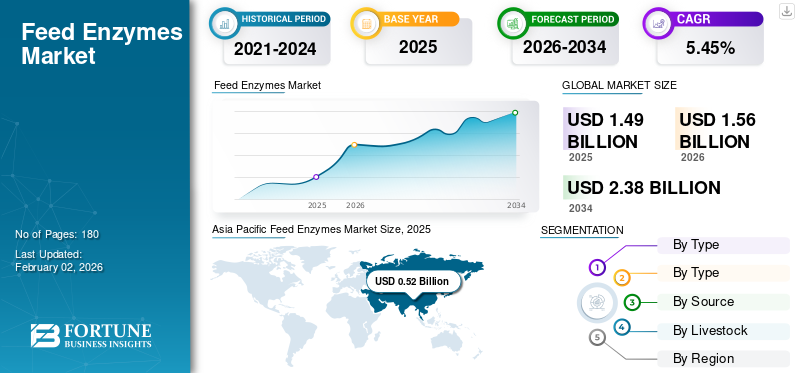
The global feed enzymes market size was valued at USD 1.49 billion in 2025 and is projected to grow from USD 1.56 billion in 2026 to USD 2.38 billion by 2034, exhibiting a CAGR of 5.45% during the forecast period. Asia Pacific dominated the global market with a share of 34.51% in 2025.
Feed enzymes are proteins that are used in the production of animal feeds to improve the functional properties of the feed. The inclusion of such products is beneficial in improving the feed efficiency of the animals' digestive systems, helping them break down complex feed into simpler forms that the body can easily digest. As the demand for chicken meat and eggs worldwide increases, so does the demand for high-quality animal feed, which in turn supports the overall market’s growth.
Companies such as Novozymes, DSM, BASF, and Kemin are some of the key players operating in this market. Growing investment in the research and development of new products, as well as increasing partnerships with market players, are key strategies driving the market’s growth.
Download Free sample to learn more about this report.
Feed Enzymes Market Key Takeaways
 Market Size & Forecast
- 2025 Market Size: USD 1.49 billion
- 2026 Market Size: USD 1.56 billion
- 2034 Forecast Market Size: USD 2.38 billion
- CAGR: 5.45% from 2026–2034
 Market Share
- Asia Pacific dominated the feed enzymes market with a 34.51% share in 2025.
- The carbohydrase segment accounted for a 42.89% market share in 2026.
- The poultry segment is projected to hold a 43.14% market share in 2026.
 Key Regional Highlights
North America
North America accounted for a 26.59% share in 2025, valued at USD 0.40 billion.
Asia Pacific
Asia Pacific held a 34.51% share in 2025, valued at USD 0.52 billion.
Europe
Europe held a 21.30% share in 2025, valued at USD 0.32 billion.
U.S.
The market projected to reach USD 0.29 billion by 2026.
Japan
The market projected to reach USD 0.10 billion by 2026.
Read More

MARKET DYNAMICS
MARKET DRIVERS
Increasing Demand for High-Quality Animal Feed Supports the Feed Enzymes Market Growth
Nutrient utilization is one of the essential factors that help improve animal health and obtain the necessary nutrients from feed products. The adoption of feed enzymes in manufacturing feed products helps the animals efficiently utilize the nutrients in the feed and maximize efficiency. Moreover, Feed Enzymes are natural and sustainable products that act as a suitable alternative for Antibiotic Growth Promoters (AGPs) for improving digestion, and some countries have even banned the use of AGPs. Thus, the enhanced efficiency of such products, along with the favorable government policies that support the use of suitable solutions in animal feed production, plays a crucial role in the use of enzymes in feed production. Feed enzymes play a vital role in improving feed efficiency, nutrient utilization, and overall sustainability in modern animal production systems.
MARKET RESTRAINTS
High Production Cost and Inconsistent Efficacy Can Impede Product Sales
One of the key sure for manufacturing feed enmesh is through microbial formation. Such a process can be costly, and it requires complex microbial fermentation, purification, and stabilization processes. This can occur if the market price of the products leads to a high cost of the feed. Moreover, the impact of such enzymes may also vary from one animal species to another, and such inconsistent results can deter animal farm owners from using the products, which can further impact the product sales and feed enzymes market growth.
MARKET OPPORTUNITY
Market Presence Expansion in Emerging Markets Creates Opportunity For Market Growth
In several emerging economies such as India, Southeast Asia, and Brazil, among others, the livestock industry is experiencing slow growth, and it is expected that the demand for high-quality animal feed will rise in these markets. Hence, companies have the opportunity to expand their presence in such countries and increase their sales through new product launches. Moreover, some companies are also investing in improving product formulations and developing advanced enzymes for different animal species.
FEED ENZYMES MARKET TRENDS
Sustainable and Eco-Friendly Feed Solutions Are the Key Trend Influencing The Market
Sustainability is one of the key trends influencing the product launches and usage in several major economies across the world. Animal feed rich in nitrogen and phosphorus has an immense negative impact on the environment, as the secretion of nitrogen causes eutrophication. Therefore, green additives in the manufacturing of animal feed are increasing. Feed Enzymes are primarily helpful in improving the quality of animal feed products and are also ecofriendly as they reduce the excretion of nitrogen into the environment.
Download Free sample to learn more about this report.
Segmentation Analysis
By Type
Carbohydras Segment Leads the Market Share Due To Proven Efficacy and Better Regulatory Acceptance
The market is divided by source into phytase, protease, carbohydrase, lipase, and others. Carbohydrase is further segmented into amylase, cellulase, xylanase, β-glucanase, and mannanase. The carbohydrase segment is projected to dominate the market with a share of 42.89% in 2026.
The carbohydrase segment accounted for the largest market share during the forecast period.
Such products have been extensively validated through commercial trials conducted on multiple animal species. The results of such trials have prompted regulatory bodies such as EFSA, AAFCO, and FSSAI to recognize carbohydrases to approve such products in the manufacturing of feed additives.
The phytase segment is expected to grow at a CAGR of 5.22% over the forecast period. The use of phytase helps reduce the need for additional phosphorus supplementation in animal feed without compromising animal growth.
By Form
High Scalability Through Microbial Fermentation Led the Microbial Segment’s Growth
The market is segmented by source into microbial-derived enzymes, plant-derived enzymes,
and animal-derived enzymes.
The microbial segment is expected to account for the largest market share of 82.91% in 2026. High scalability through microbial fermentation and versatility to produce a wide range of enzymes without the need for additional materials are responsible for the high market share of this segment.
Plant-derived enzymes are another major segment that is expected to grow at a CAGR of 4.36% during the forecast period. As these enzymes are of plant origin, they enable manufacturers to align more closely with farmers who want organic ingredient-based animal feed products for their animals.
By Form
Dry/powder Account for Major Market Share Due to High Stability and Transportation
The market is segmented by form into dry/powder form and liquid form.
The dry/powder segment is expected to account for the largest market share 70.56% in 2026. This product form is popular due to its high stability and ease of storing and transporting the product compared to the liquid format. Moreover, this form is sensitive to heat, moisture, and microbes, which is why farm owners prefer it.
The liquid segment is another major segment that is expected to grow by 4.86% during the forecast period. This format is suitable for the custom application of enzymes and can be used by the farmers for an on-farm mix of feed ingredients.
By Livestock
To know how our report can help streamline your business, Speak to Analyst
High Popularity of Poultry Meat Contributes to a Higher Share of the Segment
The market is segmented by livestock into poultry, swine, ruminants, aquaculture, and others.
Poultry is expected to account for the highest feed enzymes market share of 43.14% in 2026. The market for chicken meat and eggs is increasing, and therefore several farms across the world invest in high-quality feed for poultry farms to improve meat quality.
Swine is another major category with a CAGR of 5.07% during the forecast period. Pork is the most widely consumed meat in several countries, particularly in Asia and Europe, due to the widespread use of swine-specific animal feed in these regions.
Feed Enzymes Market Regional Outlook
By region, the market is categorized into Europe, North America, Asia Pacific, South America, and the Middle East & Africa.
Asia Pacific
Asia Pacific Feed Enzymes Market Size, 2025 (USD Billion) To get more information on the regional analysis of this market, Download Free sample
Asia Pacific dominated the market with a valuation of USD 0.52 billion in 2025 and is projected to reach USD 0.54 billion in 2026. The Asia Pacific feed enzymes market is valued at USD 0.49 billion, and is the fastest-growing market global. The Asia Pacific market is estimated to reach USD 0.52 billion by 2025. Countries such as China, India, Japan, and Southeast Asia are key markets that are investing heavily in expanding their animal farms and aquaculture, which in turn fuels the demand for high-quality animal feed products in the region. Feed Enzymes can also be used in place of feed gains, such as soybeans, wheat, and corn, thus reducing the reliance on importing such feed materials by Asian countries. In this region, China and India are estimated to reach USD 0.23 billion and USD 0.1 billion, each, in 2026.
North America
In 2025, North America held 26.59% of the global market share, reaching a valuation of USD 0.4 billion, and is projected to grow to USD 0.41 billion in 2026. The manufacturers are actively promoting the use of ingredients that help livestock owners meet the environment sustainability standards and reduce nutrient wastage. Moreover, the region has a strong research infrastructure, which facilitates the research and development of enzymes with high efficacy rates and improve feed. In 2026, the U.S. market is estimated to reach USD 0.29 billion. The U.S. is one of the largest producers of poultry in the world, and hence, the demand for animal feed in the country is high.
Europe
The market in Europe reached USD 0.32 billion in 2025, representing 21.30% of total market revenue, and is projected to reach USD 0.33 billion in 2026. and secure the position of the second-largest region in the market. The region has stringent regulatory measures on the type of animal feed ingredient that can be used in the region. The regulations support the use of climate-smart smart sustainable solutions in comparison to chemical products. These enzymes also help farm owners comply with EU environmental directives and support their carbon-neutral goals. During the forecast period, the European region is projected to record a growth rate of 4.59%. Backed by these factors, countries such as Germany are expected to record valuations of USD 0.05 billion,in 2026 France USD 0.04 billion, and the U.K. USD 0.03 billion in 2026.
South America
Over the forecast period, South America is expected to emerge as the fastest-growing market globally. The South America market in 2025 is set to record USD 0.16 billion. Countries such as Brazil, Chile, and Argentina are among the world’s largest exporters of livestock products, which supports the demand for high-quality products in the market.
In 2025, Latin America generated USD 0.16 billion, contributing 10.78% to global market revenue, and is projected to grow to USD 0.17 billion in 2026.
Middle East & Africa
The Middle East & Africa region captured 6.83% of the global market in 2025, generating USD 0.1 billion in revenue, and is projected to reach USD 0.11 billion in 2026. In the Middle East & Africa, South Africa's feed enzymes market forecast is set to grow at a CAGR of 3.96% during the forecast period. Expansion of poultry farms and other farms in the region is the key driver supporting the market’s growth in the region.
COMPETITIVE LANDSCAPE
Key Industry Players
Collaboration and Partnership, and New Product Launch, Are Key Strategies Adopted By The Market Players
The market exhibits a semi-consolidated structure, with multinational companies and regional companies competing for a high market share. Some feed manufacturers are also entering into partnerships and collaborations to expand their enzyme production, improve research and development, and enhance market penetration capabilities in untapped markets. A new product launch is another key initiative undertaken by companies, which improves bio-efficacy and boosts product sales in the global market.
LIST OF KEY FEED ENZYMES COMPANIES PROFILED
- Novozymes A/S (Denmark)
- Chr. Hansen A/S (Denmark)
- DSM Nutritional Products AG (Netherlands)
- BASF SE (Germany)
- Kemin Industries, Inc. (U.S.)
- Cargill, Inc. (U.S.)
- Adisseo France S.A.S. (France)
- AB Enzymes GmbH (Germany)
- Amano Enzyme Inc. (Japan)
- 10. BioResource International, Inc. (U.S.)
KEY INDUSTRY DEVELOPMENTS
- February 2025 – Novonesis reached an agreement with DSM Firmenich to acquire its Feed Enzymes alliance. The entire deal totaled approximately USD 1.53 billion in 2025.
- September 2024: NOVUS International Inc. is partnering with Ginkgo Bioworks to develop advanced feed additives for animal agriculture. This collaboration helps to develop efficient cost cost-effective enzymes.
- August 2024 – Adisseo, one of the leading manufacturers of animal nutrition companies, partnered with enzyme manufacturing company Allozymes to develop highly developed animal Feed Enzymes for the European market.
- October 2021: BASF SE and Cargill collaborated to expand their business in the animal nutrition business. This partnership helps to develop and produce customer-centric products for the farm owners.
- August 2020: ADM partnered with Auburn University to develop innovative poultry Feed Enzymes in the market. The university received USD 80,000 grants from ADM Cares to develop innovative Feed Enzymes.
REPORT COVERAGE
Request for Customization to gain extensive market insights.
Report Scope & Segmentation
|
ATTRIBUTE |
DETAILS |
|
Study Period |
2021-2034 |
|
Base Year |
2025 |
|
Estimated Year |
2026 |
|
Forecast Period |
2026-2034 |
|
Historical Period |
2021-2024 |
|
Growth Rate |
CAGR of 5.45% from 2026-2034 |
|
Unit |
Value (USD Billion) |
|
Segmentation |
By Type, Source, Form, Livestock, and Region |
|
By Type |
· Phytase · Protease · Carbohydrase o Amylase o Cellulase o Xylanase o β-glucanase o Mannanase · Lipase · Others |
|
By Source |
· Microbial-derived enzymes · Plant-derived enzymes · Animal-derived enzymes |
|
By Form |
· Dry / Powder Form · Liquid Form |
|
By Livestock |
· Poultry · Swine · Ruminants · Aquaculture · Others |
|
By Region |
North America (By Type, Source, Form, Livestock, and Country)
Europe (By Type, Source, Form, Livestock, and Country)
Asia Pacific (By Type, Source, Form, Livestock, and Country)
South America (By Type, Source, Form, Livestock, and Country)
Middle East and Africa (By Type, Source, Form, Livestock, and Country)
· Rest of the Middle East & Africa (By Form) |
Frequently Asked Questions
Fortune Business Insights says that the global market value stood at USD 1.49 billion in 2025 and is projected to reach USD 2.38 billion by 2034.
In 2025, the market value stood at USD 0.52 million.
The market is expected to exhibit a CAGR of 5.45% during the forecast period of 2026-2034.
By form, the dry/powder segment led the global market in 2025.
The growing demand for high-quality animal feed supports the feed enzymes market.
Novozymes, DSM, BASF, and Kemin are among the key players in the feed enzymes market.
Asia Pacific held the largest market share in 2025.
Sustainable and eco-friendly feed solutions are the key trend influencing the market.



- 2021-2034
- 2025
- 2021-2024
- 180
-
(Offer valid till 30th Sep 2026)
Get 30-60 hrs Free Customization
Expand Regional and Country Coverage, Segments Analysis, Company Profiles, Competitive Benchmarking, and End-user Insights.














Related Reports
-
US +1 833 909 2966 ( Toll Free )
-
Get In Touch With Us