Commuter Bikes Market Size, Share & Industry Analysis, By Usage Type (Personal Commuting and Commercial/Delivery Use), By Price Range (Below USD 1,500, USD 1,500- 3,000, and Above USD 3,000), By Propulsion Type (ICE and Electric), By Engine Capacity (Below 100cc, 100cc-150cc, 151cc-200cc, and Above 200cc), By Component (Engine & Powertrain, Chassis & Suspension, Wheels, Tires & Braking System, and Electrical, Electronics & Rider Assistance), and Regional Forecast, 2026-2034
 Download Free Sample
(Offer valid till 30th Sep 2026)

Commuter Bikes Market Size and Future Outlook
 Listen to Audio Version
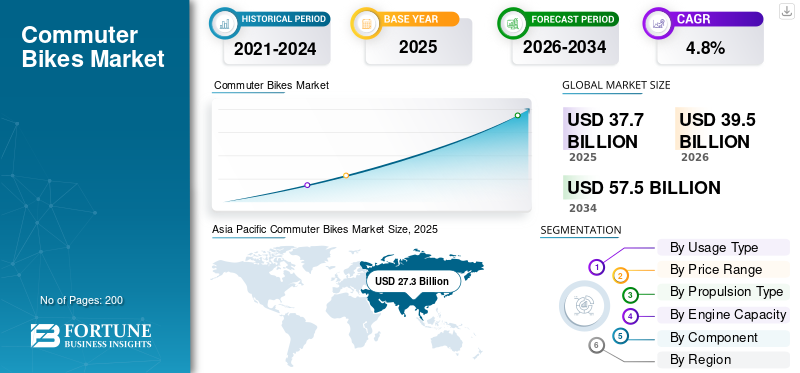
The commuter bikes market size was valued at USD 37.7 billion in 2025. The market is projected to grow from USD 39.5 billion in 2026 to USD 57.5 billion by 2034, with a CAGR of 4.8% over the forecast period. Asia Pacific dominated the commuter bikes market with a market share of 72.41% in 2025.
Commuter bikes are motorcycles designed for daily personal travel, office commuting, running errands, and short- to medium-distance mobility. They prioritize fuel efficiency, affordability, low maintenance, durability, comfort, and easy handling over high-speed performance or recreational riding. The market growth is driven by rising demand for affordable mobility, increasing traffic congestion, fuel efficiency needs, and growing urban and semi-urban travel. Expanding delivery services, replacement demand, financing availability, and adoption of electric commuter motorcycles further support demand for commuter bikes across emerging and price-sensitive markets.
Major players in the market include Honda Motor Co. Ltd., Hero MotoCorp Ltd., Yamaha Motor Co., Ltd., Bajaj Auto Ltd., TVS Motor Company Ltd., and Suzuki Motor Corporation. These companies are focusing on fuel-efficient engines, electric commuter motorcycles, connected features, safety upgrades, and 100cc-200cc model expansion.
Download Free sample to learn more about this report.
COMMUTER BIKES MARKET TRENDS
Shift Toward Feature-Rich 125cc Motorcycles is a Major Market Trend
Commuter motorcycle buyers are shifting from basic low-cost models toward feature-rich 100cc–150cc motorcycles with LED lighting, digital clusters, improved styling, better braking, and connected features. This trend is strong in India, Southeast Asia, Latin America, and Africa, where young riders demand fuel efficiency with better design and convenience. OEMs are upgrading mass-market platforms instead of only launching premium motorcycles, helping retain the market expansion affordability while increasing product value. In August 2025, Honda announced prices for the all-new CB125 Hornet and Shine 100 DX in India.
MARKET DYNAMICS
MARKET DRIVERS
Download Free sample to learn more about this report.
Rising Need for Affordable Daily Mobility Fuels Market Growth
Commuter bikes market growth is supported by the need for low-cost personal transport, daily work travel, semi-urban mobility, and last-mile commercial movement. In many emerging countries, commuter motorcycles remain more affordable than cars and highly flexible than public transport, especially where road congestion and income constraints are high. Strong two-wheeler sales also support replacement demand, spare parts consumption, and OEM production planning. In October 2025, SIAM reported India’s two-wheeler domestic sales reached 2,210,727 units for the month.
MARKET RESTRAINTS
Safety Compliance Costs Restrict Entry-Level Affordability and Hampers Market Expansion
Entry-level commuter motorcycles are highly price-sensitive, so mandatory safety upgrades can raise purchasing prices and delay adoption among first-time buyers. ABS, improved braking systems, emission-compliant engines, and helmet mandates improve rider safety but add cost pressure for OEMs and consumers. This restraint is more visible in below-125cc motorcycles, where even small price increases can affect rural and low-income demand. In June 2025, India’s road ministry announced draft rules mandating ABS for all two-wheelers manufactured from January 1, 2026.
MARKET OPPORTUNITIES
Flex-Fuel Commuter Motorcycles Create New Growth Opportunity for Market
Alternative fuel-compatible commuter motorcycles create opportunity in markets promoting ethanol blending, fuel import reduction, and lower-emission mobility. Flex-fuel models can help OEMs extend the life of ICE commuter platforms while meeting cleaner mobility goals without depending only on battery-electric adoption. This is particularly relevant in countries where charging infrastructure is still developing, but ethanol supply chains are expanding. In June 2026, Hero MotoCorp unveiled flex-fuel-ready Splendor+ and HF Deluxe motorcycles compatible with E20 to E85 ethanol blends.
MARKET CHALLENGES
Balancing Electrification Investment and Mass-Market Pricing Challenges Market Expansion
Manufacturers must invest in electric commuter motorcycles, battery systems, software, charging partnerships, and new platforms while protecting the affordability that defines the commuter sector. This creates a challenge as mass-market buyers expect low upfront cost, long range, easy serviceability, and strong resale value. OEMs also need to avoid weakening ICE commuter sales while preparing for electric demand. In October 2025, Hero MotoCorp unveiled VIDA Concept Ubex, its first global electric motorcycle concept built on a modular platform with smart connectivity.
Segmentation Analysis
By Usage Type
Daily Mobility and Practical Urban Travel Leads to Personal Commuting Segment Dominance
Based on usage type, the market is segmented into personal commuting and commercial/delivery use.
The personal commuting segment dominated the market in 2025 as commuter bikes are widely used for daily commutes, running errands, school trips, short-distance office travel, and affordable personal transportation. The segment benefits from low ownership cost, easy parking, health benefits, and suitability for congested urban routes.
The commercial/delivery use segment is projected to grow at a CAGR of 7.9% over the forecast period. It is the fastest-growing segment, supported by last-mile delivery, courier movement, food delivery, and e-cargo bike adoption.
By Price Range
Affordability and Mass Urban Mobility Drives Below USD 1,500 Segment Growth
Based on price range, the market is segmented into below USD 1,500, USD 1,500-3,000, and above USD 3,000.
The below USD 1,500 segment led the market in 2025 as commuter bikes in this range meet the core need for affordable daily commutes, running errands, and basic personal transportation. Strong adoption is supported by price-sensitive users, students, workers, and urban riders preferring low-maintenance standard bikes over higher-priced electric or connected models.
The above USD 3,000 segment is projected to grow at a CAGR of 6.1% over the forecast period. It is the fastest-growing segment, supported by premium electric bikes, cargo bikes, connected features, and higher battery capacity.
By Propulsion Type
Established Affordability and Range Reliability Sustains ICE Segment Demand
Based on propulsion type, the market is segmented into ICE and electric.
The ICE segment held the highest commuter bikes market share in 2025 due to wider availability, lower upfront pricing, familiar maintenance, and strong suitability for daily commutes, running errands, and personal mobility in price-sensitive sectors. Conventional commuter bikes remain preferred where charging access, battery replacement cost, and range confidence limit electric adoption. Established retail networks and replacement demand further support ICE models across urban and semi-urban users.
The electric segment is projected to grow at a CAGR of 15.8% over the forecast period. It is the fastest-growing segment, reinforced by lower running costs, urban sustainability policies, and e-bike incentives.
By Engine Capacity
Balanced Mileage and Practical Power Drives 100cc-150cc Segment Leadership
Based on engine capacity, the market is segmented into below 100cc, 100cc-150cc, 151cc-200cc, and above 200cc.
The 100cc-150cc segment dominated the market in 2025 due to its strong balance of affordability, fuel efficiency, durability, and daily-use performance. These commuter bikes suit office travel, rural mobility, running errands, and cost-sensitive ownership, while offering enough power for regular city and semi-urban routes. In 2025, Honda listed the SP 125 with a 123.94cc OBD2B-compliant engine and 60+ km/l mileage, supporting demand in this range.
The above 200cc segment is projected to grow at a CAGR of 9.0% over the forecast period and is the fastest-growing segment. This is supported by premium commuter demand, higher riding comfort, better braking, and stronger highway capability. In 2025, Bajaj listed the Pulsar NS400Z with a 373cc liquid-cooled engine and upgraded performance features.
To know how our report can help streamline your business, Speak to Analyst
By Component
Core Mechanical Value and Replacement Needs Leads to Engine & Powertrain Segment Growth
Based on component, the market is segmented into engine & powertrain, chassis & suspension, wheels, tires & braking system, and electrical, electronics & rider assistance.
The engine & powertrain segment dominated the market in 2025 as it represents the highest-value mechanical system in commuter bikes, covering motors, drivetrains, gears, cranks, chains, and transmission parts. These components directly affect ride efficiency, durability, maintenance cycles, and performance during daily commutes, running errands, and urban mobility.
The electrical, electronics & rider assistance segment is projected to grow at a CAGR of 8.0% over the forecast period. It is the fastest-growing segment, supported by e-bike motors, batteries, displays, app connectivity, anti-theft systems, ABS, and smart shifting.
COMMUTER BIKES MARKET REGIONAL OUTLOOK
By geography, the market is categorized into Europe, North America, Asia Pacific, South America, and Middle East & Africa.
North America
Asia Pacific Commuter Bikes Market Size, 2025 (USD Billion)
To get more information on the regional analysis of this market, Download Free sample
North America is projected to maintain steady growth in the global market, supported by rising preference for affordable short-distance mobility, growing e-bike adoption, and increasing use of bikes for daily commutes, running errands, and urban travel. The region benefits from higher fuel costs, traffic congestion, bike-sharing systems, and expanding cycling infrastructure across major cities. Mexico supports larger volume demand, while the U.S. and Canada contribute higher-value demand through electric bikes, hybrid bike models, and premium commuter bike formats.
U.S. Commuter Bikes Market
The U.S. market is estimated to reach USD 0.39 billion in 2026, supported by rising adoption of electric bikes, hybrid bike models, and practical urban mobility solutions. Demand is driven by daily commutes, running errands, bike-sharing programs, sustainability goals, and consumer preference for low-emission alternatives in congested cities.
Europe
Europe is expected to show consistent growth in the market, supported by strong cycling culture, high fuel prices, urban low-emission policies, and well-developed cycling infrastructure. Demand is further supported by electric bikes, folding bikes, hybrid bike formats, and standard commuter bikes used for daily commutes and short-distance city mobility. Countries such as Germany, France, Italy, the U.K., and the Netherlands continue to invest in cycling-friendly transport systems. At the same time, premium pricing and mature adoption keep regional growth stable during the forecast period.
U.K. Commuter Bikes Market
The U.K. market is projected to reach USD 0.24 billion in 2026, supported by rising use of folding bikes, electric bikes, and hybrid bikes for daily commutes. Integration with rail travel, low-emission transport policies, congestion concerns, and urban cycling programs continues to support adoption among workers, students, and city riders.
Germany Commuter Bikes Market
Germany market will account for approximately 19.6% of the European market in 2026, supported by strong Motorcycle ownership, high-quality cycling infrastructure, and demand for premium electric commuter bikes. Consumers prefer durable models with upright riding positions, safety features, and reliable components, while sustainability policies continue to strengthen the demand for commuter bikes.
Asia Pacific
Asia Pacific holds a leading position in the market, supported by dense urban populations, cost-sensitive consumers, and rising demand for affordable daily mobility. China, India, Japan, South Korea, and Southeast Asia support regional expansion through standard commuter bikes, electric bikes, and delivery-oriented use. Growth is further supported by strong manufacturing capabilities, increasing urbanization, rising middle-class income, and government support for cleaner mobility. Asia Pacific market remains closely linked to affordability, convenience, and daily-use transport needs.
China Commuter Bikes Market
China will account for approximately 27.6% of the regional market in 2026, supported by strong electric bike adoption, local manufacturing scale, and urban short-distance mobility needs. Consumers use commuter bikes for daily commutes, running errands, and delivery applications, while battery improvements and connected features support higher-value product demand.
India Commuter Bikes Market
India is expected to register a CAGR of 5.7% during the forecast period, supported by growing urbanization, affordability needs, and demand for practical commuter bikes. Standard bikes remain widely used, while electric bikes are gaining adoption among students, workers, delivery riders, and consumers seeking economical mobility for daily commutes.
Japan Commuter Bikes Market
Japan’s market is estimated to reach USD 0.49 billion in 2026, supported by compact city mobility, electric-assist Motorcycles, and demand for reliable short-distance transport. Consumers prefer lightweight and comfortable models for station access, grocery trips, daily commutes, and urban travel, especially in dense metropolitan areas.
South America
South America is projected to expand steadily in the market, supported by rising need for affordable transportation, traffic congestion, and increasing use of bikes for personal and commercial mobility. Brazil, Argentina, and other markets are seeing demand from students, workers, delivery riders, and cost-conscious urban consumers. Electric bikes are gradually gaining traction, while standard commuter bikes remain important due to affordability. Fuel price sensitivity, urban density, and last-mile delivery needs continue to support regional demand.
Brazil Commuter Bikes Market
Brazil will account for approximately 73.9% of the South America market in 2026, supported by its large urban population, expanding cycling culture, and growing use of bikes for daily commutes and delivery work. Affordability needs, traffic congestion, and the gradual adoption of electric bikes in major cities strengthen demand.
Middle East & Africa
Middle East & Africa is expected to record steady growth in the market, supported by rising urban mobility needs, affordability concerns, and increasing use of bikes for short-distance travel and delivery services. South Africa shows higher-value demand through formal retail channels and gradual e-bike adoption, while the rest of the region remains driven by low-cost mobility needs. The market benefits from young urban populations, traffic challenges, and growing interest in practical alternatives for daily commutes, personal transportation, and commercial movement.
South Africa Commuter Bikes Market
South Africa is projected to grow at a CAGR of 5.0% during the forecast period, supported by urban commuting demand, fitness-oriented travel, and gradual adoption of electric bikes. Consumers increasingly use commuter bikes for daily commutes, short-distance personal travel, and city mobility, while premium models gain traction in major urban centers.
COMPETITIVE LANDSCAPE
Key Industry Players
Fuel Efficiency, Electrification, and Dealer Network Expansion Define Competitive Landscape
The commuter bikes market is fragmented, with Japanese, Indian, Chinese, and regional motorcycle manufacturers competing across entry-level, 100cc–150cc, 151cc–200cc, and electric commuter motorcycle categories. Key players such as Honda Motor Co. Ltd., Hero MotoCorp Ltd., Yamaha Motor Co., Ltd., Bajaj Auto Ltd., TVS Motor Company Ltd., Suzuki Motor Corporation, and Royal Enfield/Eicher Motors Ltd. compete through fuel-efficient engines, low ownership cost, durable platforms, attractive financing, and wide dealer networks. To gain an edge, companies are upgrading commuter motorcycles with LED lighting, digital clusters, CBS/ABS, fuel injection, electric variants, and connected features while keeping prices affordable. Export expansion, localized manufacturing, and aftersales service networks help strengthen presence across Asia, Latin America, and Africa. In May 2026, Hero MotoCorp launched the Super Splendor XTEC 2.0, upgrading its 125cc commuter motorcycle with refreshed styling and daily-use features.
LIST OF KEY COMMUTER BIKES COMPANIES PROFILED
- Honda Motor Co., Ltd. (Japan)
- Hero MotoCorp Ltd. (India)
- Yamaha Motor Co., Ltd. (Japan)
- Bajaj Auto Ltd. (India)
- TVS Motor Company Ltd. (India)
- Suzuki Motor Corporation (Japan)
- Royal Enfield / Eicher Motors Ltd. (India)
- Kawasaki Heavy Industries, Ltd. (Japan)
- Piaggio & C. SpA (Italy)
- BMW Motorrad / BMW AG (Germany)
- KTM AG / Pierer Mobility AG (Austria)
- CFMOTO (China)
- Italika (Mexico)
- Lifan Technology Group (China)
- Zongshen Industrial Group (China)
KEY INDUSTRY DEVELOPMENTS
- July 2026: Yadea showcased the Como full-suspension commuter e-bike at Eurobike 2026, expanding beyond its electric scooter and motorcycle base into the commuter Motorcycle category. The model reflects rising interest from major electric mobility manufacturers in comfortable, city-focused electric bikes for daily travel.
- May 2026: Suzuki Motorcycle India expanded its retail network in Punjab with its first Bhatinda dealership, taking total touchpoints to 1,245 across India. The company said the outlet would provide access to scooters, motorcycles, and after-sales services, improving customer reach for commuter and daily-use two-wheelers.
- March 2026: TVS Motor Company launched the all-new 2026 TVS Apache RTR 160 4V, adding a projector headlamp across variants. The launch supports TVS’s 160cc motorcycle portfolio, strengthening its position among young daily riders seeking commuter usability with stronger performance, updated lighting, and sport-oriented styling.
- January 2026: Honda announced the fixed-battery electric two-wheeled personal commuter Honda UC3 for Thailand and Vietnam, with sales starting in spring 2026. The model is positioned equivalent to a 110cc ICE motorcycle, while Honda also planned charging infrastructure development in major cities to support daily commuter motorcycle adoption.
- December 2025: Bajaj Auto updated the Pulsar 150 with an LED headlamp, LED blinkers, refreshed colors, and new graphics, with prices starting at USD 1,119.8. The update improves everyday visibility and reinforces Bajaj’s accessible performance positioning within India’s 150cc commuter and daily-use motorcycle category.
REPORT COVERAGE
The commuter bikes market analysis provides an in-depth study of the market size & forecast across all market segments included in the report. It contains details on market research dynamics and trends expected to drive the market during the forecast period. It offers information on rapid technological advancements, new product launches, key industry developments, strategic partnerships, and mergers & acquisitions. The market forecast provides a comprehensive competitive landscape, including the most significant global market shares, emerging opportunities, and profiles of key players.
Request for Customization to gain extensive market insights.
Report Scope & Segmentation
| ATTRIBUTE | DETAILS |
| Study Period | 2021-2034 |
| Base Year | 2025 |
| Estimated Year | 2026 |
| Forecast Period | 2026-2034 |
| Historical Period | 2021-2024 |
| Growth Rate | CAGR of 4.8% from 2026 to 2034 |
| Unit | Value (USD Billion) and Volume (Units) |
| Segmentation | By Usage Type, By Price Range, By Propulsion Type, By Engine Capacity, By Component, and By Region |
| By Usage Type |
|
| By Price Range |
|
| By Propulsion Type |
|
| By Engine Capacity |
|
| By Component |
|
| By Region |
|
Frequently Asked Questions
Fortune Business Insights says that the global market value stood at USD 37.7 billion in 2025 and is projected to reach USD 57.5 billion by 2034.
In 2025, the Asia Pacific market value stood at USD 27.3 billion.
The market is expected to grow at a CAGR of 4.8% from 2026 to 2034.
The ICE segment leads the market by propulsion type.
Rising demand for affordable mobility, increasing traffic congestion, fuel efficiency needs, and growing urban and semi-urban travel are the key factors driving the market.
Key market players include Honda Motor Co. Ltd., Hero MotoCorp Ltd., Yamaha Motor Co., Ltd., Bajaj Auto Ltd., TVS Motor Company Ltd., and Suzuki Motor Corporation.
The Asia Pacific region holds the largest share of the market.
North America, Europe, Asia Pacific, South America, and Middle East & Africa are considered in the market.



- 2021-2034
- 2025
- 2021-2024
- 200
-
(Offer valid till 30th Sep 2026)
Get 30-60 hrs Free Customization
Expand Regional and Country Coverage, Segments Analysis, Company Profiles, Competitive Benchmarking, and End-user Insights.




















-
US +1 833 909 2966 ( Toll Free )
-
Get In Touch With Us