Motorcycle Market Size, Share & Industry Analysis, By Motorcycle Type (Standard, Sports, Cruiser, Touring, and Others), By Propulsion Type (ICE and Electric), By Engine Capacity (Up to 200cc, 200cc to 400cc, 400cc to 800cc and More than 800cc) and Regional Forecast, 2026-2034
 Download Free Sample
(Offer valid till 30th Sep 2026)

Motorcycle Market Size & Future Outlook
 Listen to Audio Version
The global motorcycle market size was USD 75.46 billion in 2025 and is projected to grow from USD 78.58 billion in 2026 to USD 118.90 billion by 2034, exhibiting a CAGR of 5.31% during the forecast period. Asia-Pacific dominated the motorcycle industry with a market share of 51.85% in 2025. The industry growth is driven by urban mobility demand, rising disposable income, electric two-wheeler adoption, premium segment expansion, and evolving commuter transportation preferences.
The motorcycle market in the U.S. is projected to grow significantly, reaching an estimated value of USD 8.76 billion by 2032, driven by the increase in year-on-year sales volume and consumer inclination towards recreational and power sports activities post-pandemic.
A motorcycle is a two-wheeled automobile powered by a motor without pedals. They are designed for higher speeds and have high-speed handling characteristics and better acceleration. These are capable of slow urban commutes or highway speeds and even beyond. They have an engine attached to the middle of the frame rather than sitting on the rear suspension, and a gas tank placed above it. Most of them have 100cc or even lower engines, and the maximum capacity also exceeds 1000 and further. The driver sits astride the vehicle engine with the gas tank in front.
The motorcycle market is entering a structural transition phase shaped by urbanization, income growth, electrification, and evolving mobility preferences. Two-wheelers continue to play a central role in commuter transportation, particularly in emerging economies where affordability and fuel efficiency remain decisive purchase factors. At the same time, developed markets are witnessing premiumization and technology-led differentiation.
Motorcycle market size expansion is supported by increasing urban congestion, rising fuel costs, and demand for cost-efficient personal mobility. Standard and commuter motorcycles dominate volume sales, particularly in Asia-Pacific and Latin America. However, sports, cruiser, and touring motorcycles contribute disproportionately to revenue in North America and Europe due to higher average selling prices.
Motorcycle market share remains concentrated among established manufacturers with strong distribution networks and localized production capabilities. Japanese and Indian manufacturers retain significant global presence, while European brands maintain strength in premium categories. Competitive intensity is increasing with the emergence of electric motorcycle manufacturers targeting both commuter and performance segments.
Motorcycle market trends highlight electrification, digital connectivity, and advanced rider assistance systems. Electric motorcycles are gaining traction in urban environments due to regulatory incentives and infrastructure expansion. Meanwhile, premium segments benefit from lifestyle positioning and customization demand.
Motorcycle market growth is expected to remain stable over the forecast period, driven by sustained demand in developing economies and gradual electrification in mature markets. Regional adoption patterns vary significantly, but motorcycles remain integral to personal mobility ecosystems. Long-term growth prospects depend on regulatory alignment, battery cost reduction, and continuous innovation in safety, connectivity, and performance features across global two-wheeler markets.
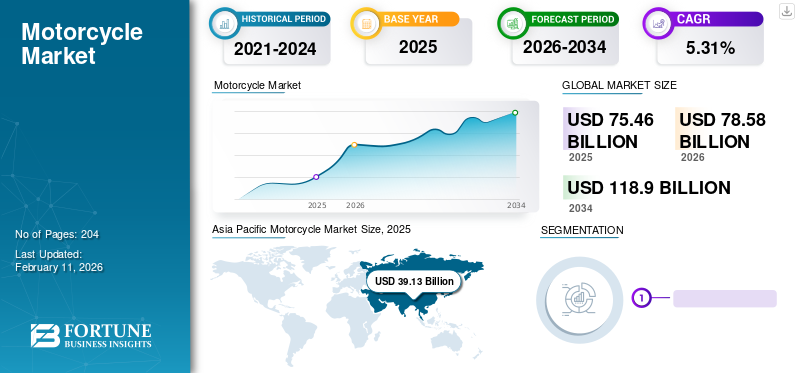
Download Free sample to learn more about this report.
Motorcycle Market Key Takeaways
 Market Size & Forecast
- 2025 Market Size: USD 75.46 billion
- 2026 Market Size: USD 78.58 billion
- 2034 Forecast Market Size: USD 118.90 billion
- CAGR: 5.31% from 2026–2034
 Market Share
- Asia Pacific dominated the motorcycle market with a 51.85% share in 2025.
- The standard segment is expected to hold the largest market share of 31.71% in 2026.
- The ICE segment is projected to dominate the market with an 89.53% share in 2026.
 Key Regional Highlights
Asia Pacific
Asia Pacific reached USD 39.13 billion in 2025 and is projected to reach USD 40.98 billion in 2026, driven by strong demand in China and India.
Europe
Europe accounted for 26.69% share in 2025, valued at USD 19.85 billion.
North America
North America accounted for USD 9.60 billion in 2025 (12.72% share), supported by strong demand for premium motorcycles.
U.S.
The market is projected to reach USD 5.15 billion by 2026, fueled by demand for cruiser and touring motorcycles.
Japan
The market is projected to reach USD 2.73 billion by 2026, supported by growing demand for electric and commuter motorcycles.
Read More

Motorcycle Market Trends
Electric Motorcycles are the Preferred Mode for a Sustainable Future
As the world gradually focuses on reducing fossil fuel use, larger two-wheeler companies are launching electric motorcycles. Based on this scenario, it can be analyzed that the future of such vehicles will be electric. Therefore, the focus will be more on electric vehicles in the future. The first wave of electric models was costly, and their riding ability was very restricted. However, futuristic vehicle brands such as Damon have made motorbike technology breakthroughs. As a result, many predictions of motorbike technology became a reality in 2023. Many companies are working on alternative fuel and battery technology to add to conventional fuel motorcycles.
- For instance, in January 2024, Bajaj Auto announced it was developing a portfolio of CNG motorcycles by the next fiscal under a new brand. The company has urged the government to reduce GST on CNG bikes to 12% to promote their adoption. These motorcycles will target mileage-conscious consumers and will have a special tank for both petrol and CNG fuel options. The company aims to promote electric vehicles alongside CNG options.
The adaptability of AI for every rider, Vehicle-to-vehicle (V2V) communication, and changes in ergonomic designs are drastically changing the two-wheeler world. Moreover, governments of various countries are making additional efforts to encourage the use of eco-friendly vehicles by supporting the purchase of electric motorcycles and scooters in terms of incentives and tax benefits.
- For example, in June 2019, the Indian government announced a plan to reduce the Goods and Services Tax (GST) for electric vehicles from 12% to 5% to accelerate the adoption of electric vehicles. Also, the plan proposes to sell only electric bikes from March 2025 onwards.
Furthermore, infrastructure facilities such as the government's installation of charging stations across countries significantly boost the adoption of electric models, thereby propelling the motorcycle market share.
Electrification is a defining motorcycle market trend. Manufacturers expand electric product portfolios to comply with emission regulations and attract environmentally conscious consumers. Battery technology improvements gradually enhance performance and range. Premiumization continues across developed markets. Consumers increasingly demand advanced features, customization, and high-performance engines. Premium motorcycles command higher margins and strengthen brand positioning.
Digital connectivity integration is expanding. Bluetooth-enabled dashboards, navigation systems, and ride analytics improve user engagement. Connectivity supports differentiation in competitive markets. Advanced safety systems are gaining adoption. Anti-lock braking systems and traction control are becoming standard in multiple segments. Regulatory mandates accelerate this trend.
Lightweight materials and design innovation improve efficiency and handling. Manufacturers invest in aluminum frames and aerodynamic optimization. Urban mobility models influence product development. Compact electric motorcycles and scooters target city commuters and delivery operators.
Download Free sample to learn more about this report.
Motorcycle Market Growth Factors
Rapid Urbanization, Coupled with Urban Traffic Congestion, is Likely to Drive the Market Growth
Urban populations are rapidly growing. According to the United Nations Conference on Trade & Development (UNCTAD) statistical handbook, the proportion of the world's urban population increased from 51.6% in 2010 to 56.2% in 2020. The proportion of the urban population has increased rapidly over the last decade.
Urbanization over the past decade has been most definite in developing regions such as Asia and Oceania. Moreover, according to the United Nations (UN) Department of Economic and Social Affairs, by 2050, almost 68% of the world's population is expected to live in urban areas. Problems with this rapidly growing urbanization include high population density, road congestion, lack of parking spaces, inadequate mobility infrastructure, and climate change.
Therefore, in both developed and developing countries, road congestion, lack of parking spaces, and other problems related to urbanization have increased the demand for motorcycles and compact mobility solutions such as two-wheeled vehicles. It is likely to spur market growth in the coming years. Emerging markets in the Asia Pacific region, such as India, where urbanization is increasing at an average annual rate of around 3%, with a significant increase in metropolitan areas, are expected to accelerate market growth during the forecast period.
Urbanization is the primary driver of the motorcycle market. Rapid population growth in cities increases congestion and limits parking availability. Motorcycles offer compact, fuel-efficient mobility solutions, particularly in densely populated regions. Rising disposable income in emerging economies further supports motorcycle market growth. Expanding middle-class populations increase demand for personal transportation and lifestyle-oriented two-wheelers. Entry-level and mid-capacity motorcycles benefit from this demographic shift.
Fuel efficiency advantages strengthen motorcycle demand. Compared to passenger vehicles, motorcycles offer lower operating costs. This cost advantage remains relevant amid fluctuating fuel prices. Expansion of ride-sharing and delivery services also drives demand. E-commerce growth increases last-mile delivery requirements. Motorcycles and scooters are widely used for urban logistics due to maneuverability and lower acquisition costs.
Market Restraints
Rising Safety Concerns Regarding Riding Two-Wheelers are Expected to Limit the Market Growth
Four-wheelers such as sedans, SUVs, and other cars provide more comfort, safety, and convenience than two-wheelers. Therefore, the populace prefers four-wheelers for long-distance rides. For instance, four-wheelers are equipped with various safety devices such as airbags, anti-lock braking systems, lock braking systems, seat belts, and other safety equipment, ensuring the driver's and passengers' safety. In contrast, two-wheelers have the least protective features for the occupants, with minimal inbuilt safety-related parts and devices. Hence, raising safety concerns regarding riding two-wheelers is hindering the market growth in the future.
In addition, an increasing number of accident cases involving two-wheelers is further anticipated to negatively impact global two-wheeler sales.
- For instance, according to the National Crime Records Bureau (NCRB), in India, the share of two-wheeler occupants' deaths was 20.7% of total road deaths in 2009, which reached roughly 38% in 2019.
The data also mentions that in 2009, fatalities of two-wheeler occupants were 26,219, whereas in 2019, the number increased to 58,747. Therefore, the rising fatalities due to two-wheeler accidents generate safety concerns among the populace, further limiting the market growth. Safety concerns represent a significant restraint in the motorcycle market. Higher accident rates compared to passenger vehicles influence regulatory scrutiny and insurance costs. Stringent safety requirements can increase production expenses.
Economic volatility affects discretionary purchasing. Premium motorcycles are particularly sensitive to consumer confidence levels. Economic downturns can reduce demand in higher-value segments. Emission regulations also pose challenges. Stricter environmental standards require engine redesign and compliance investment. Smaller manufacturers may struggle to absorb these costs.
Electric motorcycle adoption faces infrastructure limitations. Charging network availability remains inconsistent in certain regions. Battery cost and limited range affect consumer acceptance. Raw material price volatility impacts manufacturing margins. Steel, aluminum, and battery materials are subject to global supply fluctuations. These cost pressures influence pricing strategies.
Market Opportunities:
Emerging markets present substantial opportunities within the motorcycle market. Rising urbanization and income growth create long-term demand for affordable mobility solutions. Localized production enhances competitiveness. Electric motorcycle expansion offers transformative potential. Falling battery costs and improved energy density support broader adoption. Government incentives accelerate infrastructure development.
Premium segment growth provides additional revenue expansion. Customization, touring, and performance categories attract high-value consumers in developed markets. Aftermarket services represent a recurring opportunity. Parts, accessories, and maintenance contribute significant revenue beyond initial vehicle sales.
Motorcycle Market Segmentation Analysis
By Motorcycle Type Analysis
Ideal Combination of Design, Riding Posture, and Fuel Economy Makes the Standard Type Dominant in the Market
Based on type, the market is classified into standard, sports, cruiser, and touring.
Standard
The standard segment is expected to hold the largest share of 31.71% in 2026. of the global market. The standard type is the oldest style. They use advanced technology and a classic design to adjust the rider comfortably. India and Japan's industries are the major contributors to the global industry due to the presence of prominent two-wheeler companies. Besides, there is a huge market for lower-capacity (less than 300 cc) models, mainly concentrated in African and Asian countries, while produced in India and China. The affordable pricing of the standard type is expected to fuel the market demand for these vehicles.
Standard motorcycles account for the largest volume share within the motorcycle market. These models prioritize practicality, affordability, and fuel efficiency. They dominate demand in Asia-Pacific, Africa, and Latin America, where motorcycles serve as primary transportation. Low maintenance cost and high resale value support adoption. Manufacturers compete aggressively in pricing and distribution. Standard motorcycles significantly influence the global motorcycle market share due to scale-driven production and localized assembly strategies.
Sports bikes are a high-performance-oriented category of motorbikes that feature a powerful engine and a lightweight body frame.
Cruiser
Cruiser bikes are usually designed for comfortable and relaxed riding with an upright position and powerful engines with loads of low-end torque. The increase in income level, a growing trend for high-performance and long-distance models, and the increasing off-roading and sports activities have fueled the demand for sports and cruiser bikes, especially among the young population across the globe.
Cruiser motorcycles emphasize comfort, torque-focused engines, and lifestyle appeal. This segment is prominent in North America and select European markets. Customization potential enhances brand loyalty and aftermarket activity. Although volume is moderate, average selling prices remain high.
Sports
Sports motorcycles represent a smaller volume segment but contribute strong revenue margins. Performance-oriented engines, advanced braking systems, and aerodynamic design differentiate this category. Demand is concentrated in North America, Europe, and parts of Southeast Asia. Brand positioning and aspirational value strongly influence purchasing behavior. Technological innovation drives product refresh cycles.
Touring
Touring motorcycles are designed for long-distance travel. Integrated luggage systems, ergonomic seating, and advanced infotainment systems define this category. Demand remains stable but regionally concentrated.
To know how our report can help streamline your business, Speak to Analyst
By Propulsion Type Analysis
Infrastructure and Ease of Availability Propel the ICE Segment to Hold the Largest Market Share
Internal Combustion Engine (ICE)
The ICE segment is projected to dominate the market with a share of 89.53% in 2026. Based on the propulsion type, the market is segmented into ICE and electric-propelled motorcycles. The internal combustion engine (ICE) segment accounts for the largest global market share owing to its wide usage across regions. The IC engine-based models have deep penetration in the global market and comprise a large portfolio of conventional fuel offerings, which have helped prominent companies gain a significant market share worldwide. Every day, more than 2 million petrol-fueled vehicles are involved in courier services, running on roads throughout the day. In addition, with the opening of many food and beverage stores in major tier 1 and tier 2 cities, the demand for fast and convenient transportation methods continues to grow, which provides an opportunity for motor companies to offer transportation methods that are low-maintenance and cost-effective.
Electric
The growth of the electric motorcycle market is also gaining high demand and is expected to be the future of the two-wheeler industry. This development is attributed to the rapidly growing vehicular emission concerns and increasing air pollution awareness. Also, the increased investments by government agencies in developing electric vehicle charging infrastructure are expected to create more opportunities for the growth of the electric model market. Moreover, prominent market players are working to develop electric models with maximum torque and high power to adapt to the expanding market trend of high-performance and long-distance riding.
Electric motorcycles represent the fastest-growing propulsion segment. Urban mobility policies and emission regulations support adoption. Lower operating costs and government incentives enhance attractiveness. Battery cost reduction remains critical to scalability. Electric models increasingly influence motorcycle market trends, particularly in metropolitan areas.
By Engine Capacity Analysis
Affordable and Fuel-Efficient Nature Makes up to 200cc Segment Dominate the Market.
Based on the engine capacity, the market is segmented into up to 200cc, 200cc to 400cc, 400cc to 800cc, and more than 800cc motorcycles.
The up to 200 cc segment is expected to lead the market, contributing 32.15% globally in 2026. Motorcycles in the Up to 200cc category contribute to the rising global motorcycle market by offering affordable and fuel-efficient options, particularly in emerging markets. In 2024, small-displacement bikes, such as the Honda CB Shine and Yamaha FZ-S V3, remained top sellers, showcasing the demand for economical transportation solutions. Their accessible price points make them appealing choices for first-time buyers and riders in emerging markets, contributing significantly to market growth and thus dominating the segmental market.
The 200cc to 400cc motorcycles segment bolsters the global market with versatile and capable mid-sized bikes, making it the fastest-growing segment. In 2024, models such as the Bajaj Pulsar NS200 and KTM Duke 390 saw increased sales, appealing to riders seeking a balance of performance and affordability for daily commuting and leisure riding.
The 400cc to 800cc category plays a crucial role in driving the global market forward by catering to riders seeking enhanced performance and touring capabilities. Also, the more than 800cc segment contributes to the growth of the global motorcycle market by appealing to enthusiasts and affluent riders seeking premium performance and luxury. Their high-performance capabilities and iconic designs appeal to riders seeking top-of-the-line motorcycles, driving market expansion in the premium segment. Both segments contributed significantly to the market.
REGIONAL INSIGHTS
Asia Pacific Motorcycle Market Size, 2025 (USD Billion)
To get more information on the regional analysis of this market, Download Free sample
Increasing Adoption of Electric Vehicles to Propel the Market Growth in the Asia Pacific
Asia Pacific
Asia Pacific dominated the market with a valuation of USD 39.13 billion in 2025 and is projected to reach USD 40.98 billion in 2026. Asia Pacific will share the maximum market share in 2022. The Asia Pacific region dominates the global market owing to high demographic growth, a larger number of middle and lower-middle-class populations, and an increasing inclination towards a private mode of transportation over public transport in this region. The Indian industry is one of the largest markets, accounting for a significant share of global motorcycle sales. The Indian government is also taking initiatives such as FAME-II to provide subsidies and tax exemptions to consumers to encourage the use of electric two-wheelers in the country. Moreover, the high sales and production in China, the increasing demand for affordable electric models for short commutes in developing economies, and the government promoting electric two-wheelers are expected to boost the Asia Pacific market during the forecast period. The Japan market is projected to reach USD 2.73 billion by 2026, the China market is projected to reach USD 14.27 billion by 2026, and the India market is projected to reach USD 10.63 billion by 2026.
North America Motorcycle Market Analysis:
In 2025, North America held 12.72% of the global market share, reaching a valuation of USD 9.6 billion, and is projected to grow to USD 9.88 billion in 2026. of the global market owing to the great demand for an extensive range of sports, cruisers, and touring, propelling growth in this region. The U.S. market is projected to reach USD 5.15 billion by 2026. North America represents a high-value motorcycle market driven by cruiser, touring, and sports segments. Consumer preference for premium and lifestyle-oriented motorcycles shapes revenue distribution. Stable replacement cycles and strong aftermarket activity sustain growth. Electrification adoption is gradual but expanding in urban regions.
United States Motorcycle Market:
The United States dominates the regional motorcycle market with strong brand loyalty and premium segment concentration. Cruiser and touring motorcycles command substantial motorcycle market share. Electrification initiatives and customization trends support incremental growth. Economic conditions influence discretionary demand patterns.
Europe Motorcycle Market Analysis:
The market in Europe reached USD 19.85 billion in 2025, representing 26.69% of total market revenue, and is projected to reach USD 20.55 billion in 2026. The regional market is highly lucrative for OEMs due to the adoption of advanced technologies, highly advanced manufacturing hubs, and the increasing demand for various types of motorbikes. The U.K. market is projected to reach USD 2.99 billion by 2026, while the German market is projected to reach USD 5.92 billion by 2026.
Europe’s motorcycle market balances commuter demand with premium sports and touring segments. Emission regulations accelerate electric motorcycle adoption. Urban mobility policies influence purchasing behavior. Strong brand presence and export capability sustain regional motorcycle market growth.
German Motorcycle Market:
Germany emphasizes performance and touring motorcycles within the motorcycle market. Strong engineering capability supports premium positioning. Electric motorcycle adoption is growing in urban centers. Stable replacement demand sustains moderate growth.
United Kingdom Motorcycle Market:
The United Kingdom motorcycle market features sports and commuter segments. Urban congestion supports two-wheeler demand. Electrification incentives gradually influence purchasing decisions. Market growth remains steady.
Motorcycle Industry Competitive Landscape
The Reliability, Versatility, and Comfort Provided by Honda Motor Company have made it a Key Player in the Market.
Honda Motor Co., Ltd. is the world's largest two-wheeler manufacturer. The company is one of the leading manufacturers of internal combustion engines, with an annual production capacity of more than 14 million internal combustion engines. The total production volume of 2019 reached 400 million units. They envision being the leader in the advancement of mobility by developing the world’s first technologies and providing top-notch safety to riders. Moreover, other players, including Yamaha, Bajaj, and TVS Motors, are focusing on entering the electric vehicle market by introducing new production plants and converting existing motorcycles and scooters into electric vehicles.
The motorcycle industry's competitive landscape is characterized by established global manufacturers and emerging electric-focused entrants. Japanese and Indian manufacturers dominate the global motorcycle market share through scale-driven production and extensive distribution networks. European brands compete strongly in premium sports and touring segments. American manufacturers retain leadership in cruiser categories. Competitive differentiation focuses on engine performance, brand identity, pricing, and technological innovation.
Electric motorcycle startups increasingly influence motorcycle market trends. Strategic partnerships with battery suppliers and technology firms enhance product development capability. Traditional manufacturers are investing in modular electric platforms to maintain relevance. Aftermarket ecosystem strength influences brand loyalty. Parts, customization, and service networks create recurring revenue streams. Digital connectivity and advanced safety features are emerging as competitive differentiators.
LIST OF KEY COMPANIES PROFILED:
- Honda Motor Co., Ltd. ( Japan)
- TVS Motor Company Ltd. (India)
- Bajaj Auto Ltd. (India)
- Yamaha Motors Co. ( Japan)
- Suzuki Motor Corporation (Japan)
- Triumph Motorcycles (U.K.)
- Bayerische Motoren Werke (BMW) AG (Germany)
- Harley-Davidson, Inc. (U.S.)
- Hero MotoCorp Ltd. (India)
- Kawasaki Motors Corp (Japan)
KEY INDUSTRY DEVELOPMENTS:
- January 2024, Raptee Energy, an EV startup, showcased its high-voltage drive train featured at the Tamil Nadu Global Investor Meet (GIM). Along with a powerful drivetrain, it also has a top speed of 135km/hr and a range of 150 km. According to the company, it is set to be launched by April 2024.
- March 2023, Hero MotoCorp (India) collaborated with Zero Motorcycles (California, USA), with Hero MotoCorp investing up to USD 60 million in Zero. In this collaboration, Zero Motors will develop power trains with the scale of manufacturing, sourcing, and marketing of Hero MotoCorp's electric motorcycles.
- February 2023, Japanese motorcycle manufacturer Yamaha updated its entire two-wheeler range in India to the On Board Diagnostic (OBD-II) system from April 2023. Under this, the company will introduce a traction control system (TCS) in its 150cc offerings, namely the FZS-Fi V4 Deluxe, FZ-X, and MT-15 V2 Deluxe models, as standard safety equipment. According to the company, TCS will help control the ignition timing and fuel injection volume to avoid excessive slippage, ensuring efficient power delivery to the rear wheel and minimizing wheelspin, enabling better rider control of the vehicle, especially while cornering. The company also announced its gasoline offerings by the end of 2023.
- January 2023, India’s largest two-wheeler maker, Hero MotoCorp, announced the start of trial production of e20 fuel two-wheelers capable of taking any combination of e10 and e20. It has started commercial production trials for flex fuel motorcycles, which will be introduced in the 100-125 cc mass market
- January 2023, Bajaj Auto will be stepping into the premium two-wheeler segment by aspiring to manufacture higher displacement (above 390cc) KTM bikes for the domestic and global markets. The models will be considered in the production plan in the coming months.
REPORT COVERAGE
Request for Customization to gain extensive market insights.
The market research report provides detailed market analysis and focuses on many key aspects, such as leading companies, product types, and product applications. Besides this, the report offers insights into the market trends and highlights key industry developments. In addition to the factors above, the report encompasses several factors that have contributed to the growth of the market over recent years.
Report Scope & Segmentation
|
ATTRIBUTE |
DETAILS |
|
Study Period |
2021-2034 |
|
Base Year |
2025 |
|
Estimated Year |
2026 |
|
Forecast Period |
2026-2034 |
|
Historical Period |
2021-2024 |
|
Growth Rate |
CAGR of 5.31% from 2026 to 2034 |
|
Unit |
Value (USD billion) & Volume (Thousand units) |
|
Segmentation |
By Motorcycle Type
|
|
By Propulsion Type
|
|
|
By Engine Capacity
|
|
|
By Geography
|
Frequently Asked Questions
Fortune Business Insights research report says that the market is projected to reach USD 118.90 billion by 2034.
The market is expected to register a growth rate of (CAGR) 5.31% during the forecast period 2026-2034.
Rapid Urbanization Coupled with the Urban Traffic Congestion is Likely to Drive the Market Growth
Asia Pacific led the market in 2025.
Honda is the leading player in the market.



- 2021-2034
- 2025
- 2021-2024
- 204
-
(Offer valid till 30th Sep 2026)
Get 30-60 hrs Free Customization
Expand Regional and Country Coverage, Segments Analysis, Company Profiles, Competitive Benchmarking, and End-user Insights.




















Related Reports
-
US +1 833 909 2966 ( Toll Free )
-
Get In Touch With Us