Computational Chemistry Market Size, Share & Industry Analysis, By Component (Software and Services), By Technology (Molecular Mechanics, Quantum Chemistry, Molecular Dynamics, Docking & Virtual Screening, Cheminformatics, & Others), By Application (Drug Discovery & Lead Optimization, Molecular Property Prediction, Molecular Simulation & Analysis, Reaction Modelling & Mechanism Studies, Materials Science & Catalyst Design, & Others), By End User (Pharmaceutical & Biotechnology Companies, Academic & Research Institutes, & Others), and Regional Forecast, 2026-2034
 Download Free Sample
Computational Chemistry Market Size and Future Outlook
 Listen to Audio Version
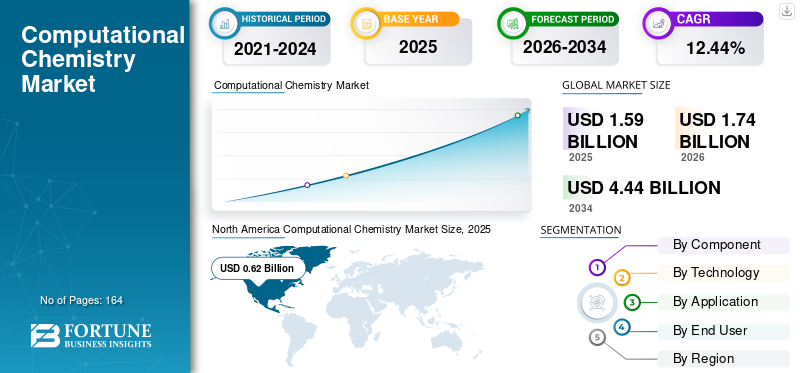
The global computational chemistry market size was valued at USD 1.59 billion in 2025. The market is projected to grow from USD 1.74 billion in 2026 to USD 4.44 billion by 2034, exhibiting a CAGR of 12.44% during the forecast period. North America dominated the computational chemistry market with a market share of 38.99% in 2025.
Computational chemistry utilizes computer-aided techniques to investigate the behavior, structure, properties, and interactions of molecules and materials. The market growth is fueled by the growing need for quicker and more economical drug discovery, increased application of virtual screening and simulations to lessen wet-lab workload, wider acceptance of cloud-based computational processes, and heightened incorporation of AI-powered molecular design and data-informed chemistry platforms.
Key players include Schrödinger, Inc., Dassault Systèmes, Chemical Computing Group ULC., and Q-Chem, Inc. These firms are concentrating on molecular modeling and simulation platforms, quantum chemistry and materials modeling tools, docking and virtual screening solutions, cloud-based molecular design environments, and comprehensive cheminformatics workflows for users in pharmaceuticals, biotechnology, academia, and industrial chemistry.
Download Free sample to learn more about this report.
Computational Chemistry Market Key Takeaways
 Global Market Size & Forecast
- 2025 Market Size: USD 1.59 billion
- 2026 Market Size: USD 1.74 billion
- 2034 Forecast Market Size: USD 4.44 billion
- CAGR: 12.44% from 2026–2034
 Market Share
- North America dominated the computational chemistry market with a 38.99% share in 2025.
- Software segment held the leading market position due to broad workflow applications.
- Drug discovery & lead optimization accounted for the largest application share with 33.5% in 2026.
 Key Regional Highlights
North America
North America led the market with USD 0.62 billion in 2025, driven by strong pharmaceutical R&D and HPC investments.
Europe
Europe is growing steadily with increasing adoption of computational tools in pharma and materials research.
Asia Pacific
Asia Pacific is projected to reach USD 0.46 billion in 2026, supported by expanding biopharma and CRO/CDMO ecosystems.
U.S.
The U.S. market is projected at USD 0.62 billion in 2026, representing around 35.7% of global revenues.
Japan
The Japan market is estimated at USD 0.09 billion in 2026, accounting for around 5.4% of global revenues.
Read More

COMPUTATIONAL CHEMISTRY MARKET TRENDS
Increasing Integration of Artificial Intelligence is a Significant Trend Observed in Global Market
The growing integration of artificial intelligence represents a significant trend in the sector as firms transition from conventional simulation to AI-enhanced molecule design, optimization, and decision-making. AI accelerates screening cycles by quickly identifying promising compounds, enhancing molecular property predictions, and minimizing the required wet-lab experiments. It is enhancing the scalability of such platforms by integrating predictive models with cloud infrastructure, automation, and progressively agent-based workflows. This trend holds significant importance in drug discovery, as firms seek quicker hit identification, enhanced lead optimization, and improved prioritization of synthesis candidates. Recent scientific publications demonstrate an increasing interest in explainable AI for molecular design, indicating the market's transition to more reliable and practical AI-driven chemistry processes. These factors are supporting the overall global computational chemistry market growth.
- For instance, in February 2026, Evogene announced an expanded collaboration with Google Cloud to integrate advanced AI agents into its ChemPass AI platform for small-molecule discovery and optimization.
MARKET DYNAMICS
MARKET DRIVERS
Download Free sample to learn more about this report.
Accelerated Drug Discovery Research is Propelling Market Growth
Speeding up drug discovery is a key factor for the market as firms are compelled to find viable drug candidates more quickly and at reduced costs. Tools in computational chemistry assist researchers in conducting virtual screenings, modeling protein-ligand interactions, optimizing lead compounds, and forecasting molecular properties prior to engaging in costly wet-lab experiments. This decreases the quantity of compounds requiring synthesis and testing, accelerates early-phase discovery timelines, and enhances R&D efficiency. The driver is gaining strength as pharmaceutical and biotechnology firms more frequently merge physics-based modeling, cloud computing, and AI to accelerate hit identification and lead optimization. Schrödinger’s 2025 outcomes likewise endorse this trend, as the company announced USD 200 million in software earnings and sustained growth in hosted software use, indicating robust market demand for quicker computational discovery processes. All these factors cumulatively drive the overall market growth.
- For instance, in June 2025, IonQ announced results from a collaboration with AstraZeneca, AWS, and NVIDIA to develop a quantum-accelerated computational chemistry workflow for drug development. The results showed the demonstration achieved a 20 times speedup over previous demonstrations and highlighted its potential to design more efficient ways of producing pharmaceuticals.
MARKET RESTRAINTS
High Cost of Software to Limit Market Growth
The high cost of software is a major limitation for the global market growth, as sophisticated platforms for molecular modeling, quantum chemistry, simulation, and virtual screening frequently demand significant licensing fees, continuous maintenance, and often extra computing resources. This establishes a greater entry barrier for small biotech companies, research institutions, new ventures, and users in price-sensitive areas. Although organizations recognize significant scientific value, budget constraints may postpone adoption, limit the number of licenses acquired, or steer buyers toward more restricted tool usage rather than comprehensive platform implementation.
- For instance, Dassault Systèmes’ price terms update published in 2025, stated that the company applies past and next planned price revisions by licensee country. This is relevant as BIOVIA offerings, including chemistry and materials modeling software, sit within Dassault’s licensed-program pricing structure, so periodic price revisions can further increase the cost burden for customers already facing high software and support expenses.
MARKET OPPORTUNITIES
Shift Toward Digitalization in Chemical Manufacturing and Research to Offer Market Growth Opportunities
The move toward digitalization in chemical manufacturing and research is generating a significant opportunity for the computational chemistry sector, as chemical and materials firms are progressively utilizing simulation, molecular modeling, reaction analysis, and predictive design tools to minimize trial-and-error efforts in laboratories and production facilities. These instruments assist researchers in assessing formulations, catalysts, reaction routes, and material characteristics prior to physical testing, enhancing R&D speed, reducing development expenses, and facilitating more effective scale-up. The opportunity is expanding as organizations embrace digital workflows to enhance process comprehension, speed up new material discovery, and link chemistry research more effectively with manufacturing performance. This is particularly important in specialty chemicals, catalysts, polymers, batteries, and advanced materials, where digital models can reduce development times and enhance product quality. All these factors would drive the market growth in the coming years.
- For instance, in June 2025, Dassault Systèmes highlighted enhancements across microkinetic modeling, reaction workflows, classical mechanics, coarse-grained simulation, and materials informatics. These updates directly support the digitalization of chemical research and development by helping users model chemical behavior, optimize formulations, and analyze materials more efficiently in a virtual environment before moving to physical experiments or manufacturing steps.
MARKET CHALLENGES
Limited Number of Experts Trained in Computational Chemistry Pose a Prominent Challenge to Market Growth
The restricted number of experts skilled in computational chemistry poses a significant challenge for the market, as these tools demand a blend of chemistry understanding, molecular modeling abilities, data management, and software proficiency that is not commonly found in all organizations. Numerous pharmaceutical, biotech, academic, and industrial users can acquire software, yet they continue to struggle in locating qualified professionals who can accurately analyze simulations, enhance workflows, and convert computational results into actionable R&D choices. This delays adoption, lengthens implementation schedules, and frequently diminishes software use post-purchase. The challenge grows in significance as platforms advance and incorporate AI, cloud workflows, and multi-method modeling. Recent conversations in both industry and academia indicate that digital and computational skills are increasingly essential in chemistry, yet the talent pipeline is failing to meet the growing demand. All the factors cumulatively affect the market growth.
- For instance, in January 2025, The Royal Society of Chemistry stated in its workforce report that more chemical scientists are needed and warned that pressures on universities could weaken the future skills pipeline.
Segmentation Analysis
By Component
Broad Utility of Modeling Platforms Across Workflows Supported Software Segment Dominance
In terms of component, the market is divided into software and services.
The software segment dominated the global market in 2025. Software platforms are the core value-generating layer in computational chemistry, as they enable molecular modeling, docking, simulation, quantum chemistry, visualization, and data analysis within a single workflow. Moreover, software can be deployed across multiple projects and teams, which increases utilization and supports recurring licensing revenue. As pharma, biotech, and industrial users expand digital discovery programs, demand for integrated and scalable software tools continues to rise. Companies are also focusing on enhancing platform capabilities through AI, cloud delivery, and collaborative informatics, further increasing adoption of software.
- For instance, in January 2026, Schrödinger announced that Lilly’s TuneLab platform would be made available in LiveDesign, Schrödinger’s enterprise informatics software, to help biotech companies access AI-driven drug discovery workflows more efficiently.
The services segment is anticipated to rise with a CAGR of 10.99% over the forecast period.
To know how our report can help streamline your business, Speak to Analyst
By Technology
Wide Use in Structure Preparation and Energy Minimization Supported Molecular Mechanics Segment Dominance
Based on technology, the market is classified into quantum chemistry, molecular dynamics, molecular mechanics, docking & virtual screening, cheminformatics, and others.
The molecular mechanics segment led the global market in 2025. Molecular mechanics is commonly employed as it provides a rapid and efficient means to examine molecular structures, conformations, and interactions without the significant computational expense of more intricate techniques. It is frequently utilized in structure formation, energy reduction, conformational assessment, and initial molecular design, thus becoming a standard instrument in pharmaceutical, biotechnology, and academic processes. In comparison with alternative technologies, scaling for large molecules and high-throughput studies is simpler, facilitating wider commercial acceptance. Firms are enhancing force fields and simulation processes to boost precision and user-friendliness. Furthermore, the segment is set to hold 21.0% share in 2026.
- For instance, in June 2025, Dassault Systèmes released BIOVIA Materials Studio 2025 SP1, which included enhancements in classical mechanics and related simulation workflows.
The quantum chemistry segment is anticipated to rise with a CAGR of 11.85% over the forecast period.
By Application
Rising Need for Faster Candidate Selection Supported Drug Discovery & Lead Optimization Segment Dominance
On the basis of application, the market is divided into drug discovery & lead optimization, molecular property prediction, molecular simulation & analysis, reaction modelling & mechanism studies, materials science & catalyst design, biologics/protein-ligand modelling, toxicity/ADMET assessment, and others.
The drug discovery & lead optimization segment captured the largest global computational chemistry market share in 2025. This segment leads as it is most widely used to identify promising molecules, improve binding performance, and reduce the number of compounds that need to be synthesized and tested in the lab. It helps researchers screen large libraries, refine lead candidates, and make faster design decisions in early-stage drug development. Compared with other applications, it has stronger commercial demand from pharmaceutical and biotechnology companies, where speed, cost control, and better success rates are critical. Companies are also investing in advanced screening, predictive modeling, and AI-enabled design tools to strengthen this workflow. Furthermore, the segment is set to hold 33.5% share in 2026.
- For instance, in September 2025, Cadence Molecular Sciences (OpenEye) launched ROCS X, an AI-enabled molecular search solution designed to help scientists search trillions of drug-like molecules for virtual screening.
The biologics/protein-ligand modelling segment is anticipated to rise with a CAGR of 13.24% over the forecast period.
By End User
Higher Adoption of Advanced AI Systems in Acute Care Settings Led to Pharmaceutical & Biotechnology Segment Dominance
Based on end user, the market is segmented into pharmaceutical & biotechnology companies, academic & research institutes, chemical companies, CROs/CDMOs, and others.
The pharmaceutical & biotechnology companies segment dominated the market share in 2025. These companies are the largest users of computational chemistry as they depend on molecular modeling, docking, simulation, and property prediction tools to speed up drug discovery and improve lead selection. Compared with other end users, they have higher R&D spending, larger software budgets, and a stronger need for faster and more efficient molecule design. They also use these platforms across multiple stages of discovery, from hit identification to lead optimization and candidate selection. As pipeline pressure increases, pharma and biotech companies are investing more in digital and predictive chemistry workflows to reduce time, cost, and experimental risk. Furthermore, the segment is set to hold 59.0% share in 2026.
- For instance, in February 2025, Schrödinger announced an expanded research collaboration agreement with Otsuka Pharmaceutical Co., Ltd. to discover and develop novel therapeutics using Schrödinger’s computational platform.
In addition, CROs/CDMOs are projected to witness 12.96% growth rate during the forecast period.
Computational Chemistry Market Regional Outlook
By region, the market is divided into Asia Pacific, Europe, Latin America, North America, and the Middle East & Africa.
North America
North America Computational Chemistry Market Size, 2025 (USD Billion)
To get more information on the regional analysis of this market, Download Free sample
The North America market size attained USD 0.57 billion in 2024 and topped the worldwide market. In 2025, the area maintained its top spot, with USD 0.62 billion. North America dominated the global market due to strong pharmaceutical research infrastructure and large investments in high‑performance computing technologies.
U.S. Computational Chemistry Market
The U.S. market led the North American region and is projected to be approximately USD 0.62 billion in 2026, representing about 35.7% of the worldwide market.
Europe
Europe market size is anticipated to grow at 10.78% CAGR during the forecast period. Europe’s growth is supported by a strong academic research base, large pharmaceutical R&D investments, rising use of simulation in chemicals and materials science, and increasing collaboration between research institutes, biotech firms, and software providers.
U.K. Computational Chemistry Market
The U.K. market in 2026 is estimated at around USD 0.09 billion, representing roughly 5.3% of global revenues.
Germany Computational Chemistry Market
Germany market size is projected to reach approximately USD 0.10 billion in 2026, equivalent to around 6.0% of global sales.
Asia Pacific
The Asia Pacific market size is expected to reach a valuation of USD 0.46 billion by 2026. Expanding biopharma innovation, rapid growth of CRO/CDMO ecosystems, rising digitalization of drug discovery, improving research infrastructure, and growing adoption of cost-efficient computational tools are key growth drivers in this region.
Japan Computational Chemistry Market
The Japan market in 2026 is estimated at around USD 0.09 billion, accounting for roughly 5.4% of global revenues.
China Computational Chemistry Market
China’s market is projected to reach revenues of around USD 0.12 billion in 2026, representing roughly 7.1% of global sales.
India Computational Chemistry Market
The India market in 2026 is estimated at around USD 0.05 billion, accounting for roughly 2.9% of global revenues.
Latin America and Middle East & Africa
Latin America and the Middle East & Africa regions are anticipated to witness a slower growth over the study period. The market is growing due to increasing pharmaceutical research activity, gradual adoption of digital chemistry tools, rising academic and industrial interest in modeling and simulation, and improving access to cloud-based software platforms. The Latin America market in 2026 is estimated at around USD 0.08 billion.
In the Middle East and Africa region, the GCC market is projected to reach approximately USD 0.04 billion by 2026, representing about 2.1% of worldwide revenues.
COMPETITIVE LANDSCAPE
Key Industry Players
Major Players Focus on AI-Integrated Platforms and Hosted Software Models to Strengthen Market Position
The global market is moderately fragmented, with major players such as Schrödinger, Inc., Dassault Systèmes, Chemical Computing Group ULC, and Q-Chem, Inc. accounting for a notable share of market revenue. These companies are focusing on expanding molecular modeling, docking, simulation, and cheminformatics capabilities to improve discovery speed, workflow efficiency, and predictive accuracy. The market is also witnessing rising emphasis on AI-enabled molecular design, cloud/hosted software delivery, and integrated end-to-end platforms that support both drug discovery and materials research. In addition, strategic collaborations, product upgrades, and broader enterprise software adoption are helping companies strengthen their competitive positions over the forecast period.
Other significant participants include Jubilant Biosys Limited, Analytica Chemie, Certara, Acellera Therapeutics Inc., Cresset, and others. These companies are expected to prioritize new product innovation, collaborations & partnerships, and scalable data-platform development to improve their competitive positions over the forecast period.
- For instance, in December 2025, Cresset announced the latest release of Flare V11, highlighting new AI-driven efficiency gains in its digital molecular discovery platform to improve computational chemistry workflows and support faster decision-making in drug discovery.
LIST OF KEY COMPUTATIONAL CHEMISTRY COMPANIES PROFILED
- Schrödinger, Inc. (U.S.)
- Dassault Systèmes (France)
- Chemical Computing Group ULC. (Canada)
- Q-Chem, Inc. (U.S.)
- Cadence Design Systems, Inc. (U.S.)
- Jubilant Biosys Limited (India)
- Analytica Chemie (India)
- Certara (U.S.)
- Acellera Therapeutics Inc. (U.S.)
- Cresset (U.K.)
KEY INDUSTRY DEVELOPMENTS
- December 2025: Dassault Systèmes BIOVIA announced the release of BIOVIA Materials Studio 2026, continuing product advancement in computational chemistry and materials modeling workflows.
- December 2025: Dassault Systèmes BIOVIA announced the release of BIOVIA Discovery Studio 2025, continuing upgrades in molecular modeling, simulation, and AI/ML-supported drug discovery workflows.
- July 2025: Cresset announced the acquisition of Molab.ai, aimed at combining Cresset’s computational chemistry platform with Molab.ai’s AI technologies for molecular research and predictive ADME modeling.
- May 2025: Cresset announced updated Spark fragment databases and launched a new agrochemical-focused collection, expanding the searchable bioisostere space for molecular design projects.
- January 2025: Cadence announced that Cadence Molecular Sciences (OpenEye) is integrating NVIDIA BioNeMo NIM microservices with the Orion Molecular Design Platform to advance AI-driven molecular design workflows.
REPORT COVERAGE
The global market analysis includes a thorough evaluation of the market size and forecasts for every segment highlighted in the report. It offers insights into the market dynamics and trends expected to drive the market throughout the forecast period. It provides understanding of essential factors, including technological progress, product innovations, the regulatory environment, and the launch of new products. Additionally, it details partnerships, mergers & acquisitions, technological advancements, as well as key developments in the industry within the market. The global computational chemistry market forecast report also provides an in-depth competitive landscape, including information on market share and profiles of key active players.
Request for Customization to gain extensive market insights.
Report Scope & Segmentation
| ATTRIBUTE | DETAILS |
| Study Period | 2021-2034 |
| Base Year | 2025 |
| Estimated Year | 2026 |
| Forecast Period | 2026-2034 |
| Historical Period | 2021-2024 |
| Growth Rate | CAGR of 12.44% from 2026-2034 |
| Unit | Value (USD Billion) |
| Segmentation | By Component, Technology, Application, End User, and Region |
| By Component |
|
| By Technology |
|
| By Application |
|
| By End User |
|
| By Region |
|
Frequently Asked Questions
According to Fortune Business Insights, the global market value stood at USD 1.59 billion in 2025 and is projected to reach USD 4.44 billion by 2034.
In 2025, the market value stood at USD 0.62 billion.
The market is expected to exhibit a CAGR of 12.44% during the forecast period.
By component, the software segment is expected to lead the market.
The growing need for high performing computing and increasing drug discovery research are primarily driving market expansion.
Schrodinger, Inc., Dassault Systèmes, Chemical Computing Group ULC, and Q-Chem, Inc. are some of the prominent players in the global market.
North America dominated the market in 2025.



- 2021-2034
- 2025
- 2021-2024
- 164
Get 30-60 hrs Free Customization
Expand Regional and Country Coverage, Segments Analysis, Company Profiles, Competitive Benchmarking, and End-user Insights.













.webp)






Related Reports
-
US +1 833 909 2966 ( Toll Free )
-
Get In Touch With Us