Condensed Whey Market Size, Share & Industry Analysis, By Product Type (Sweet Condensed Whey, Unsweetened Condensed Whey, and Condensed Acid Whey), By Form (Liquid Condensed Whey and Semi-Solid / High-Viscosity), By Application (Food & Beverage, Animal Nutrition & Feed, and Industrial & Fermentation), and Regional Forecast, 2026-2034
 Download Free Sample
(Offer valid till 30th Sep 2026)

KEY MARKET INSIGHTS
 Listen to Audio Version
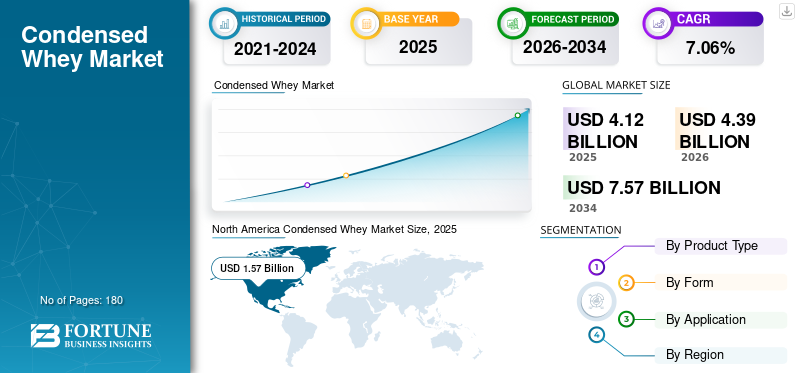
The global condensed whey market size was valued at USD 4.12 billion in 2025. The market is projected to grow from USD 4.39 billion in 2026 to USD 7.57 billion by 2034, exhibiting a CAGR of 7.06% during the forecast period. North America dominated the global condensed whey market with a market share of 38.11% in 2025.
Condensed whey is a concentrated liquid dairy ingredient derived from whey stream generated during cheese manufacturing. This product is made by removing water content from liquid sweet whey or acid whey resulting in increased total solids. It is rich in lactose, whey proteins, minerals, and organic acids which makes it suitable for food and beverage and animal feed usage. Growing usage of such ingredients in bakery, confectionery and dairy products is boosting demand.
Fonterra Co-operative Group, Lactalis Group, Arla Foods Ingredients, Dairy Farmers of America (DFA), and Saputo Inc. are some of the key players operating in this market. Capacity expansion is a key strategy adopted to support growth.
Download Free sample to learn more about this report.
Condensed Whey Market Key Takeaways
 Global Market Size & Forecast
- 2025 Market Size: USD 4.12 billion
- 2026 Market Size: USD 4.39 billion
- 2034 Forecast Market Size: USD 7.57 billion
- CAGR: 7.06% from 2026–2034
 Market Share
- North America dominated the market with a 38.11% share in 2025.
- Sweet condensed whey segment held the largest market share in 2025.
- Liquid condensed whey segment held the largest market share in 2025.
 Key Regional Highlights
North America
The market reached USD 1.57 billion in 2025 and is projected to reach USD 1.68 billion by 2026.
Asia Pacific
The market reached USD 1.14 billion in 2025 and is projected to reach USD 1.22 billion by 2026, driven by rising demand.
Europe
The market is projected to reach USD 1.10 billion by 2026, supported by advanced food manufacturing.
U.S.
The market is projected to reach USD 1.33 billion by 2026, driven by a strong cheese manufacturing industry.
Japan
The market reached USD 0.16 billion in 2025, supported by growing food and beverage demand.
Read More

CONDENSED WHEY MARKET TRENDS
Growing Usage of Demineralized Condensed Whey is a Key Market Trend
There is a growing demand for demineralized whey (low ash content), which is traditionally used in manufacturing infant formula and specialized nutritional products. Condensed whey manufacturers are developing new condensed demineralized whey that is used as an intermediate ingredient by food and beverages. The use of such products help to reduce manufacturing steps, lowers handling costs, and improves ingredient solubility. As suppliers have the ability to tailor the ingredients, they are suited for usage in high-value food and beverage products.
Download Free sample to learn more about this report.
MARKET DYNAMICS
MARKET DRIVERS
Cost Competitiveness and Ingredient Optimization Supports Market Growth
Condensed whey is a cost effective alternative of energy-intensive spray-dried products, making it substantially cheaper than powdered whey ingredients. As the product is affordable, it is suitable for adoption in mid-tier and large-scale processors in food and beverage and animal feed products. As manufacturers are facing pressure to generate higher profit margins they are increasingly incorporating condensed whey to manufacture their products. This makes condensed whey highly attractive for cost-optimized formulations and supports the condensed whey market growth.
MARKET RESTRAINTS
Short Shelf Life and High Microbial Sensitivity to Impede Market Growth
Condensed whey remains a high-moisture liquid ingredient and it is prone to bacterial growth, high enzymatic activity and can undergo spoilage during storage or transit. Such products require strong refrigeration infrastructure, and manufacturers need to rapidly utilize them due to their short life. This limits long-distance distribution, export opportunities, and increases operational costs for buyers, especially in warmer climates or regions lacking cold chain infrastructure. This severely impacts the demand for dairy based products and negatively impacts market growth.
MARKET OPPORTUNITIES
Alignment with Clean-Label and Minimal-Processed Food Products Fuel Growth Prospects
Condensed whey is a naturally manufactured ingredient as it undergoes minimal processing compared to dried whey powders. These products can be used by food manufacturers to develop cleaner, minimal processed ingredient based food products, therefore aligning with growing consumer demand for cleaner labels and natural products. This creates opportunity for the manufacturer to develop separate product lines which cater to the growing popularity of clean ingredient based food and beverages.
Segmentation Analysis
By Product Type
Sweet Condensed Whey is Highly Preferred Due to Mild Flavor and Versatile Application
By product type, the market is sub-segmented into sweet condensed whey, unsweetened condensed whey and condensed acid whey.
The sweet condensed whey segment accounts for the largest condensed whey market share. Such product type has a neutral or slightly sweet taste with low acidity, which makes it highly suitable for a wide range of food formulations.
The unsweetened condensed whey segment is expected to grow at a CAGR of 7.11% over the forecast period. Unsweetened condensed whey is a preferred ingredient in animal feed products due to its high lactose content, moderate protein and mineral levels with high digestibility. Animal feed manufacturers favor unsweetened condensed whey as a reliable, economical carbohydrate source leading to its growing popularity.
By Application
Food & Beverages Account for Major Market Share Due to Strong Usage Across Multiple Food Categories
By application, the market is classified into food & beverage, animal nutrition & feed and industrial & fermentation.
The food & beverage segment is expected to account for the largest market share in 2025. Condensed whey provides several technical and functional advantages in several food and beverage products such as browning and mallard reaction enhancement in baked products and confectionery, emulsification, gelation and thickening, flavor enhancement, and others. These capabilities help to reduce the need for multiple additives or stabilizers, therefore appealing to manufacturers seeking formulation efficiency.
Animal nutrition & feed is another major segment that is expected to grow by 7.12% during the forecast period. Whey protein is rich in lactose that acts as a rich source of protein for piglets, calves, young poultry, and enhances gut development and intestinal health in animals. Such benefits make whey an early-life feed ingredients making it a key reason for its high demand in animal nutrition products.
To know how our report can help streamline your business, Speak to Analyst
By Form
Strong Nutritional Value of Liquid Condensed Whey Contributes to its Higher Share
Based on form, the market is categorized into liquid condensed whey and semi-solid / high-viscosity.
Liquid condensed whey form accounted for the largest market share in 2025. It offers processors and manufacturers a highly economical, nutrient-rich ingredient which can be incorporated directly into multiple applications without the need for extensive processing or drying.
Semi solid / high viscosity form is another major category with a CAGR of 6.60% during the forecast period. It is suitable in different industries due to its functional performance, low moisture content and logistics cost in comparison to liquid whey.
Condensed Whey Market Regional Outlook
By geography, the market is categorized into Europe, North America, Asia Pacific, South America, and the Middle East & Africa.
North America
North America Condensed Whey Market Size, 2025 (USD Billion)
To get more information on the regional analysis of this market, Download Free sample
North America’s condensed whey market is estimated to reach USD 1.68 billion in 2026 and is the leading region. The U.S., Canada, and Mexico have a strong cheese manufacturing base, food processing infrastructure, with substantial demand for condensed whey in both food and feed sectors. This type is one of the most consistently used whey formats in the region.
U.S Condensed Whey Market
In 2026, the U.S. market is estimated to reach USD 1.33 billion. It is one of the leading manufacturers of cheese producers with high milk production by the dairy farmers of America globally therefore generating a huge volume of whey as a by-product. Hence the country has a well-developed condensed whey supply chain that supports a wide range of industrial applications in the country.
Europe
The market in Europe is estimated to reach USD 1.10 billion in 2026 and secure the position of the second-largest region. Europe’s food and beverage producers have advanced manufacturing systems that integrate condensed whey in food manufacturing leading to operational ease. This increases its popularity and usage across industrial bakeries, confectionery factories, and dairy blending plants. Moreover, European consumers and regulators emphasize the use of minimally processed natural ingredients and condensed whey meets these expectations leading to higher usage in European markets.
Germany Condensed Whey Market
Germany’s market in 2025 reached USD 0.22 billion, representing roughly 5.46% of global condensed whey market revenues.
U.K. Condensed Whey Market
The U.K. condensed whey market is projected to reach approximately USD 0.11 billion in 2025, equivalent to around 2.61% of global sales.
Asia Pacific
Asia Pacific’s condensed whey market was valued at USD 1.14 billion in 2025, and is also one of the fastest-growing markets. The regional market is estimated to reach USD 1.22 billion in 2026. Condensed whey offers lower cost than whey powder, lactose powder, or milk solids and provides exceptional functionality at a competitive price. As manufacturers in emerging markets opt for cost competitive products for their industries, condensed whey is attractive for mid-scale and mass-market manufacturers. Growing application-level demand for such products in China, India, South Korea and Southeast Asia, in food and beverage categories is also boosting the market growth.
India Condensed Whey Market
India’s market in 2025 is estimated at around USD 0.14 billion, accounting for roughly 3.41% of global market revenues.
China Condensed Whey Market
China’s condensed whey market is projected to be one of the largest, with 2025’s revenues touching USD 0.30 billion, representing roughly 7.24% of global sales.
Japan Condensed Whey Market
Japan in 2025 is estimated at around USD 0.16 billion, accounting for roughly 3.81% of global condensed whey market revenues.
South America and the Middle East & Africa
South America is expected to experience significant growth in this market as the region is set to record USD 0.27 billion in 2026. Over the forecast period, South America will witness a high growth in Brazil, Argentina, Uruguay, and Chile as they have strong cheese manufacturing infrastructure that generate whey as a by-product. This strong regional production helps to strengthen the availability and popularity of condensed whey.
The Middle East & Africa is another growing region and is expected to account USD 0.12 billion in 2026. Saudi Arabia, UAE, Egypt, Kenya, South Africa, and others import large quantities of dairy ingredients and have limited local dairy processing capacity which impacts market growth.
South Africa Condensed Whey Market
South Africa is estimated to grow at a rate of 6.48% as the region has a well-developed food processing industry wherein the demand of condensed whey product is high.
COMPETITIVE LANDSCAPE
Key Industry Players
Product Innovation and Capacity Expansion is Used by Companies to Increase Product Sales
The market exhibits a fragmented structure, with intense competition among market players. Product innovation is the key area where companies are investing and expanding their presence to meet the growing demand for condensed whey in the global market. Moreover, capacity expansion is another major initiative that is undertaken to strategically assess the markets and expand their production capacities in new territories.
LIST OF KEY CONDENSED WHEY COMPANIES PROFILED
- Fonterra Co-operative Group (New Zealand)
- Lactalis Group (France)
- Arla Foods Ingredients (Denmark)
- Dairy Farmers of America (DFA) (U.S.)
- Saputo Inc. (Canada)
- Leprino Foods Company (U.S.)
- FrieslandCampina Ingredients (Netherlands)
- Glanbia Nutritionals (Ireland)
- Kerry Group plc (Ireland)
- Hilmar Cheese Company, Inc (U.S.)
KEY INDUSTRY DEVELOPMENTS
- November 2024 – Arla Foods Ingredients launched a new whey protein hydrolysate named Lacprodan DI-3092 which provides high taste and lower bitterness when added in high-protein medical and functional nutrition products.
- April 2023 – Lactalis Group invested USD 32 million in a whey protein factory in the U.S. to boost its production of whey by 30%.
- January 2023 – Saputo Dairy Australia focused on enhancing its whey processing capabilities to meet surging export demand in Asia Pacific. The products are designed for infant formula, sports nutrition, and functional foods industries that align with growing demand for high-protein dairy ingredients.
- September 2021 – LACTALIS Ingredients developed an innovative sweet whey manufacturing process for its Flowhey sweet whey powder and manufacture high quality liquid whey.
- May 2021 – Saputo Inc. announced strategic acquisition of dairy alternatives and value-added ingredients segments manufacturers amounting USD 213 million that helps to modernize its dairy processing plants generating higher volumes of whey-derived ingredients.
REPORT COVERAGE
Request for Customization to gain extensive market insights.
Report Scope & Segmentation
|
ATTRIBUTE |
DETAILS |
|
Study Period |
2021-2034 |
|
Base Year |
2025 |
|
Estimated Year |
2026 |
|
Forecast Period |
2026-2034 |
|
Historical Period |
2021-2025 |
|
Growth Rate |
CAGR of 7.06% from 2026-2034 |
|
Unit |
Value (USD Billion) |
|
Segmentation |
By Product Type, Form, Application and Region |
|
By Product Type |
· Sweet Condensed Whey · Unsweetened Condensed Whey · Condensed Acid Whey |
|
By Form |
· Liquid Condensed Whey · Semi-Solid / High-Viscosity |
|
By Application |
· Food & Beverage · Animal Nutrition & Feed · Industrial & Fermentation |
|
By Geography |
North America (By Type, Form, Application, and Country)
Europe (By Type, Form, Application, and Country)
Asia Pacific (By Type, Form, Application, and Country)
South America (By Type, Form, Application, and Country)
Middle East & Africa (By Type, Form, Application, and Country)
· Rest of the Middle East & Africa (By Form) |
Frequently Asked Questions
Fortune Business Insights says that the global market value stood at USD 4.12 billion in 2025 and is projected to reach USD 7.57 billion by 2034.
In 2025, North Americas market value stood at USD 1.57 billion.
The market is expected to exhibit a CAGR of 7.06% during the forecast period of 2026-2034.
By application, the food and beverages segment led the global market in 2025.
Cost competitiveness and ingredient optimization drives market growth.
Fonterra Co-operative Group, Lactalis Group, Arla Foods Ingredients, Dairy Farmers of America (DFA), and Saputo Inc. are top players in the market.
North America held the largest market share in 2025.
Growing usage of demineralized condensed whey is the key trend influencing the market.



- 2021-2034
- 2025
- 2021-2024
- 180
-
(Offer valid till 30th Sep 2026)
Get 30-60 hrs Free Customization
Expand Regional and Country Coverage, Segments Analysis, Company Profiles, Competitive Benchmarking, and End-user Insights.



















Related Reports
-
US +1 833 909 2966 ( Toll Free )
-
Get In Touch With Us