Connected Construction Equipment Market Size, Share & Industry Analysis, By Equipment Type (Excavators, Loaders, Cranes, Bulldozers, and Others), By Application (Fleet Management, Remote Monitoring, Predictive Maintenance, and Others), By End User (Residential Construction, Commercial Construction, Industrial Construction, and Infrastructure), and Regional Forecast, 2026 – 2034
 Download Free Sample
Connected Construction Equipment Market Size and Future Outlook
 Listen to Audio Version
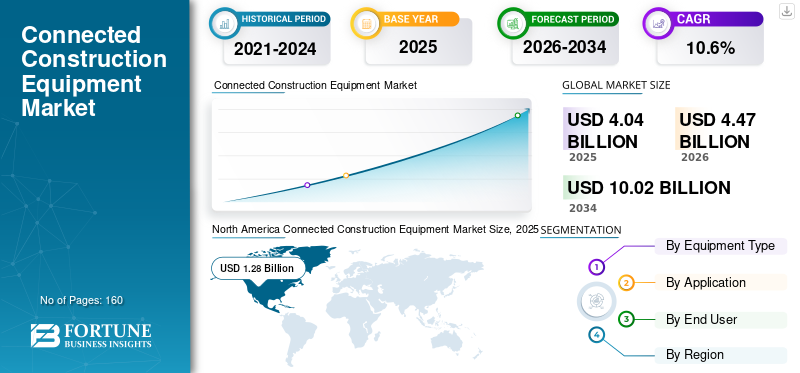
The global connected construction equipment market size was valued at USD 4.04 billion in 2025. The market is projected to grow from USD 4.47 billion in 2026 to USD 10.02 billion by 2034, exhibiting a CAGR of 10.6% during the forecast period. North America dominated the connected construction equipment market with a market share of 31.68% in 2025.
The connected construction equipment refers to the market for construction machinery and equipment integrated with digital connectivity technologies that enable real-time data exchange, remote monitoring, automation, predictive maintenance, fleet management, and operational optimization. The market is witnessing steady expansion as construction companies increasingly adopt connected technologies to enhance operational efficiency, equipment utilization, and project visibility. Growth is driven by rising infrastructure development, urbanization, and the growing integration of IoT, telematics, and AI in construction equipment. Connected solutions enable real-time data exchange, improved decision-making, and optimized fleet performance.
Key players such as Caterpillar, Komatsu, and Volvo Construction Equipment are actively developing advanced telematics and connectivity solutions to enhance equipment intelligence and operational efficiency. Over the long term, increasing emphasis on automation, digital construction practices, and data-driven project management is expected to support sustained market growth.
Download Free sample to learn more about this report.
CONNECTED CONSTRUCTION EQUIPMENT MARKET KEY TAKEAWAYS
 Market Size & Forecast
- 2025 Market Size: USD 4.04 Billion
- 2026 Market Size: USD 4.47 Billion
- 2034 Forecast Market Size: USD 10.02 Billion
- CAGR: 10.6% from 2026–2034
 Market Share
- North America dominated the connected construction equipment market with a 31.68% share in 2025.
- The excavators segment accounted for the largest market share in 2025.
- The fleet management segment held the largest market share in 2025.
 Key Regional Highlights
North America
North America led the market with a value of USD 1.28 billion in 2025.
Europe
Europe is projected to reach USD 1.21 billion in 2026, driven by smart construction technologies.
Asia Pacific
Asia Pacific is expected to reach USD 1.17 billion in 2026, supported by rapid infrastructure development.
U.S.
The market is estimated at USD 1.19 billion in 2026, driven by strong infrastructure investments.
Japan
The market is estimated at USD 0.17 billion in 2026, accounting for approximately 3.8% of global revenue.
Read More

CONNECTED CONSTRUCTION EQUIPMENT MARKET TRENDS
Increasing Adoption of IoT and Telematics Solutions is Enhancing Equipment Connectivity and Data-Driven Operations
The market is experiencing a significant shift toward the adoption of IoT and telematics technologies, enabling real-time tracking, performance monitoring, and data-driven decision-making across construction operations. These technologies allow companies to optimize equipment utilization, reduce downtime, and improve overall project efficiency. The integration of cloud platforms and analytics tools further enhances visibility into fleet operations and supports predictive insights. As construction projects become more complex and time-sensitive, demand for connected equipment solutions is expected to rise, driving innovation and adoption across both developed and emerging markets.
- For instance, Caterpillar’s Cat Connect platform provides advanced telematics and data analytics solutions to improve fleet performance and operational efficiency in construction environments.
MARKET DYNAMICS
MARKET DRIVERS
Download Free sample to learn more about this report.
Rising Infrastructure Development and Need for Efficient Fleet Management are Driving Market Growth
The increasing investment in large-scale infrastructure projects and urban development is significantly driving demand for connected construction equipment. Construction companies are focusing on improving operational efficiency, reducing project delays, and optimizing equipment utilization through connected solutions. Fleet management systems enable real-time tracking, performance analysis, and resource allocation, which are critical for large and complex construction projects. Additionally, the growing adoption of digital construction practices and smart technologies is further accelerating demand for connected equipment capable of delivering enhanced productivity and cost efficiency.
- For example, governments across regions are investing heavily in infrastructure development projects, driving demand for connected equipment solutions to manage large-scale construction operations.
MARKET RESTRAINTS
High Implementation Costs and Data Security Concerns are Limiting Adoption Across Small Contractors
Despite strong growth potential, the market faces challenges due to the high cost associated with implementing connected technologies in construction equipment. Small and mid-sized contractors often face budget constraints and may hesitate to invest in advanced telematics and connectivity solutions. Additionally, concerns related to data security, system integration, and interoperability between different equipment and platforms can further limit adoption. These factors can slow down the deployment of connected solutions, particularly in regions with limited digital infrastructure and technological readiness.
MARKET OPPORTUNITIES
Expansion of Smart Construction and Digitalization is Creating Long-Term Growth Opportunities
The growing adoption of smart construction practices and digital transformation across the construction industry is creating significant opportunities for the market. Technologies such as AI, machine learning, and cloud computing are enabling advanced analytics, predictive maintenance, and automated operations. These innovations are helping companies improve project efficiency, reduce operational costs, and enhance safety. Furthermore, increasing demand for sustainable construction and optimized resource utilization is encouraging the adoption of connected equipment solutions, supporting long-term market expansion.
- For instance, Komatsu’s Smart Construction solutions integrate digital technologies and connected equipment to enhance productivity and project management efficiency.
Segmentation Analysis
By Equipment Type
Excavators Segment Held Largest Share Due to Extensive Usage across Construction Activities
Based on equipment type, the market is divided into excavators, loaders, cranes, bulldozers, and others.
In 2025, the excavators segment accounted for the highest connected construction equipment market share due to their widespread use across various construction applications, including digging, material handling, and site preparation. Excavators are among the most commonly used construction machines, making them a primary focus for connectivity integration. The adoption of telematics and monitoring systems in excavators enables real-time tracking, performance optimization, and improved maintenance planning. Additionally, increasing infrastructure projects and urban development are further driving demand for connected excavators, supporting segment dominance.
- For example, Volvo Construction Equipment offers connected excavator solutions with integrated telematics systems for enhanced monitoring and performance optimization.
The loaders segment is anticipated to rise with a CAGR of 10.8% over the forecast period. The segment is witnessing progressive growth due to rising infrastructure development activities and growing demand for real-time machine diagnostics, fuel optimization, and remote equipment tracking capabilities.
To know how our report can help streamline your business, Speak to Analyst
By Application
Fleet Management Segment Held Largest Share Due to Critical Role in Optimizing Equipment Utilization
Based on application, the market is segmented into fleet management, remote monitoring, predictive maintenance, and others.
In 2025, the fleet management segment accounted for the highest market share as it plays a crucial role in optimizing equipment utilization, reducing operational costs, and improving project efficiency. Fleet management systems enable real-time tracking of equipment location, usage, and performance, allowing construction companies to make informed decisions and improve resource allocation. The increasing scale and complexity of construction projects are further driving demand for advanced fleet management solutions integrated with connected equipment technologies.
The predictive maintenance segment is expected to grow at a CAGR of 11.2% over the forecast period.
By End User
Infrastructure Segment Held Largest Share Due to Large-Scale Projects and High Equipment Utilization
Based on end user, the market is segmented into residential construction, commercial construction, industrial construction, and infrastructure.
In 2025, the infrastructure segment held the largest market share due to the extensive use of construction equipment in large-scale projects such as roads, bridges, railways, and energy infrastructure. These projects require efficient equipment management, real-time monitoring, and optimized resource utilization, driving demand for connected solutions. Governments and private sector investments in infrastructure development are further supporting growth in this segment, as connected equipment helps improve project timelines, reduce costs, and enhance operational efficiency.
- For example, large-scale infrastructure projects globally are increasingly utilizing connected equipment solutions to improve efficiency and project management.
The industrial construction segment is expected to grow at a CAGR of 10.7% over the forecast period owing to rising investment in road and transit infrastructure.
Connected Construction Equipment Market Regional Outlook
By geography, the market is categorized into Europe, North America, Asia Pacific, South America, and the Middle East & Africa.
North America
North America Connected Construction Equipment Market Size, 2025 (USD Billion)
To get more information on the regional analysis of this market, Download Free sample
North America held the dominant position in the market in 2024 and continued to lead in 2025, with a market valuation of USD 1.28 billion. The region benefits from early adoption of connected equipment solutions, supported by digital construction practices and the presence of leading OEMs. Increasing focus on automation, safety, and productivity optimization is further strengthening demand for connected construction equipment across large-scale projects.
U.S. Connected Construction Equipment Market
The U.S. market is estimated at around USD 1.19 billion in 2026, supported by robust infrastructure spending and rapid adoption of telematics-enabled equipment. Construction companies are increasingly integrating connected solutions for fleet optimization, remote diagnostics, and improved project efficiency, driving sustained market growth.
Europe
Europe market is estimated at around USD 1.21 billion in 2026. Market growth is supported by strong regulatory frameworks, focus on sustainability, and adoption of smart construction technologies. Germany, France, and the U.K. are investing in digital construction practices and automation to improve efficiency and reduce emissions, supporting steady connected construction equipment market growth.
U.K. Connected Construction Equipment Market
The U.K. market is estimated at around USD 0.21 billion in 2026, representing roughly 4.8% of global revenues.
Germany Connected Construction Equipment Market
Germany’s market is projected to reach USD 0.30 billion in 2026, equivalent to around 6.8% of global sales.
Asia Pacific
Asia Pacific’s market is projected to reach USD 1.17 billion in 2026. The region’s growth is driven by rapid urbanization, large-scale infrastructure projects, and increasing adoption of digital construction technologies. China, India, and Japan are investing heavily in smart construction practices, supporting demand for connected equipment.
Japan Connected Construction Equipment Market
The Japan market is estimated at around USD 0.17 billion in 2026, accounting for roughly 3.8% of global revenue.
China Connected Construction Equipment Market
The China market is estimated at around USD 0.44 billion in 2026, accounting for roughly 9.9% of global revenue.
India Connected Construction Equipment Market
The India market is estimated at around USD 0.17 billion in 2026, accounting for roughly 3.8% of global market.
South America and Middle East & Africa
The South America and Middle East & Africa regions are expected to witness moderate growth in this market during the forecast period. South America is projected to reach a market valuation of USD 0.31 billion in 2026, driven by increasing infrastructure investments and gradual adoption of connected construction technologies. The Middle East & Africa market is expected to reach a valuation of USD 0.37 billion in 2026, supported by large-scale infrastructure projects and increasing adoption of advanced construction solutions.
GCC Connected Construction Equipment Market
The GCC market is projected to reach around USD 0.17 billion in 2026, representing roughly 3.9% of global market.
COMPETITIVE LANDSCAPE
Key Industry Players
Key Industry Players Focus on Telematics Integration and Digital Solutions to Strengthen Market Position
The connected construction equipment market is moderately competitive, with key players focusing on integrating telematics, IoT, and digital platforms into construction machinery to enhance performance and efficiency. Companies such as Caterpillar, Komatsu, Volvo Construction Equipment, and Hitachi Construction Machinery are investing in advanced connectivity solutions to support real-time monitoring, predictive maintenance, and fleet optimization. Market participants are also emphasizing automation, data analytics, and cloud-based platforms to improve operational efficiency and reduce downtime. Strategic partnerships, product innovation, and expansion into emerging markets are enabling companies to strengthen their market position and capture growing demand for connected construction solutions.
LIST OF KEY CONNECTED CONSTRUCTION EQUIPMENT COMPANIES PROFILED IN REPORT
- Caterpillar Inc. (U.S.)
- Komatsu Ltd. (Japan)
- Volvo Construction Equipment (Sweden)
- Hitachi Construction Machinery Co., Ltd. (Japan)
- Deere & Company (U.S.)
- Liebherr Group (Switzerland)
- Hyundai Construction Equipment (South Korea)
- CNH Industrial N.V. (U.K.)
- JCB Ltd. (U.K.)
- SANY Group (China)
KEY INDUSTRY DEVELOPMENTS
- March 2026: Caterpillar showcased advanced connected jobsite technologies and integrated digital fleet management solutions at CONEXPO-CON/AGG 2026, focusing on AI, automation, and end-to-end connectivity.
- March 2026: Caterpillar partnered with Geotab to integrate on-road vehicles into its VisionLink platform, enabling unified telematics and improved fleet visibility across mixed fleets.
- January 2026: Caterpillar introduced AI-powered autonomous construction equipment and the “Cat AI Assistant” at CES 2026, enhancing real-time fleet analytics, predictive maintenance, and operator support.
- January 2026: Caterpillar expanded its collaboration with NVIDIA to accelerate AI integration in construction equipment, supporting autonomous operations and intelligent jobsite solutions.
- March 2025: Komatsu, in collaboration with NVIDIA, advanced its Smart Construction platform with AI-powered digital twin and 3D visualization capabilities for real-time jobsite monitoring.
- February 2025: Leading OEMs such as Caterpillar, Komatsu, John Deere, and Kubota unveiled connected, autonomous, and electric construction equipment at CES 2025, highlighting industry-wide digital transformation.
REPORT COVERAGE
The global connected construction equipment market analysis includes a comprehensive study of the market size & forecast by all the market segments included in the report. It includes details on the market dynamics and market trends expected to drive the market over the forecast period. It provides information on key aspects, including an overview of technological advancements, pipeline candidates, the regulatory environment, and product launches. Additionally, it details partnerships, mergers & acquisitions, as well as key industry developments and prevalence by key regions. The global market research report also provides a depth competitive landscape with information on the market share and profiles of key operating players.
Request for Customization to gain extensive market insights.
Report Scope & Segmentation
| ATTRIBUTE | DETAILS |
| Study Period | 2021-2034 |
| Base Year | 2025 |
| Estimated Year | 2026 |
| Forecast Period | 2026-2034 |
| Historical Period | 2021-2024 |
| Growth Rate | CAGR of 10.6% from 2026-2034 |
| Unit | Value (USD Billion) |
| Segmentation | By Equipment Type, Application, End User, and Region |
| By Equipment Type |
|
| By Application |
|
| By End User |
|
| By Region |
|
Frequently Asked Questions
According to Fortune Business Insights, the global market value stood at USD 4.04 billion in 2025 and is projected to reach USD 10.02 billion by 2034.
In 2025, the North Americas market value stood at USD 1.28 billion.
The market is expected to exhibit a CAGR of 10.6% during the forecast period of 2026-2034.
By end user, the infrastructure segment led the market in 2025.
The market is driven by increasing infrastructure investments and the growing need for efficient fleet management through connected and telematics-enabled construction equipment.
Caterpillar, Komatsu, Volvo Construction Equipment, and Hitachi Construction Machinery are the top players in the market.
North America held the largest market share in 2025.


- 2021-2034
- 2025
- 2021-2024
- 160
Get 30-60 hrs Free Customization
Expand Regional and Country Coverage, Segments Analysis, Company Profiles, Competitive Benchmarking, and End-user Insights.














-
US +1 833 909 2966 ( Toll Free )
-
Get In Touch With Us