Connected TV Market Size, Share & Industry Analysis, By Technology (LED, OLED, QLED, and Others), By Screen Size (Below 30 Inches, 30-50 Inches, 50-70 Inches, and Above 70 Inches), By Operating System (Android TV, Tizen OS, Web OS, and Others), By End-User (Household, Hotels, Offices, and Others), By Distribution Channel (Specialty Stores, Brand Stores, Online Channels, and Others), and Regional Forecast, 2026-2034
 Download Free Sample
(Offer valid till 15th Oct 2026)

Connected TV Market Size
 Listen to Audio Version
The global connected TV market size was valued at USD 246.85 billion in 2025 and is projected to grow from USD 264.61 billion in 2026 to USD 414.57 billion by 2034, exhibiting a CAGR of 5.77% during the forecast period. Asia Pacific dominated the global connected TV market, accounting for 39.53% of the market share in 2025.
The connected TV market has evolved into a central component of the global digital media ecosystem, reshaping how content is distributed, monetized, and consumed. Connected televisions integrate internet connectivity directly into television hardware, enabling streaming services, application ecosystems, advertising platforms, and interactive media experiences. As broadband penetration expands and streaming services proliferate, connected televisions are rapidly replacing traditional broadcast viewing environments.
The connected TV market size continues to expand as households increasingly prioritize on-demand digital entertainment. Smart television adoption, declining hardware prices, and widespread availability of streaming platforms are accelerating the transition from linear broadcasting to internet-delivered video. Media companies and technology providers are investing heavily in platform development, content aggregation, and advertising technologies that leverage connected television interfaces.
From an ecosystem perspective, the connected TV industry operates at the intersection of consumer electronics manufacturing, digital media distribution, advertising technology, and cloud-based content delivery infrastructure. Television manufacturers compete not only on display quality and pricing but also on operating systems, application ecosystems, and data-driven advertising capabilities. This convergence has elevated the strategic importance of connected televisions within the broader digital advertising economy.
Several structural forces underpin connected TV market growth. Global broadband availability and the rollout of high-speed fiber and 5G networks have improved streaming reliability and video quality. At the same time, subscription-based and ad-supported streaming platforms have expanded content availability, making connected televisions the primary gateway for premium video consumption. Advertisers increasingly view connected TV platforms as a measurable and targeted alternative to traditional television advertising.
Connected TVs offer the advantages of on-demand online streaming, personalized content recommendations, and the ability to stream content across multiple devices. Such products offer cost-effective viewing options compared to traditional cable-based TVs and subscription fees. Technological advancements in models with upgraded screen resolution, graphics, voice-control features, and other AI-based features are encouraging tech-savvy consumers to purchase such products, driving global CTV market growth. In January 2025, Samsung Electronics Co., Ltd. unveiled its flagship Neo QLED 8K QN990F, an upgrade to its Lifestyle TVs and future display technologies, at the CES 2025 First Look event.
Key companies operating in the global market include Samsung Electronics Co. Ltd., LG Electronics, Inc., TCL Technology Group Corp., Hisense Group Co., Ltd., and Sony Group Corporation. These players focus on conducting R&D activities related to the product designs to launch upgraded technology-based products. Additionally, they establish partnerships with emerging AI technology companies to develop innovative products.
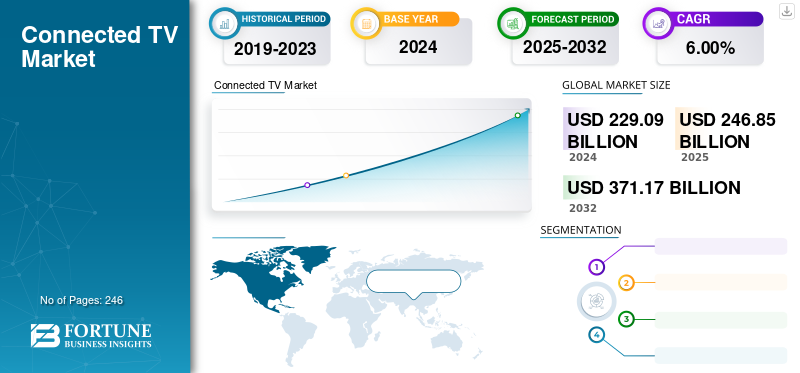
Download Free sample to learn more about this report.
Connected TV Market Key Takeaways
 Market Size & Forecast
- 2025 Market Size: USD 246.85 billion
- 2026 Market Size: USD 264.61 billion
- 2034 Forecast Market Size: USD 414.57 billion
- CAGR: 5.77% from 2026–2034
 Market Share
- Asia Pacific dominated the connected TV market with a 39.53% share in 2025.
- The LED segment accounted for the largest market share of 51.90% in 2026.
- The 30-50 inches segment held the largest market share of 56.60% in 2026.
 Key Regional Highlights
North America
North America was the second-largest regional market in 2025.
Asia Pacific
Asia Pacific held 39.53% share in 2025, valued at USD 97.57 billion.
Europe
Europe was the third-largest regional market in 2025.
U.S.
Market projected to reach USD 53.50 billion by 2026.
Japan
Strong connected TV market growth driven by advanced consumer electronics innovation and high household connectivity.
Read More

MARKET DYNAMICS
Market Drivers
Rising Adoption of Streaming Devices and OTT Platforms to Drive Product Demand
The rising adoption of streaming content servicing devices and OTT platforms is encouraging consumers to replace their existing traditional TVs with connected TVs, driving the global connected TV market growth. According to the Press Information Bureau (PIB), Government of India, as of 2024, OTT streaming platforms are serving around 600 million users in India. India’s Media & Entertainment (M&E) sector is projected to grow from USD 28.19 billion in 2024 to USD 33.83 billion in 2027. In addition, shifting consumer preferences toward buying IoT-based devices that deliver personalized content experiences to consumers, including smartphones, tablets, laptops, and TVs, are favoring product revenue growth across many countries. Besides, the rising ad spend by brands to scale up the connected TV advertising and reach targeted audiences is also favoring market growth.
The connected TV market is expanding rapidly as digital media consumption shifts from traditional broadcast television toward internet-based streaming platforms. Broadband penetration, smart television adoption, and the proliferation of subscription and ad-supported streaming services are key structural forces driving connected TV market growth. One of the most significant drivers is the rapid expansion of streaming ecosystems. Global streaming platforms continue to invest heavily in exclusive content, localized programming, and subscription models that encourage households to adopt connected television devices. This transformation has positioned connected televisions as the primary gateway for premium digital entertainment.
Another major growth catalyst is the increasing integration of advertising technology within connected TV platforms. Advertisers are shifting budgets toward programmatic and data-driven advertising formats available through connected televisions. These platforms enable targeted advertising and performance measurement capabilities that traditional broadcast television cannot provide. As a result, connected TV advertising revenue is becoming a critical component of the broader connected TV market size expansion.
Market Restraints
Data Security Concerns to Restrain Market Growth
Smaller established CTV platforms may offer services with weaker data privacy protection, which could lead to data theft issues. Increasing data security concerns regarding the use of such platforms are reducing the need for installing smart TVs, thereby restraining global market growth. In addition, the growing incidence of device hijacking through ad fraud schemes and other illegal activities is hampering product demand across many countries.
Despite strong adoption momentum, the connected TV market faces several structural constraints that may influence the pace of market expansion. One of the primary restraints involves platform fragmentation within the connected television ecosystem. Numerous operating systems, application environments, and device manufacturers compete for platform dominance, creating interoperability challenges for developers, advertisers, and content distributors.
Content licensing complexity also presents operational barriers. Streaming services often operate under regional licensing agreements, which can restrict the availability of certain content across geographic markets. These limitations reduce platform uniformity and can affect consumer adoption in regions where premium content libraries are restricted.
Privacy and data regulation represent another important restraint. Connected televisions generate significant user data related to viewing behavior, content preferences, and advertising interactions. Governments and regulators are increasingly scrutinizing data collection practices associated with connected devices. Compliance with evolving privacy regulations can increase operational costs for platform providers and advertisers operating within the connected TV industry.
Hardware price sensitivity in emerging markets also affects connected TV market growth. While device prices have declined significantly, smart televisions remain a relatively high-cost purchase in several developing economies. Consumers in these regions may continue relying on conventional televisions paired with external streaming devices.
Market Opportunities
Rising Demand for Smart Housing Facilities to Increase Product Installation Rate
Rising demand for smart housing facilities increases consumer demand for installing smart TVs and accessories, creating new market growth opportunities. In addition, the growing number of single-person households opting for compact-sized connected TV (CTV) sets in their living spaces is driving product sales across many countries. Additionally, the evolving consumer’s product replacement rate for installing the latest technology-based products is positively contributing to market expansion.
Several emerging opportunities are expected to shape the next phase of connected TV market expansion. One of the most significant opportunities lies in the continued growth of connected television advertising. As traditional broadcast audiences decline, advertisers are reallocating budgets toward connected TV platforms that offer precise audience targeting and measurable campaign performance.
The expansion of emerging markets represents another major growth opportunity. Many regions across Asia-Pacific, Latin America, and parts of Africa are experiencing rapid improvements in broadband infrastructure and smartphone-driven digital ecosystems. As household incomes rise and internet penetration improves, demand for connected television devices is expected to accelerate.
Integration between connected televisions and broader smart home ecosystems also presents an emerging opportunity for industry participants. Televisions increasingly function as central digital hubs that integrate voice assistants, home automation systems, and multimedia platforms. This convergence expands the role of connected televisions beyond entertainment into broader household technology ecosystems.
Cloud-based gaming and interactive entertainment platforms are also opening new avenues for the growth of the connected TV market. Advanced processing capabilities and high-speed internet connectivity allow televisions to support cloud gaming environments that deliver immersive gaming experiences without dedicated consoles.
Market Trends
Increasing Number of Gamers Preferring TVs Compatible with Latest Gaming Platforms to Augment Market Growth
Video gamers seek connected TVs that are compatible with gaming platforms, including Google Stadia, Xbox Cloud Gaming, NVIDIA GeForce, and others. Users can easily connect their consoles to smart TVs and play video games seamlessly. The increasing number of video gamers opting for TVs compatible with gaming platforms is driving global market growth. In addition, consistent efforts by manufacturers to develop televisions integrated with gaming GPUs and NVIDIA G-Sync & AMD FreeSync technology systems are creating new industry growth prospects.
The connected TV market is undergoing rapid transformation as technological innovation reshapes content distribution, advertising models, and consumer viewing behavior. One of the most prominent connected TV market trends is the rapid expansion of ad-supported streaming services. Media companies increasingly offer advertising-supported subscription tiers to attract cost-sensitive consumers while generating advertising revenue.
Programmatic advertising has become another defining industry trend. Connected television platforms enable advertisers to target audiences based on viewing patterns, demographics, and behavioral insights. This capability improves campaign measurement and advertising efficiency compared with traditional television broadcasting. Consequently, connected TV advertising is becoming an increasingly important segment of the global digital advertising ecosystem.
Operating system ecosystems are also becoming central competitive battlegrounds within the connected TV industry. Technology companies are investing heavily in proprietary television operating systems designed to control application distribution, advertising data, and user engagement. These ecosystems allow platform providers to capture a greater share of the connected TV market value beyond hardware sales. Content aggregation platforms are gaining prominence as consumers face growing complexity in navigating multiple streaming services. Aggregated interfaces simplify content discovery by integrating multiple applications and subscription services into unified user experiences.
Download Free sample to learn more about this report.
MARKET CHALLENGES:
High Cost of Connected TVs Compared to Traditional Models to Challenge Market Expansion
The high cost of connected TVs with advanced features compared to traditional models is posing challenges to key players in building product revenues from this product category. Additionally, the high cost of repairing smart TVs and the need for consumers to invest in OTT platform subscription service packages are negatively impacting product demand among middle-income consumer groups.
Connected TV Market Segmentation Analysis
By Technology
Cost-Effectiveness and Wider Adoption of LED TVs Led to the Dominance of the LED Segment
By technology, the market is segmented into LED, OLED, QLED, and others.
LED
The LED segment exhibited a leading global market share of 51.90% in 2026. The dominance of the LED segment is attributed to the cost-effectiveness and broader price-sensitive consumer base of LED TVs across many countries. In addition, the wide availability of LED televisions in different screen sizes, compared to counterpart technology models, is generating considerable revenues from this segment.
Light-emitting diode (LED) technology remains the dominant display architecture in the connected TV market. Its broad adoption reflects a balance between cost efficiency, display performance, and manufacturing scalability. Most connected televisions sold globally utilize LED-backlit liquid crystal display panels, making this technology central to the overall connected TV market size.
Manufacturers favor LED displays because they support high brightness levels and acceptable energy efficiency while remaining affordable for mass-market consumers. This combination allows television vendors to offer connected features at competitive prices across both developed and emerging markets. Consequently, LED-based connected televisions account for the largest portion of global unit shipments.
Another important factor supporting LED technology adoption is the maturity of global supply chains. Component manufacturing, panel fabrication, and assembly operations are well established across Asia-Pacific manufacturing hubs. This supply chain stability enables manufacturers to scale production rapidly while maintaining relatively low device prices.
QLED
Quantum dot light-emitting diode (QLED) technology represents another premium display option within the connected TV market. QLED displays enhance traditional LED technology by incorporating quantum dot materials that improve color accuracy and brightness performance.
Television manufacturers promote QLED displays as high-performance alternatives to OLED technology, particularly in brightly lit environments where increased brightness levels provide superior viewing experiences. This technology is particularly popular in large screen formats where brightness and color vibrancy significantly influence image quality.
QLED displays are widely adopted by major consumer electronics brands seeking to differentiate premium product lines. These displays support advanced features such as enhanced color volume, high dynamic range imaging, and improved display longevity. These characteristics make QLED televisions attractive for consumers seeking premium viewing experiences without the cost associated with OLED technology.
To know how our report can help streamline your business, Speak to Analyst
The other segment, including various technology models such as Micro-LEDs, Mini-LEDs, and Dual-Cell Models, is projected to grow at the fastest CAGR of 13.02% during the forecast period of 2026-2034. The segment’s fastest growth is attributed to the rising demand for innovative LED technology, advanced backlighting systems, and foldable screen technology-based models in the hospitality and official facilities sectors globally. Furthermore, consistent advancements in the development of mini-LED screen models are favoring segmental revenue growth.
By Screen Size
High Households’ Preference for Compact-Sized Televisions Led to the Dominance of the 30-50 Inches Segment
By screen size, the market is segmented into below 30 inches, 30-50 inches, 50-70 inches, and above 70 inches.
Below 30 Inches
Connected televisions with screen sizes below 30 inches occupy a relatively small segment within the connected TV market. These devices are typically used in secondary viewing environments such as bedrooms, dormitories, kitchens, or small apartments. The growth of mobile devices and tablets has reduced demand for very small televisions in many markets. Consumers increasingly prefer larger screens for immersive streaming experiences. As a result, this segment contributes a modest share of the global connected TV market size.
However, compact connected televisions remain relevant in space-constrained environments and emerging markets where affordability remains a key purchasing factor.
30–50 Inches
The 30-50 inches segment exhibited a leading global market share of 56.60% in 2026. Households with compact TV space requirements primarily prefer TVs measuring 30 to 50 inches. The segment’s dominance is attributed to the high demand from households for Televisions of 30-50 inches in size. Additionally, increasing consumers' access to 30-50-inch television models featuring 4K Ultra HD content availability is driving segmental revenue growth.
Televisions within the 30-to-50-inch range represent a major segment of the connected TV market. These devices provide an optimal balance between screen size, price, and living room compatibility. Many households consider this range suitable for standard residential entertainment setups. Manufacturers frequently position televisions within this category as mainstream consumer devices. These models often include essential connected features such as streaming applications, voice assistants, and wireless connectivity.
Because this size category offers broad affordability and practical viewing dimensions, it contributes significantly to connected TV market share across both developed and emerging economies.
50–70 Inches
The 50-to-70-inch segment has become one of the fastest-growing categories within the connected TV market. Improvements in display manufacturing and declining panel costs have made large televisions increasingly accessible to mainstream consumers.
Consumers seeking immersive home entertainment experiences increasingly favor larger screens capable of delivering cinematic viewing quality. Streaming services providing high-definition and ultra-high-definition video content further reinforce demand for larger televisions. As a result, this segment contributes significantly to connected TV market growth, particularly in regions with high household purchasing power.
Above 70 Inches
The above 70 inches segment is projected to grow at the fastest CAGR of 10.63% from 2026 to 2034. Its fastest growth is attributed to increasing consumer preferences for immersive home theater experiences, which necessitate the installation of television sets equipped with high-end technologies such as 4K/8K resolution, OLED, and MicroLED displays, exceeding 70 inches. Furthermore, the rising luxury home renovation trends are accelerating the demand for television sets with screen sizes above 70 inches among households globally.
Televisions exceeding 70 inches represent a premium segment of the connected TV market. These devices are commonly used in high-end residential home theaters, luxury hospitality environments, and corporate display settings. Although adoption volumes remain smaller than mid-range categories, the segment generates high revenue per unit. Premium display technologies such as OLED and QLED are frequently integrated into these large-format televisions.
As production costs decline and consumer preferences shift toward larger screens, this segment is expected to play an increasingly important role in connected TV market expansion.
By Operating System
Wider Consumer Base of Android-based TV Users Led Android TV Segment to Hold a Leading Market Share
Based on the operating system, the market is segmented into Android TV, Tizen OS, Web OS, and others.
Android TV
The Android TV segment exhibited a leading global market share of 47.02% in 2026. Android-based television models offer a wider range of applications that can be accessed on larger screens. The growing internet connectivity and high consumer demand for online streaming services, including Netflix, YouTube, and others, as well as fitness applications, are generating considerable product revenues from this segment. Furthermore, the smoother performance, user-friendly interface, and regular software updates of Android systems are encouraging consumers to purchase Android-powered products, positively contributing to the segment’s growth.
Android TV represents one of the most widely adopted operating systems in the connected TV market due to its open ecosystem, extensive application support, and strong developer community. Developed by Google, the platform enables television manufacturers to integrate a broad range of streaming applications, digital services, and smart home integrations within connected televisions.
A major advantage of Android TV lies in its compatibility with the Google Play application marketplace. This ecosystem enables consumers to access thousands of streaming applications, gaming platforms, and productivity tools through a unified interface. For manufacturers, the platform reduces software development costs while providing a robust application environment. Android TV also supports integration with voice assistants and smart home devices, strengthening its role within broader connected household ecosystems. Voice-based search, content recommendations, and personalized user profiles enhance the consumer viewing experience and increase engagement with streaming services.
From a strategic perspective, the platform allows television manufacturers to accelerate product development cycles by leveraging Google's software infrastructure. This has made Android TV particularly attractive to mid-tier television brands seeking to compete with larger consumer electronics companies.
Tizen OS
Tizen OS represents a proprietary operating system widely deployed within premium connected televisions manufactured by major consumer electronics companies. The platform is designed to deliver a streamlined user interface, fast navigation, and strong integration with device-specific hardware capabilities.
Tizen-based connected televisions emphasize performance optimization and seamless integration with manufacturer-developed applications and services. This approach allows hardware vendors to maintain tighter control over user experience, software updates, and platform monetization strategies.
A distinguishing feature of Tizen OS is its emphasis on integrated ecosystem connectivity. Televisions using this platform often integrate seamlessly with other consumer electronics products, including smartphones, smart appliances, and wearable devices. This cross-device connectivity enhances user convenience and strengthens brand loyalty. The operating system also supports a growing ecosystem of streaming applications and content platforms. Major video streaming providers prioritize compatibility with Tizen devices due to their substantial installed base of connected televisions globally.
In the competitive landscape of the connected TV market, proprietary operating systems such as Tizen provide manufacturers with opportunities to capture additional revenue streams from advertising partnerships, content distribution, and data analytics. These capabilities contribute to the platform's strategic significance within the broader connected TV industry.
Web OS
Web OS represents another proprietary operating system widely used within the connected TV market. Designed with a strong focus on user interface simplicity, the platform offers intuitive navigation, rapid application switching, and visually organized content interfaces. One of Web OS's defining characteristics is its emphasis on user-friendly interaction. The platform incorporates features such as card-based menus, customizable home screens, and simplified content discovery tools. These capabilities reduce complexity for consumers while improving overall platform usability.
Streaming platforms and content providers frequently prioritize Web OS compatibility due to its strong installed base of connected televisions worldwide. This ensures that consumers using Web OS devices can access a comprehensive range of video streaming services, gaming applications, and digital media platforms. Another strategic advantage lies in the operating system's integration with artificial intelligence-driven recommendation engines. These systems analyze user viewing patterns to deliver personalized content suggestions, improving engagement and increasing platform usage.
Within the connected TV market, Web OS contributes significantly to platform competition among operating system providers. Its focus on simplicity, performance, and content accessibility supports strong adoption across premium consumer electronics product lines.
The other segment covering the analysis on various operating system segments, including Amazon Fire TV, Roku OS, HarmonyOS, and Linux, is slated to grow at the fastest CAGR of 6.08% during the forecast period of 2026-2034. The segment’s fastest growth is attributed to the consistent growth of other operating system-based television makers with retail ecosystems and content partners globally.
By End-User
High Smart TV Penetration Led to Dominance of the Household Segment
Based on end-user, the market is segmented into household, hotels, offices, and others.
Household
The household segment exhibited a leading global market share of 84.88% in 2026. The segment is projected to grow at the fastest rate of 6.26% during the forecast period of 2026-2034. Connected television sets are an integral part of home systems. The segment’s leading global market share is attributed to the wider adoption of smart television sets among households globally. Furthermore, the growing demand for housing apartments, condominiums, and other forms of housing facilities, which require the installation of smart television sets, is favoring segmental growth.
Household consumers represent the dominant end-user segment in the connected TV market. Residential adoption has expanded rapidly as streaming services replace traditional cable and satellite television subscriptions. Connected televisions have become the primary device for digital video consumption in many households.
Several factors drive household adoption. Increasing broadband penetration, falling television hardware prices, and widespread availability of streaming platforms have made connected televisions accessible to a large consumer base. Consumers increasingly prefer on-demand viewing experiences, personalized recommendations, and multi-platform content access that connected televisions provide.
Household users typically rely on connected televisions for streaming video services, gaming platforms, digital media libraries, and smart home integrations. Voice assistants and integrated application ecosystems further enhance the value proposition for residential consumers. Screen size preferences within this segment have also evolved. Larger displays are becoming increasingly popular as consumers seek immersive entertainment experiences. This shift is influencing connected TV market growth by encouraging replacement cycles among households upgrading from older television models.
Hotels
Hotels represent an important commercial segment within the connected TV market. Hospitality providers increasingly deploy connected televisions to enhance guest entertainment experiences and differentiate service offerings. Connected televisions allow hotels to deliver personalized streaming content, interactive information services, and integrated guest communication platforms.
Traditional hotel television systems relied on cable broadcasting or centralized media servers. However, guest expectations have evolved significantly. Many travelers now expect the ability to access personal streaming subscriptions directly from hotel televisions. Connected television platforms enable secure login environments where guests can temporarily access their digital media accounts.
Another advantage of connected television deployment in hospitality environments is the ability to integrate property management systems and digital concierge services. Hotels can display service menus, promotional content, and facility information directly through television interfaces.
Offices
The offices segment is projected to grow at the second-fastest CAGR of 5.60% during the forecast period of 2026-2034. The rising adoption of larger screen-sized television sets compatible with digital signage tools, video conferencing, presentations, and virtual meetings is primarily driving the segmental growth. Furthermore, the growing number of corporate facilities and governmental assistance in building corporate infrastructural hubs is positively contributing to the segment’s growth.
Corporate environments represent another emerging application segment within the connected TV market. Businesses increasingly utilize connected televisions for collaboration, digital signage, corporate communication, and presentation environments. Connected televisions support a variety of workplace functions, including video conferencing, training programs, internal communications, and marketing displays. Integration with cloud-based collaboration tools enables organizations to utilize televisions as large interactive displays during meetings and presentations.
The rise of hybrid work environments has further expanded demand for digital communication infrastructure within office spaces. Connected televisions allow organizations to distribute multimedia content across multiple office locations, supporting employee engagement and knowledge sharing.
By Distribution Channel
Product Demonstrations and Superior Expert Advice Led Dominance of the Specialty Stores Segment
Based on distribution channel, the market is segmented into specialty stores, brand stores, online channels, and others.
Specialty Stores
The specialty stores segment held a leading global market share of 44.69% in 2024. The segment’s leading share is due to the consistent provision of hands-on product demonstrations and expert advice by specialty stores, generating considerable product sales from these stores. Furthermore, consistent base expansion activities by specialty retailers are strengthening product sales internationally and favoring segmental revenue growth.
Specialty electronics retailers remain a significant distribution channel within the connected TV market. These stores provide consumers with opportunities to physically evaluate television display quality, screen sizes, and feature sets before making purchasing decisions.
Retail sales personnel often assist customers in understanding product specifications, operating systems, and connectivity features. This guidance can influence purchasing decisions, particularly for consumers purchasing premium television models. Specialty stores also allow manufacturers to showcase new technologies such as OLED displays, high dynamic range imaging, and voice assistant integration. Demonstration environments help communicate product value propositions effectively.
Brand Stores
Brand-operated retail stores represent another important channel for connected television distribution. These stores allow manufacturers to present products within curated brand environments that highlight design, technology capabilities, and ecosystem integrations.
Brand stores often emphasize cross-device connectivity by demonstrating how televisions integrate with smartphones, tablets, and smart home products. This strategy strengthens customer engagement and reinforces brand loyalty. Manufacturers also use brand stores to introduce new flagship models and premium display technologies. Direct retail operations enable companies to control pricing strategies and deliver consistent brand experiences.
As competition within the connected TV market intensifies, brand-operated retail channels provide manufacturers with strategic advantages in product positioning and customer education.
Online Channels
Online retail platforms have become one of the fastest-growing distribution channels in the connected TV market. E-commerce platforms allow consumers to compare prices, review product specifications, and access customer reviews before making purchasing decisions. Digital marketplaces offer a broad range of connected television models across multiple price tiers. This accessibility has expanded consumer reach, particularly in regions where physical electronics stores are limited.
Online retailers frequently offer promotional discounts, bundled services, and extended warranty programs that encourage consumers to purchase televisions through digital channels. Logistics improvements and reliable delivery networks have further strengthened consumer confidence in online purchases.
Although online retail channels are expanding rapidly, specialty stores continue to play an important role in high-value electronics purchases. The rising adoption of online shopping for luxury home systems among households is primarily driving the online channels segment at a rate of 7.68% during 2026-2034. Furthermore, improved logistics, payment methods, and return policies related to online shopping are positively contributing to the growth of online product sales.
Connected TV Market Regional Insights
By geography, the market is categorized into North America, Europe, Asia Pacific, South America, and the Middle East & Africa.
Asia-Pacific Connected TV Market Analysis
Global Connected TV Market Size 2025 (USD Billion)
To get more information on the regional analysis of this market, Download Free sample
The Asia Pacific region exhibited a leading global connected TV market share of 39.53% in 2025. The region’s market size is estimated to reach USD 97.57 billion in 2025 and is projected to grow during the forecast period. A wider household consumer base across China, India, and Southeast Asia led to considerable product revenue generation from the region. Rising residential & commercial infrastructure settings, along with the increasing adoption of connected technology-based home devices among middle- and upper-income household groups, are favoring the region’s market growth.
Asia-Pacific represents the fastest-expanding region within the connected TV market due to rapid urbanization, growing middle-class populations, and expanding broadband infrastructure. Rising consumer demand for digital entertainment services is accelerating the adoption of smart televisions across several regional markets. Strong consumer electronics manufacturing capacity also supports widespread device availability. These factors collectively position Asia-Pacific as a major contributor to future connected TV market growth.
Japan Connected TV Market
Japan maintains a technologically advanced connected TV market supported by strong consumer electronics innovation and high household connectivity levels. Japanese consumers increasingly access streaming platforms and digital media services through connected televisions. Domestic electronics manufacturers continue introducing advanced display technologies and integrated operating systems. These developments contribute to stable connected TV market expansion and reinforce Japan’s role as a technology leader.
China's Connected TV Market
China represents one of the largest connected TV markets globally due to its massive consumer base and rapidly expanding digital entertainment ecosystem. Domestic streaming platforms and technology companies play significant roles in shaping platform development. Government policies encouraging digital infrastructure expansion also support market growth. These factors collectively contribute to strong connected TV market size expansion within the Chinese consumer electronics sector.
The Chinese market size reached USD 36.77 billion in 2026. Robust electronic manufacturing facilities, a widespread consumer base, and consistent governmental initiatives aimed at promoting the electronic manufacturing industry and digital transformation are generating product revenues across China. The proliferation of AI-based TVs compatible with 5G technologies is favoring the growth of the Chinese market.
North America Connected TV Market Analysis
The North America region exhibited a second leading global market position in 2025. The wider adoption of online streaming services and high consumer demand for televisions featuring voice control and enhanced resolution are generating product revenues across the U.S. and Canada. In addition, the growing infrastructure facilities related to specialty electronic retailers and brand outlets are positively contributing to product sales across Canada and Mexico.
North America represents one of the most mature regions within the connected TV market, supported by strong broadband penetration, widespread streaming adoption, and a highly developed digital advertising ecosystem. Households increasingly rely on connected televisions as primary media consumption devices. The region also hosts major streaming platforms and advertising technology providers, reinforcing connected TV market growth through continuous content innovation and platform-driven revenue models.
United States Connected TV Market
The United States dominates the North American connected TV market due to early streaming platform adoption and advanced digital advertising infrastructure. Most households utilize connected televisions for streaming video, gaming, and application-based entertainment services. Strong competition among streaming providers continues to expand content availability. This dynamic environment strengthens the connected TV market size while supporting rapid innovation in advertising technologies and platform monetization strategies.
The U.S. market size reached USD 53.50 billion in 2026. The high demand for AI-powered home systems and consistent efforts by manufacturers to launch innovative products are positively contributing to the U.S. market expansion. In addition, the growing home renovation trends are expected to increase households’ demand for the newer technology-based products, favoring U.S. market growth.
Europe Connected TV Market Analysis
The European region held a third-leading global market share in 2025. The increasing consumer preference for immersive home entertainment experiences and the rising demand for energy-efficient television sets among household and hospitality consumers are favoring Western European market growth. Furthermore, the growth of hospitality and official infrastructural facilities is positively contributing to product demand across Russia and the Eastern European region.
Europe represents a significant contributor to the connected TV market, supported by high household internet penetration and strong consumer demand for streaming media services. Many European broadcasters are transitioning toward hybrid broadcast and streaming platforms accessible through connected televisions. Regulatory frameworks focused on digital media competition also influence platform strategies. These dynamics collectively support stable connected TV market growth across several major European economies.
Germany's Connected TV Market
Germany plays a key role in the European connected TV market due to strong consumer electronics demand and expanding digital media consumption. Households increasingly rely on connected televisions for streaming services and internet-based entertainment platforms. Television manufacturers and streaming providers actively compete for platform engagement within the German market. This competition contributes to steady connected TV market growth and encourages continuous technological innovation.
United Kingdom Connected TV Market
The United Kingdom connected TV market benefits from advanced broadband infrastructure and strong adoption of streaming entertainment platforms. Consumers increasingly prefer internet-delivered content through connected televisions rather than traditional broadcast channels. Public broadcasters and digital media providers are investing heavily in streaming platforms compatible with connected televisions. These initiatives support continued connected TV market expansion while reshaping national television consumption patterns.
Latin America Connected TV Market Analysis
Latin America is experiencing steady expansion in the connected TV market as broadband availability improves and streaming services gain popularity among urban populations. Consumer demand for affordable smart televisions continues to increase across several regional economies. International streaming platforms are investing heavily in localized content production to strengthen audience engagement. These developments contribute to the gradual connected TV market growth across Latin America.
SOUTH AMERICA and MIDDLE EAST & AFRICA
Over the global market forecast period, the market in the South America and Middle East & Africa regions is expected to witness a moderate growth rate. The South America market in 2025 is set to reach a valuation of USD 14.91 billion. Increasing urbanization and the growing number of middle-income households in Brazil, Colombia, Argentina, and other countries are mainly driving the South American market growth. The Middle East and Africa region represents an emerging connected TV market supported by expanding broadband infrastructure and rising demand for digital entertainment services. Urban households increasingly adopt smart televisions to access streaming content. Although adoption remains uneven across countries, improvements in internet connectivity and device affordability are expected to support gradual connected TV market growth.
The expansion of hospitality & corporate infrastructure facilities, along with the rising number of upper-income household groups across the UAE, Saudi Arabia, Qatar, and South Africa, is driving product demand in these countries. In the Middle East & African market, the UAE is expected to reach a market value of USD 3.71 billion by 2025.
Connected TV Industry Competitive Landscape
Key Industry Players:
Consistent Product Innovation and Retail Base Building to Help Key Players Maintain Competitive Market Position.
The global market is highly competitive, with leading players including Samsung Electronics Co., Ltd., LG Electronics, Inc., TCL Technology Group Corp., Hisense Group Co., Ltd., and Sony Group Corporation. These players exhibit considerable market shares across global markets. These players focus on strengthening the innovative product portfolio by investing in R&D activities. In addition, they establish partnerships with global specialty retailer firms or open new brand outlets to increase product reach across global markets. For instance, in March 2023, Samsung Electronics Co. Ltd. opened a network of 1,700 brand stores located across India. These stores offer a wide range of premium home products, including televisions, smartphones, and other electronic devices.
The connected TV market is characterized by a multi-layered competitive environment involving consumer electronics manufacturers, operating system developers, streaming platforms, and advertising technology providers. Unlike traditional television markets dominated primarily by hardware vendors, the connected TV ecosystem is shaped by platform control, software ecosystems, and digital content distribution strategies.
Television manufacturers remain central participants in the connected TV industry. Major consumer electronics companies compete on display technology innovation, screen size expansion, and integrated operating system capabilities. Hardware differentiation increasingly depends on display technologies such as OLED, QLED, and mini-LED, as well as performance improvements in image processing and connectivity features.
Operating system providers represent another powerful competitive layer within the connected TV market. Control over the television operating system determines access to application ecosystems, user interface design, and advertising data flows. Operating system platforms such as Android TV, Tizen OS, and Web OS compete to attract both device manufacturers and streaming application developers. These platforms also enable monetization through advertising services, application distribution, and data-driven content recommendations.
Streaming platform providers are equally influential in shaping connected TV market share dynamics. Streaming services compete aggressively for consumer attention through exclusive content libraries, subscription models, and advertising-supported viewing options. Their success often influences which operating systems and hardware platforms gain prominence within the market.
LIST OF KEY CONNECTED TV COMPANIES PROFILED:
- Samsung Electronics Co. Ltd. (South Korea)
- LG Electronics, Inc. (South Korea)
- TCL Technology Group Corp. (China)
- Hisense Group Co., Ltd. (China)
- Sony Group Corporation (Japan)
- Xiaomi Corporation (China)
- Skyworth Group Co., Ltd. (China)
- VIZIO Inc. (U.S.)
- Koninklijke Philips N.V. (Netherlands)
- Panasonic Corporation (Japan)
KEY INDUSTRY DEVELOPMENTS:
- July 2025: Movistar Plus+ launched Titan OS-powered Philips Smart TVs in the Spanish market. Through such an offering, Spanish households will gain access to premium entertainment content from the television’s operating systems.
- September 2025: VIDAA International Holdings B.V. established a partnership with Hisense and Deutsche Telekom's MagentaTV service. The partnerships enable the company to eliminate external hardware requirements by integrating television programming and streaming services into smart TV operating systems.
- May 2025: Samsung Electronics Co., Ltd. launched the ultra-premium 2025 models of Neo QLED 8K, Neo QLED 4K, OLED, and QLED TVs, as well as the Frame lineup in India. These products are equipped with Vision AI technology, which delivers a seamless home entertainment experience to users.
- January 2023: Xumo, a streaming platform, established a joint venture with Comcast and Charter to develop next-generation 4K streaming devices and smart TVs.
REPORT COVERAGE
The global connected TV market analysis provides an in-depth study of market insights, size, and forecast by all the market segments included in the report. In addition, the report on the market outlooks, market dynamics, and market trends expected to drive the market during the forecast period is also included. It offers information on the technological advancements, new product launches, key industry developments, and details on partnerships, mergers & acquisitions. The research report also encompasses a detailed competitive landscape with information on the market share and profiles of key operating players.
Request for Customization to gain extensive market insights.
Report Scope & Segmentation
| ATTRIBUTE | DETAILS |
| Study Period | 2021-2034 |
| Base Year | 2025 |
| Forecast Period | 2026-2034 |
| Historical Period | 2021-2024 |
| Growth Rate | CAGR of 5.77% from 2026-2034 |
| Unit | Value (USD Billion) |
| Segmentation | By Technology, Screen Size, Operating System, End-User, Distribution Channel, and Region |
| By Technology |
|
| By Screen Size |
|
| By Operating System |
|
| By End-User |
|
| By Distribution Channel |
|
| By Region |
|
Frequently Asked Questions
Fortune Business Insights says that the global market value stood at USD 246.85 billion in 2025 and is projected to reach USD 414.57 billion by 2034.
In 2025, the market value stood at USD 97.57 billion.
At a CAGR of 5.77%, the global connected TV market is projected to grow during 2026-2034.
By 2032, the LED segment is expected to maintain a leading global market share.
The rising adoption of streaming devices and OTT platforms is set to drive the global market.
Samsung Electronics Co. Ltd., LG Electronics, Inc., TCL Technology Group Corp., Hisense Group Co., Ltd., and Sony Group Corporation are among the prominent players in the market.
Asia Pacific dominated the market in 2025.
The rising demand for smart housing facilities is expected to increase the product installation rate.



- 2021-2034
- 2025
- 2021-2024
- 246
-
(Offer valid till 15th Oct 2026)
Get 30-60 hrs Free Customization
Expand Regional and Country Coverage, Segments Analysis, Company Profiles, Competitive Benchmarking, and End-user Insights.



















Related Reports
-
US +1 833 909 2966 ( Toll Free )
-
Get In Touch With Us