Specialty Malt Market Size, Share & Industry Analysis, By Type (Caramel/Crystal Malt, Roasted Malt, Dark Malt, and Others), By Form (Dry and Liquid), By Grain Type (Barley, Wheat, Rye, Oats, and Others), By Application (Brewing, Distilling, Non-alcoholic Malt Beverages, Baking, Dairy & Frozen Products, and Others), and Regional Forecast, 2026–2034
 Download Free Sample
(Offer valid till 15th Oct 2026)

Specialty Malt Market Size & Future Outlook
 Listen to Audio Version
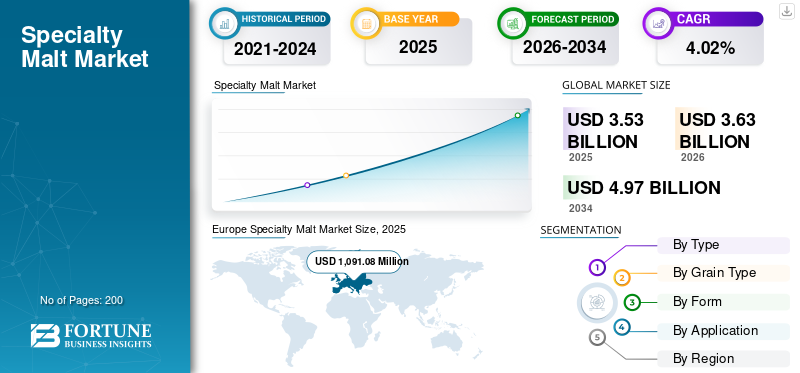
The global specialty malt market size was valued at USD 3,532.89 million in 2025. The market is projected to grow from USD 3,633.91 million in 2026 to USD 4,979.31 million by 2034, exhibiting a CAGR of 4.02% during the forecast period. Europe dominated the specialty malt market with a market share of 30.88% in 2025.
Specialty malts are processed cereal grains, primarily barley, that undergo controlled roasting, kilning, or caramelization to impart specific color, flavor, and functional properties to food and beverage products. These malts play a critical role in brewing, distilling, bakery, and dairy applications where flavor complexity, color intensity, and texture enhancement are essential product attributes.
The global specialty malt industry is experiencing steady expansion driven by rising demand for craft beer, premium alcoholic beverages, and artisanal food products. Increasing consumer preference for unique flavor profiles, combined with the growing popularity of microbreweries and small-scale distilleries, is significantly boosting demand for specialty malts. Additionally, the expansion of non-alcoholic malt beverages and clean-label food formulations is further supporting market penetration across developed and emerging economies.
The market growth is expected to be driven by key players such as Viking Malt, Simpsons Malt Ltd., Soufflet Group, Malteurop Groupe, and Briess Malt & Ingredients Co., which are actively focusing on product innovation, sustainable sourcing, and expansion of malting capacities.
Download Free sample to learn more about this report.
Specialty Malt Market Key Takeaways
 Global Market Size & Forecast
- 2025 Market Size: USD 3,532.89 million
- 2026 Market Size: USD 3,633.91 million
- 2034 Forecast Market Size: USD 4,979.31 million
- CAGR: 4.02% from 2026–2034
 Market Share
- Europe dominated the specialty malt market with a market share of 30.88% in 2025.
- The caramel/crystal malt segment led the market due to its extensive use in brewing for color and flavor enhancement.
- The barley segment dominated the market, supported by its high enzymatic activity and established role in brewing and malting.
 Key Regional Highlights
North America
The market reached USD 946.45 million in 2025 and is projected to grow at a 3.62% CAGR, supported by a mature brewing industry and rising demand for premium and specialty beers.
Europe
The region generated USD 1,091.08 million in 2025 and maintained its leading position, supported by its strong brewing heritage, established malting infrastructure, and high beer consumption.
Asia Pacific
Valued at USD 1,058.45 million in 2025, the region is expected to record the fastest growth at a 4.90% CAGR, driven by urbanization, rising disposable income, and increasing beer consumption.
U.S.
The market stood at USD 752.35 million in 2025 and is expected to grow at a 3.80% CAGR through 2034, driven by a large craft brewery base and strong demand for premium beer.
Japan
The market was valued at USD 127.94 million in 2025 and is projected to grow at a 1.95% CAGR, supported by a mature market with steady demand for premium beer products.
Read More

Specialty Malt Market Trends
Expansion of Non-Alcoholic and Functional Malt-Based Beverages to Shape Industry Growth
Specialty malts are gaining traction in non-alcoholic malt beverages and functional drinks, especially in regions such as the Middle East and Africa. These beverages are positioned as nutritious alternatives, offering natural sweetness and vitamins and minerals derived from malted grains. Increasing health awareness and demand for alcohol-free options are encouraging manufacturers to diversify malt applications beyond traditional brewing.
- In November 2025, Ghodawat Consumer Limited (GCL), the FMCG arm of the Sanjay Ghodawat Group, launched Coolberg Diet, positioned as India's first zero‑sugar malt beverage. Coolberg Diet is a zero‑sugar, zero‑alcohol malt‑based drink designed for "mindful drinking" and health‑conscious consumers, especially those looking to avoid sugary soft drinks and alcohol.
MARKET DYNAMICS
Market Drivers
Download Free sample to learn more about this report.
Rising Demand for Craft Brewing and Flavor Differentiation Driving Specialty Malt Innovation
The rapid expansion of the global craft beer industry is significantly influencing specialty malt market growth. Brewers are increasingly using a diverse range of specialty malts, such as caramel, roasted, and dark malts, to develop differentiated flavor profiles with notes of chocolate, coffee, caramel, and nuts. This trend is particularly prominent in North America and Europe, where microbreweries are experimenting with customized malt blends to enhance product uniqueness and premium positioning.
- According to the Brewers Association, operating U.S. craft breweries increased from 9,552 in 2022 to 9,761 in 2023, a net increase of 209 craft breweries, or about 2.19% year-over-year.
Market Restraints
Volatility in Barley Supply and Climate Dependency Impacting Production Costs
The global specialty malt market is highly dependent on the consistent availability of premium quality malting barley, making it structurally vulnerable to climatic variability and agricultural supply fluctuations. Barley is a climate-sensitive crop that requires specific temperature ranges, adequate rainfall during germination, and dry conditions during harvest. Any deviation, such as droughts, excessive rainfall, heatwaves, or unseasonal frosts, can significantly affect both yield and grain quality raw materials (protein content, kernel size, germination rate), all of which are critical for specialty malt production.
- According to the National Institute of Health, Adverse weather conditions in 2022 significantly affected barley production, with extreme weather, specifically droughts and floods, impacting yields in major producing nations, including France and Canada.
Market Opportunities
Growth in Premium and Artisanal Bakery Segment to Unlock New Growth Avenues for the Market
The rapid expansion of the premium and artisanal bakery segment globally is emerging as a significant opportunity for the specialty malt market, as bakery manufacturers increasingly seek differentiated ingredients that enhance flavor, texture, color, and nutritional appeal.
Artisanal and premium bakery products, such as sourdough breads, multigrain loaves, brioche, bagels, pretzels, crackers, and gourmet pastries, are characterized by their emphasis on traditional baking methods, clean-label formulations, and superior sensory profiles. Specialty malts (including caramel malt, roasted malt, and malt extracts) play a critical functional and aesthetic role in these products.
- S. baked goods exports are valued at approximately USD 4.27 billion in 2025, showing a 2.2% compound growth rate since 2016, according to the USDA Foreign Agricultural Service.
SEGMENTATION ANALYSIS
By Type
Caramel/Crystal Malt Segment Dominated Due to Extensive Use in Flavor and Color Enhancement
Based on type, the market is segmented into caramel/crystal malt, roasted malt, dark malt, and others.
The caramel/crystal malt segment dominated the global specialty malt market share, valued at USD 1,718.57 million in 2025, primarily due to its widespread use in brewing to enhance color and sweetness balance across a wide range of beer styles. These malts are essential in both large-scale and craft brewing, offering versatility in flavor development.
Meanwhile, the dark malt segment is projected to be the fastest-growing segment, with a 5.00% CAGR during 2026–2034, driven by rising consumption of premium dark beers and increased experimentation in craft brewing.
To know how our report can help streamline your business, Speak to Analyst
By Form
Dry Malt Segment Led Market Due to Storage Efficiency and Wide Industrial Adoption
Based on form, the market is segmented into dry and liquid.
The dry form segment dominated the market, reaching USD 2,995.23 million in 2025, supported by its longer shelf life, ease of storage, and suitability for bulk transportation. It is widely preferred by breweries and food manufacturers due to its operational stability and cost efficiency. Liquid malt, although smaller in share, is increasingly used in brewing and food processing where ease of mixing is required.
The liquid malt segment is projected to grow at the fastest CAGR of 5.04% during the forecast period, driven by rising adoption among craft brewers and increasing demand for ready-to-use ingredient formats. The shift toward convenience and process optimization is supporting this segment's growth.
By Grain Type
Barley Segment Dominated Owing to Superior Malting Properties and Industry Standardization
Based on grain type, the market is segmented into barley, wheat, rye, oats, and others.
The barley segment dominated the market, valued at USD 3,000.09 million in 2025, due to its high enzymatic activity, optimal starch content, and well-established role in brewing and malting processes. It remains the preferred grain for both traditional and industrial-scale production.
Notably, the oats segment is expected to grow at the fastest CAGR of 6.67% during 2026–2034, driven by increasing demand for smooth mouthfeel and its use in premium and health-oriented beverages. This diversification reflects evolving consumer preferences and innovation in grain utilization.
By Application
Brewing Segment Dominated Due to Core Dependence on Specialty Malt in Beer Production
Based on application, the market is segmented into brewing, distilling, non-alcoholic malt beverages, baking, dairy & frozen products, and others.
The brewing segment dominated the global specialty malt market, valued at USD 3,388.82 million in 2025, as specialty malts are essential for determining beer flavor, color, and aroma. The growth is strongly supported by the expansion of craft breweries and premium beer consumption globally.
The baking segment is projected to be the fastest-growing, registering a CAGR of 8.22% during the forecast period, driven by rising demand for clean-label and artisanal bakery products.
Specialty Malt Market Regional Outlook
Regionally, the report covers the global market analysis across North America, Europe, Asia Pacific, South America, and the Middle East & Africa.
North America
Europe Specialty Malt Market Size, 2025 (USD Million)
To get more information on the regional analysis of this market, Download Free sample
North America accounted for USD 946.45 million in 2025 and is projected to grow at a CAGR of 3.62% during the forecast period. The region benefits from a well-established brewing industry, a strong presence of craft breweries, and a high demand for premium alcoholic beverages. Increasing consumer preference for flavored and specialty beers continues to support specialty malt consumption.
U.S. Specialty Malt Market
The U.S. dominated the region with a market size of USD 752.35 million in 2025, growing at a CAGR of 3.80% during 2026–2034, driven by the presence of over 9,700 craft breweries and strong demand for premium and flavored beers.
Europe
Europe reached USD 1,091.08 million in 2025, dominating the global market, and is projected to expand at a CAGR of 3.18%. The region is characterized by strong brewing heritage, high per-capita beer consumption, and well-established malting infrastructure.
U.K. Specialty Malt Market
The U.K. reached USD 136.04 million in 2025, expanding at a CAGR of 2.38%, driven by a robust demand for craft beers and increasing consumer demand for premium ales and stouts.
Germany Specialty Malt Market
Germany accounted for USD 233.02 million in 2025, growing at a CAGR of 1.86%, supported by its strong brewing culture and adherence to strict quality standards. Demand for specialty beer varieties continues to support growth.
Asia Pacific
Asia Pacific represented USD 1,058.45 million in 2025 and is the fastest-growing region, registering a CAGR of 4.90% during 2026–2034. Rapid urbanization, rising disposable income, and growing beer consumption are key growth drivers.
China Specialty Malt Market
China dominated the region with a market size of USD 369.52 million in 2025, growing at a CAGR of 3.90%, driven by increasing beer consumption and premiumization trends.
Japan Specialty Malt Market
Japan accounted for USD 127.94 million in 2025, growing at a CAGR of 1.95%, supported by a mature but premium-oriented beer market.
South America and the Middle East & Africa
South America accounted for USD 252.66 million in 2025, expanding at a CAGR of 4.11%. Growth is driven by increasing beer consumption and the expansion of local brewing industries.
The Middle East & Africa reached USD 184.25 million in 2025, growing at a CAGR of 5.31%, the highest among all regions. The demand in the region is driven by the non-alcoholic malt beverages industry and urban population growth.
Brazil Specialty Malt Market
Brazil dominated the region with USD 169.96 million in 2025, growing at a CAGR of 3.64%, supported by strong beer consumption and the expanding craft brewing sector.
COMPETITIVE LANDSCAPE
Key Industry Players
Key Players Are Focused on Product Innovation and Capacity Expansion
The global specialty malt market is moderately consolidated, with leading players focusing on expanding malting capacities, sourcing high-quality barley, and developing customized malt solutions for breweries and food manufacturers. Strategic initiatives include partnerships with craft breweries, sustainability programs, and geographic expansion.
Key Players in the Specialty Malt Market
|
Rank |
Company Name |
|
1 |
Malteurop Groupe |
|
2 |
Soufflet Group |
|
3 |
Viking Malt |
|
4 |
Simpsons Malt Ltd. |
|
5 |
Briess Malt & Ingredients Co. |
List of Key Specialty Malt Companies Profiled in Report
- Malteurop Groupe (France)
- Soufflet Group (France)
- Viking Malt (Finland)
- Simpsons Malt Ltd. (U.K.)
- Briess Malt & Ingredients Co. (U.S.)
- Boortmalt (Belgium)
- Muntons plc (U.K.)
- Rahr Corporation (U.S.)
- GrainCorp Limited (Australia)
- Cargill, Incorporated (U.S.)
KEY INDUSTRY DEVELOPMENTS
- September 2025: Soufflet Malt, one of the world's leading maltsters, launched MALTiply 2030 as a strategic roadmap to expand malt's applications across brewing, distilling, food, beverages, and related sectors. This initiative targets "malt at every moment of the day," pushing into areas such as breakfast cereals, soft drinks, snacks, and innovative spirits flavors.
- September 2025: Bushmills launched its innovative 26-Year-Old Crystal Malt single malt Irish whiskey in the U.S. market. This premium release joins the distillery's Prestige Collection, highlighting rare and aged expressions from the world's oldest licensed whiskey distillery. The whiskey uses crystal malt barley, where sugars are crystallized during malting for intense caramel and creamy chocolate flavors.
- April 2025: Blue Ox Malthouse, based in Lisbon Falls, Maine, debuted seven new roasted malt varieties following extensive R&D with breweries such as Maine Beer Co., Tributary Brewing, and Goodfire Brewing.
- October 2023: Briess Malt & Ingredients launched Crystal Red, a specialty caramel malt, designed as the reddest malt available, with an intense color rating of around 200 SRM. It's produced through specialized roasting to deliver deep red hues while allowing flexible use in formulations.
- August 2023: Voyager Craft Malt and Cryer Malt announced an exclusive partnership to launch Dexter Malt, a sustainable light caramel malt produced in Australia. This collaboration aligns with trends in locally sourced, artisanal ingredients for brewing and distilling.
REPORT COVERAGE
The global specialty malt market industry report analyzes the market in depth and highlights crucial aspects such as global market trends, supply chain, market dynamics, prominent companies, investment in research and development, and end-use. Besides this, the research report also provides insights into the global market analysis and highlights significant industry developments.
Request for Customization to gain extensive market insights.
Report Scope & Segmentation
| ATTRIBUTE | DETAILS |
| Study Period | 2021-2034 |
| Base Year | 2025 |
| Estimated Year | 2026 |
| Forecast Period | 2026-2034 |
| Historical Period | 2021-2024 |
| Growth Rate | CAGR of 4.02% from 2026 to 2034 |
| Unit | Value (USD Million) |
|
Segmentation |
By Type
|
|
By Grain Type
|
|
|
By Form
|
|
|
By Application
|
|
|
By Region
|
Frequently Asked Questions
Fortune Business Insights says that the global market was valued at USD 3,532.89 million in 2025 and is anticipated to reach USD 4,979.31 million by 2034.
At a CAGR of 4.02%, the global market will exhibit steady growth over the forecast period.
By type, the caramel/crystal malt is the leading segment in the market.
Europe held the largest market share in 2025.
Rising demand for craft brewing and flavor differentiation is driving specialty malt innovation.
Viking Malt, Simpsons Malt Ltd., Soufflet Group, Malteurop Groupe, and Briess Malt & Ingredients Co. are the leading players in the global market.
Expansion of non-alcoholic and functional malt-based beverages to shape industry growth.



- 2021-2034
- 2025
- 2021-2024
- 200
-
(Offer valid till 15th Oct 2026)
Get 30-60 hrs Free Customization
Expand Regional and Country Coverage, Segments Analysis, Company Profiles, Competitive Benchmarking, and End-user Insights.




















Related Reports
-
US +1 833 909 2966 ( Toll Free )
-
Get In Touch With Us