CubeSat Market Size, Share & Industry Analysis, By Size (0.25U to 1U, 2U, 3U, 6U, 12U, & Above 12 U), By Component (Payload, Structure, Power System, Propulsion system, Thermal control, Onboard Computer & Data Handling, Attitude Determination & Control System), By Payload (Scientific Instruments, Communication Equipment’s, Telescopes, Cameras), By Application (Earth Observation & Remote sensing, Scientific Research & Space Exploration, Maritime & Transport Tracking, & Others), By End User (Government & Military, Commercial, Research Institutions, & Others), & Regional Forecast, 2026-2034
 Download Free Sample
CubeSat Market Size and Industry Overview
 Listen to Audio Version
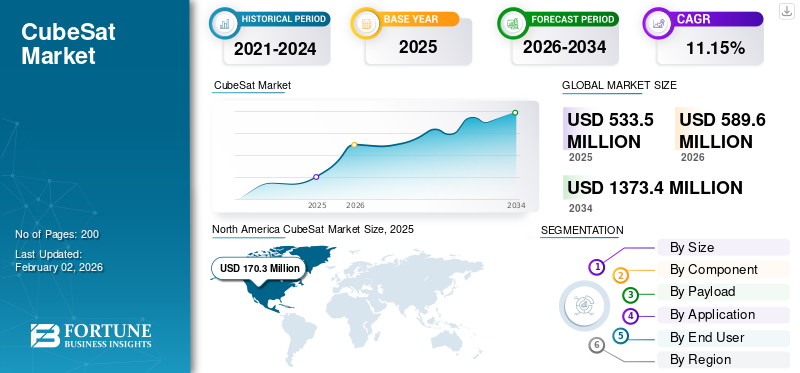
The global CubeSat market size was valued at USD 533.50 million in 2025 and is projected to grow from USD 589.60 million in 2026 to USD 1,373.40 million by 2034, exhibiting a CAGR of 11.15% over the forecast period. North America dominated the CubeSat market with a market share of 31.93% in 2025.
CubeSats are a type of nanosatellite with a standardized size and design. With a "one unit" or "1U" measuring 10x10x10 cm, the typical nano satellite size is extensible to bigger sizes, such as 1.5, 2, 3, 6, and even 12U. The creation of CubeSats has grown into its own sector, with collaboration between government, industry, and academia to continuously enhance capabilities. CubeSats are currently a low-cost platform for scientific research, new technology demonstrations, and sophisticated mission concepts that uses constellations, swarms, and disaggregated systems.
Some of the leading companies operating in the market include Planet Labs (U.S.), Pumpkin Space Systems (U.S.), GomSpace (Germany), Clyde Space (U.K.), Surrey Satellite Technologies (U.S.), Sierra Nevada Corporation (U.S.), Capella Space (U.S.), and others. These firms are aggressively growing their business by investing in research and development, and creating cutting-edge small parts to improve nano satellite performance.
Delays in production, supply chain disruptions, and mission postponements were all caused by the severe impact of the COVID-19 pandemic on the market. Although the outbreak first slowed the market, it also brought attention to the vital function of CubeSats in fields including environmental monitoring and disaster management, which eventually resulted in market growth.
Fig: Basic functional components of next generation CubeSat
Source: I.F. Akyildiz, J.M. Jornet and S. Nie / Ad Hoc Networks 86 (2019) 166–178
Download Free sample to learn more about this report.
CubeSat Market Key Takeaways
 Market Size & Forecast
- 2025 Market Size: USD 533.50 million
- 2026 Market Size: USD 589.60 million
- 2034 Forecast Market Size: USD 1,373.40 million
- CAGR: 11.15% from 2026–2034
 Market Share
- North America dominated the CubeSat market with a 31.93% share in 2025.
- The 3U segment is projected to hold a 23.34% market share in 2026.
- The payload segment is expected to account for a 23.29% market share in 2026.
 Key Regional Highlights
North America
North America accounted for 31.93% of the global market in 2025 and is projected to reach USD 188.1 million in 2026.
Europe
Europe represented 29.10% of global revenue in 2025 and is expected to reach USD 171.3 million in 2026.
Asia Pacific
Asia Pacific contributed USD 113.9 million in 2025 and is projected to grow to USD 126.9 million in 2026.
U.S.
The CubeSat market is expected to reach USD 126.40 million by 2026.
Japan
The CubeSat market is projected to be valued at USD 24.7 million by 2026.
Read More

Impact of U.S. Tariff
The U.S. Tariffs, particularly imposed in 2025 under Trump administration have introduced significant uncertainty and cost pressure on the global market. These tariffs target a wide range of raw materials and components vital for satellite manufacturing such as aluminum, lithium, silicon for solar panels, rare earth elements and electronics. As a result, this has intensified the overall cost of production for CubeSats and related space hardware. In June 2025, as per CEO of Veridiam, a California-based component manufacturer for launch vehicles and rocket engine, few U.S. space companies have reported operational cost increases of 10-20% due to tariffs which cab strain the cash flow and lead to delays or cancellations.
|
Tariff |
Tariff Rate (2024-2026) |
Target Products |
Effective Date |
|
Section 232 |
50% |
Steel and aluminum products |
2024-2026 |
|
Section 301 |
50% |
solar cells |
2024-2026 |
|
50% |
Semiconductor |
Market Dynamics
Market Drivers
Rise in Partnership Amongst Government, Space Agencies and Private Players is Expected to Bolster the Market Growth
Partnership within government, space agencies and private players have become a defining features of the market, driving innovation, lowering cost and expanding access to space. By adding resources, expertise, and infrastructure, these collaborations accelerate the development and deployment of nano satellite mission. For instance, NASA’s Artemis II mission recently finalized agreements with international partners such as Argentina’s CONAE, Germany’s DLR, Korea Aerospace agency and others. These international collaborations demonstrate enhanced capabilities.
In addition to flagship government led initiatives there are growing market for academic and private sector. For instance, United Nations/Japan KiboCUBE initiative, KiboCUBE, implemented by INOOSA enables educational institutions and research organizations around the world to deploy nano satellite from international space stations.
Market Restraints
Technical Complexity Owing to Inherent Compactness of Nano Satellite is Ought to Restrict Market Growth
The compactness of CubeSats which restricts the size and complexity of technologies is a major market restrain. This limitation affects payload capacity, limiting the types of instruments and sensors that can be carried and thus constraining the scope of missions CubeSats can undertake. The small size also poses challenges for propulsion systems, making it difficult to execute maneuvers or maintain orbits.
The reliability of miniaturized components is a another concern as small satellites are more suspectable to failures due to harsh space environments. Additionally, navigating complex international space regulations and compliance with safety, and environmental standards can be time consuming and costly for nano satellite developers.
Market Opportunities
Rise of Nano Satellite constellations along with Networks of Small Satellite Offer Major Growth Opportunity
The space sector has a significant development opportunity in nano satellite constellations, which provide a more affordable and scalable means of launching satellite networks for a variety of uses. These constellations are made up of many tiny satellite and provide more frequent revisit times, allowing for more frequent data collection and enhanced monitoring capabilities, especially in far-off locations. This approach is valuable for applications demanding real time data monitoring such as earth observation and traffic monitoring, IoT, telecommunication and others.
Unlike traditional large satellites, which often serve a single mission or region, constellation of small nano satellite working together can provide continuous, global coverage with high revisit rates. Nano satellite constellations are particularly used for industries seeking to bridge connectivity gaps in remote or underserved regions. For example, these networks can deliver broadband internet, support disaster response communication and enable asset tracking for maritime, aviation and logistics sector.
Market Challenges
Radiofrequency Spectrum Management in Nano Satellite can Challenge the Market Growth
At the lower frequencies at which nano satellite function, the radiofrequency spectrum is getting congested. Even after following the licensing procedures that allocate and manage frequencies, nano satellite frequently encounter interference due to congestion. As nano satellite constellations or swarms grow in popularity, it becomes increasingly important to develop infrastructure and communication protocols to control the radio frequency spectrum. Presently, there are no rules in place to stop space systems in constellations from using their own individual frequencies, which could waste scarce radio communication resources or cause increased interference. Instead, the entire constellation utilizes a single coordinated frequency.
CubeSat Market Trends
Increased Use of Commercial Off-The-Shelf (COTS) Components is an Emerging Market Trend
COTS components are mass produced, electronic and mechanical parts originally designed for terrestrial applications and widely used in space missions including CubeSat. COTS components are readily available, require minimal customization and can be integrated into nano satellite designs within a week or months. The cost saving is substantial for COTS components and can be up to 60% less expensive.
The proliferation of COTS components in nano satellite has enabled rapid expansion of small satellite constellations for various applications. Companies deploying large constellations of nano satellite for various applications with standardization on COTS parts, streamlining manufacturing and reducing cost. This standardization also facilitates rapid deployment which is critical for large scale satellite network. Furthermore, the use of COTS components allows for easy upgrade and replacement, making nano satellites more adaptable to evolving mission requirements and technological advancements.
Download Free sample to learn more about this report.
SEGMENTATION ANALYSIS
By Size
3U Dominated the Market Owing to its Increased Payload Flexibility for Space Missions
The market segments are classified by size into 0.25U-1U, 2U, 3U, 6U, 12U, and Above 12 U.
Among the size, the 3U segment is projected to dominated the global with a share of 23.34% in 2026, and is expected to be the fastest growing segment for 2026-2034 period. 3U CubeSat can accommodate more advanced instruments and subsystems compared to small sizes, making them attractive for commercial and scientific space missions. 3U are most commonly used in earth observation, scientific research and technology demonstrations.
The 0.25U-1U segment is anticipated to show significant growth during the study period. These types of cubeSat are low-cost to build and launch, making them ideal for universities, startups and educational institutions. They serve as testing satellites for new sensors, communication protocols and among others.
To know how our report can help streamline your business, Speak to Analyst
By Component
Miniaturization and Advance Sensor Technologies Boosts the Growth of Payloads Segment in the Market
By component, the market is segmented into payload, structure, power system, propulsion system, thermal control, onboard computer and data handling, attitude determination and control system, and others (Access port, motor, solar panel and other).
Among the component, the payload segment held the largest CubeSat market with a share of 23.29% in 2026, and is expected to be the fastest growing segment for 2025-2032 period. The payload is mission critical module of a satellite, equipped with instruments, sensors and communication equipment. Miniaturization and innovative sensor technologies enable smaller, more efficient payloads, increasing accessibility for a wider range of missions.
The structure segment is anticipated to witness significant growth during the study period. The structure provides the physical framework and protection for the satellite and its payload. Advanced materials enhance durability and reduce launch mass. This boosts the segmental growth during the study period.
By Payload
Rising investment in Scientific Space Exploration Drives the Scientific Instruments Segment in 2024
By payload, the market is categorized into scientific instruments, communication equipment, telescopes, cameras, and others.
Among the payload, the scientific instruments segment dominated the global market in 2025. Scientific instruments are used for space exploration, climate research, and fundamental science. Growing investment in space exploration by government and private entities accelerate the demand for advanced scientific payloads. For instance, Aalto-1- which is a three-unit nano satellite carrying the Aalto Spectral Imager, Radiation Monitor, and Electrostatic Plasma Brake, DICE- Two CubeSats measuring ionosphere plasma and electric fields are few examples of scientific payloads.
The communication equipment segment is anticipated to show moderate growth during the study period. These payloads include transponder, antennas, and optical communication systems for data transmission. Growing need for global connectivity (broadband, IoT, 5G) drives the demand for high output satellite communication payloads.
By Application
Advancements in Imaging Technologies Boost Earth Observation Demand, Contributing to the Segment’s Growth
By application, the market is categorized into earth observation & remote sensing, scientific research & space exploration, communication, maritime & transport tracking, others (training, signal monitoring and other.)
Among the application, the earth observation & remote sensing segment is projected to dominated the global market with a share of 32.68% in 2026. Advancement in imaging technologies such as hyperspectral, radar, optical sensors increase data quality and utility for various industries. These technologies give rise to such applications for space missions.
The scientific research & space exploration segment in type is anticipated to show moderate growth during the study period. Government and private sector investments in space exploration missions such as mars mission, moon exploration mission, deep space missions drive the segmental demand.
By End User
Rise in Government Initiatives in Space exploration Drives Government & Military Segment Growth
By end user, the market is categorized into government & military, commercial, research institutions, others.
Among the end users, the government & military segment is projected to dominated the global market with a share of 40.43% in 2026. Government are investing in nano satellite initiatives. These initiatives leverage nano satellite affordability, modularity, and rapid development to address wide range of space explorations.
The commercial segment is anticipated to show significant growth during the study period. Commercial user includes telecom operators, navigation service providers and others. Growing demand for satellite based services such as telecom, navigation, and earth observation fuels commercial payload adoptions.
CUBESAT MARKET REGIONAL OUTLOOK
Geographically, the market is segmented into North America, Europe, Asia Pacific, and Rest of the World.
North America
North America CubeSat Market Size, 2025 (USD Million)
To get more information on the regional analysis of this market, Download Free sample
In 2025, North America held 31.93% of the global market share, reaching a valuation of USD 170.3 million, and is projected to grow to USD 188.1 million in 2026. North America leads the market primarily due to its mature space infrastructure and the presence of major aerospace and technology companies such as Amazon, SpaceX, and established agencies including NASA and Department of Defense. Furthermore, significant investments from both the public and private sectors fuel innovation and deployment. The U.S. government allocates substantial budgets for space research, while private companies invest heavily in satellite constellations for communication, earth observations and others. The U.S. is the dominant country within the North America’s market, due to highly developed space sector, government funding, and launch missions. The U.S. CubeSat market is valued at USD 126.40 million by 2026.
Europe
The market in Europe reached USD 155.3 million in 2025, representing 29.10% of total market revenue, and is projected to reach USD 171.3 million in 2026. The European Space Agency (ESA), alongside other national agencies, strongly supports nano satellite initiatives, mainly for environmental monitoring, scientific research, and others. For instance, the Copernicus program has led to numerous nano satellite contracts for environmental data collection and disaster management in Europe region. The UK CubeSat market is anticipated to valued at USD 53.6 million by 2026, while the Germany CubeSat market is anticipated to valued at USD 45.1 million by 2026.
Asia Pacific
Asia Pacific contributed approximately USD 113.9 million to the global market in 2025, accounting for 21.34% share, and is expected to reach USD 126.9 million in 2026. Asia Pacific nano satellite market is emerging as a growing region, and is expected to account for highest CAGR during the study period. This is driven by increasing demand for applications such as disaster management, environmental monitoring, and telecommunication. Countries including China, India, Japan are investing heavily in space technology further boosting the CubeSat market growth in the region. The Japan CubeSat market is expected to valued at USD 24.7 million by 2026, the China CubeSat market is expected to valued at USD 41.7 million by 2026, and the India CubeSat market is valued at USD 35.2 million by 2026.
Rest of the World
The Rest of the World market accounted for USD 94 million in 2025, representing 17.63% of the global industry, and is expected to reach USD 103.2 million in 2026. Rest of the World includes Latin America and Middle East & Africa. These regions have started to invest in nano satellite technology, with partnership and collaboration from international partners and commercial satellite service providers. They are also focused on building local expertise and infrastructure for satellite development, often through partnerships with established space agencies and private companies.
COMPETITIVE LANDSCAPE
Key Industry Players
Key players Focus on Rapid Expansion Driven By Technological Advancements
Key players in the market are focused on rapid market expansion owing to increased commercial and government interest in space missions. The market features a dynamic mix of established aerospace firms, innovative startups and satellite manufacturers. Planet Labs (U.S.), Pumpkin Space Systems (U.S.), GomSpace (Germany), Clyde Space (U.K.), Surrey Satellite Technologies (U.S.), Sierra Nevada Corporation (U.S.), and Capella Space (U.S.) among others are a few top players in the market. These companies are actively expanding their services, investing in R&D and developing advanced miniaturized components to enhance nano satellite capabilities.
LIST OF KEY CUBESAT COMPANIES PROFILED
- Planet Labs (U.S.)
- Pumpkin Space Systems (U.S.)
- GomSpace (Germany)
- Clyde Space (U.K.)
- Surrey Satellite Technologies (U.S.)
- Sierra Nevada Corporation (U.S.)
- Capella Space (U.S.)
- Space Systems Loral (U.S.)
- EnduroSat (Bulgaria)
- CU Aerospace (U.S.)
- Spire Global (US.).
- Lockheed Martin Corporation (U.S.)
- Northrop Grumman Corporation (U.S.)
KEY INDUSTRY DEVELOPMENTS
- May 2025– The second CubeSat for the Ramses mission, which will explore the asteroid Apophis as it travels within 32,000 kilometers of Earth, has been contracted by the ESA. The Rapid Apophis Mission for Space Safety (Ramses) mission, which is being run as part of the ESA's Space Safety Program, was initially revealed in July 2024. One main probe and two CubeSats will make up the mission.
- May 2025 – The Saudi Space Agency and NASA have reached an agreement for a nano satellite to travel aboard the Artemis II test flight for NASA. After Orion is successfully flying alone with its crew of four astronauts, the Saudi Space Agency's nano satellite will be launched from a spacecraft adapter on the SLS (Space Launch System) rocket in high Earth orbit and will measure various aspects of space weather at different distances from Earth.
- March 2025 – Exolaunch, has signed a Launch Services Agreement (LSA) with the Canadian Space Agency (CSA) to support the deployment of CubeSat’s as part of CUBICS (CubeSat’s Initiative in Canada for STEM), a program intended at fostering space science technology and education for Canada's next generation of space leaders. The agreement facilitates the launch of nine 3U CubeSat’s created by Canadian institutions, with the possibility of more missions through the middle of 2028.
- November 2024 – Open Cosmos, a European smallsat developer, has secured a contract with the European Space Agency for a trio of CubeSat’s that will investigate the Earth's ionosphere and magnetic field. At the ESA Earth Observation Commercialization, the NanoMagSat mission's development contract was formally signed by representatives from ESA and Open Cosmos. The development, launch, and commissioning of the satellites are covered by the contract, which is valued at USD 36.5 million.
- September 2024 – Unseenlabs and GomSpace agreed to a deal for the delivery of four more cube satellites (CubeSats). The satellites are expected to be delivered in the second or third quarter of 2025, and the contract is worth USD 4.10 million.
REPORT COVERAGE
The report outlines competitive dynamics by assessing market segmentations, product offerings, target market earnings, geographical reach, and significant strategic initiatives by leading manufacturers. The global CubeSat market research analysis provides a detailed insights of the market segmentation. Besides this, the report offers insights into the global market trends, porter’s five forces analysis, supply chain trends, factors increasing demand for CubeSat, company profile and highlights key industry developments.
Request for Customization to gain extensive market insights.
Report Scope & Segmentation
|
ATTRIBUTE |
DETAILS |
|
Study Period |
2021-2034 |
|
Base Year |
2025 |
|
Estimated Year |
2026 |
|
Forecast Period |
2026-2034 |
|
Historical Period |
2021-2024 |
|
Growth Rate |
CAGR of 11.15% from 2026 to 2034 |
|
Unit |
Value (USD Million) |
|
Segmentation |
By Size
|
|
By Component
|
|
|
By Payload
|
|
|
By Application
|
|
|
By End User
|
|
|
By Region
|
Frequently Asked Questions
As per the Fortune Business Insights study, the market size was valued at USD 589.60 million in 2026 and is anticipated to USD 1,373.40 million by 2034.
The market is likely to grow at a CAGR during the forecast period of 11.15%.
The top ten leading players in the industry are Planet Labs (U.S.), Pumpkin Space Systems (U.S.), GomSpace (Germany), Clyde Space (U.K.), Surrey Satellite Technologies (U.S.), Sierra Nevada Corporation (U.S.), Capella Space (U.S.) and among others.
North America dominated in the market in 2025.
Rise in partnership within government, space agencies and private players.
Technical complexity owing to inherent compactness of nano satellite.



- 2021-2034
- 2025
- 2021-2024
- 200
Get 30-60 hrs Free Customization
Expand Regional and Country Coverage, Segments Analysis, Company Profiles, Competitive Benchmarking, and End-user Insights.




















-
US +1 833 909 2966 ( Toll Free )
-
Get In Touch With Us