 Download Free Sample



Get a Quote
Receive a tailored pricing based on your needs.
- Choose license type
- Multiple user options
- Custom scope & coverage
- Fast turnaround
"Electrifying your pathway to success through in-depth market research"
 Listen to Audio Version
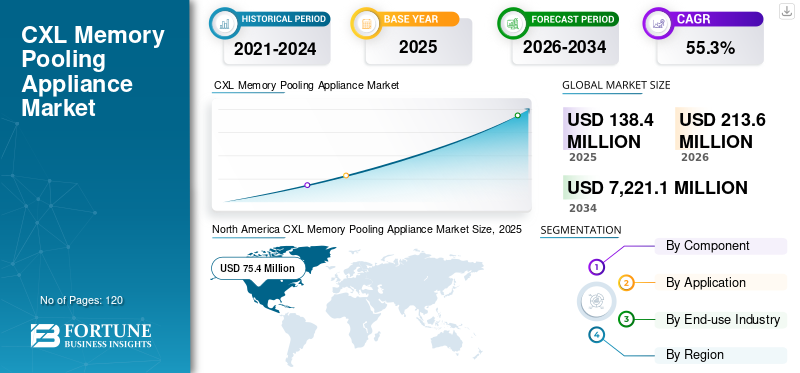
The global CXL memory pooling appliance market size was valued at USD 138.4 million in 2025. The market is projected to grow from USD 213.6 million in 2026 to USD 7,221.1 million by 2034, exhibiting a CAGR of 55.3% during the forecast period. North America dominated the CXL memory pooling appliance market with a market share of 54.48% in 2025.
The CXL memory pooling appliance market comprises hardware and software devices that provide pooled, shared, and dynamically allocated memory through Compute Express Link (CXL) for use across servers and accelerators in data centers. This allows data centers to increase their efficiency by using disaggregated and composable memory infrastructures, resulting in improved memory usage for AI, HPC, and cloud applications. The market growth is driven by the growing need for high-bandwidth/scale-memory infrastructures to support AI, cloud, and high-performance (HPC) applications while reducing wasted DRAM and increasing the efficiency of data centers.
Furthermore, many key market players, such as Samsung Electronics Co., Ltd., SK Hynix Inc., Intel Corporation, Micron Technology, Inc., and Astera Labs, Inc., operating in the market, are focusing on strategic partnerships, ecosystem development, and product innovation to provide integrated CXL memory pooling solutions, ensuring compatibility with hyperscale data centers and AI workloads, which accelerates adoption and strengthens their competitive positioning.
Download Free sample to learn more about this report.
 Global Market Size & Forecast
 Market Share
 Key Regional Highlights
North America
North America was valued at USD 75.4 million in 2025 and maintained the largest regional market share.
Asia Pacific
Asia Pacific is estimated to reach USD 55.5 million in 2026 and is expected to grow at the highest CAGR of 57.0% during the forecast period.
Europe
Europe is projected to reach USD 31.9 million in 2026, growing at a CAGR of 55.2% during the forecast period.
U.S.
The U.S. market is estimated to reach USD 88.3 million in 2026.
Japan
The Japan market is estimated to reach USD 10.5 million in 2026.
Read More

AI Infrastructure Growth Fueling Demand for CXL-Based Memory Pooling Systems
The substantial memory requirements of generative AI workloads (such as LLMs) and real-time inference for AI workloads necessitate disaggregated memory systems provided by a CXL pooling appliance. As gen AI continues to grow in size and complexity, reliance on local DRAM and High-Bandwidth Memory (HBM) alone to meet the increasing demands of memory is no longer economically feasible. Thus, CXL-based memory pooling is quickly becoming an attractive long-term option for hyperscalers and cloud service providers.
With the ability to dynamically allocate shared, high-capacity memory across a combination of CPUs, GPUs, and accelerators, CXL memory pooling is helping to bridge the gap created by the "memory wall" in AI. As a result, there have been unprecedented levels of accelerated development, integration, and commercialization of CXL switching and pooling technologies specifically designed for use with AI clusters and inference traffic. For instance,
Thus, this factor fuels the market growth in the coming years.
Expansion of Hyperscale Data Centers Accelerates CXL Memory Adoption
As hyperscale cloud companies continue their physical growth, adding to their global data center footprint to meet the increasing needs of cloud services, artificial intelligence workloads, and digital infrastructure. The number of data centers operated by hyperscale cloud companies is climbing rapidly, with new facilities being added at multiple locations, and total capacity being significantly expanded to support heavily compute-based workloads. In this context, there will be a growing need for advanced infrastructure components, including memory pooling appliances based on CXL technology, which will help enable optimized utilization of memory resources and greater scalability of compute resources across distributed server clusters.
With the addition of larger AI clusters, and more memory based infrastructure being created by hyperscalers, there will be a concomitant demand for disaggregated memory, and new composable systems, which will provide additional support for the growth of the CXL appliance market. In conclusion, the anthropomorphic expansion of hyperscale cloud also drives investments in memory pooling technologies and, as such, will enable the providers of cloud services to design increasingly efficient and cost-effective solutions, at scale, with respect to both performance and cost. For instance,
Download Free sample to learn more about this report.
Cost Efficiency and Resource Optimization to Boost Market Growth
Memory pooling appliances based on CXL help data centers to dynamically share and allocate memory between servers instead of having significant amounts of DRAM lying idle, as in traditional, per-server provisioning methods. As a result, pooled memory reduces a data center’s total cost of ownership (TCO) by eliminating the need for unnecessary amounts of server-level memory and by minimizing stranded or wasted memory capacity.
With an emphasis on the use of CXL pooled memory, memory efficiencies and cost savings from avoiding redundant purchases are realized and can result in reduced operational costs, as well as optimized performance efficiencies for AI, cloud, and high performance computing workloads. As workloads grow and scale, the amount of memory being allocated in a pooled manner becomes even more instrumental in meeting the requirements of generative AI and in-memory analytics workloads, which require large amounts of available and flexible memory pools. Therefore, organizations and hyperscale cloud service providers have begun to consider CXL memory pooling as a viable, cost-effective method to optimize resource utilization without affecting performance.
High Initial Deployment Cost May Hinder Market Growth
CXL memory pooling systems require large amounts of upfront cash in hardware components and software for orchestration and management, making them an expensive option for many small/medium-sized organizations or data centers with limited budgets. Additionally, integrating into existing server and accelerator infrastructures may also require further engineering/validation, thereby increasing the total cost of deployment. Consequently, some organizations are either delaying adoption or continuing to use traditional DRAM expansion and HBM solutions until the price of CXL appliances comes down or the economies of scale for CXL appliances deliver substantial benefits to end-users. In conclusion, the large upfront capital expenditure still presents a primary constraint on the faster growth of the market for early-stage deployments.
Growing Industry Adoption of AI and HPC Creates New Opportunities for CXL Memory Solutions
As more businesses adopt AI or HPC in areas including automotive, healthcare, finance, scientific research, and manufacturing, the demand for scalable and high-performance infrastructures is growing rapidly. To be able to perform model computations and process large amounts of data, these workloads need large memory capacity and bandwidth; something that existing memory architectures in traditional servers cannot give. The shift toward more advanced memory technologies or disaggregated-memory solutions, including CXL memory pooling solutions, provides businesses with new ways to support the needed infrastructures and create more flexible architectures within their data centers. This creates a significant opportunity for CXL-based memory pooling vendors who can provide low-latency, highly utilized AI or HPC workloads in heterogeneous compute environments.
Strong Demand for CXL Memory Modules and Controllers Supported Hardware Segment’s Leadership in Market
Based on component, the market is divided into hardware, software, and services.
Hardware captured the largest CXL memory pooling appliance market share in 2025. This is owing to CXL memory pooling devices are fundamentally infrastructure intensive systems, and most of the early deployments concentrated on either physical memory board types, CXL switches, controllers, or rack level systems. Also, at this time period, hardware Investments create the base enabling layer for software orchestration as well as the business value of services, making them the major source of market revenue compared with software and services during this early stage of adoption.
Software segment is anticipated to grow at the highest CAGR of 65.7% over the forecast period. This is owing to increasing adoption of orchestration, memory management, and monitoring solutions is essential to fully leverage CXL memory pooling appliances for AI, HPC, and cloud workloads, driving strong demand for software components relative to hardware and services.
Expansion of Data Center Workloads Boosted Segment’s Dominance
Based on application, the market is categorized into data center, high performance computing, AI & ML, and others.
Data center segment accounted for the largest market share in 2025. This is owing to the majority of CXL memory pooling appliances being deployed in hyperscale and enterprise data centers, enabling greater optimization of memory and less wasting of stranded DRAM. With an increase in cloud infrastructure and the number of workloads requiring virtualization, storage, and artificial intelligence inference in the data centre space, it further supports this segment at the early stages of commercial adoption.
AI & ML segment is anticipated to grow at the highest CAGR of 63.9% over the forecast period. This is owing to the rapid expansion of generative AI, large language models, and machine learning workloads is driving an unprecedented demand for scalable, high-bandwidth memory that CXL memory pooling appliances can efficiently provide.
To know how our report can help streamline your business, Speak to Analyst
Expansion of Cloud and Network Infrastructure Led to IT & Telecom Segment’s Leadership
Based on end-use industry, the market is classified into BFSI, healthcare, IT & telecom, manufacturing, and others.
IT & telecom segment witnessed a dominating market share in 2025. This is owing to continued investment by companies operating in or affiliated with cloud services; telecommunications with substantial reliance on AI technologies, virtualized environments and cloud-based workloads; and ongoing investments in global data centers and networks being expanded globally. These trends will support an increase in technology spending and hence an increase in technology related revenues.
Manufacturing segment is anticipated to grow at the highest CAGR of 61.4% during the forecast period. This is owing to the industries increasingly deploying AI, HPC, and advanced analytics for automation, digital twins, and smart manufacturing, which require scalable, high-bandwidth memory enabled by CXL memory pooling appliances.
By geography, the market is categorized into North America, South America, Europe, the Middle East & Africa, and Asia Pacific.
North America CXL Memory Pooling Appliance Market Size, 2025 (USD Million)
To get more information on the regional analysis of this market, Download Free sample
North America held the largest market share in 2024, valuing at USD 49.3 million, and also maintained the leading share in 2025, with USD 75.4 million. The growth is driven by continued domination of both hyperscale providers and those in AI technology infrastructure as well as early adopters of CXL memory pooling. In addition, the market will be supported by improved data center infrastructure, high levels of R&D spending, and an early developing ecosystem in the region. These factors play a significant role in fueling the CXL memory pooling appliance market growth.
Based on North America’s strong contribution and the U.S. dominance within the region, the U.S. market can be analytically approximated at around USD 88.3 million in 2026, accounting for roughly 41.3% of global sales.
To know how our report can help streamline your business, Speak to Analyst
Europe is projected to record a growth rate of 55.2% in the coming years, which is the fourth highest among all regions, and reach a valuation of USD 31.9 million by 2026. The market in Europe is experiencing growth, owing to the region’s strategic investments in AI and HPC data center infrastructure, as national and regional initiatives target sovereign compute capabilities and robust digital ecosystems to support future workloads. This localization of advanced compute infrastructure encourages adoption of scalable memory architectures such as CXL, which address bottlenecks in memory capacity and utilization while aligning with sustainability and energy‑efficiency goals of European data centers.
The U.K. market is estimated at around USD 5.6 million in 2026, representing roughly 2.6% of global revenues.
Germany’s market is projected to reach approximately USD 7.1 million in 2026, equivalent to around 3.3% of global sales.
Asia Pacific region is estimated to reach USD 55.5 billion in 2026 and is expected to grow at the highest CAGR of 57.0% during the forecast period. This is owing to the rapid growth of artificial intelligence (AI) and the expansion of cloud-ready data centre infrastructure. AI and cloud-enabled data centres have become an industry standard in Asia since many operators in China, India, Southeast Asia, Japan, and South Korea are investing heavily to support scalable compute for generative AI, big data, and digital services. Government and foreign investments in AI, cloud computing and data centres are driving hyperscale data centre construction and creating demand for advanced interconnects including CXL memory pooling, to meet performance and scalability requirements. For instance,
China’s market is projected to be one of the largest globally, with 2026 revenues estimated at around USD 12.9 million, representing roughly 6.0% of global sales. This is owing to the massive investments in hyperscale AI and cloud data centers, along with the rapid adoption of generative AI and HPC workloads that require high-capacity, high-bandwidth CXL memory pooling appliances.
The Japanese market is estimated at around USD 10.5 million in 2026, accounting for roughly 4.9% of global revenues.
The Indian market is estimated at around USD 7.5 million in 2026, accounting for roughly 3.5% of global revenues.
South America is expected to witness moderate growth in this market during the forecast period. The South America market is set to reach a valuation of USD 3.8 million in 2026. The market growth in South America is driven by emerging investments in cloud infrastructure, AI deployments, and industrial digitalization in Brazil, Argentina, and Chile, which are increasing demand for scalable and high-performance CXL memory pooling appliances.
Brazil’s market is set to reach a value of USD 1.8 million in 2026.
The Middle East and Africa is estimated to reach USD 6.6 million in 2026 and expected to grow at a prominent growth rate in the coming years. In the region, investments in hyperscale data centers, sovereign cloud infrastructure, and AI/HPC deployments in UAE, South Africa, and Israel are the primary reasons for growing market demand. As demand for CXL memory pooling appliances (for maximum efficiency of memory use and performance) increases due to factors such as increased adoption of AI, digital transformation initiatives and government sponsored smart city/industrial projects, it is apparent that CXL memory pooling appliances will play a significant role in enhancing memory utilization and performance in emerging compute intensive applications.
The GCC market is set to reach a value of USD 2.2 million in 2026.
Focus on Expanding Advanced Node Logic Capabilities by Key Players to Propel Market Growth
The global CXL memory pooling appliance market holds a semi-consolidated market structure. With key companies investing in CXL switches, memory controllers, pooled memory modules, composable infrastructure solutions, and orchestration software to meet rising demand from AI data centers, cloud service providers, HPC clusters, and enterprise workloads. Their focus on high-capacity memory pooling, low-latency interconnects, dynamic allocation, and optimized memory utilization is supporting adoption across AI, HPC, cloud, telecom, industrial, and research applications.
Other notable players in the global market include Marvell Technology Group, Rambus Inc., SMART Modular Technologies, XConn Technologies, and MemVerge, Inc., which are concentrating on continuous product innovation, development of scalable memory pooling platforms, strategic customer partnerships, and investment in next-generation CXL ecosystem technologies to strengthen their competitive positioning and expand market share over the forecast period.
The global CXL memory pooling appliance market analysis includes a comprehensive study of the market size & forecast by all the market segments included in the report. It includes details on the market dynamics and market trends expected to drive the market over the forecast period. It provides information on key aspects, including an overview of technological advancements, pipeline candidates, the regulatory environment, and product launches. Additionally, it details partnerships, mergers & acquisitions, as well as key industry developments. The global market research report also provides a detailed competitive landscape with information on the market share and profiles of key operating players.
Request for Customization to gain extensive market insights.
| ATTRIBUTE | DETAILS |
| Study Period | 2021-2034 |
| Base Year | 2025 |
| Estimated Year | 2026 |
| Forecast Period | 2026-2034 |
| Historical Period | 2021-2024 |
| Growth Rate | CAGR of 55.3% from 2026-2034 |
| Unit | Value (USD Million) |
| Segmentation | By Component, Application, End-use Industry, and Region |
| By Component |
|
| By Application |
|
| By End-use Industry |
|
| By Region |
|
According to Fortune Business Insights, the global market value stood at USD 138.4 million in 2025 and is projected to reach USD 7,221.1 million by 2034.
In 2025, the North Americas market value stood at USD 75.4 million.
The market is growing at a CAGR of 55.3% during the forecast period of 2026-2034.
By end-use industry, IT & telecom segment led the market.
Cost efficiency and resource optimization boosting CXL memory pooling adoption.
Samsung Electronics Co., Ltd., SK Hynix Inc., Intel Corporation, Micron Technology, Inc., and Astera Labs, Inc. are the top players in the market.
North America held the largest market share in 2025.
Get 30-60 hrs Free Customization
Expand Regional and Country Coverage, Segments Analysis, Company Profiles, Competitive Benchmarking, and End-user Insights.




















Get In Touch With Us
US +1 833 909 2966 ( Toll Free )
Receive a tailored pricing based on your needs.
Discuss your questions with our industry experts.
Have questions? Get quick answers before you purchase.

