Cyanate Ester Resin Market Size, Share & Industry Analysis, By Type (Bisphenol Derivatives, Novolac), By Application (Composites, Adhesives, Coatings), By End-use, By Region, and Regional Forecast, 2026-2034
 Download Free Sample
Cyanate Ester Resin Market Overview
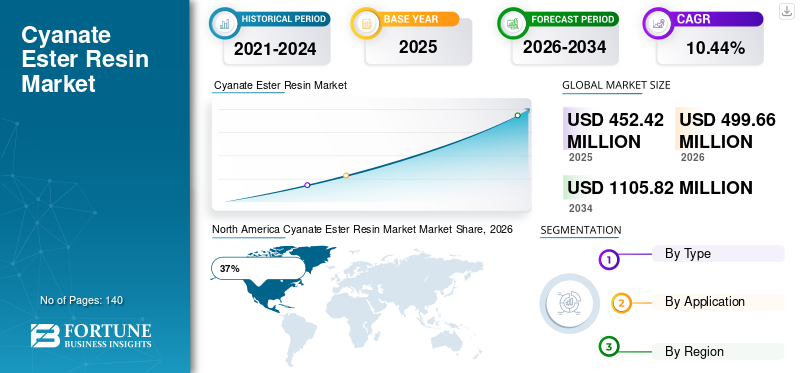
The cyanate ester resin market size was valued at USD 452.42 million in 2025. The market is projected to grow from USD 499.66 million in 2026 to USD 1105.82 million by 2034, exhibiting a CAGR of 10.44% during the forecast period.

The cyanate ester resin market is an important segment of the advanced polymer and specialty materials industry, driven by growing demand for high-performance thermosetting resins across aerospace, defense, electronics, automotive, and industrial applications. Cyanate ester resins are valued for their exceptional thermal stability, low dielectric properties, moisture resistance, dimensional stability, and mechanical strength. These characteristics make them suitable for applications requiring superior performance under demanding operating conditions. Manufacturers are increasingly focusing on advanced resin formulations that deliver improved processing capabilities and enhanced durability. The cyanate ester resin market report indicates strong demand from industries seeking lightweight materials, high-frequency electronic performance, and long-term reliability. The market continues to benefit from technological developments in composites and next-generation electronic systems.
The United States represents one of the most significant markets for cyanate ester resins due to its extensive aerospace, defense, and electronics manufacturing sectors. Demand remains strong among aircraft manufacturers, satellite developers, defense contractors, and producers of advanced electronic systems. The increasing use of lightweight composite materials in military and commercial aviation has accelerated adoption of cyanate ester resin technologies. Furthermore, investments in semiconductor packaging, telecommunications infrastructure, and high-frequency electronic components are creating additional opportunities for resin manufacturers.
research institutions and industrial organizations across the United States continue to support innovation in advanced polymer technologies. Manufacturers are developing customized cyanate ester formulations to meet evolving performance requirements in aerospace structures, radomes, antennas, and electronic circuit applications. The USA cyanate ester resin market outlook remains favorable due to sustained investments in technological innovation and advanced manufacturing capabilities.
Download Free sample to learn more about this report.
Cyanate Ester Resin Market Key Takeaways
 Global Market Size & Forecast
- 2025 Market Size: USD 452.42 Million
- 2026 Market Size: USD 499.66 Million
- 2034 Forecast Market Size: USD 1,105.82 Million
- CAGR: 10.44% from 2026-2034
 Market Share
- The market in North America dominated with a revenue share of 37% in 2025.
- Bisphenol derivative cyanate ester resins dominated by type with a market share of approximately 68%.
- Composites dominated by application with a market share of approximately 52%
 Key Regional Highlights
North America
North America led the market with a 37% share, supported by strong demand for advanced composites in aerospace, defense, and electronics.
Europe
Europe accounted for 28% of the market, driven by established aerospace and industrial manufacturing capabilities.
Asia-Pacific
Asia-Pacific held a 26% share, supported by expanding electronics manufacturing and growing demand for high-performance materials.
U.S
The U.S. remains a key market, supported by strong aerospace, defense, and advanced electronics industries.
Japan
Japan accounted for approximately 24% of the Asia-Pacific market, supported by advanced electronics manufacturing and demand for high-performance resin materials.
Read More

Cyanate Ester Resin Market Latest trends
One of the most prominent trends in the cyanate ester resin market is the increasing utilization of advanced composite materials in aerospace and defense applications. Aircraft manufacturers are seeking materials that reduce overall weight while maintaining structural integrity and thermal resistance. Cyanate ester resins have emerged as a preferred solution because they provide excellent performance under extreme environmental conditions.
Download Free sample to learn more about this report.
Another significant trend is the growing adoption of high-frequency communication systems. The expansion of advanced telecommunications networks, satellite communication systems, and radar technologies has increased demand for materials with low dielectric constants and low signal loss characteristics. Cyanate ester resins fulfill these requirements effectively, making them highly attractive for next-generation electronic applications.
The market is also witnessing increased research into hybrid resin systems that combine cyanate ester chemistry with other high-performance materials. Such innovations aim to improve processability, reduce manufacturing costs, and enhance performance characteristics. Additionally, sustainability initiatives are encouraging manufacturers to optimize production methods and develop environmentally responsible resin technologies. These developments continue to shape cyanate ester resin market trends and influence long-term industry growth.
Cyanate Ester Resin Market Dynamics
DRIVER
Rising Demand for High-Performance Composites in Aerospace and Defense
The primary driver of the cyanate ester resin market growth is the increasing use of advanced composite materials in aerospace and defense sectors. Modern aircraft, satellites, military vehicles, and defense systems require materials capable of delivering exceptional thermal stability, low weight, and superior mechanical properties. Cyanate ester resins provide these characteristics while maintaining excellent resistance to moisture and harsh environmental conditions.
The growing emphasis on fuel efficiency and operational performance has accelerated the adoption of lightweight composite structures. Aerospace manufacturers are increasingly replacing traditional metallic components with advanced composite materials to reduce overall weight. Cyanate ester resins enable the production of durable and lightweight structures that satisfy strict regulatory and performance standards. In defense applications, these materials are used in radar systems, communication equipment, missile components, and advanced protective structures. The combination of superior dielectric properties and thermal resistance continues to strengthen market demand and supports the overall cyanate ester resin market forecast.
RESTRAINT
High Manufacturing and Raw Material Costs
One of the major restraints affecting the cyanate ester resin market is the relatively high cost associated with raw materials and manufacturing processes. Compared with conventional resin systems, cyanate ester resins require specialized production technologies and stringent quality control measures. These factors contribute to higher production expenses and can limit widespread adoption in cost-sensitive industries.
The complexity of synthesis processes and the requirement for advanced processing equipment increase operational expenditures for manufacturers. Small and medium-sized enterprises may find it challenging to integrate cyanate ester technologies into their production operations due to capital investment requirements. Additionally, fluctuations in specialty chemical supply chains can influence raw material availability and pricing. These cost-related concerns may encourage some end users to explore alternative resin systems, creating competitive pressure within the market. Despite these limitations, industries requiring exceptional performance continue to justify the investment in cyanate ester materials.
OPPORTUNITY
Expansion of Advanced Electronics and Telecommunications Infrastructure
The rapid growth of telecommunications networks and advanced electronic systems presents substantial opportunities for the cyanate ester resin market. The deployment of next-generation communication technologies requires materials capable of supporting high-frequency signal transmission while minimizing energy loss. Cyanate ester resins offer favorable dielectric characteristics that make them ideal for these applications.
Manufacturers are increasingly utilizing these resins in printed circuit boards, antennas, radomes, satellite communication equipment, and electronic packaging solutions. The growing demand for data transmission efficiency and enhanced connectivity is expected to create new opportunities across commercial and industrial sectors. In addition, increasing investments in semiconductor manufacturing and advanced electronics production facilities are encouraging greater adoption of specialty resin materials. These developments support positive cyanate ester resin market opportunities and provide manufacturers with new avenues for expansion.
CHALLENGE
Competition from Alternative High-Performance Resin Technologies
A significant challenge facing the Cyanate Ester Resin industry is competition from alternative high-performance resin systems, including epoxy, bismaleimide, and polyimide resins. These competing materials often offer attractive cost-performance characteristics and benefit from established manufacturing ecosystems.
End users evaluate materials based on performance requirements, processing efficiency, availability, and cost considerations. In some applications, alternative resin technologies may provide sufficient performance at lower costs, reducing the incentive to adopt cyanate ester products. Furthermore, continuous innovation among competing resin manufacturers intensifies market competition. To maintain competitiveness, cyanate ester resin producers must invest in research and development, optimize production methods, and deliver enhanced material performance. Successfully addressing these challenges will remain critical for sustaining long-term market penetration and expanding the cyanate ester resin market share.
Cyanate Ester Resin Market Segmentation
By Type
Bisphenol derivative cyanate ester resins represent the dominant product category within the cyanate ester resin market, accounting for approximately 68% market share. These materials are widely used because they provide an excellent balance of thermal performance, mechanical strength, dielectric properties, and processing flexibility. Aerospace manufacturers frequently utilize bisphenol derivative resins in structural composites, aircraft components, and satellite systems where long-term reliability is essential.
The growing adoption of lightweight composite structures continues to support demand for this segment. Electronic manufacturers also prefer bisphenol derivative resins for advanced circuit boards and communication devices due to their low dielectric characteristics. Continuous improvements in resin chemistry have enhanced toughness and processability, expanding application opportunities. The strong performance profile and broad industrial acceptance of bisphenol derivatives contribute significantly to overall cyanate ester resin market Size and industry development.
Novolac-based cyanate ester resins account for approximately 32% market share and are primarily utilized in applications requiring enhanced thermal resistance and dimensional stability. These resins are known for their highly cross-linked molecular structure, which contributes to superior heat resistance and outstanding mechanical performance under demanding conditions.
Industries such as aerospace, defense, electronics, and industrial manufacturing increasingly utilize novolac cyanate ester formulations for critical applications. The ability to withstand elevated temperatures while maintaining structural integrity makes these materials attractive for advanced engineering projects. research activities focused on improving resin processing and reducing manufacturing complexity continue to support growth within this segment. Demand for high-performance materials in mission-critical applications remains a key factor supporting adoption of novolac-based cyanate ester technologies.
To know how our report can help streamline your business, Speak to Analyst
By Application
Composites represent the largest application segment in the cyanate ester resin market, accounting for approximately 52% market share. The extensive use of cyanate ester resin in advanced composite structures is driven by the increasing demand for lightweight materials capable of delivering exceptional thermal and mechanical performance. Aerospace manufacturers rely heavily on composite components produced using cyanate ester resins to improve fuel efficiency, structural integrity, and operational reliability.
The aerospace and defense sectors continue to be the primary consumers of cyanate ester-based composites. These materials are widely used in aircraft fuselage structures, radomes, satellite components, launch vehicles, and military equipment. Their low moisture absorption and outstanding dielectric performance further enhance suitability for high-frequency communication systems and electronic applications. Increasing investments in advanced air mobility platforms, space exploration programs, and next-generation defense technologies are expected to support continued demand. The segment remains a major contributor to cyanate ester resin market growth due to ongoing innovation in lightweight engineering materials.
Adhesives account for approximately 27% market share within the cyanate ester resin market. These specialty adhesive systems are increasingly utilized in applications requiring strong bonding performance, resistance to harsh environments, and long-term structural durability. Cyanate ester adhesives are particularly valuable in aerospace assemblies, electronic packaging systems, and industrial equipment where conventional adhesives may not provide adequate performance.
Manufacturers are focusing on developing advanced adhesive formulations capable of operating under extreme temperature conditions while maintaining mechanical integrity. The growing complexity of electronic devices and aerospace structures has increased the need for high-performance bonding materials. Cyanate ester adhesive systems offer low outgassing properties and superior dimensional stability, making them suitable for mission-critical applications. Demand is further supported by technological advancements in electronic miniaturization and composite assembly techniques. These factors continue to strengthen the role of adhesives in the overall cyanate ester resin market analysis.
Coatings represent approximately 21% market share in the cyanate ester resin market. Cyanate ester-based coatings are widely utilized in industries where thermal stability, corrosion resistance, and dielectric performance are essential. These coatings provide durable protective barriers for advanced electronic components, aerospace structures, industrial machinery, and specialized equipment.
The increasing deployment of sophisticated electronics and communication systems has created additional demand for protective coating technologies capable of maintaining performance under demanding operating conditions. Cyanate ester coatings offer superior resistance to moisture, chemicals, and thermal degradation compared to many traditional coating systems. Manufacturers continue to invest in research and development initiatives aimed at improving application efficiency and extending service life. As industrial sectors seek higher-performing protective materials, cyanate ester coatings are expected to remain an important application segment supporting overall market expansion.
Cyanate Ester Resin Market Regional outlook
North America Cyanate Ester Resin Market Share, 2026 (%)
To get more information on the regional analysis of this market, Download Free sample
North America
North America remains the leading regional market for cyanate ester resin, holding approximately 37% market share. The region benefits from a highly developed aerospace and defense industry, significant investments in advanced manufacturing technologies, and strong demand for high-performance materials. The presence of major aircraft manufacturers, defense contractors, and electronics companies contributes substantially to market development.
The United States dominates regional consumption due to extensive utilization of advanced composites in commercial aviation, military systems, and space exploration initiatives. Demand is also supported by ongoing modernization programs in defense infrastructure and increasing adoption of advanced communication technologies. Manufacturers continue to expand production capabilities and invest in material innovation to meet evolving industry requirements. The combination of technological leadership and strong industrial demand supports North America's position within the cyanate ester resin market outlook.
Europe
Europe accounts for approximately 28% market share in the global cyanate ester resin market. The region is characterized by a strong aerospace manufacturing base, advanced automotive engineering capabilities, and significant investments in research and development. European industries place considerable emphasis on lightweight materials, sustainable engineering practices, and technological innovation.
The region's aerospace sector remains a major consumer of cyanate ester resin products, particularly for aircraft structures, communication systems, and satellite applications. Additionally, growing investments in renewable energy infrastructure and advanced transportation technologies are contributing to increased material demand. European manufacturers continue to pursue innovations that improve performance characteristics while meeting stringent environmental standards. These factors collectively support stable growth across the regional market.
Germany cyanate ester resin market
Germany represents approximately 31% of the European cyanate ester resin market. As Europe's largest industrial economy, Germany plays a crucial role in the adoption and development of advanced materials technologies. The country's strong engineering tradition and advanced manufacturing capabilities create favorable conditions for the utilization of high-performance resin systems.
German aerospace manufacturers increasingly rely on lightweight composite materials to improve aircraft performance and operational efficiency. In addition, advanced electronics production and industrial automation initiatives contribute to growing demand for specialty resins. research institutions and industrial organizations actively collaborate to develop innovative materials capable of supporting next-generation manufacturing requirements. The emphasis on precision engineering and technological excellence continues to reinforce Germany's leadership position within the regional cyanate ester resin industry.
United Kingdom cyanate ester resin market
The United Kingdom accounts for approximately 22% of the European cyanate ester resin market. Demand is largely driven by aerospace, defense, electronics, and advanced manufacturing industries. The country's established aerospace sector remains a key consumer of cyanate ester composites used in aircraft structures, communication systems, and defense equipment.
Ongoing investments in innovation, materials science, and advanced manufacturing technologies support continued market development. British manufacturers are increasingly focused on high-value engineering applications that require superior thermal performance and mechanical durability. Furthermore, collaborations between industry participants and research organizations contribute to the development of specialized resin formulations tailored to emerging market requirements. The UK's emphasis on technological advancement and engineering excellence strengthens its position within the European market.
Asia-Pacific
Asia-Pacific accounts for approximately 26% market share and represents one of the fastest-evolving regions in the cyanate ester resin market. Rapid industrialization, expanding electronics manufacturing capabilities, and increasing investments in aerospace infrastructure are driving demand across multiple countries. The region has become a major center for advanced materials production and technology development.
Growing semiconductor manufacturing activities, telecommunications expansion, and rising defense expenditures are creating significant opportunities for cyanate ester resin suppliers. Countries throughout the region continue to invest heavily in research and development programs focused on advanced materials and high-performance composites. The increasing presence of domestic aerospace manufacturers further supports market growth. These factors collectively contribute to the expanding importance of Asia-Pacific within the global industry landscape.
Japan cyanate ester resin market
Japan accounts for approximately 24% of the Asia-Pacific cyanate ester resin market. The country's advanced electronics industry and strong focus on technological innovation create favorable conditions for specialty resin adoption. Japanese manufacturers utilize cyanate ester materials in high-performance electronic components, communication systems, and aerospace applications.
The demand for materials capable of supporting miniaturized electronics and high-frequency communication technologies remains strong. research and development activities continue to focus on improving resin performance, processing efficiency, and long-term reliability. Japan's emphasis on quality, precision engineering, and technological leadership supports sustained market demand. Additionally, investments in aerospace technologies and advanced industrial manufacturing contribute to the growing utilization of cyanate ester resin products throughout the country.
China cyanate ester resin market
China represents approximately 42% of the Asia-Pacific cyanate ester resin market. The country has emerged as a major manufacturing hub for electronics, aerospace components, telecommunications equipment, and advanced industrial products. Strong government support for high-technology industries continues to encourage adoption of advanced materials.
The expansion of domestic aerospace programs, satellite development initiatives, and next-generation communication infrastructure has significantly increased demand for cyanate ester resin products. Chinese manufacturers are investing heavily in research, production capacity expansion, and technological innovation to strengthen competitiveness. The growing need for lightweight composite materials and advanced electronic performance further supports market development. These factors position China as a key contributor to regional and global industry growth.
Rest of World
The Rest of World region accounts for approximately 9% market share in the cyanate ester resin market. This category includes Latin America, the Middle East, and Africa, where demand is gradually increasing as industrial capabilities continue to develop. Infrastructure modernization, defense investments, and expansion of industrial manufacturing activities contribute to market opportunities.
Several countries within these regions are increasing investments in aerospace maintenance, telecommunications infrastructure, and advanced engineering projects. Although market penetration remains lower than in developed regions, growing awareness of high-performance materials is encouraging adoption. Manufacturers are increasingly exploring opportunities to expand distribution networks and establish strategic partnerships in emerging markets. The gradual expansion of industrial sectors across these regions supports long-term demand for cyanate ester resin technologies.
List of Top Cyanate Ester Resin Companies
- Huntsman International LLC
- Arxada Ltd.
- Toray Advanced Composites
- Hexcel Corporation
- MITSUBISHI GAS CHEMICAL COMPANY, INC
- Henkel AG & Company
- Novoset, LLC
- Solvay
- Syensqo
- TenCate Advanced Composites
Top Two Companies with Highest Market share
- Mitsubishi Gas Chemical Company, Inc. – approximately 18%
- Huntsman International LLC – approximately 15%
Investment analysis and opportunities
Investment activity within the cyanate ester resin market continues to increase as manufacturers and end users recognize the growing importance of advanced polymer technologies. Aerospace modernization programs, satellite deployment initiatives, defense procurement projects, and next-generation electronics manufacturing are creating attractive opportunities for investors seeking exposure to high-performance materials. Capital expenditure is increasingly directed toward expanding production facilities, improving resin synthesis technologies, and developing customized formulations capable of addressing specialized application requirements.
One of the most promising investment areas involves advanced composite manufacturing. The increasing use of lightweight structural materials across aerospace and transportation sectors is encouraging long-term investment in cyanate ester resin technologies. Companies are allocating resources toward research programs focused on improving processability, reducing manufacturing complexity, and enhancing product performance.
Another major opportunity stems from the rapid expansion of telecommunications infrastructure and advanced semiconductor production. As industries seek materials with superior dielectric properties and thermal stability, demand for cyanate ester resin products is expected to strengthen. Strategic partnerships, technology licensing agreements, and regional manufacturing expansion projects continue to provide attractive opportunities for industry participants. Investors are particularly interested in companies capable of supplying innovative materials for aerospace, defense, and high-frequency electronic applications.
New Product Development
Innovation remains a key competitive factor in the cyanate ester resin market. Manufacturers are actively developing advanced resin formulations designed to meet evolving performance requirements across aerospace, electronics, and industrial sectors. New product development efforts are focused on improving thermal resistance, mechanical strength, processing efficiency, and environmental durability while maintaining the fundamental advantages of cyanate ester chemistry.
Recent innovations include hybrid resin systems that combine cyanate ester technology with complementary high-performance materials. These formulations are designed to provide enhanced toughness, improved manufacturing flexibility, and reduced curing times. Such developments help manufacturers address customer requirements for greater production efficiency and lower operational costs.
In the electronics sector, research activities are targeting materials capable of supporting high-frequency signal transmission and advanced semiconductor packaging applications. Manufacturers are also introducing specialized grades optimized for aerospace structures, satellite components, and defense communication systems. Continued investment in material science and polymer engineering is expected to generate additional opportunities for differentiation and market expansion.
Five Recent Developments (2023–2025)
- Expansion of Aerospace Composite Programs
- Development of Advanced Low-Dielectric Resin Systems
- Increased Investment in Production Capacity
- Strategic Collaboration for Composite Innovation
- Introduction of Enhanced Thermal Stability Grades
report Coverage
The cyanate ester resin market research report provides a comprehensive assessment of industry dynamics, competitive developments, application trends, technological advancements, and regional demand patterns. The report evaluates key factors influencing market expansion, including developments in aerospace manufacturing, defense modernization, telecommunications infrastructure, and advanced electronics production.
Request for Customization to gain extensive market insights.
The study includes detailed analysis of major product categories, application segments, regional markets, and competitive strategies adopted by leading manufacturers. Market participants can utilize the report to understand evolving customer requirements, identify emerging opportunities, and evaluate strategic investment priorities. The assessment further examines innovation trends, production developments, and technological advancements shaping the future direction of the industry.
Additionally, the report provides valuable insights regarding supply chain developments, manufacturing capabilities, product differentiation strategies, and industry challenges. Coverage extends across established and emerging markets, enabling stakeholders to evaluate growth prospects and competitive positioning. The Cyanate Ester Resin industry report serves as a valuable resource for manufacturers, investors, distributors, suppliers, technology developers, and other stakeholders seeking a comprehensive understanding of current market conditions and future opportunities.
Frequently Asked Questions
Fortune Business Insights says that the global market value stood at USD 452.42 million in 2025 and is projected to reach USD 1,105.82 million by 2034.
The market is expected to exhibit a CAGR of 10.44% during the forecast period of 2026-2034.
Bisphenol derivative cyanate ester resins led the type segment with approximately 68% share, supported by their strong thermal, mechanical, and dielectric properties and broad industrial use.
Key players include Huntsman International LLC, Arxada Ltd., Toray Advanced Composites, Hexcel Corporation, Mitsubishi Gas Chemical Company, Inc., and Henkel AG & Company.
Major trends include increasing use of advanced composite materials in aerospace and defense and growing adoption in high-frequency communication systems. North America dominated with a 37% market share.



- 2021-2034
- 2025
- 2021-2024
- 140
-

(Offer valid till 15th Oct 2026)
Get 30-60 hrs Free Customization
Expand Regional and Country Coverage, Segments Analysis, Company Profiles, Competitive Benchmarking, and End-user Insights.


















-
US +1 833 909 2966 ( Toll Free )
-
Get In Touch With Us