Cyberknife Market Size, Share & Industry Analysis, By Application (Tumor, Cancer, Vascular Malformation), By End-use (Hospitals, Outpatient Facilities, Research & Manufacturing), and Regional Forecast, 2026-2034
 Download Free Sample
Cyberknife Market Overview
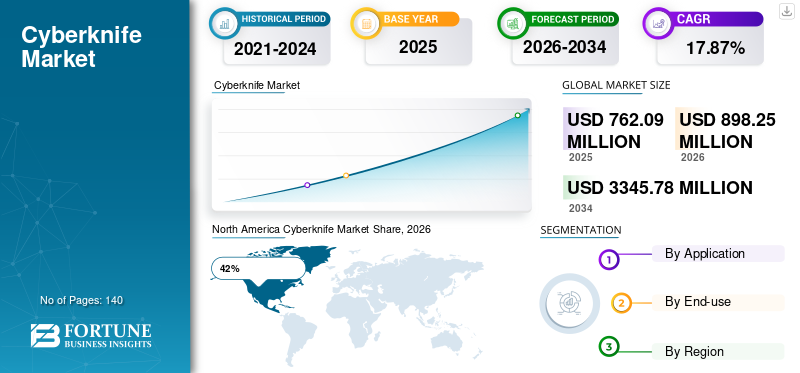
The global cyberknife market size was valued at USD 762.09 million in 2025. The market is projected to grow from USD 898.25 million in 2026 to USD 3,345.78 million by 2034, exhibiting a CAGR of 17.87% during the forecast period.

The cyberknife market is experiencing steady expansion due to increasing demand for non-invasive radiosurgery systems used in the treatment of cancerous and non-cancerous tumors. Cyberknife technology delivers highly precise radiation therapy while minimizing damage to surrounding healthy tissues, making it a preferred solution in advanced oncology care. Growing adoption of image-guided robotic radiosurgery, rising incidence of prostate cancer, brain tumors, lung cancer, and spinal lesions, and increasing healthcare investments are supporting market expansion. The cyberknife market report indicates that hospitals and specialty cancer centers are increasingly incorporating robotic radiation systems to improve treatment accuracy, patient outcomes, and operational efficiency. Continuous technological improvements and treatment planning innovations are further strengthening cyberknife market growth.
The United States accounts for approximately 39% of the global cyberknife market share due to its advanced healthcare infrastructure and widespread adoption of robotic radiosurgery systems. More than 2,100 radiation oncology centers operate across the country, with a significant number offering stereotactic radiosurgery procedures. Rising diagnosis rates of prostate cancer, lung cancer, and brain tumors continue to drive demand for precision treatment technologies. Academic medical centers and specialized oncology facilities are actively expanding radiosurgery capabilities. Increasing utilization of outpatient cancer treatment programs and favorable reimbursement structures further support cyberknife market growth in the United States. The country remains a major hub for technological advancements, clinical trials, and innovation in robotic radiation therapy systems.
Download Free sample to learn more about this report.
Cyberknife Market Key Takeaways
 Global Market Size & Forecast
- 2025 Market Size: USD 762.09 Billion
- 2026 Market Size: USD 898.25 Billion
- 2034 Forecast Market Size: USD 3,345.78 Billion
- CAGR: 17.87% from 2026-2034
 Market Share
- The market in North America dominated with a revenue share of 42% in 2025.
- The cancer application segment accounted for approximately 52% of the market share.
- The hospitals segment accounted for approximately 63% of the market share.
 Key Regional Highlights
North America
North America held the largest regional share at 42% in 2025.
Europe
Europe accounted for 29% of the global market.
Asia-Pacific
Asia-Pacific represented 22% of the global market, supported by increasing adoption of advanced radiosurgery technologies.
U.S
The U.S. is a major market due to advanced healthcare infrastructure and strong adoption of precision oncology technologies.
Japan
Japan accounted for 36% of the Asia-Pacific market, supported by advanced medical technology and growing demand for minimally invasive cancer treatment.
Read More

Cyberknife Market Latest Trends
Several emerging trends are shaping the cyberknife market outlook. One of the most notable trends is the increasing adoption of hypofractionated radiation therapy, where patients receive fewer treatment sessions with higher radiation doses. This approach improves patient convenience and reduces healthcare resource utilization. Artificial intelligence integration into treatment planning systems is enhancing targeting accuracy and workflow efficiency. Another significant trend involves expansion of Cyberknife applications beyond oncology into functional neurological disorders and vascular abnormalities.
Healthcare providers are increasingly focusing on personalized radiation treatment plans based on patient-specific imaging and biological characteristics. Growth in outpatient radiosurgery facilities is creating new opportunities for equipment deployment. The cyberknife industry analysis also highlights increasing investments in image-guided treatment platforms capable of real-time tumor tracking. Demand for non-invasive treatment alternatives among elderly patients is rising significantly. Furthermore, healthcare institutions are prioritizing technologies that reduce hospitalization periods and improve treatment precision. These developments continue to strengthen cyberknife market trends and support broader adoption across developed and emerging healthcare systems.
Download Free sample to learn more about this report.
Cyberknife Market Dynamics
DRIVER
Rising Prevalence of Cancer and Demand for Non-Invasive Treatment Solutions
The increasing global burden of cancer remains the primary growth driver for the cyberknife market. More than 20 million new cancer cases are diagnosed annually worldwide, creating substantial demand for advanced treatment technologies. Cyberknife systems offer a non-invasive alternative to conventional surgery, making them highly attractive for patients who are unsuitable for surgical intervention. The ability to precisely target tumors while preserving healthy tissue improves treatment outcomes and reduces complications. Healthcare providers are increasingly adopting stereotactic radiosurgery technologies to address growing oncology workloads. Rising awareness regarding minimally invasive procedures and improving patient preference for shorter recovery periods continue to accelerate cyberknife market growth. Expansion of cancer treatment facilities and increasing investments in oncology infrastructure further support long-term market development.
RESTRAINT
High Installation and Operational Costs
The substantial capital investment required for Cyberknife systems remains a major market restraint. Installation costs frequently exceed those associated with conventional radiotherapy equipment, limiting adoption among smaller healthcare institutions. Additional expenses related to facility modifications, staff training, maintenance, and software upgrades further increase ownership costs. Budget constraints in developing healthcare systems continue to restrict widespread deployment. Many hospitals prioritize alternative radiation technologies with lower acquisition costs. Reimbursement limitations in certain healthcare markets also affect purchasing decisions. The cyberknife market analysis indicates that financial barriers remain particularly significant in emerging economies where healthcare spending levels are comparatively lower. These factors continue to moderate adoption rates despite growing clinical demand for advanced radiosurgery solutions.
OPPORTUNITY
Expansion of Oncology Infrastructure in Emerging Economies
Rapid healthcare modernization across emerging markets presents significant opportunities for cyberknife market expansion. Countries throughout Asia-Pacific, Latin America, and the Middle East are increasing investments in specialized cancer treatment facilities. Growing awareness regarding advanced radiation therapy options is encouraging healthcare providers to upgrade oncology infrastructure. Public and private sector collaborations are supporting installation of advanced radiosurgery systems in regional cancer centers. Increasing healthcare expenditure and expanding insurance coverage improve patient access to precision oncology treatments. The cyberknife market research report identifies emerging economies as a key growth area due to large patient populations and rising cancer incidence. Continued infrastructure development is expected to create substantial opportunities for manufacturers and healthcare providers.
CHALLENGE
Shortage of Highly Trained Radiation Oncology Professionals
Effective operation of Cyberknife systems requires specialized expertise in radiation oncology, medical physics, and treatment planning. Many healthcare facilities face challenges in recruiting and retaining qualified professionals capable of managing advanced radiosurgery procedures. Training requirements are extensive and often require significant institutional investment. Workforce shortages are particularly evident in developing healthcare systems where access to specialized education remains limited. The increasing complexity of modern radiation therapy technologies further elevates staffing requirements. cyberknife market Insights suggest that human resource limitations can delay implementation timelines and reduce system utilization rates. Addressing workforce development challenges remains critical for maximizing adoption and ensuring optimal clinical outcomes.
Cyberknife Market Segmentation
By Application
Tumor treatment represents approximately 31% of the cyberknife market share. Cyberknife systems are widely utilized for treating brain tumors, spinal tumors, lung tumors, liver tumors, and pancreatic tumors. The technology's ability to deliver sub-millimeter accuracy enables effective treatment of complex tumor locations while minimizing radiation exposure to surrounding tissues. Increasing diagnosis rates and growing demand for non-invasive treatment approaches continue to support this segment. Healthcare providers are increasingly adopting robotic radiosurgery for recurrent and inoperable tumors. Improved imaging capabilities and real-time tracking technologies further enhance treatment effectiveness.
Cancer applications account for approximately 52% of the cyberknife market share, making it the dominant segment. Prostate cancer, lung cancer, breast cancer, and head-and-neck cancers are major treatment categories. Growing global cancer incidence and increasing emphasis on precision oncology are supporting segment growth. Cyberknife systems enable targeted radiation delivery with fewer treatment sessions compared to traditional approaches. Healthcare institutions are expanding cancer treatment programs to accommodate rising patient volumes. Clinical evidence demonstrating improved treatment precision and reduced side effects continues to drive adoption.
Vascular malformation applications hold approximately 17% of the cyberknife market share. The technology is increasingly utilized for treating arteriovenous malformations and other vascular abnormalities that are difficult to manage through conventional surgery. Precision targeting capabilities make Cyberknife systems particularly valuable in neurologically sensitive regions. Rising awareness among neurosurgeons and radiation specialists is supporting broader utilization. Advances in imaging technologies improve lesion identification and treatment planning accuracy. Growing preference for minimally invasive treatment alternatives further contributes to segment expansion. Healthcare providers continue exploring new applications of robotic radiosurgery for complex vascular conditions.
To know how our report can help streamline your business, Speak to Analyst
By End-use
Hospitals account for approximately 63% of the cyberknife market share. Large medical centers possess the infrastructure, capital resources, and specialized staff required to operate advanced radiosurgery systems. Hospitals manage high patient volumes and frequently serve as referral centers for complex oncology cases. Integration of multidisciplinary cancer care programs supports adoption of precision radiation technologies. Increasing investments in oncology departments and growing demand for advanced treatment capabilities continue driving market growth within this segment. Hospitals remain the primary end users of Cyberknife systems worldwide.
Outpatient facilities represent approximately 24% of the cyberknife market share. Growing emphasis on cost-effective healthcare delivery is encouraging expansion of outpatient radiosurgery services. Cyberknife treatment often requires limited recovery time, making it well suited for outpatient settings. Patients increasingly prefer treatment options that minimize hospitalization and reduce disruption to daily activities. Advances in treatment planning and workflow efficiency further support utilization in outpatient environments. The segment is expected to maintain strong growth as healthcare systems focus on operational efficiency and patient convenience.
Research and manufacturing organizations account for approximately 13% of the cyberknife market share. These institutions play a critical role in technology development, clinical validation, and product innovation. Research centers conduct studies evaluating treatment efficacy, expanding clinical indications, and optimizing treatment protocols. Manufacturing investments focus on robotics, imaging technologies, software platforms, and radiation delivery systems. Collaboration between academic institutions and industry participants continues driving technological advancement. This segment supports long-term cyberknife market opportunities through innovation and product enhancement.
Cyberknife Market Regional Outlook
North America
North America Cyberknife Market Share, 2025 (%)
To get more information on the regional analysis of this market, Download Free sample
North America dominates the cyberknife market with approximately 42% market share due to its advanced healthcare ecosystem and extensive adoption of innovative cancer treatment technologies. The region benefits from a large number of specialized cancer treatment centers equipped with robotic radiosurgery systems. Growing incidence of prostate cancer, lung cancer, brain tumors, and spinal tumors continues to support demand for precise radiation therapy solutions. Healthcare providers increasingly invest in image-guided treatment platforms that improve clinical outcomes and patient safety. Strong reimbursement frameworks encourage hospitals and outpatient facilities to expand radiosurgery capabilities. Academic institutions and research organizations actively conduct clinical studies that support broader utilization of Cyberknife technology. Continuous technological innovation, high healthcare spending, and strong awareness among oncology professionals contribute to sustained market growth. The region also benefits from early adoption of artificial intelligence-assisted treatment planning and real-time tumor tracking technologies. Expansion of outpatient oncology services further strengthens market opportunities across the United States and Canada.
Europe
Europe accounts for approximately 29% of the cyberknife market share and remains a key region for advanced radiation oncology services. The market is supported by well-established healthcare systems, increasing investments in cancer treatment infrastructure, and growing demand for minimally invasive therapies. Several European countries continue to modernize radiotherapy facilities to improve treatment precision and patient outcomes. Rising prevalence of cancer and aging populations create sustained demand for robotic radiosurgery solutions. Healthcare providers increasingly focus on technologies that reduce treatment complications while improving operational efficiency. Research collaborations among hospitals, universities, and technology providers contribute to innovation and clinical validation of new treatment applications. The region benefits from strong regulatory standards and growing physician acceptance of stereotactic radiosurgery procedures. Expansion of specialized oncology centers and increasing awareness regarding non-invasive treatment options continue to support cyberknife market growth across Europe.
Germany Cyberknife Market
Germany represents approximately 22 % of the global cyberknife market share and remains one of Europe's most important markets for advanced radiation therapy systems. The country possesses a highly developed healthcare infrastructure with numerous specialized oncology hospitals and cancer treatment centers. Increasing demand for precision cancer therapies has encouraged healthcare providers to invest in robotic radiosurgery technologies. Growing diagnosis rates of prostate cancer, brain tumors, and lung cancer continue to drive treatment volumes. German hospitals emphasize clinical excellence and technological innovation, supporting adoption of advanced treatment platforms. Research institutions actively participate in studies focused on treatment optimization and expanded clinical applications. Strong healthcare funding mechanisms and physician expertise contribute to widespread utilization of Cyberknife systems. Continuous modernization of oncology departments and increasing patient preference for non-invasive procedures further strengthen market expansion within Germany.
United Kingdom Cyberknife Market
The United Kingdom accounts for approximately 35% of the global cyberknife market share and continues to experience steady growth in robotic radiosurgery adoption. Increasing focus on improving cancer treatment outcomes has encouraged healthcare organizations to expand access to precision radiation technologies. Specialized oncology centers are investing in advanced treatment systems capable of delivering highly targeted therapy with minimal impact on healthy tissue. Rising incidence of prostate, lung, and brain cancers contributes significantly to market demand. Healthcare providers are emphasizing shorter treatment schedules and improved patient convenience through advanced radiosurgery techniques. Government-supported healthcare modernization initiatives continue to strengthen treatment infrastructure across the country. Growing awareness among clinicians regarding the benefits of stereotactic radiosurgery supports broader adoption. Expansion of outpatient cancer treatment services and ongoing investments in oncology innovation further contribute to market development.
Asia-Pacific
Asia-Pacific holds approximately 22% of the cyberknife market share and is emerging as the fastest-growing regional market. Rapid healthcare infrastructure development, increasing healthcare expenditure, and rising cancer prevalence are key factors driving growth. Governments across the region are investing heavily in modern oncology facilities and advanced medical technologies to address growing healthcare demands. Large patient populations and increasing awareness regarding non-invasive treatment options create favorable market conditions. Healthcare institutions are expanding cancer treatment capacities and adopting precision radiation therapy solutions to improve clinical outcomes. International partnerships and technology transfer agreements are accelerating the deployment of advanced radiosurgery systems. Urbanization and improving healthcare accessibility support broader adoption across major economies. Continuous investment in physician training and specialized oncology services further strengthens market expansion. The region presents significant opportunities for manufacturers seeking long-term growth in emerging healthcare markets.
Japan Cyberknife Market
Japan accounts for approximately 36% of the global cyberknife market share and remains a technologically advanced market for robotic radiosurgery systems. The country's aging population contributes to rising demand for cancer treatment solutions and minimally invasive therapeutic options. Hospitals and specialized cancer centers actively invest in precision radiation technologies to improve treatment outcomes. High standards of healthcare delivery and strong physician expertise support widespread adoption of advanced oncology equipment. Japanese healthcare providers prioritize technologies that enhance treatment accuracy while reducing patient discomfort. Ongoing research and development activities contribute to innovation in radiation therapy protocols and treatment planning. Government support for healthcare modernization and cancer management initiatives further strengthens market growth. Increasing utilization of image-guided radiosurgery systems continues to support expansion across the Japanese healthcare sector.
China Cyberknife Market
China represents approximately 7% of the global cyberknife market share and is one of the most rapidly expanding markets for advanced cancer treatment technologies. Growing healthcare expenditure and large-scale investment in hospital infrastructure are supporting market growth. Rising cancer incidence and increasing demand for precision treatment options continue to drive adoption of robotic radiosurgery systems. Major healthcare institutions are expanding oncology services to accommodate growing patient volumes. Government healthcare reforms and modernization initiatives encourage acquisition of advanced medical technologies. Increased awareness regarding non-invasive cancer treatment alternatives is improving patient acceptance. International collaborations and technology partnerships are facilitating knowledge transfer and clinical development. Expansion of specialized cancer treatment centers and improving healthcare accessibility contribute significantly to market growth across China.
Rest of World
The Rest of World region accounts for approximately 7% of the cyberknife market share and includes Latin America, the Middle East, and Africa. Although adoption levels remain lower than in developed regions, significant growth opportunities are emerging due to ongoing healthcare modernization efforts. Governments and private healthcare organizations are investing in advanced oncology infrastructure to improve access to cancer treatment services. Rising awareness regarding precision radiation therapy is encouraging healthcare providers to explore robotic radiosurgery technologies. Increasing cancer incidence across several countries is creating demand for effective and minimally invasive treatment options. Public-private partnerships are supporting installation of advanced medical equipment in specialized healthcare facilities. Improvements in physician training and healthcare accessibility contribute to market expansion. Growing focus on reducing cancer-related mortality and improving treatment outcomes continues to drive long-term cyberknife market opportunities across the region.
List of Top Cyberknife Companies
- Advanced Micro Devices
- AiCure
- Arm Limited
- Atomwise, Inc.
- Ayasdi AI LLC
- Baidu, Inc.
Top Two Companies with Highest Market Share
- Baidu, Inc. – 22%
- Arm Limited – 18%
Investment Analysis and Opportunities
Investment activity within the cyberknife market continues to increase as healthcare providers prioritize precision oncology technologies. Hospitals and cancer centers are allocating significant capital toward advanced radiosurgery systems to enhance treatment capabilities. Investors recognize growing demand for non-invasive cancer treatment solutions and expanding applications beyond traditional oncology indications. Strategic partnerships between technology developers and healthcare institutions support innovation and commercialization efforts.
Emerging markets present substantial investment opportunities due to ongoing healthcare infrastructure development and increasing cancer burden. Private healthcare providers are actively expanding oncology services, creating demand for advanced treatment technologies. Investments in artificial intelligence, imaging systems, and robotic treatment planning platforms are expected to improve operational efficiency and clinical outcomes. Venture capital participation in digital oncology solutions continues to rise. Manufacturers are focusing on geographic expansion, product upgrades, and service network development to strengthen competitive positioning. The cyberknife market forecast suggests strong opportunities associated with healthcare modernization initiatives and growing emphasis on precision medicine.
New Product Development
Product innovation remains a major focus within the cyberknife market. Manufacturers are introducing advanced imaging systems capable of improving tumor visualization and treatment accuracy. Enhanced real-time motion tracking technologies enable more precise radiation delivery for moving targets such as lung tumors. Artificial intelligence integration is improving treatment planning efficiency and workflow automation.
New software platforms support adaptive treatment strategies based on patient-specific characteristics and treatment responses. Improvements in robotic arm functionality enhance positioning accuracy and operational flexibility. Manufacturers are also focusing on reducing treatment times while maintaining precision. Cloud-based data management solutions are improving collaboration among oncology professionals. Research initiatives continue exploring new clinical indications including neurological disorders and vascular conditions. These technological developments strengthen cyberknife market growth by improving treatment effectiveness, operational efficiency, and patient experience.
Five Recent Developments (2023-2025)
- Introduction of advanced AI-assisted treatment planning software to improve targeting precision and workflow efficiency.
- Expansion of Cyberknife installations across major oncology centers in Asia-Pacific healthcare markets.
- Development of enhanced real-time tumor tracking technologies for respiratory motion management.
- Launch of upgraded imaging integration systems supporting adaptive radiation therapy protocols.
- Strategic collaborations between healthcare providers and technology developers to expand radiosurgery accessibility.
Report Coverage
The cyberknife market report provides comprehensive analysis of industry structure, market dynamics, technological advancements, competitive landscape, and regional performance. The report evaluates key growth drivers, restraints, opportunities, and challenges influencing market development. Detailed segmentation analysis examines treatment types and application categories while highlighting their respective market shares and adoption trends.
Request for Customization to gain extensive market insights.
The study includes extensive assessment of regional markets across North America, Europe, Asia-Pacific, and Rest of World. Competitive analysis reviews major market participants, strategic initiatives, innovation activities, and expansion strategies. Investment trends, product development activities, and technological advancements are thoroughly examined to provide actionable business intelligence. The cyberknife industry report further evaluates healthcare infrastructure development, oncology treatment demand, and emerging market opportunities. Coverage extends to regulatory developments, adoption patterns, and future industry prospects, enabling stakeholders to make informed strategic decisions within the evolving cyberknife market.
Frequently Asked Questions
Fortune Business Insights says that the global market value stood at USD 762.09 billion in 2025 and is projected to reach USD 3,345.78 billion by 2034.
The market is expected to exhibit a CAGR of 17.87% during the forecast period of 2026-2034.
Cancer applications led the market with approximately 52% share, supported by rising cancer incidence and growing emphasis on precision oncology.
Key players mentioned on the page include Advanced Micro Devices, AiCure, Arm Limited, Atomwise, Inc., Ayasdi AI LLC, and Baidu, Inc.
Major trends include the increasing adoption of hypofractionated radiation therapy and AI-integrated treatment planning; North America leads regionally with approximately 42% market share.



- 2021-2034
- 2025
- 2021-2024
- 140
-

(Offer valid till 15th Oct 2026)
Get 30-60 hrs Free Customization
Expand Regional and Country Coverage, Segments Analysis, Company Profiles, Competitive Benchmarking, and End-user Insights.













.webp)






-
US +1 833 909 2966 ( Toll Free )
-
Get In Touch With Us