Dairy Desserts Market Size, Share & Industry Analysis, By Product Type (Ice Cream, Custard, Pudding, and Others), By Distribution Channel [B2B and B2C (Supermarkets/Hypermarkets, Convenience Stores, Specialty Stores, Online Retail, and Others)], and Regional Forecast, 2026-2034
 Download Free Sample
(Offer valid till 15th Oct 2026)

KEY MARKET INSIGHTS
 Listen to Audio Version
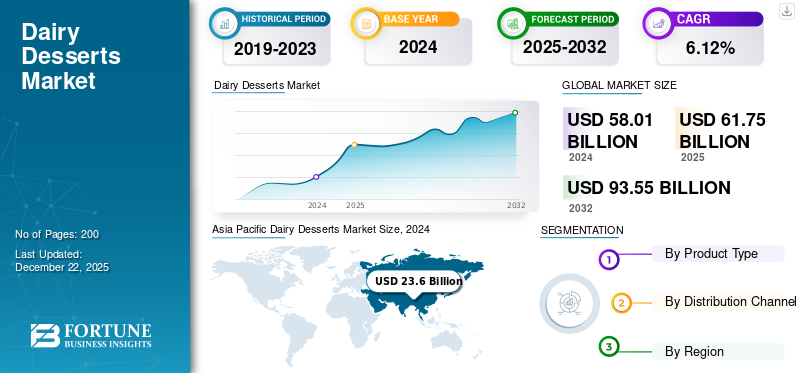
The global dairy desserts market size was valued at USD 61.75 billion in 2025 and is projected to grow from USD 65.44 billion in 2026 to USD 101.66 billion by 2034, exhibiting a CAGR of 5.66% during the forecast period. Asia Pacific dominated the dairy desserts market with a market share of 40.24% in 2025.
Dairy desserts are ready-to-eat products primarily using milk or milk products as a key ingredient. These include frozen dairy confections and novelties, and dairy-based fillings such as ice creams, custards, and other products. The market is expected to grow significantly, owing to rising consumer demand for convenience foods, growing disposable incomes, particularly in developing regions, and innovation by key manufacturers. Danone SA, Nestlé S.A., Unilever plc, Baskin-Robbins Inc., and Meiji Holdings are some of the major players operating in the market.
Download Free sample to learn more about this report.
Dairy Desserts Market Key Takeaways
 Global Market Size & Forecast
- 2025 Market Size: USD 61.75 billion
- 2026 Market Size: USD 65.44 billion
- 2034 Forecast Market Size: USD 101.66 billion
- CAGR: 5.66% from 2026–2034
 Market Share
- Asia Pacific dominated the dairy desserts market with a 40.24% share in 2025.
- The ice cream segment accounted for the largest market share in 2025.
- The B2C distribution segment held the highest market share in 2025.
 Key Regional Highlights
Asia Pacific
Asia Pacific led the global market, generating USD 24.84 billion in revenue in 2025.
North America
North America generated USD 15.14 billion in revenue in 2025.
Europe
Europe recorded USD 9.94 billion in market revenue in 2025.
U.S.
Strong demand for premium frozen desserts supports market growth.
Japan
Rising interest in innovative dairy dessert flavors drives product adoption.
Read More

MARKET DYNAMICS
MARKET DRIVERS
Growing Demand for Convenience Foods to Drive Market Expansion
In recent years, the demand for dairy desserts has been exponentially growing and is driven by changing consumer preferences with a growing inclination toward convenience and a variety of foods. This inclination was further intensified by the COVID-19 pandemic, which changed the dynamics of the market and stimulated sales to new heights. According to the International Dairy Foods Association, in 2020, the retail sales of ice cream in the U.S. rose as much as 30% in comparison with 2019 levels. Thus, the rising demand for convenience food boosts the consumption of dairy desserts, fueling market growth.
MARKET RESTRAINTS
Growing Concerns Over High Sugar and Fat Content to Impede Market Expansion
Health concerns about elevated sugar and fat content in dairy desserts have been rising, leading to more examination. Popular dairy treats such as ice cream and custard contain high levels of sugar and unhealthy fats, which may lead to health issues such as heart disease, diabetes, and obesity if eaten consistently. According to the Institute for Health Metrics and Evaluation, the global incidence of diabetes increased from 529 million in 2023 and is projected to rise to 1.3 billion by 2050. This has led consumers to look for alternatives that are low in fat or lack lactose, such as plant-based alternatives, impeding the demand for traditional dairy desserts.
MARKET OPPORTUNITIES
Product Innovation to Accelerate Growth Opportunities
Innovation is gradually expanding to developing economies, owing to the rising adoption of Westernized food culture. With growing affluence, consumers are no longer satisfied with regular ice cream or any other dessert widely available in the market, as they seek better-for-you indulgence options. Prominent players in the market are also coming up with products catering to the consumer's needs. For instance, in October 2024, Fresh Del Monte Produce, a subsidiary of Del Monte Foods, launched healthy dessert options, Del Monte Dessert Pudding Cups. The new products contain chocolate or vanilla pudding with toppings such as granola, cinnamon streusel, and others.
DAIRY DESSERTS MARKET TRENDS
Growing Popularity of Low-Calorie or No-Sugar Products to Fuel Market Growth
Recently, there has been a surge in the demand for low-calorie food due to the increasing consumer awareness of its health benefits. One of the major drivers of the low-calorie or no-sugar desserts is the rising prevalence of diseases such as obesity and other heart-related diseases. This growing trend toward low-calorie and sugar-free desserts leads manufacturers to innovate products and cater to this rising demand. For instance, in April 2025, Two Spoons Creamery, a premium ice cream brand, launched a new line of high-protein ice cream with zero added sugar. The new range caters to health-conscious consumers seeking indulgent and nutritious frozen desserts.
Download Free sample to learn more about this report.
Segmentation Analysis
By Product Type
Rise in Demand for Premium and Artisanal Options Fosters Ice Cream Sales
Based on product type, the market is subdivided into ice cream, custard, pudding, and others.
The ice cream segment dominates the global dairy desserts market share. The segment growth is driven by the rising demand for premium and artisanal options, innovation in production techniques, and the launch of various flavors and formulations. Moreover, the soaring incomes and a growing middle class also lead to a surge in ice cream consumption. Prominent players in the market have been launching novel products and catering to diverse consumer preferences. For instance, in February 2025, the Magnum brand launched a new Utopia range of marbled ice cream in two varieties: Double Cherry and Double Hazelnut. The new range caters to consumers who buy ice cream for an indulgent treat.
The custard segment is expected to emerge as a significant and rapidly growing segment in the global market. Custard is known to have a nostalgic appeal and a rich texture, contributing to its popularity. Its availability in various forms, such as custard tarts, crème brûlée, and cream pie, further impacts its demand.
By Distribution Channel
Convenience and Accessibility Fueled B2C Segment Growth
Based on the distribution channel, the market is bifurcated into B2B and B2C.
The B2C segment dominated the global market in 2024. The segment comprises supermarkets/hypermarkets, convenience stores, specialty stores, online retail, and others. Under the B2C segment, the supermarket segment accounts for a majority of the market share, as these establishments offer a wide range of products at competitive prices and attract a diverse customer base. These retail channels also offer convenience to consumers with both traditional and innovative frozen dessert options under one roof.
The online retail channel sub-segment is expected to grow at a high CAGR over the forecast period. One of the key advantages of online retail is its extensive global reach to consumers. Unlike any physical store, which is bounded by geographical constraints, an e-commerce channel allows businesses to connect with consumers in any corner of the world, fueling the segment's growth.
The B2B segment is expected to grow moderately over the forecast period. The desserts have become a crucial part of the fine dining experience and showcase visually appealing treats. Restaurants have been capitalizing on the trend to attract consumers and boost revenue.
Dairy Desserts Market Regional Outlook
By geography, the market is categorized into North America, Europe, Asia Pacific, South America, and the Middle East & Africa.
Asia Pacific
Asia Pacific Dairy Desserts Market Size, 2025 (USD Billion)
To get more information on the regional analysis of this market, Download Free sample
Asia Pacific maintained a strong presence in the global market, reaching USD 24.84 billion in 2025, accounting for 40.24% share, and is expected to reach USD 26.06 billion in 2026. Countries such as China and India hold a major share in the market owing to their massive consumer base and growing middle-class population. In Asia Pacific, dairy desserts such as ice cream are a popular treat, appealing to a wide range of consumers. Ice cream is enjoyed in various ways, including conventional scoops, novelty foods, and dairy-free alternatives. The growing shift toward urban living has further led to access to a wider variety of regional culinary experiences and new product launches. Furthermore, the rise of e-commerce also had a huge impact on the market, offering consumers the ease of online ordering and home delivery, fueling the market expansion.
Europe
The Europe region captured 16.11% of the global market in 2025, generating USD 9.94 billion in revenue, and is projected to reach USD 10.74 billion in 2026. Europe is anticipated to experience significant growth in the global dairy desserts market. The regional market is influenced by a combination of factors that vary from country to country within the region. Moreover, economic conditions, including high disposable income levels, further affect the market in the region. High disposable income enables consumers to seek artisanal, gourmet, and branded desserts that they may not have previously considered. The trend toward premiumization is further significantly contributing to the overall growth of the market, as consumers in the region are willing to invest more in premium dairy desserts such as ice creams. This ever-evolving landscape of preferences has been constantly encouraging product innovation among dessert manufacturers, fueling the growth of the market.
North America
In 2025, the North America market stood at USD 15.14 billion, representing 24.52% of global demand, and is projected to grow to USD 16.27 billion in 2026. The North American dairy desserts market, which consists of the U.S., Canada, and Mexico, has been expanding, with ice cream leading the way. According to the U.S. Census Bureau, in 2021, U.S. individuals consumed 20.3 pounds of frozen dairy products per capita. The market is mature due to a strong consumer base, diverse flavor preferences, and the influence of global trends. According to the U.S. Department of Agriculture (USDA), ice cream production in the U.S. totaled 1.3 billion gallons in 2023. Additionally, the rise of specific dietary trends, such as zero sugar, gluten-free, vegan, and organic diets, has driven the demand for dairy desserts in the region that cater to these preferences. Therefore, manufacturers are expanding their product lines to include a wider variety of options. For instance, in April 2024, Alec's Ice Cream, a U.S.-based brand, launched nine new premium flavors of ice cream. The new product range is gluten-free and sustainably sourced with regenerative organic ingredients.
South America
The South America market, consisting of countries such as Brazil and Argentina, is increasingly recognized for its unique flavors and artisanal production methods owing to its vibrant culture. Furthermore, an increase in disposable income in these countries provides consumers with the choice to purchase high-quality premium products. As the employment rate rises, there is a significant shift in consumers' consumption and dietary lifestyles. Consumers in the region are increasingly looking for unique, high-quality, and locally-sourced ingredients, leading to the proliferation of boutique ice cream shops experimenting with flavors, further driving the dairy desserts market growth.
Middle East & Africa
The Middle East & Africa market accounted for USD 5.26 billion in 2025, representing 8.52% of the global industry, and is expected to reach USD 5.52 billion in 2026. The Middle East & Africa food industry has evolved over centuries, shaped by the influences of various cultures and empires. The region’s long-standing connection with ancient civilizations such as Persia and Arab has further deeply impacted its culinary traditions, including its approach to desserts. As the Middle East-style dessert "Dubai Chocolate," i.e., Kunafa, is gaining sensational popularity in UAE, manufacturers are incorporating it into various desserts. For instance, in November 2024, Barakat, a UAE-based company, launched a new product, Kunafa Pistachio Ice Cream Bites. The new product combines pistachio ice cream coated in chocolate and coated with pistachios and roasted Kunafa.
Latin America
In 2025, Latin America represented USD 6.56 billion, accounting for 10.62% of the worldwide market, and is projected to grow to USD 6.85 billion in 2026.
COMPETITIVE LANDSCAPE
Key Industry Players
Growing Foreign Direct Investment by International Players to Fuel Industry Growth
The global market is dominated by major global players such as Nestlé, Unilever, and Danone. These players have been focusing on leveraging their brand image, innovative product portfolios, and vast distribution networks to maintain their leadership in the market. The increase in consumer expenditure also helps attract foreign direct investment, which in turn helps expand and improve these countries' production capabilities. For instance, companies such as Nestlé and Unilever expanded their ice cream production facilities in countries such as India, Thailand, and Malaysia. For instance, in May 2025, Baskin-Robbins, an American multinational chain of ice cream, strategically expanded its presence in India to meet the surging demand for ice cream and other chocolate-based treats. Such expansion initiatives by multinational companies and the inflow of FDI help to create employment opportunities, which in turn support increased consumer expenditure on premium food items, including dairy desserts, especially in developing countries. Prominent players in the market include Danone SA, Nestlé S.A., Unilever plc, Baskin-Robbins Inc., and Meiji Holdings.
LIST OF KEY DAIRY DESSERT COMPANIES PROFILED
- Danone SA (France)
- Nestlé S.A. (Switzerland)
- Unilever plc (U.K.)
- Baskin-Robbins Inc. (U.S.)
- Breyers Ice Cream (U.S.)
- Dippin' Dots, LLC (U.S.)
- Meiji Holdings (Japan)
- Dairy Queen (U.S.)
- General Mills Inc. (U.S.)
- Wells Enterprises (U.S.)
KEY INDUSTRY DEVELOPMENTS
- July 2025: Britannia Industries Limited, an Indian multinational food products company, launched NIC Bourbon Ice Cream. The new product combines NIC’s chocolate ice cream with Britannia Bourbon biscuit crumbs.
- April 2025: Kwality Wall's, an Indian multinational frozen desserts brand, launched the Dairy Factory brand, consisting of a range of slow-churned ice creams. The new range is available in four variants, including chocolate, butterscotch, mango, and vanilla.
- February 2025: Lotte Wellfood, a South Korean confectionery company, opened an ice cream manufacturing facility in Pune, with an annual production capacity of 50 million liters. The company initially invested USD 57.42 million in this manufacturing plant and would continue investing about USD 300 million in the supply chain and capacity expansion in India.
- April 2023: Mother Dairy Ice Cream launched over 10 new ice cream variants comprising kulfi, cones, bars, and others in India.
- June 2021: Keventers Milkshake, an Indian milkshake brand, expands its dessert footprint in India by launching its new ‘Ice Creamery’ brand. The new brand would offer six new ice cream flavors.
REPORT COVERAGE
The global market report provides market size and forecast on the basis of various segments. It includes details on market dynamics and trends expected to drive the market over the forecast period. It offers information about the key regions/countries, key industry developments, new product launches, and details on key countries' partnerships, mergers, and acquisitions. The market analysis also covers a detailed competitive landscape with information on the market shares and profiles of key players.
Request for Customization to gain extensive market insights.
Report Scope & Segmentation
|
ATTRIBUTE |
DETAILS |
|
Study Period |
2021-2034 |
|
Base Year |
2025 |
|
Estimated Year |
2026 |
|
Forecast Period |
2026-2034 |
|
Historical Period |
2021-2024 |
|
Growth Rate |
CAGR of 5.66% from 2026-2034 |
|
Unit |
Value (USD Billion) |
|
Segmentation |
By Product Type
|
|
By Distribution Channel
|
|
|
By Region
|
Frequently Asked Questions
Fortune Business Insights says that the global market value stood at USD 61.75 billion in 2025 and is projected to reach USD 101.66 billion by 2034.
The market is expected to exhibit a CAGR of 5.66% during the forecast period of 2026-2034.
By distribution channel, the B2C segment led the market in 2025.
Growing demand for convenience foods is a key factor driving market growth.
Danone SA, Nestlé S.A., Unilever plc, Baskin-Robbins Inc., and Meiji Holdings are the top players in the market.
Asia Pacific dominated the market in 2025.
The growing popularity of low-calorie or no-sugar products is a recent trend in the market.



- 2021-2034
- 2025
- 2021-2024
- 200
-
(Offer valid till 15th Oct 2026)
Get 30-60 hrs Free Customization
Expand Regional and Country Coverage, Segments Analysis, Company Profiles, Competitive Benchmarking, and End-user Insights.




















-
US +1 833 909 2966 ( Toll Free )
-
Get In Touch With Us