Dancewear Market Size, Share & Industry Analysis, By Product Type (Leotards & Unitards, Tights & Leggings, Dance Shoes, and Others), By Dance Style (Ballet, Jazz & Tap, Contemporary & Lyrical, and Others), By End User (Men, Women, and Children/Kids), By Distribution Channel (Specialty Stores, Online Retail, Brand-owned Stores, and Others), and Regional Forecast, 2026-2034
 Download Free Sample
(Offer valid till 15th Oct 2026)

Dancewear Market Size and Future Outlook
 Listen to Audio Version
The global dancewear market size was valued at USD 3.72 billion in 2025 and is projected to grow from USD 3.91 billion in 2026 to USD 6.28 billion by 2034, exhibiting a CAGR of 6.10% during the forecast period. North America dominated the dancewear market with a market share of 34.40% in 2025.
The dancewear industry is experiencing constant growth amid increased dance education, dance performance, fitness-based dances, and dance as a leisure activity. The market is experiencing the demand for products beyond conventional ballet and ballroom wear. There is a growing demand for dance apparel, including leotards, tights, leggings, skirts, tops, footwear, and active wear. The need for breathability, flexibility, and durability is on the rise, together with style preferences. Online marketing, social media influence, and celebrity dance trends are boosting brand visibility. The industry in North America and Europe is mature, while there is great potential in the Asia Pacific.
Leading players in the market include Capezio, Bloch, Repetto, Wear Moi, and Nikolay/Grishko. Their main emphasis at present is expanding their product range to include dance shoes, leotards, tights, and other performance-based accessories, as well as streetwear. An important marketing strategy that they have embraced involves increasing their direct online presence through comfortable collections.
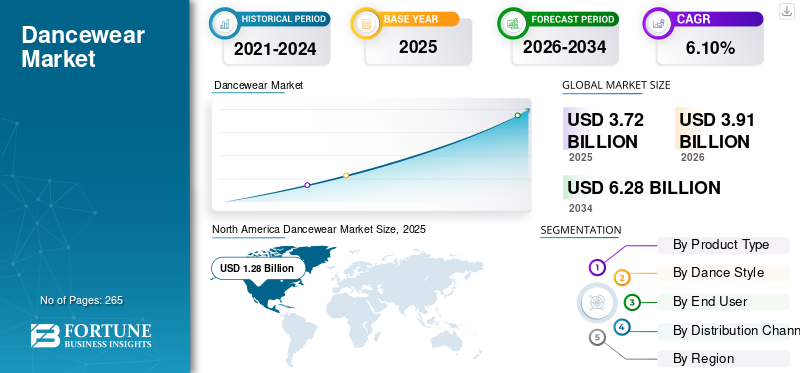
Download Free sample to learn more about this report.
Dancewear Market Key Takeaways
 Global Market Size & Forecast
- 2025 Market Size: USD 3.72 billion
- 2026 Market Size: USD 3.91 billion
- 2034 Forecast Market Size: USD 6.28 billion
- CAGR: 6.10% (2026–2034)
 Market Share
- North America dominated the market with a 34.40% share in 2025.
- The leotards & unitards segment is projected to witness the fastest growth, expanding at a 6.91% CAGR during the forecast period.
- The contemporary & lyrical segment is expected to register the highest growth, expanding at a 7.26% CAGR during the forecast period.
 Key Regional Highlights
Asia Pacific
Asia Pacific generated USD 0.90 billion in 2025 and is projected to grow at a 7.62% CAGR during the forecast period.
North America
North America generated USD 1.28 billion in 2025 and is projected to grow at a 5.51% CAGR during the forecast period.
Europe
Europe accounted for USD 1.12 billion in 2025, making it the second-largest regional market.
U.S.
U.S. market reached USD 1.00 billion in 2025.
Japan
Japan market reached USD 0.19 billion in 2025.
Read More

DANCEWEAR MARKET TRENDS
Rising Preference for Athleisure-Inspired Dancewear
The increasing demand for fashion clothing is encouraging dancing apparel companies to integrate the elements of athletic and stylish clothing into their garments. Nowadays, the demand is for items that help users perform well in class and at home while remaining comfortable and fashionable. Thus, businesses have started offering clothing that is functional but stylish and trendy.
MARKET DYNAMICS
MARKET DRIVERS
Download Free sample to learn more about this report.
Rising Participation in Dance and Fitness Activities to Accelerate Market Growth
An increased dance participation in academies, school dance programs, dance television reality shows, and various dance fitness programs such as Zumba and Barre has driven the demand for specialized apparel, propelling the global dancewear market growth. Consumers who attend dance classes in ballet, contemporary, hip hop, and other forms of dance require specialized dance attire meeting their needs. Such trends have compelled manufacturers to introduce new styles of dancing wear, including leotards, leggings, tights, and shoes, thereby enhancing sales and boosting market revenues from recurring purchases and upgrades worldwide.
MARKET RESTRAINTS
High Product Cost to Limit Mass Adoption Hampering Market Expansion
The manufacturing of high-end dancewear requires the use of specific materials, precise fit, sturdy stitching, and appropriate footwear, thereby increasing costs. As a result, many cost-conscious consumers, novices, and parents will delay their purchases or opt for cheaper alternatives. The consequence of this is that customers will be unwilling to make repeat purchases, limiting sales in developing countries and other emerging markets.
MARKET OPPORTUNITIES
Expansion of Online and Customizable Wear Offerings to Create Growth Opportunities
The increasing penetration of e-commerce and consumer demand for customization in dancewear are offering new avenues for industry participants. The ability to target niche customers via online platforms enables brands to serve a wider audience, including those who do not frequent physical stores. In contrast, customization helps meet diverse requirements for size, style, and functionality.
MARKET CHALLENGES
Intense Competition from Low-cost Alternatives to Create Challenges for Industry Expansion
With the emergence of cheap activewear and imitation dancewear, pricing pressures are mounting on existing brands. In that case, as beginners and even casual users prefer value-for-money clothes and end up buying imitations/counterfeit products rather than high quality garments offered by these brands. This affects profitability and brand differentiation and requires the company to increase promotional expenditures, which can pose difficulties for business growth.
Segmentation Analysis
By Product Type
Higher Unit Value and Replacement Demand to Drive Dance Shoes Segment Growth
By product type, the market is segmented into leotards & unitards, tights & leggings, dance shoes, and others.
The dance shoes segment dominated the market in 2025, given the particular type of shoes for every dance form. The popular types of dance shoes include ballet shoes, tap shoes, jazz shoes, ballroom shoes, and sneakers, which are generally more expensive than clothing. Moreover, the frequent need for replacement due to size changes among children, wear and tear from constant use, and performance-specific shoe requirements further accelerate market growth, thereby increasing revenue contribution.
To know how our report can help streamline your business, Speak to Analyst
The leotards & unitards segment is anticipated to rise at the fastest CAGR of 6.91% over the forecast period.
By Dance Style
Formal Training and Recurring Product Needs to Impel Ballet Segment Growth
Based on dance style, the market is divided into ballet, jazz & tap, contemporary & lyrical, and others.
The ballet segment dominated the market in 2025 in terms of revenue, driven by the demand for a broad array of standardized products, including leotards, tights, ballet flats, pointe shoes, skirts, and warm-ups. Since ballet is usually taught in well-established schools with a specific code of dress, learners have to buy their clothes and shoes constantly.
The contemporary & lyrical segment is anticipated to rise at the fastest CAGR of 7.26% over the forecast period.
By End User
Wider Product Adoption and Premium Purchases to Boost Women Segment Growth
Based on end user, the market is divided into men, women, and children/kids.
The women segment captured a leading dancewear market share in 2025 due to higher dance participation rates across all dance styles. This segment offers a broader range of products, including leotards, tights, leggings, skirts, tops, warming clothes, and dance footwear. The greater consumer preference for fashionable and athletic wear increases per-consumer expenditure, making it more profitable.
The children/kids segment is anticipated to rise at the fastest CAGR of 6.82% over the forecast period.
By Distribution Channel
Specialty Stores Segment Led the Market owing to Consumer Preference for Precise Fitting
Based on distribution channel, the market is segmented into specialty stores, online retail, brand-owned stores, and others.
The specialty stores segment held the dominant share in 2025, as dancers tend to prefer assistance in choosing the right fit for their shoes, leotards, tights, and performance wear. As items such as pointe shoes, ballet flats, tap shoes, and jazz shoes require accurate fitting and guidance, customers find it easier to buy from specialty stores rather than other channels.
The online retail segment is projected to grow at the fastest CAGR of 7.21% during the forecast period.
Dancewear Market Regional Outlook
By geography, the market is categorized into Europe, North America, Asia Pacific, South America, and the Middle East & Africa.
North America
North America Dancewear Market Size, 2025 (USD Billion)
To get more information on the regional analysis of this market, Download Free sample
North America dominated the global market in 2025 and is projected to grow at a CAGR of 5.51% over the forecast period. The region reached a valuation of USD 1.28 billion in 2025, driven by high participation in school dance, dance competitions, fitness dance training, and performing arts. Consumers spend heavily on high-end leotards, tights, dance footwear, and athleisure-inspired attire, thereby boosting revenues. Specialty stores and top brands ensure easy access to products and fit services as well as customer trust.
U.S. Dancewear Market
With North America’s strong contribution and the U.S. dominance in the region, the U.S. market reached USD 1.00 billion in 2025, accounting for roughly 26.84% of global market sales. The fast-paced growth of e-commerce and trends in dance on social media platforms increases product visibility and sales, driving revenue growth in the U.S. market.
Europe
Europe held the second-largest share in 2025, valued at USD 1.12 billion, accounting for 30.14% of the global market. Europe is a mature market for ballet, theatre, and other performing arts, driving an increased product demand. Considering preferences among European consumers, they tend to opt for products that are durable, comfortable, and eco-friendly. Such preferences have led to an increased emphasis on the production of premium materials and designs, which, in turn, have raised average selling prices and driven revenue growth.
U.K. Dancewear Market
The U.K. market reached USD 0.21 billion in 2025, representing roughly 5.53% of global market revenues.
Germany Dancewear Market
The Germany market reached USD 0.20 billion in 2025, equivalent to around 5.41% of global market sales.
Asia Pacific
Asia Pacific ranked third in the global market reaching USD 0.90 billion in 2025 and is anticipated to expand at a CAGR of 7.62% over the analysis period. The factors driving the regional market growth include an increased participation in dance academies, school activities, competitive events, and fitness-related dance performances in countries such as China, India, Japan, and Australia. Growth in disposable incomes, the presence of youth in urban areas, and social media dance trends have increased the demand for fashion-conscious products. The rise in e-commerce activity has made products even more easily accessible, accelerating market development in the region.
Japan Dancewear Market
The Japanese market was valued at USD 0.19 billion in 2025, accounting for roughly 5.19% of global market revenues. The market growth in this country is driven by a well-planned curriculum for dance classes, a rich tradition of ballet and performing arts, and an increasing involvement of young people in dance-related programs at schools and dance studios. An increase in e-commerce sales and the youth trend of dancing on social media platforms are further driving these factors.
China Dancewear Market
The China market was valued at USD 0.28 billion in 2025, representing roughly 7.50% of the global market sales.
India Dancewear Market
The India market was valued at USD 0.15 billion in 2025, accounting for roughly 4.12% of global market revenues.
South America and the Middle East & Africa
The South America and the Middle East & Africa regions are expected to witness moderate expansion during the forecast period. The South American market reached USD 0.23 billion in 2025. The factors fueling South America's market growth include strong Latin dance culture, rising participation in recreational dance and fitness programs, and expanding access to online retail. These factors together increase the demand for affordable and stylish dance shoes, dance costumes, and accessories. In the Middle East & Africa, the UAE reached USD 0.04 billion in 2025.
South Africa Dancewear Market
The South African market reached USD 0.03 billion in 2025, representing roughly 0.91% of global market revenues.
COMPETITIVE LANDSCAPE
Key Industry Players
Pivotal Companies Focus on Portfolio Expansion for Standing out from their Competitors
The dancewear industry records moderate competition with major competitors being Capezio, Bloch, Repetto, Wear Moi, and Nikolay/Grishko, who focus on high quality and brand loyalty. The companies have extended their product ranges to include leotards, tights, pointe shoes, ballet slippers, jazz shoes, tapping shoes, and accessories, targeting both student and professional dancers. Marketing the products directly to consumers through company websites is one of the most effective strategies being considered by the firms. Comfort-driven materials, luxurious designs, and fashion-oriented products will help the products compete with inexpensive alternatives in international markets.
LIST OF KEY DANCEWEAR COMPANIES PROFILED
- Capezio Ballet Makers Inc. (U.S.)
- Bloch International (Australia)
- Repetto (France)
- Wear Moi (France)
- Freed of London (U.K.)
- Nikolay / Grishko (Russia)
- Só Dança (Brazil)
- Intermezzo Dancewear / Malltex S.A. (Spain)
- Energetiks (Australia)
- Body Wrappers (U.S.)
KEY INDUSTRY DEVELOPMENTS
- November 2025: Freed of London introduced the Velvet Rose Collection, a limited-edition capsule made using ECONYL, to expand its eco-conscious performance garment range.
- April 2025: Freed of London launched additional NELA Collection pieces, including leotards and rehearsal skirts, to strengthen its premium dancewear strategy, which is led by collaboration.
- April 2025: Argand Partners acquired Capezio to support the next phase of growth for the iconic global dancewear and technical footwear brand.
- March 2025: Freed of London released its Floral Collection, a limited-edition capsule made using ECONYL regenerative nylon, highlighting sustainability and in-house U.K. manufacturing.
- October 2024: Repetto launched Repetto Studio Days to promote its new Activewear collection through movement-focused Pilates events at its Paris, Bordeaux, and Brussels boutiques.
REPORT COVERAGE
The global dancewear market analysis includes a comprehensive study of the market and forecast by all the market segments included in the report. This qualitative and quantitative report includes details on the market dynamics and trends that are expected to drive the market over the forecast period. It provides information on key aspects, including technological advancements, the regulatory environment, and product launches. Additionally, it details partnerships, mergers, acquisitions, and key industry developments. The global research report combines the market outlook with a detailed competitive landscape, including market share and profiles of key players.
Request for Customization to gain extensive market insights.
Report Scope & Segmentation
| ATTRIBUTE | DETAILS |
| Study Period | 2021-2034 |
| Base Year | 2025 |
| Estimated Year | 2026 |
| Forecast Period | 2026-2034 |
| Historical Period | 2021-2024 |
| Growth Rate | CAGR of 6.10% from 2026 to 2034 |
| Unit | Value (USD Billion) |
| Segmentation | By Product Type, Dance Style, End User, Distribution Channel, and Region |
| By Product Type |
|
| By Dance Style |
|
| By End User |
|
| By Distribution Channel |
|
| By Region |
|
Frequently Asked Questions
According to Fortune Business Insights, the global market value stood at USD 3.72 billion in 2025 and is projected to reach USD 6.28 billion by 2034.
In 2025, the market value stood at USD 1.28 billion.
The market is expected to grow at a CAGR of 6.10% over the forecast period.
By product type, the dance shoes segment led the market in 2025.
The rising participation in dance academies, dance competitions, performing arts, and fitness-based dance forms, increasing demand for stylish, comfortable, performance-oriented dancing apparel, and expanding online retail access are driving the global market.
Capezio, Bloch, Repetto, Wear Moi, and Nikolay/Grishko are the major players in the global market.
North America dominated the market in 2025.



- 2021-2034
- 2025
- 2021-2024
- 265
-
(Offer valid till 15th Oct 2026)
Get 30-60 hrs Free Customization
Expand Regional and Country Coverage, Segments Analysis, Company Profiles, Competitive Benchmarking, and End-user Insights.



















Related Reports
-
US +1 833 909 2966 ( Toll Free )
-
Get In Touch With Us