"Smart Strategies, Giving Speed to your Growth Trajectory"
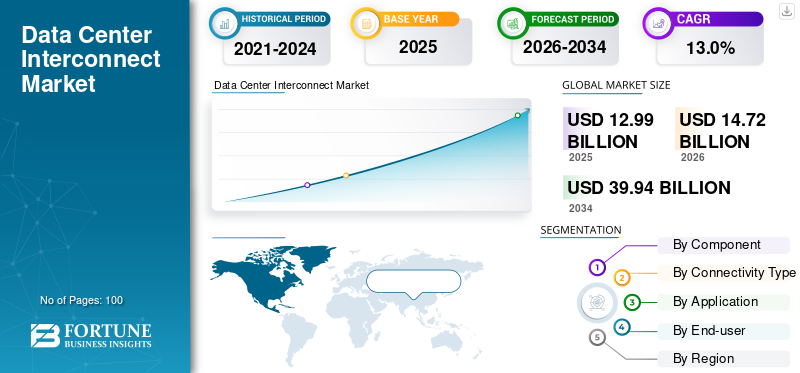
The global data center interconnect market size was valued at USD 12.99 billion in 2025. The market is projected to grow from USD 14.72 billion in 2026 to USD 39.94 billion by 2034, exhibiting a CAGR of 13.29% during the forecast period.
The data center interconnect market is expanding rapidly due to increasing demand for high-speed data transfer, cloud computing infrastructure, edge computing deployment, and hyperscale data center expansion. Organizations are investing heavily in advanced networking technologies to support seamless connectivity between geographically distributed data centers. The data center interconnect market Report highlights growing adoption of optical transport networks, packet switching solutions, and software-defined networking technologies for efficient workload management and low-latency communication. Rising digital transformation initiatives, AI-driven workloads, and large-scale enterprise data processing requirements are strengthening the global demand for data center interconnect infrastructure across telecommunications, finance, healthcare, and IT industries.
The USA data center interconnect market is witnessing substantial growth due to rising investments in hyperscale cloud infrastructure, advanced enterprise networking systems, and high-capacity internet traffic management. Major technology enterprises and cloud service providers are increasingly deploying high-speed interconnect solutions to improve operational scalability and data security. The USA data center interconnect market Analysis highlights increasing demand for low-latency optical fiber networks, AI-ready data center architecture, and scalable software-defined interconnect platforms. Expansion of edge computing facilities, 5G deployment, and rising enterprise dependence on hybrid cloud ecosystems continue supporting long-term market expansion across the United States.
The data center interconnect market Trends indicate growing adoption of software-defined networking and network automation technologies designed to improve traffic optimization, bandwidth allocation, and operational flexibility. Enterprises are increasingly transitioning toward cloud-native infrastructure environments that require seamless interconnectivity between multiple data centers and hybrid cloud platforms. AI-driven analytics and intelligent network management systems are also becoming important for improving traffic efficiency and predictive maintenance capabilities within large-scale data center ecosystems.
Download Free sample to learn more about this report.
Another major trend shaping the data center interconnect market Growth is the rapid deployment of high-capacity optical transport technologies including 400G and 800G optical networking solutions. Telecom operators and hyperscale cloud providers are investing in ultra-low latency infrastructure to support real-time applications, video streaming, IoT ecosystems, and AI processing workloads. The Data Center Interconnect Industry Analysis also highlights rising integration of edge computing facilities and modular data centers to reduce transmission delays and improve localized computing performance. Sustainability initiatives focused on energy-efficient networking infrastructure are further influencing technology innovation within the market.
Rising Adoption of Cloud Computing and Hyperscale Data Centers
The rapid growth of cloud computing infrastructure and hyperscale data center deployment remains one of the primary drivers accelerating the data center interconnect market Growth. Enterprises are increasingly relying on interconnected data center environments to support large-scale digital operations, business continuity, disaster recovery, and high-volume data traffic management. As organizations expand cloud-native applications and hybrid IT infrastructure, demand for high-speed and low-latency interconnect solutions continues to increase globally.
The data center interconnect market Research Report highlights strong investment activity among hyperscale cloud providers and telecom operators focused on optical networking expansion and scalable interconnect architecture. AI processing workloads, machine learning applications, video streaming services, and enterprise SaaS platforms are generating substantial bandwidth demand across distributed data centers. Increasing adoption of software-defined networking and network virtualization technologies is also supporting flexible workload allocation and efficient data mobility. Expansion of 5G infrastructure and edge computing ecosystems further contributes to rising deployment of advanced data center interconnect solutions worldwide.
High Infrastructure Deployment and Operational Costs
One of the major restraints affecting the data center interconnect market Size is the high capital expenditure associated with deploying advanced optical networking systems, high-capacity routers, and long-distance fiber connectivity infrastructure. Building scalable and resilient interconnect architecture requires substantial investment in hardware, software integration, power systems, and cybersecurity protection mechanisms. Small and medium-sized enterprises often face budget limitations that restrict adoption of premium interconnect technologies.
The data center interconnect market Analysis also identifies ongoing maintenance costs and network complexity as operational barriers affecting market expansion. Organizations managing geographically distributed data centers frequently encounter challenges associated with interoperability, latency optimization, and bandwidth allocation. Skilled workforce shortages in optical networking and software-defined infrastructure management further complicate deployment processes. Regulatory compliance requirements regarding cross-border data transmission and cybersecurity standards additionally increase implementation complexity within the global data center interconnect industry.
Expansion of Ai Workloads and Edge Computing Infrastructure
The increasing deployment of artificial intelligence applications and edge computing platforms presents substantial opportunities for the data center interconnect market Opportunities segment. AI-driven applications require massive data processing capabilities and ultra-fast communication between interconnected data centers to support machine learning training, predictive analytics, and real-time processing tasks. Enterprises are therefore investing heavily in advanced optical networking infrastructure and high-capacity interconnect systems optimized for AI workloads.
The data center interconnect market Forecast highlights strong opportunities linked to edge computing deployment across smart cities, autonomous vehicles, industrial automation, and IoT ecosystems. Edge facilities require low-latency connectivity with centralized cloud data centers to ensure seamless data synchronization and rapid decision-making capabilities. Telecom operators and cloud providers are also expanding regional edge infrastructure to improve customer experience and localized processing performance. Continuous innovation in network automation, optical transport technologies, and software-defined architecture continues creating long-term business opportunities within the market.
Increasing Cybersecurity and Network Reliability Concerns
One of the most significant challenges influencing the data center interconnect market Outlook is the growing complexity of cybersecurity protection across interconnected digital infrastructure environments. Organizations handling sensitive enterprise data and mission-critical applications require secure and resilient interconnect architecture capable of preventing cyberattacks, data breaches, and network disruptions. As cloud environments become increasingly interconnected, vulnerability exposure also rises substantially.
The Data Center Interconnect Industry Report highlights additional challenges associated with maintaining uninterrupted service availability, minimizing latency, and ensuring scalability across high-traffic networks. Telecom operators and cloud providers must continuously upgrade infrastructure to manage growing bandwidth requirements and evolving enterprise workloads. Network congestion, hardware compatibility issues, and operational downtime risks further complicate large-scale deployment projects. Balancing network performance, security compliance, and operational efficiency remains a major challenge within the rapidly evolving global data center interconnect market.
Hardware accounts for approximately 48% of the data center interconnect market Share due to rising deployment of routers, switches, optical transport systems, transceivers, and high-capacity fiber infrastructure across hyperscale data centers. Hardware components remain essential for establishing reliable, scalable, and low-latency communication between geographically distributed facilities. Enterprises and telecom operators increasingly invest in advanced optical networking hardware to support AI processing, cloud computing, and high-bandwidth enterprise applications.
The data center interconnect market Insights indicate growing demand for 400G and 800G optical networking equipment designed for ultra-fast data transfer and workload optimization. Manufacturers are focusing on compact, energy-efficient, and modular networking hardware capable of supporting flexible data center architecture. Rising adoption of edge computing infrastructure and next-generation telecom networks continues strengthening hardware demand within the global market.
Software contributes approximately 31% of the data center interconnect market Share because enterprises increasingly prioritize intelligent network orchestration, software-defined networking, and automated traffic management solutions. Software platforms help organizations optimize bandwidth utilization, monitor network health, and improve workload allocation across interconnected data centers. Growing dependence on hybrid cloud environments and multi-cloud deployment strategies is significantly accelerating software adoption globally.
The data center interconnect market Research Report highlights rising implementation of AI-powered analytics, network virtualization, and automation software designed to reduce operational complexity and improve network resilience. Enterprises are increasingly investing in centralized network management systems capable of delivering real-time visibility and predictive maintenance capabilities. Expansion of software-defined infrastructure and cloud-native data center architecture continues supporting long-term software segment growth.
Services account for approximately 21% of the data center interconnect market Share due to increasing enterprise demand for consulting, implementation, maintenance, and managed networking services. Organizations deploying advanced interconnect infrastructure often require specialized expertise for network design, integration, cybersecurity compliance, and operational optimization. Managed service providers are increasingly supporting enterprises through scalable connectivity solutions and continuous network monitoring services.
The data center interconnect market Trends highlight growing reliance on professional services associated with cloud migration, optical network deployment, and software-defined infrastructure transformation. Telecom operators and hyperscale cloud providers are expanding managed connectivity offerings to improve customer scalability and operational flexibility. Increasing network complexity and rising cybersecurity requirements continue driving strong demand for specialized interconnect services globally.
Workload and data mobility applications account for approximately 44% of the data center interconnect market Share because enterprises increasingly require seamless migration of applications, workloads, and storage resources between distributed data centers. Cloud-native business operations and disaster recovery strategies depend heavily on efficient workload mobility infrastructure capable of minimizing downtime and improving operational continuity.
The data center interconnect market Analysis highlights strong demand for high-speed optical networks and software-defined interconnect solutions supporting dynamic workload allocation and real-time synchronization. Enterprises operating multi-cloud and hybrid cloud environments increasingly invest in low-latency connectivity to improve application performance and business resilience. Rising adoption of AI processing, virtualization, and remote enterprise operations continues strengthening segment growth globally.
Shared data and resources applications contribute approximately 33% of the data center interconnect market Share because organizations increasingly centralize computing resources, databases, and enterprise applications across interconnected infrastructure environments. Enterprises require reliable and secure interconnect systems capable of enabling efficient resource sharing between distributed facilities and cloud ecosystems.
The data center interconnect market Outlook highlights increasing demand for collaborative enterprise platforms, centralized analytics systems, and shared storage architecture across healthcare, banking, retail, and telecommunications industries. High-capacity optical transport networks and software-defined connectivity solutions are enabling scalable resource access and efficient bandwidth management. Continuous expansion of enterprise digital ecosystems is supporting strong demand for shared data infrastructure applications.
Advanced workload mobility applications represent approximately 23% of the data center interconnect market Share due to increasing enterprise demand for AI-driven orchestration, predictive workload balancing, and automated disaster recovery systems. Large-scale organizations require advanced interconnect technologies capable of supporting complex enterprise workloads distributed across multiple regional and global data centers.
The Data Center Interconnect Industry Analysis highlights rising investment in intelligent automation systems and edge-integrated connectivity architecture supporting advanced workload migration capabilities. Enterprises are prioritizing scalable infrastructure capable of supporting evolving AI workloads, machine learning applications, and real-time analytics environments. Increasing operational complexity and demand for uninterrupted business continuity continue accelerating adoption within this application segment.
The commercial segment accounts for approximately 58% of the data center interconnect market Share due to increasing deployment of interconnected infrastructure across telecom companies, hyperscale cloud providers, banking institutions, healthcare enterprises, and large-scale IT organizations. Commercial users require high-speed connectivity solutions capable of supporting real-time analytics, AI workloads, cloud-native applications, and large-scale enterprise operations. Rising digital transformation initiatives among multinational enterprises continue accelerating demand for advanced interconnect technologies within commercial environments.
The data center interconnect market Report highlights strong adoption of optical networking systems, software-defined networking platforms, and automated traffic management solutions across commercial data centers. Financial institutions increasingly rely on secure and low-latency interconnect architecture to support digital banking operations and cybersecurity compliance. Telecom providers and cloud operators are also investing heavily in scalable interconnect infrastructure to manage growing internet traffic and enterprise cloud demand. Expansion of hybrid cloud environments, edge computing ecosystems, and AI-powered enterprise applications continues strengthening the commercial end-use segment within the global Data Center Interconnect Industry Analysis.
North America accounts for approximately 39% of the global data center interconnect market Share because of strong hyperscale cloud infrastructure deployment and advanced enterprise networking investments throughout the region. The United States and Canada host some of the world’s largest data center operators, telecom companies, and cloud service providers that continuously invest in scalable optical networking infrastructure. Rising demand for AI-ready data centers and low-latency cloud services further supports regional market expansion.
The data center interconnect market Report highlights increasing deployment of edge computing facilities and high-capacity optical fiber infrastructure throughout North America. Financial institutions, healthcare organizations, government agencies, and technology enterprises are heavily investing in secure and resilient data center interconnect systems. Continuous innovation in software-defined networking and cloud-native infrastructure remains a key growth contributor within the region.
Europe represents approximately 27% of the global data center interconnect market Share because enterprises throughout the region are increasingly adopting cloud transformation strategies and advanced digital infrastructure solutions. Countries including Germany, the United Kingdom, France, and the Netherlands continue expanding high-capacity data center facilities and optical networking ecosystems. Strict data protection regulations and rising enterprise dependence on secure connectivity infrastructure are also influencing regional market growth.
The data center interconnect market Growth in Europe is strongly supported by investments in renewable-powered data centers, AI infrastructure, and sustainable networking technologies. Telecom providers and enterprise cloud operators are increasingly deploying low-latency optical transport networks to improve regional connectivity and operational scalability. Expansion of smart manufacturing, digital banking, and industrial automation projects further accelerates demand for interconnect infrastructure.
Germany accounts for approximately 26% of the European data center interconnect market Share because of strong industrial digitization initiatives and advanced enterprise cloud adoption. German enterprises are heavily investing in secure data infrastructure, optical networking systems, and scalable interconnect architecture to support Industry 4.0 transformation and AI-driven business operations. Expansion of colocation facilities and sustainable data center infrastructure continues strengthening regional market growth.
The Germany data center interconnect market Insights highlight rising demand for low-latency cloud connectivity and software-defined networking solutions across manufacturing, automotive, banking, and healthcare industries. Telecom providers are increasingly expanding fiber-optic infrastructure and edge computing facilities to improve enterprise network performance. Regulatory focus on cybersecurity compliance and energy-efficient infrastructure also continues influencing technology deployment strategies within Germany.
The United Kingdom contributes approximately 22% of the European data center interconnect market Share due to increasing enterprise dependence on cloud computing, financial technology infrastructure, and digital business platforms. London remains a major connectivity hub supporting large-scale interconnect deployment among telecom providers, cloud operators, and financial institutions. Rising demand for scalable and resilient digital infrastructure continues accelerating market expansion.
The United Kingdom data center interconnect market Analysis highlights growing implementation of software-defined networking, AI-powered traffic management systems, and edge-integrated cloud platforms. Financial services companies and enterprise IT providers are investing heavily in high-capacity optical transport systems designed for secure real-time data exchange. Continuous growth in e-commerce, digital banking, and cloud-native enterprise applications supports long-term market development across the UK.
Asia-Pacific accounts for approximately 24% of the global data center interconnect market Share because of rapid digitalization, expanding internet penetration, and strong investment in cloud infrastructure throughout the region. Countries including China, Japan, India, Singapore, and South Korea are rapidly expanding hyperscale data center facilities and regional connectivity infrastructure to support increasing enterprise data traffic and digital transformation initiatives.
The data center interconnect market Opportunities in Asia-Pacific are driven by rising deployment of 5G infrastructure, smart city projects, and edge computing platforms. Telecom operators and cloud providers are increasingly investing in high-speed optical networking technologies and AI-ready infrastructure environments. Growth in e-commerce, financial technology, and industrial automation continues strengthening demand for scalable interconnect systems throughout the region.
Japan accounts for approximately 21% of the Asia-Pacific data center interconnect market Share due to advanced telecom infrastructure and rising enterprise investment in cloud-native technologies. Japanese organizations increasingly prioritize low-latency connectivity, AI-ready data architecture, and disaster-resilient networking systems to support digital transformation strategies. Expansion of smart manufacturing and automation technologies continues contributing to interconnect infrastructure demand.
The Japan data center interconnect market Forecast highlights growing adoption of software-defined networking and energy-efficient optical transport systems throughout enterprise IT environments. Telecom providers are deploying advanced fiber-optic infrastructure and localized edge facilities to improve operational reliability and reduce latency. Increasing adoption of IoT ecosystems and AI applications further supports market expansion in Japan.
China contributes approximately 46% of the Asia-Pacific data center interconnect market Share because of massive cloud infrastructure expansion and strong government support for digital economy development. Chinese technology companies and telecom operators are heavily investing in hyperscale data centers, AI infrastructure, and high-capacity optical networking systems to support growing internet traffic and enterprise digitalization.
The China data center interconnect market Trends indicate rising deployment of edge computing platforms, smart city connectivity systems, and AI-driven networking infrastructure. Expansion of domestic cloud services, e-commerce platforms, and industrial automation projects continues driving strong demand for scalable interconnect architecture. Investments in advanced optical transport technologies and high-speed fiber infrastructure remain central to long-term market growth throughout China.
Rest of World accounts for approximately 10% of the global data center interconnect market Share because of increasing digital infrastructure development across Latin America, the Middle East, and Africa. Governments and telecom operators throughout these regions are investing in cloud infrastructure modernization and optical networking deployment to support growing enterprise digitalization and internet penetration.
The data center interconnect market Outlook highlights rising demand for secure cloud connectivity, edge computing infrastructure, and telecom network expansion across emerging economies. Financial institutions, government agencies, and enterprise IT providers are increasingly deploying scalable interconnect solutions to improve operational efficiency and data accessibility. Expansion of smart city projects and digital business ecosystems continues supporting regional market development.
The data center interconnect market Opportunities segment is attracting substantial investments from telecom operators, cloud service providers, hyperscale infrastructure developers, and enterprise networking companies. Organizations are investing heavily in optical transport technologies, software-defined networking platforms, and AI-ready infrastructure designed to improve bandwidth efficiency and operational scalability. Rising deployment of edge computing and 5G infrastructure is also creating long-term investment opportunities within regional connectivity ecosystems.
The data center interconnect market Research Report highlights growing investment activity in sustainable data center infrastructure and energy-efficient networking technologies. Companies are increasingly deploying automation software, intelligent traffic management systems, and ultra-low latency fiber networks to improve enterprise performance capabilities. Expansion of AI workloads, hybrid cloud environments, and real-time analytics infrastructure continues generating strong business opportunities for hardware manufacturers, software developers, and managed service providers across the global market.
Innovation within the data center interconnect market Trends is increasingly focused on high-capacity optical networking, AI-driven network automation, and energy-efficient infrastructure technologies. Manufacturers are introducing advanced 800G optical transceivers, programmable switches, and intelligent network orchestration platforms designed for hyperscale cloud environments and enterprise AI workloads. These technologies help improve bandwidth performance, reduce latency, and optimize operational scalability.
The Data Center Interconnect Industry Analysis also highlights rising development of software-defined interconnect solutions capable of automating workload distribution and predictive traffic management. Vendors are launching compact modular networking hardware, cloud-native network management software, and integrated cybersecurity features designed for distributed enterprise environments. Continuous innovation in edge computing connectivity and intelligent optical transport systems remains central to product development strategies within the market.
The data center interconnect market Report provides detailed analysis of networking infrastructure, optical transport technologies, software-defined architecture, and managed connectivity solutions shaping the global market landscape. The report evaluates hardware, software, and services segments while examining key applications including workload mobility, shared resources, and enterprise cloud connectivity. Market coverage additionally includes analysis of hyperscale data centers, edge computing deployment, AI infrastructure expansion, and enterprise digital transformation trends influencing industry growth.
Request for Customization to gain extensive market insights.
The data center interconnect market Analysis also offers regional insights covering North America, Europe, Asia-Pacific, and Rest of World with detailed country-level evaluation for the United States, Germany, the United Kingdom, Japan, and China. The report examines investment activities, product innovation strategies, sustainability initiatives, competitive benchmarking, and enterprise networking developments implemented by leading market participants. Operational challenges, cybersecurity concerns, bandwidth demand, and future connectivity opportunities remain central focus areas within the global data center interconnect industry report.
Get 20% Free Customization
Expand Regional and Country Coverage, Segments Analysis, Company Profiles, Competitive Benchmarking, and End-user Insights.

Get In Touch With Us
US +1 833 909 2966 ( Toll Free )