 Download Free Sample



Get a Quote
Receive a tailored pricing based on your needs.
- Choose license type
- Multiple user options
- Custom scope & coverage
- Fast turnaround
"Smart Strategies, Giving Speed to your Growth Trajectory"
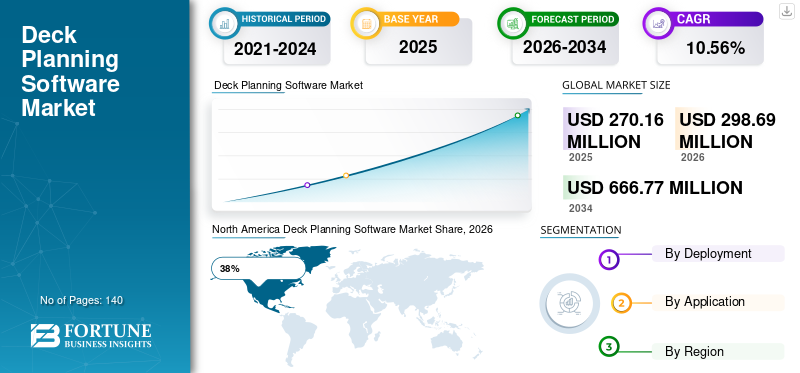
The global deck planning software market size was valued at USD 270.16 Million in 2025. The market is projected to grow from USD 298.69 Million in 2026 to USD 666.77 Million by 2034, exhibiting a CAGR of 10.56% during the forecast period.

The deck planning software market is experiencing steady expansion as residential and commercial construction projects increasingly adopt digital design technologies to improve planning accuracy and project visualization. Deck planning software enables architects, builders, contractors, remodelers, and homeowners to create detailed deck layouts, generate material estimates, visualize structures in three-dimensional environments, and streamline project workflows. The growing preference for customized outdoor living spaces, combined with rising demand for digital construction solutions, is strengthening software adoption. deck planning software market analysis indicates that cloud integration, mobile accessibility, automated design tools, and Building Information Modeling compatibility are becoming essential features. The market continues to benefit from increasing digital transformation across the construction and home improvement industries.
The United States represents the largest market for deck planning software due to its extensive residential remodeling sector and strong demand for outdoor living enhancements. Homeowners increasingly invest in decks, patios, and exterior entertainment spaces, creating significant demand for design and planning tools. Construction firms and remodeling contractors utilize deck planning software to improve project accuracy, reduce material waste, and accelerate customer approvals through realistic visualizations. The adoption of cloud-based construction software platforms continues to grow among builders seeking workflow efficiency. The U.S. market also benefits from widespread digital technology adoption, advanced construction practices, and increasing use of 3D design applications throughout residential and commercial construction projects.
Download Free sample to learn more about this report.
 Global Market Size & Forecast
 Market Share
 Key Regional Highlights
North America
North America led the market with a 38% share, supported by strong demand for digital design tools and outdoor living projects.
Europe
Europe accounted for 27% of the market, driven by increasing adoption of digital construction and design technologies.
Asia-Pacific
Asia-Pacific held a 25% share, supported by expanding construction activity and growing adoption of software-based planning solutions.
U.S
The U.S. remains a key market, supported by strong residential renovation activity and adoption of digital construction technologies.
Japan
Japan accounted for approximately 24% of the Asia-Pacific market, supported by advanced construction practices and growing adoption of digital design solutions.
Read More

The deck planning software market trends reveal significant technological advancements transforming design and construction workflows. One major trend is the increasing use of cloud-based platforms that allow project stakeholders to collaborate remotely and access designs from multiple devices. This capability has become especially valuable for contractors managing multiple projects simultaneously. Artificial intelligence and automation are also influencing software development. Modern deck planning applications increasingly incorporate automated material calculations, design recommendations, and error detection features that improve project efficiency. Three-dimensional visualization tools have become standard functionality, enabling clients to view realistic renderings before construction begins.
Download Free sample to learn more about this report.
Mobile compatibility continues to gain importance as contractors require access to project files directly from construction sites. Integration with Building Information Modeling systems is becoming more common, allowing seamless coordination between deck designs and broader construction projects. Augmented reality visualization features are also emerging, helping customers view proposed deck structures within actual outdoor environments. Another important trend involves sustainability-focused planning tools. Software developers are incorporating environmentally friendly material databases and waste-reduction calculators into design platforms. deck planning software market research report findings indicate increasing demand for customizable templates, automated compliance checking, and integrated cost estimation capabilities. These innovations are strengthening software adoption among architects, builders, remodelers, and design professionals worldwide.
Growing Demand for Digital Construction Design Solutions
The primary growth driver for the deck planning software market is the increasing adoption of digital construction design technologies throughout residential and commercial building sectors. Construction firms are prioritizing software solutions that improve planning accuracy, reduce design errors, and accelerate project delivery. Deck planning software allows users to generate detailed layouts, automate measurements, calculate material requirements, and create realistic visual presentations for clients. The growing popularity of customized outdoor living spaces further supports demand for advanced design tools. Contractors and architects increasingly rely on software platforms to enhance productivity, improve communication with customers, and streamline project management processes. As digital transformation continues across construction industries, adoption of deck planning software is expected to expand significantly.
Limited Adoption Among Small Contractors and Traditional Builders
A key restraint affecting the deck planning software market is the slower adoption rate among small construction firms and traditional builders that continue to rely on manual design methods. Many smaller contractors operate with limited technology budgets and may perceive software investments as unnecessary expenses. Some users also face challenges related to software training requirements and workflow transitions. Resistance to adopting digital design platforms can reduce market penetration, particularly in regions where construction technology usage remains limited. Furthermore, certain businesses continue utilizing conventional drafting techniques that have been established for many years. These factors can slow software implementation despite the operational advantages offered by modern deck planning solutions.
Expansion of Residential Remodeling and Outdoor Living Projects
The growing popularity of residential remodeling and outdoor living enhancements creates substantial opportunities for the deck planning software market. Homeowners increasingly view outdoor spaces as extensions of indoor living areas, driving demand for decks, patios, pergolas, and entertainment structures. This trend encourages contractors and designers to adopt advanced planning software capable of producing customized designs and realistic project visualizations. The increasing availability of cloud-based subscription models also expands accessibility for smaller businesses. Emerging opportunities exist in integrating artificial intelligence, augmented reality, and virtual reality technologies into planning workflows. Software providers that deliver user-friendly, highly customizable solutions can capitalize on expanding demand from residential construction, remodeling, and landscape design sectors.
Software Compatibility and Integration Complexity
One of the major challenges facing the deck planning software market involves ensuring compatibility with diverse construction software ecosystems. Many construction firms utilize multiple digital platforms for project management, cost estimation, procurement, and design activities. Integrating deck planning software with existing systems can be technically complex and may require additional investment. Data migration challenges, interoperability issues, and varying file formats can affect workflow efficiency. Additionally, software developers must continuously update applications to remain compatible with evolving operating systems and hardware technologies. Maintaining seamless integration while delivering advanced functionality remains a significant challenge for software providers seeking to satisfy increasingly sophisticated customer requirements.
Cloud-based solutions account for approximately 67% of the deck planning software market share, making them the dominant deployment model. These platforms provide users with remote accessibility, real-time collaboration capabilities, automatic software updates, and flexible subscription pricing structures. Architects, builders, and remodelers increasingly prefer cloud-based systems because they enable project stakeholders to access design files from multiple locations and devices. The ability to share plans instantly with clients improves communication and accelerates project approvals. Cloud deployment also reduces hardware maintenance requirements and simplifies software management. Integration with project management applications and mobile devices further enhances usability.
To know how our report can help streamline your business, Speak to Analyst
On-premise solutions hold approximately 33% of the deck planning software market share and remain important for organizations requiring greater control over software infrastructure and project data. Large construction companies, engineering firms, and specialized design organizations often prefer on-premise deployments because they offer enhanced security, customized configurations, and direct management of software environments. These solutions can operate independently of internet connectivity, which benefits users working in locations with limited network access. On-premise software is frequently integrated into broader enterprise construction management systems. While cloud adoption continues expanding, many organizations maintain on-premise installations due to regulatory requirements, internal IT policies.
Residential applications account for approximately 62% of the deck planning software market share and represent the largest application segment. Growing homeowner interest in outdoor living spaces continues driving demand for deck design and planning solutions. Contractors utilize software to create customized layouts, generate material estimates, and provide realistic visualizations that help customers evaluate project concepts. Rising renovation activity and increasing investments in backyard improvements support segment growth. Residential projects often require unique design features, making advanced planning tools particularly valuable. Software solutions help improve accuracy, reduce design revisions, and accelerate project completion timelines. The popularity of outdoor entertainment areas, multi-level decks.
Commercial applications represent approximately 38% of the deck planning software market share. Hotels, resorts, restaurants, recreational facilities, mixed-use developments, and public infrastructure projects increasingly utilize deck planning software during design and construction phases. Commercial projects often involve complex structural requirements and larger-scale installations, creating demand for advanced design capabilities and detailed project documentation. Software platforms assist designers in managing project specifications, compliance requirements, and material calculations. Three-dimensional visualization features improve communication among stakeholders and support project approvals. As commercial developers seek greater efficiency.
Architects & Builders represent the largest end-use segment in the deck planning software market, accounting for approximately 46% market share. These professionals use deck planning software to create accurate structural layouts, generate material estimates, develop construction-ready drawings, and produce realistic 3D visualizations. The software helps streamline project planning, improve client communication, and reduce design errors before construction begins. Increasing adoption of digital construction technologies and Building Information Modeling integration is further supporting software demand. Architects and builders benefit from automated measurements, compliance verification tools, and customizable design templates, making deck planning software an essential solution for residential and commercial outdoor construction projects.
Remodelers account for approximately 34% market share in the deck planning software market. This segment primarily focuses on renovating and upgrading existing outdoor living spaces, including decks, patios, pergolas, and entertainment areas. Deck planning software enables remodelers to visualize renovation concepts, create customized designs, and provide detailed project presentations to homeowners. The software assists in material estimation, cost planning, and project documentation, improving operational efficiency and reducing planning time. Growing homeowner spending on outdoor renovations and backyard enhancements continues to drive demand within this segment. Remodelers increasingly prefer cloud-based platforms that support remote collaboration, faster revisions.
Interior Designers hold approximately 20% market share in the deck planning software market and are increasingly involved in designing integrated indoor-outdoor living environments. These professionals use deck planning software to ensure visual consistency between interior spaces and exterior structures. Advanced rendering capabilities allow designers to present realistic outdoor concepts that align with overall property aesthetics. The software supports customization of materials, colors, furniture layouts, lighting elements, and landscaping features. Growing consumer interest in seamless indoor-outdoor living experiences is increasing software adoption among interior designers.
North America Deck Planning Software Market Share, 2026 (%)
To get more information on the regional analysis of this market, Download Free sample
North America dominates the deck planning software market with a 38% share of global demand. The region benefits from a mature construction industry, strong home renovation activity, and widespread use of digital design technologies. Homeowners across the United States and Canada continue investing in outdoor living enhancements, creating sustained demand for deck planning solutions. Contractors increasingly rely on software platforms to improve project visualization, generate accurate material estimates, and streamline customer communication. The region has a high concentration of architects, builders, and remodeling firms utilizing cloud-based design platforms. Three-dimensional rendering capabilities and automated design tools have become standard requirements for many construction projects. Increasing adoption of mobile construction technologies further supports software demand. Commercial construction projects, including hospitality developments and recreational facilities, also contribute significantly to market expansion. Digital transformation initiatives across construction organizations continue encouraging software implementation.
Europe accounts for 27% of the global deck planning software market share and remains an important market for digital design solutions. The region is characterized by advanced architectural standards, extensive renovation activities, and growing adoption of Building Information Modeling technologies. Construction companies increasingly integrate deck planning software into broader project workflows to improve design accuracy and collaboration. Demand is particularly strong in residential remodeling projects where homeowners seek customized outdoor spaces. Architects utilize software tools to create highly detailed visualizations that improve client engagement and project approval rates. Commercial developers also employ deck planning solutions for hospitality, retail, and mixed-use projects requiring precise planning and material management. Environmental sustainability objectives are influencing software development across Europe. Many users seek planning tools capable of supporting sustainable construction practices and efficient material utilization. Cloud-based platforms continue gaining popularity due to their accessibility and collaborative capabilities.
Germany represents approximately 35% of the global deck planning software market share and serves as one of Europe's leading construction technology markets. The country benefits from strong engineering expertise, advanced architectural practices, and widespread adoption of digital design tools. Construction companies increasingly utilize deck planning software to improve design precision and project efficiency. Residential renovation projects continue generating demand for customized outdoor living solutions. Architects and builders rely on advanced visualization capabilities to support project planning and customer engagement. Growing integration of Building Information Modeling technologies further strengthens software adoption. Germany's emphasis on quality construction standards and technological innovation supports sustained demand for deck planning solutions.
The United Kingdom accounts for approximately 25% of the global deck planning software market share. Home improvement projects and outdoor space renovations continue driving demand for digital design solutions throughout the country. Construction professionals increasingly adopt software platforms that improve project visualization, material estimation, and planning accuracy. Residential remodeling remains a key market contributor as homeowners seek functional and aesthetically appealing outdoor environments. Cloud-based software adoption is expanding among contractors and design professionals due to its flexibility and collaboration benefits. The growing focus on digital construction workflows and project efficiency supports continued market development. The United Kingdom remains an important regional market for deck planning technology providers.
Asia-Pacific holds 25% of the global deck planning software market share and represents one of the fastest-developing regional markets. Rapid urbanization, expanding construction activity, and increasing technology adoption are supporting market growth across the region. Residential construction projects, commercial developments, and infrastructure modernization initiatives continue generating demand for advanced design solutions. Countries throughout Asia-Pacific are investing in digital transformation programs that encourage adoption of software-driven construction workflows. Architects and contractors increasingly utilize planning platforms to improve project efficiency and reduce design errors. Cloud-based software solutions are particularly attractive due to their scalability and accessibility. The growth of middle-income populations in several countries is contributing to increased spending on home improvement and outdoor living enhancements. Software providers are expanding regional operations to address growing demand from builders, remodelers.
Japan contributes approximately 24% of the global deck planning software market share. The country is recognized for its advanced construction technologies and high standards of architectural design. Builders and design professionals increasingly utilize software solutions to improve planning accuracy and streamline project execution. Residential renovation projects and outdoor lifestyle enhancements support demand for deck planning applications. Three-dimensional visualization capabilities are particularly valued for client presentations and project approvals. Japanese construction firms continue investing in digital technologies to improve operational efficiency and maintain quality standards. Integration with broader construction management systems further supports software utilization. The market remains driven by innovation and technology-focused construction practices.
China accounts for approximately 16% of the global deck planning software market share, making it one of the largest markets in Asia-Pacific. Rapid urban development and expanding residential construction activity support increasing demand for digital planning solutions. Construction firms are adopting software platforms to improve design accuracy, reduce project delays, and optimize material utilization. Growing awareness of digital construction benefits is accelerating adoption among architects and contractors. Cloud-based solutions are becoming increasingly popular due to their scalability and cost efficiency. The expansion of commercial developments and modern housing projects further contributes to market demand. China's ongoing digital transformation initiatives continue strengthening opportunities for software providers.
The Rest of World region represents 10% of the global deck planning software market share and includes Latin America, the Middle East, and Africa. Market development is supported by increasing Residential remodeling activities are becoming more common in urban centers across these regions, creating opportunities for deck planning software providers. Commercial developments such as hotels, entertainment facilities, and mixed-use projects also contribute to demand. Cloud-based deployment models are particularly attractive because they reduce infrastructure requirements and simplify implementation. Governments and private organizations are increasingly promoting digital transformation initiatives within construction industries. Training programs and technology partnerships are helping expand awareness of software benefits among construction professionals. As digital adoption continues improving and construction activity expands, the Rest of World market is expected to generate increasing demand for deck planning software solutions across diverse end-user segments.
The deck planning software market offers attractive investment potential because demand is being shaped by residential remodeling, outdoor living upgrades, and the wider shift toward digital construction workflows. Investors are favoring companies that combine fast 2D drafting, realistic 3D visualization, automated material lists, and cloud collaboration. The strongest opportunity sits in software that shortens the sales cycle for builders and remodelers by helping clients approve designs faster. Subscription-based platforms are also appealing because they create recurring customer relationships and lower adoption barriers for smaller firms. Cloud delivery, mobile access, and browser-based collaboration are especially valuable as contractors work across job sites and offices. There is also clear upside in integration with broader design ecosystems, since deck planning is increasingly linked with floor planning, exterior visualization, and construction documentation. Products that reduce rework, improve estimating accuracy, and simplify client presentations can capture share from both professional and semi-professional users.
New product development in the deck planning software market is centered on speed, realism, automation, and ease of use. Vendors are improving rendering engines so users can produce polished visuals faster and present deck concepts with more convincing material and lighting output. SmartDraw’s move toward a unified visual app and its ongoing floor-plan improvements show how vendors are broadening from simple drafting into collaborative visual workspaces. SketchUp 2025 emphasizes richer storytelling, photorealistic materials, and drag-and-drop workflows, which is important for deck planning and exterior design presentations. RoomSketcher has advanced AI Convert, allowing plan images to become editable digital plans in seconds, which reduces manual redrawing effort. Chief Architect continues to refine home design tools with versioned updates and support for professional residential workflows. Cedreo keeps pushing faster 2D and 3D plan creation with client-ready presentation output, which is a strong fit for builders and remodelers. Across the market, innovation is clearly moving toward faster approvals, better visualization, and lower project friction.
The deck planning software market Report covers the full structure of the industry, including deployment type, application split, end-use behavior, regional demand patterns, and competitive positioning. It evaluates cloud-based and on-premise software adoption, while also examining demand from residential and commercial users as well as architects, builders, remodelers, and interior designers. The report framework reflects the market’s real purchasing logic, where ease of use, visual output quality, collaboration, and integration capability drive buying decisions.
Request for Customization to gain extensive market insights.
It also tracks how deck planning software is converging with broader construction and visualization tools, especially as customers expect 2D drafting, 3D rendering, and client presentation capabilities in one workflow. Regional coverage spans North America, Europe, Asia-Pacific, and Rest of World, with country-level focus where adoption is especially meaningful. The report also includes competitive coverage of major vendors such as Autodesk, Trimble, Cedreo, Chief Architect, SmartDraw, RoomSketcher, and others, along with recent product development activity and investment themes shaping the deck planning software market outlook.
Fortune Business Insights says that the global market value stood at USD 270.16 million in 2025 and is projected to reach USD 666.77 million by 2034.
The market is expected to exhibit a CAGR of 10.56% during the forecast period of 2026-2034.
Cloud-based deployment was the leading deployment segment, accounting for approximately 67% of the market, supported by remote accessibility, real-time collaboration, and flexible subscription models.
Key players include Autodesk Inc., Trimble Inc., Cedreo, Chief Architect, Inc., SmartDraw, LLC, and RoomSketcher AS.
Major trends include growing adoption of cloud-based platforms, AI-powered automation, and 3D visualization, along with increasing integration with BIM and mobile technologies. North America dominated with a 38% market share.


(Offer valid till 31st Oct 2026)
Get 30-60 hrs Free Customization
Expand Regional and Country Coverage, Segments Analysis, Company Profiles, Competitive Benchmarking, and End-user Insights.




















Get In Touch With Us
US +1 833 909 2966 ( Toll Free )
Receive a tailored pricing based on your needs.
Discuss your questions with our industry experts.
Have questions? Get quick answers before you purchase.

